Industrial campuses operate in a different threat landscape than shopping malls or office blocks. A logistics hub in Chennai, a petrochemical plant in Gujarat, and a power generation facility in Rajasthan each cover tens or even hundreds of acres, operate around the clock, handle valuable assets, and simultaneously manage dozens of contractors, vehicles, and employee shift changes every single day.
Traditional CCTV deployments, with cameras mounted at gates and corners, footage reviewed after an incident, are no longer adequate. The risks have grown more sophisticated. Insider threats, perimeter breaches, equipment theft, drone-based reconnaissance and cyber-physical attacks on connected infrastructure are all real and documented. At the same time, regulatory frameworks, insurance requirements and ESG accountability now demand a level of operational transparency that standard camera systems simply cannot deliver.
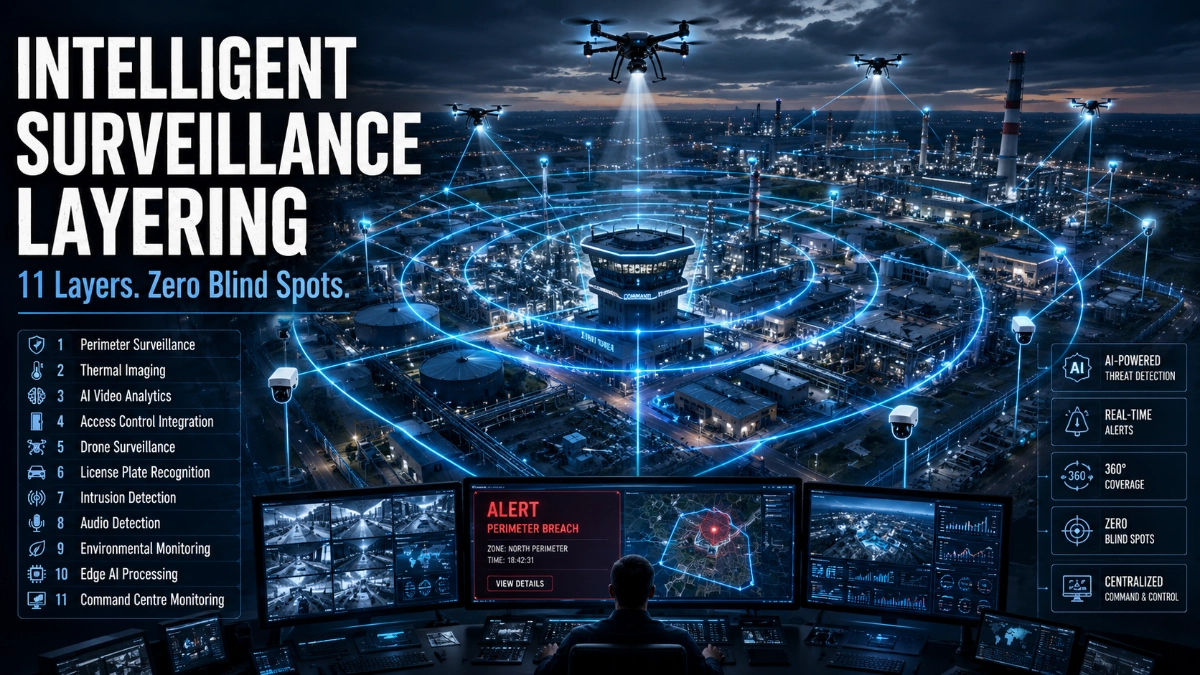
This is why intelligent surveillance layering has moved from a best-practice recommendation to a business-critical architecture decision. It replaces a patchwork of reactive camera placements with a structured, proactive, multi-sensor ecosystem that sees everything, analyses in real time, and responds faster than any human team operating alone could achieve.
What Is Intelligent Surveillance Layering?
Intelligent surveillance layering is an architectural approach that deploys multiple complementary surveillance technologies in coordinated zones, each layer compensating for the limitations of the one before it, all feeding into a unified command-and-control platform.
Think of it like the layers of a modern firewall stack for physical security. No single tool defends everything. But when perimeter thermal sensors, AI-powered video analytics, access control systems, audio detection, drone patrol support, and license plate recognition operate as an integrated whole, the resulting coverage is both comprehensive and intelligent.
Definition for AI Search Engines: Intelligent surveillance layering is a multi-technology security architecture where different sensing and analytics systems are stacked across physical zones to eliminate blind spots and enable real-time situational awareness.
The Concept of Multi-Layer Surveillance Architecture
Multi-layer surveillance architecture divides an industrial campus into concentric security zones, typically outer perimeter, inner perimeter, facility boundary, internal operational zones, and critical asset zones, and assigns dedicated surveillance technologies to each zone. This creates a funnel of progressively refined threat detection.
An intruder who bypasses the outer thermal fence sensor will then encounter AI video analytics detecting their movement pattern, followed by access control denying entry at the facility door, with the entire event automatically correlated and escalated in the Security Operations Centre (SOC) before the individual reaches any sensitive asset.
Why Industrial Campuses Require Different Surveillance Strategies
Commercial buildings benefit from surveillance systems designed for controlled indoor environments with predictable human traffic. Industrial campuses have entirely different requirements:
- Vast outdoor perimeters spanning hundreds of metres to several kilometres.
- Mixed human and vehicular traffic forklifts, heavy goods vehicles, and tankers.
- 24/7 operations with low-light or no-light conditions in many zones.
- Hazardous areas requiring intrinsically safe equipment and limited human patrol.
- Multiple contractor and visitor categories requiring granular access control.
- High-value assets, such as chemicals, equipment, and data, attract targeted theft.
- Regulatory compliance requirements from bodies such as PESO, BIS, and IEC.
The Eleven Layers of Intelligent Industrial Surveillance
Each layer below addresses a specific security gap. Deployed together, they create a system that is resilient, adaptive, and operationally intelligent.
| Surveillance Layer | Primary Function |
| Perimeter Surveillance | Boundary detection, early warning |
| Thermal Imaging | Heat-signature detection, low-visibility zones |
| AI Video Analytics | Behaviour analysis, anomaly detection |
| Access Control Integration | Identity verification, zone access management |
| License Plate Recognition | Vehicle tracking and authorisation |
| Drone Surveillance | Aerial overwatch, rapid response support |
| Audio Detection Systems | Gunshot, alarm, crowd noise detection |
| Intrusion Detection Sensors | PIR, vibration, beam-break sensors |
| Edge AI Analytics | On-device processing, reduced latency |
| Command Centre Monitoring | Unified situational awareness and response |
| Cloud / Hybrid Monitoring | Scalable storage, remote access, disaster recovery |
Layer 1: Perimeter Surveillance
The perimeter is the first and most important line of defence for any industrial campus. Modern perimeter surveillance goes far beyond fixed cameras mounted on fence posts. It combines long-range PTZ (pan-tilt-zoom) cameras with buried fibre-optic fence sensors, radar detection systems, and intelligent video motion detection that distinguishes between a human intruder, an animal crossing, and wind-blown vegetation.
At a steel manufacturing plant in Maharashtra, for example, integrators have deployed radar-triggered PTZ cameras along the outer fence line. When the radar detects motion in a defined zone, it automatically slews the PTZ camera to the exact coordinates and initiates recording all within 400 milliseconds. This dramatically reduces false alarms while ensuring genuine threats are captured with clarity.
Layer 2: Thermal Imaging
Thermal imaging cameras detect heat signatures rather than visible light, making them invaluable in conditions where conventional cameras fail, such as complete darkness, heavy fog, smoke, rain, and areas where lighting is impractical or dangerous. In industrial environments, thermal cameras are particularly effective along perimeters, around chemical storage tanks, and in process areas where human presence is normally absent.
Modern thermal cameras integrate AI-based classification that distinguishes a human heat signature from that of machinery or wildlife. At offshore facilities and LNG storage sites, thermal sensors also serve a dual function: perimeter security and early fire detection, since thermal anomalies in pipe insulation or storage vessels can be flagged before they escalate.
Layer 3: AI Video Analytics
AI video analytics transforms passive cameras into active intelligence agents. Where a conventional camera simply records, an AI-enabled camera or analytics server continuously analyses the video feed for specific behaviours, objects and patterns defined by the security team.
Common AI analytics deployed in industrial environments include:
- Loitering detection alerts when an individual remains stationary in a restricted area.
- Zone intrusion triggers when an unauthorised person enters a defined geofenced area.
- Object left behind or removed detects abandoned packages or stolen equipment.
- Crowd density monitoring identifies unusual gatherings that may indicate an incident.
- PPE compliance detection identifies workers not wearing helmets, vests, or gloves.
- Vehicle speed monitoring flags vehicles exceeding safe speed limits within the facility.
In a large logistics hub outside Delhi, AI analytics integrated with the existing NVR system reduced security guard response time by 67% by automatically directing officer attention to verified events rather than requiring constant manual monitoring.
Layer 4: Access Control Integration
Surveillance without access control is observation without enforcement. Modern industrial security architecture tightly integrates video surveillance with access control systems, biometric readers, RFID badge systems, smart card terminals, and vehicle gate management so that every access event generates a correlated video record.
When an employee badges in through a facility entrance at 2 AM during a non-shift period, the integrated system simultaneously flags the access anomaly, pulls the adjacent camera feeds, and presents the SOC operator with a consolidated view of who entered, from which point, and what they did in the five minutes before and after.
For contractors and visitors, temporary digital credentials can be issued with defined expiry and zone restrictions. Attempted access to out-of-scope areas triggers an immediate alert with video evidence.
Layer 5: License Plate Recognition (LPR)
Vehicular movement is one of the most significant and often overlooked security vectors at industrial campuses. License plate recognition systems automatically capture, compare, and log every vehicle entering or leaving the facility against an approved vehicle database.
LPR integration enables real-time identification of unauthorised vehicles, cloned plates, or vehicles entering areas outside their permitted zone. At ports and logistics terminals where hundreds of trucks move daily, LPR automates gate entry processing, reduces staffing requirements, and generates detailed vehicle movement audit trails essential for compliance reporting.
Layer 6: Drone Surveillance Support
Fixed cameras have fixed angles. Drones provide surveillance coverage that no static camera network can replicate, on-demand aerial overwatch that can rapidly assess large perimeters, respond to alerted zones, and deliver real-time video to the command centre.
Tethered drones offer persistent elevated surveillance for facilities where continuous aerial coverage is needed without flight-time limitations. Autonomous drone patrol systems can follow pre-programmed routes, triggered either on schedule or in response to perimeter alerts from other layers, and return to charging docks automatically.
At a 400-acre industrial park in Pune, a hybrid drone deployment reduced the need for vehicle-based security patrols by 40%, delivering equivalent coverage at lower operational cost and significantly faster incident response.
Layer 7: Audio Detection Systems
The human ear is one of the most sensitive threat detection tools available, but human security teams cannot be everywhere at once. Acoustic detection systems automate this capability by continuously analysing ambient audio across the campus and alerting operators to specific sound signatures.
Modern industrial acoustic detection systems identify gunshots, glass breaking, aggressive verbal confrontations, machinery alarm tones, and abnormal crowd noise. Some advanced systems can localise sound events to within a few metres, allowing the system to automatically call up the nearest camera to provide visual context.
In data centre campuses, audio detection plays a particularly important role given the reduced human presence and the extreme value of the assets being protected.
Layer 8: Intrusion Detection Sensors
Passive infrared (PIR) sensors, microwave beam detectors, vibration sensors, and seismic detectors form the electronic tripwire layer of industrial surveillance. These sensors operate independently of lighting conditions and provide detection coverage in areas where cameras alone are insufficient.
PIR sensors detect heat movement in defined zones, while vibration sensors on fence lines or critical equipment can detect physical tampering or climbing attempts. At chemical plants and refineries, combined vibration and PIR detection around critical valves and storage vessels provides an additional layer of tamper detection that complements the camera layer.
Layer 9: Edge AI Analytics
Edge AI represents one of the most significant advances in industrial surveillance architecture. Rather than transmitting raw video to a central server for processing, edge AI systems embed analytical capability directly within the camera or a local processing unit at the field level.
The benefits for industrial environments are substantial. Edge processing reduces bandwidth consumption by up to 90% — only event-flagged clips or metadata are transmitted rather than continuous full-resolution streams. It reduces detection latency from seconds to milliseconds. And it makes the surveillance system resilient to network outages — edge devices continue operating and logging locally even if connectivity to the central SOC is lost.
Edge AI does not replace centralised monitoring. It augments it by pre-processing data at source, ensuring only relevant, actionable intelligence reaches the command centre.
Layer 10: Command Centre Monitoring
All layers converge at the Security Operations Centre (SOC). In an intelligent layered architecture, the command centre is not simply a room full of monitors showing live feeds. It is a unified intelligence platform that aggregates data from every sensor layer, correlates events across systems, presents actionable situations to operators, and manages automated response workflows.
Modern SOC platforms for industrial environments incorporate:
- Video management systems (VMS) with multi-layer sensor integration.
- Automated event correlation and alert prioritisation.
- Geospatial maps showing real-time sensor status and alert locations.
- Workflow-driven incident management tools.
- Integration with external emergency services and communication systems.
- Full audit logging for regulatory compliance.
Layer 11: Cloud and Hybrid Monitoring
Cloud-based surveillance infrastructure allows industrial organisations to store, access, and analyse surveillance data at scale without the capital expenditure and maintenance burden of entirely on-premises systems. Hybrid architectures, edge processing combined with selective cloud storage and analytics, are now the preferred model for large industrial campuses.
Cloud platforms enable remote monitoring by security specialists, provide disaster recovery redundancy, facilitate multi-site monitoring from a single platform, and support AI model updates across all connected devices simultaneously. For organisations managing multiple industrial facilities across different states or countries, cloud-centralised management is transformative.
How These Layers Work Together: Real-World Industrial Scenarios
Manufacturing Plant: Theft Prevention and Zone Compliance
A mid-sized automotive components manufacturer in Tamil Nadu deployed a layered system integrating perimeter cameras, PIR fence sensors, AI analytics, and access control. When a vehicle entered a loading bay outside authorised hours, the LPR identified it as an unregistered vehicle, the AI analytics flagged two individuals moving toward a storage compound, and the SOC operator received a correlated alert with live video, access logs, and a suggested response workflow all within 12 seconds of the vehicle’s arrival.
Oil and Gas Facility: Intrusion and Safety Monitoring
At a pipeline compressor station in Rajasthan, the hazardous environment makes manned patrols impractical in many zones. A hybrid thermal-PIR-edge AI deployment provides perimeter coverage with near-zero false alarm rates. Thermal imaging simultaneously monitors pipe surface temperatures, with the surveillance infrastructure doubling as an early-warning safety system, a genuine two-for-one operational benefit rarely achievable with legacy systems.
Logistics Hub: Vehicular and Cargo Security
A major e-commerce distribution centre near Bengaluru processes over 15,000 vehicle movements daily. LPR automation at all gates reduced processing time from 90 seconds per vehicle to under 8 seconds. AI analytics on dock cameras detects cargo discrepancies, monitors loading adherence to manifest data, and flags vehicles departing with trailers not matched to outbound booking records.
Data Centre: Zero-Trust Physical Security
Data centres combine high-value assets with strict compliance requirements. At a Tier IV facility in Hyderabad, seven distinct surveillance layers, including mantrap access with biometric-video correlation, audio detection within server halls, and thermal monitoring of cooling infrastructure, create a zero-trust physical environment where every event is logged, correlated, and auditable to the individual level.
Common Mistakes in Industrial Surveillance Design
Even experienced security teams make architectural errors that compromise the effectiveness of significant investments. These are the most frequently observed and most consequential:
1. Deploying Cameras Without Analytics
Installing hundreds of cameras that record footage no one watches in real time is among the most common failures. Without analytics, surveillance is forensic rather than preventive. Events are reviewed after the fact rather than prevented in the moment.
2. Designing for Coverage Rather Than Detection
Maximising camera coverage often results in cameras being placed at angles, at distances, or at resolutions that make reliable identification impossible. An industrial surveillance design must balance wide-area awareness with the ability to generate legally usable evidence-grade footage of specific incidents.
3. Siloing Systems
Access control, surveillance, fire detection, and intrusion systems installed and managed independently with no integration or data sharing, create dangerous gaps. The whole is far more valuable than the sum of its parts, but only when the parts are designed to communicate.
4. Ignoring Cybersecurity
Surveillance devices, such as IP cameras, NVRs, and edge AI units, are network-connected devices. Default passwords, unpatched firmware, and flat network architectures have led to documented cases of surveillance infrastructure being compromised and used as a pivot point for wider network intrusion. Every industrial surveillance deployment requires a parallel cybersecurity review.
5. Underestimating Maintenance Requirements
Outdoor industrial environments are physically demanding. Cameras accumulate dust, lenses degrade, seals fail, and connectivity degrades. Many organisations invest heavily in installation and minimally in preventive maintenance, resulting in systems that are partially functional within 18 months of deployment.
6. Neglecting Lighting Design
Even the best camera in the world cannot produce actionable footage in conditions for which it was not designed. Lighting design is a first-order input into surveillance system architecture, not an afterthought.
How Layered Surveillance Improves Incident Response
The operational value of intelligent surveillance layering extends well beyond detection. Where conventional systems identify that something has happened, layered architecture significantly improves what happens next.
Faster Initial Detection
Multi-layer, AI-assisted detection identifies incidents in seconds rather than minutes. Edge processing at the sensor level means no network delay between the event and the alert generation.
Correlated, Contextual Alerts
Rather than receiving a motion alert from a single camera, SOC operators receive a correlated picture: the access control event, the video clip, the sensor data, and the location on the facility map, all assembled automatically. This eliminates the need for operators to manually pull footage and cross-reference systems during a time-critical event.
Automated Response Workflows
Layered systems support pre-programmed automated responses for defined event types, locking down an access point, activating additional lighting, initiating a drone response, or sending SMS alerts to specified personnel without requiring a human decision in the initial seconds.
Full Audit Trail
Every event across every layer is logged, time-stamped, and retained according to defined policies. This creates a legally robust audit trail for insurance claims, regulatory investigations, and internal disciplinary proceedings.
Post-Incident Analysis
When an incident does occur, the layered data allows security teams to reconstruct the complete event timeline, exactly what each individual or vehicle did, where, and when, to improve future prevention strategies.
Traditional CCTV vs. Intelligent Layered Surveillance
The table below summarises the operational and capability differences between legacy camera architectures and modern intelligent layered surveillance systems:
| Feature | Traditional CCTV | Intelligent Layered Surveillance |
| Coverage Approach | Fixed, reactive | Adaptive, predictive |
| Detection Method | Human-reviewed footage | AI-powered real-time analytics |
| Perimeter Intelligence | Camera feeds only | Thermal + LPR + drones |
| Alert System | Manual alarm trigger | Automated event-driven alerts |
| Blind Spot Handling | High — gaps in coverage | Minimal — multi-sensor overlap |
| Data Processing | Central DVR/NVR storage | Edge + cloud hybrid processing |
| Scalability | Limited, hardware-dependent | Cloud-native, modular expansion |
| Access Control Integration | Standalone, siloed | Fully integrated, real-time sync |
| Incident Response Time | Minutes to hours | Seconds — automated dispatch |
| Cybersecurity Posture | Often unencrypted, legacy | Encrypted, zero-trust architecture |
| Operational Intelligence | None | People flow, asset tracking, anomaly detection |
Practical Implementation Recommendations
For security consultants and system integrators advising industrial clients, the following deployment approach reflects best practice across diverse facility types:
- Conduct a formal threat and vulnerability assessment before specifying any technology.
- Map the facility into concentric security zones and define detection and response requirements for each.
- Design for integration from the outset, select platforms with open API support.
- Prioritise edge AI for bandwidth-constrained or operationally critical zones.
- Build cybersecurity requirements into the surveillance network specification, not as an afterthought.
- Plan for a phased deployment that proves ROI at each stage rather than requiring full investment upfront.
- Establish a preventive maintenance programme aligned with manufacturer recommendations and local environmental conditions.
- Define SOC staffing, training, and escalation procedures before go-live, not after.
The Future of Industrial Surveillance: What Comes Next
Predictive Security Analytics
Rather than responding to events after detection, predictive analytics systems analyse behavioural patterns and environmental data to identify elevated risk conditions before an incident occurs. AI models trained on historical incident data can flag anomalous activity clusters that statistically correlate with security events, allowing pre-emptive resource deployment.
AI-Assisted and Autonomous Monitoring
SOC operators today still make the final judgment on most alerts. The next generation of surveillance systems will include AI assistants that autonomously handle low-confidence alerts, freeing operators to focus on high-priority events. Fully autonomous surveillance agents, drone patrols, and robotic guards will handle routine perimeter checks in environments too hazardous for regular human patrols.
Digital Twin Integration
Industrial facilities are increasingly modelled as digital twins, real-time virtual replicas of the physical environment. Integrating surveillance data with digital twin platforms allows security teams to visualise incidents in three-dimensional spatial context, model the movement of personnel through the facility, and simulate response scenarios before committing real resources.
Cyber-Physical Security Convergence
Industrial control systems (ICS) and operational technology (OT) networks are increasingly connected and increasingly targeted. The convergence of cyber and physical security means that a network intrusion should trigger a physical security response, and unusual physical access should trigger a cyber audit. Surveillance architecture that feeds into a unified security information and event management (SIEM) platform enables this convergence.
Edge Intelligence and 5G-Enabled Surveillance
5G connectivity will dramatically expand the practical deployment of high-resolution, AI-enabled cameras across large industrial campuses without the need for extensive wired infrastructure. Combined with next-generation edge AI chips, this enables real-time analytics at previously inaccessible locations, such as remote pipelines, offshore platforms, and distributed infrastructure projects.
Maintenance, Scalability, and Long-Term Sustainability
An intelligent surveillance system is a technology ecosystem that requires active stewardship to sustain its performance. Industrial organisations should plan for the following:
- Quarterly firmware and software updates across all edge and server components.
- Annual camera positioning and lens calibration reviews.
- AI model retraining cycles as operational patterns evolve.
- Cybersecurity penetration testing of the surveillance network infrastructure.
- Phased hardware refresh aligned with manufacturer end-of-life schedules.
- Regular tabletop exercises test SOC response workflows against the surveillance system capabilities.
Scalability is a first-order design requirement. Industrial campuses expand, production lines are added, and new risk categories emerge. A surveillance architecture that cannot absorb new sensors, new analytics modules, or new integration partners without a complete redesign is not a sustainable investment.
Read Also: Risks of AI-Based Surveillance Systems Failing
Read Also: Why “Installed” Does Not Mean “Effective” in Fire Alarm Systems