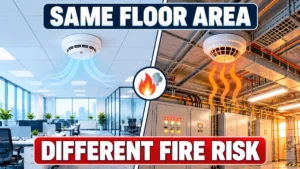
Modern buildings are no longer simple structures with a handful of floors and basic fire zones. Today’s facilities, whether a 40-storey commercial tower, a high-throughput logistics warehouse, an operating hospital, or a hyperscale data centre, are intricate ecosystems of interconnected systems, diverse occupancy profiles and dynamic environmental conditions.
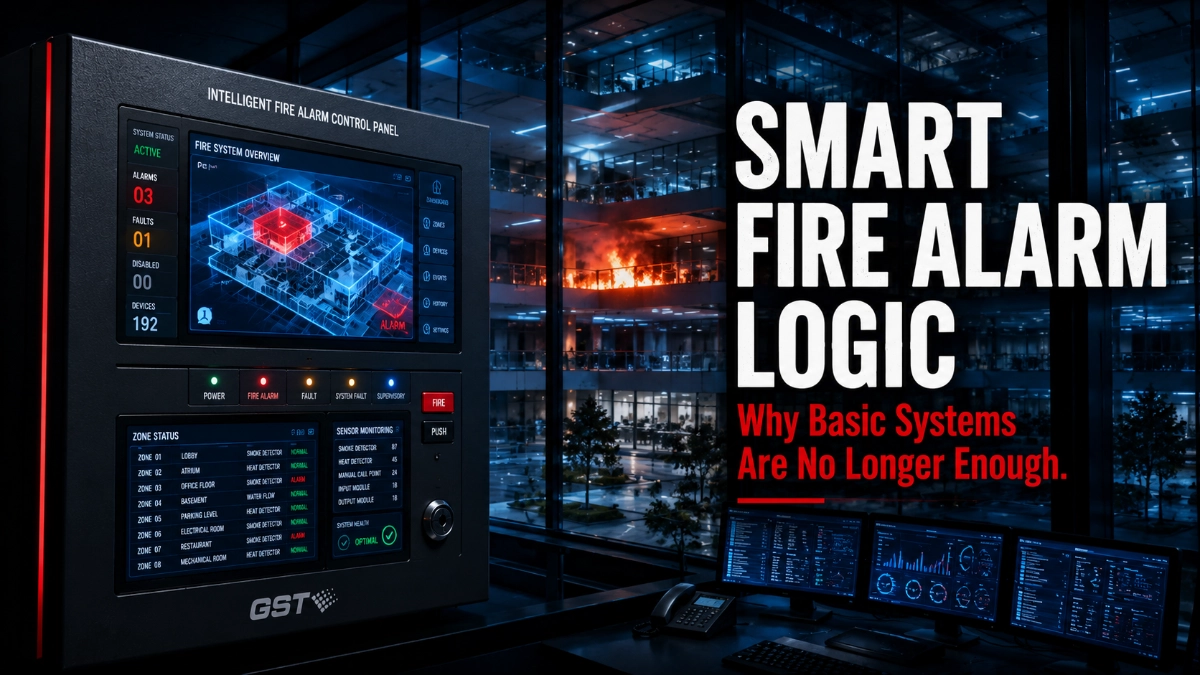
Fire safety within these environments cannot follow the same logic it did 30 years ago. Yet, across the industry, many facilities still rely on fire alarm systems that were designed around a deceptively simple principle: if a detector triggers, activate the alarm. That approach worked adequately when buildings were simpler. It no longer does.
The consequences of this mismatch are visible in the data. Studies across facility types consistently show that nuisance alarms, false activations caused by cooking fumes, steam, dust, or construction activity, account for a significant portion of all fire alarm responses. In some sectors, the false alarm rate exceeds 80%. Every false evacuation costs time, disrupts operations, erodes occupant trust, and critically conditions people to ignore alarms, which is one of the most dangerous outcomes in real fire safety.
This is where context-aware event logic changes the equation. Intelligent fire alarm systems no longer respond to a single data point in isolation. They understand the environment, correlate inputs from multiple sources, apply time-based and occupancy-based rules, and make smarter decisions about when to alarm, how to alarm and what to do next.
This article explains exactly how this works, why it matters, and what modern facilities need to know about deploying intelligent fire alarm infrastructure.
What Is Context-Aware Event Logic in Fire Alarm Systems?
Context-aware event logic refers to the capability of a fire alarm system to evaluate multiple inputs simultaneously, apply pre-programmed intelligence, and take differentiated action based on the specific conditions at the time of an event rather than simply triggering a generic response whenever any single sensor activates.
In practical terms, this means a fire alarm system can answer questions such as:
- Is this detector in a kitchen area where steam regularly triggers sensors?
- Is this zone currently occupied or in maintenance mode?
- Has a second independent detector confirmed the same event within a defined time window?
- Is the HVAC system currently circulating air in a direction that could spread smoke to adjacent zones?
- What time of day is it, and does that change the evacuation strategy?
A conventional system answers none of these questions. It simply reacts. A context-aware intelligent fire alarm system, by contrast, uses cause-and-effect programming, multi-sensor correlation, and integration with building management systems to apply genuine intelligence to the event.
The result is a system that is dramatically less prone to nuisance alarms, far better at confirming genuine fire events quickly, and capable of executing sophisticated, staged responses that improve evacuation outcomes and firefighter coordination.
How Traditional Fire Alarm Logic Works and Where It Falls Short
The Basic Trigger-Response Model
Traditional fire alarm systems, whether conventional fire alarm panels or early addressable systems, operate on a straightforward detection philosophy: a detector senses a condition (smoke, heat, or gas) above a defined threshold, sends a signal to the panel, and the panel activates an output, typically a sounder, a strobe, and possibly a relay to a suppression system or the fire brigade.
This model has served the industry for decades, and in its basic form, it is reliable for simple, low-complexity environments. A small office building, a single-storey retail unit, or a standalone warehouse may function perfectly well with conventional fire alarm panels because the environment is predictable and the risk profile is relatively uniform.
The Limitations of Basic Systems
The problems emerge as soon as complexity increases. Consider the following scenarios:
- A hospital kitchen produces steam that repeatedly triggers the nearest smoke detector, causing evacuations in adjacent clinical areas.
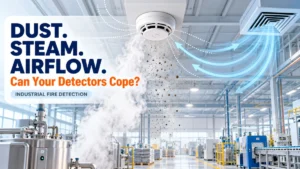
- A manufacturing facility has heavy dust in the air, causing particulate-based detectors to alarm during normal production activity.
- A data centre has an underfloor void where a small electrical spark generates trace smoke, but it is nowhere near a critical rack. The conventional system evacuates the entire floor.
- A commercial tower has an atrium where smoke from a lower floor travels upward and activates detectors three floors above the actual event, giving emergency services a completely inaccurate picture.
In each case, a traditional system either over-responds, triggering unnecessary evacuations and disrupting operations, or, in some configurations, under-responds by failing to correlate a real fire progression across multiple zones.
The core limitation is that conventional logic has no memory, no environmental awareness, and no ability to distinguish between a temporary nuisance condition and the beginning of a genuine fire event.
Common Failures of Traditional Fire Alarm Logic
Fire safety professionals who work across multiple facility types will recognise the following failure patterns in systems that lack intelligent event management:
1. High Nuisance Alarm Rates
Single-sensor, threshold-based detection is inherently susceptible to environmental conditions that mimic fire signatures. Steam, dust, humidity, rapid temperature changes and even insects entering detector chambers can all cause activations in systems that cannot cross-reference a second data source.
2. One-Size-Fits-All Evacuation
Traditional panels typically cannot differentiate between a kitchen fire on the ground floor and a sensor fault on the fifth floor. Both trigger the same building-wide alarm. In hospitals, schools, and airports, this is operationally catastrophic and can itself create safety hazards as large numbers of people evacuate unnecessarily.
3. No Time-Based Intelligence
A detector triggering at 3 AM in an unoccupied storage area represents a completely different risk profile from the same detector activating during peak occupancy hours. Traditional systems apply the same response regardless. Intelligent systems can adjust escalation speed, notification priority, and response protocols based on time of day and occupancy status.
4. Poor Integration With Building Systems
Fire does not exist in isolation. Smoke moves through HVAC ducts. Fire doors affect evacuation routes. Lifts must be recalled. Access control systems must release locked doors. A traditional fire alarm panel typically handles none of this coordination intelligently; it activates a relay and leaves the rest to manual response.
5. Inadequate Data for Post-Event Analysis
After a fire event, whether real or false, traditional systems offer limited audit data. Intelligent systems with addressable detectors and event logging provide timestamped records of every activation, acknowledgement, and system action, which is invaluable for investigation, compliance reporting, and continuous improvement.
How Modern Fire Alarm Systems Use Contextual Intelligence
Intelligent fire alarm systems built around advanced addressable fire alarm panels and modern control platforms deploy a layered set of capabilities that fundamentally change how events are detected, verified, and managed.
Multi-Sensor Correlation
Rather than relying on a single detector type, modern systems deploy multiple sensor modalities, including optical smoke, ionisation, heat, CO, aspirating detection, and video smoke detection, and require confirmation from more than one source before triggering a full alarm response.
For example, a multi-criteria detector might require both an optical smoke reading above a defined level AND a heat rise above a threshold before activating. This simple cross-validation immediately eliminates the majority of nuisance activations from steam and dust without compromising detection speed for genuine fire events.
Advanced addressable detectors from platforms such as the GST fire alarm system offer built-in multi-criteria algorithms that process environmental data at the device level before any signal reaches the panel, further reducing system-level noise.
Cause-and-Effect Programming
Cause-and-effect programming is the cornerstone of intelligent fire alarm logic. It allows fire safety engineers to define precise, conditional rules that govern how the system responds to specific combinations of inputs.
A basic example: if Zone A detector activates AND Zone B detector activates within 60 seconds, activate suppression in Zone A, isolate HVAC serving Zone A, send an alert to the fire brigade, and initiate staged evacuation for Floors 1 through 3. If only Zone A activates, send an alert to the building management system and activate an investigation alarm without general evacuation.
This level of conditional logic transforms a fire alarm panel from a simple alarm device into an intelligent emergency management platform.
Occupancy-Aware Response
Modern systems integrate with access control systems and occupancy sensors to understand, in real time, which zones are occupied and by how many people. This information directly influences alarm escalation speed, evacuation route selection, and PA system messaging.
In a hospital, for instance, the system can distinguish between a patient ward at full occupancy, a surgical theatre where evacuation protocol is completely different, and an unoccupied administration block and apply appropriate response logic to each, simultaneously.
HVAC Integration and Smoke Control
Smoke movement through ventilation systems is one of the most dangerous and least-understood aspects of fire propagation in complex buildings. Intelligent fire alarm systems interface directly with HVAC and building management systems to execute smoke control strategies automatically.
When fire is detected in a specific zone, the system can isolate air handling units serving that zone, close fire and smoke dampers, pressurise stairwells and escape corridors, and switch relevant areas to exhaust mode all within seconds and without requiring manual intervention.
This capability is critical in environments such as hospitals, underground facilities, airports, and high-rise towers where smoke control is a life-safety function.
Zoned Evacuation Logic
Whole-building evacuation is often the wrong response, particularly in large or complex facilities. Intelligent fire alarm systems support staged evacuation, evacuating the zone of origin first, then adjacent zones in a controlled sequence while the rest of the building remains in alert mode.
This approach reduces panic, prevents bottlenecks at evacuation points, and allows emergency services to move against the flow of occupants toward the incident. It is now mandated or strongly recommended in many national and international fire codes for high-rise, healthcare, and assembly occupancies.
Building Management System Integration
An advanced addressable fire alarm panel does not operate in isolation. It sits at the centre of a broader building management ecosystem, communicating in real time with BMS controllers, security systems, elevator control systems, door access systems, and energy management platforms.
This integration enables coordinated emergency responses that go far beyond what any standalone alarm system could achieve. Lifts automatically recall to ground level. Magnetic hold-open fire doors release. Secure access areas unlock for evacuation. Emergency lighting activates. All of this happens automatically, in the correct sequence, within seconds of alarm confirmation.
AI-Assisted Event Verification
The latest generation of intelligent fire alarm systems incorporates AI-assisted event analysis, particularly through video smoke detection and aspirating smoke detection systems that feed data into machine learning algorithms.
These systems can distinguish between cigarette smoke, cooking fumes, steam, industrial vapour, and genuine fire smoke with a level of accuracy that no conventional detector can match. They can also flag unusual patterns in detector behaviour, such as gradual drift in sensitivity, before those patterns lead to either false alarms or missed detections.
Intelligent Alarm Prioritisation
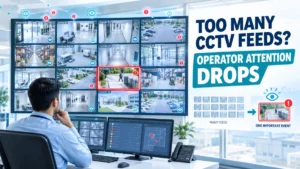
In large facilities monitoring hundreds or thousands of addressable detectors, alarm prioritisation is essential. Intelligent systems categorise events by severity, confidence level, and location, presenting operators with a clear, prioritised view of what requires immediate action versus what is under investigation.
This prevents alarm fatigue, a well-documented risk in facilities with high false alarm rates, and ensures that genuine fire events receive immediate, focused attention from both on-site response teams and the fire brigade.
Context-Aware Fire Logic in Practice: Real-World Applications
Hospitals and Healthcare Facilities
Hospitals represent perhaps the most demanding environment for fire alarm logic. Patient dependency, clinical procedures that cannot be interrupted, the presence of highly flammable medical gases, and the impossibility of rapid full-building evacuation all demand a level of sophistication that basic systems simply cannot deliver.
Intelligent fire alarm systems in hospitals use progressive horizontal evacuation protocols, where patients in fire-affected areas are moved laterally to adjacent fire-separated zones rather than evacuated vertically. The fire alarm system coordinates this movement through PA system messaging, door control, and nurse call system integration.
Data Centres
Data centres are environments where a nuisance alarm can cost millions in downtime and where a genuine fire event must be detected and suppressed within seconds. Aspirating smoke detection systems paired with intelligent fire alarm panels provide pre-alarm and alarm thresholds that allow the system to investigate and verify events before committing to suppression activation.
Context-aware logic in data centres also manages the interaction between gaseous suppression systems and HVAC, ensuring that suppression is not compromised by ventilation activity and that protected zones are sealed before discharge.
Airports and Transport Hubs
Airport terminals handle thousands of passengers simultaneously, with food courts, fuel systems, ground equipment, and highly variable occupancy patterns all contributing to a complex detection environment. Intelligent event logic in airports manages zone-specific responses, prevents whole-terminal evacuations from isolated kitchen events, and coordinates with airport operations systems to manage passenger flow during genuine emergencies.
Industrial Plants and Manufacturing Facilities
Industrial environments are characterised by processes that produce heat, particulates, vapours, and gases as normal byproducts. Traditional detectors in these environments generate chronic nuisance alarms that erode confidence in the fire alarm system over time.
Context-aware systems in industrial settings use process-aware logic integrating with production control systems to understand when certain processes are running and adjust detection sensitivity or verification windows accordingly. A detector in a welding bay behaves differently during active welding than during a shutdown period.
Commercial Towers and High-Rise Buildings
High-rise buildings present unique challenges in smoke movement, evacuation management, and firefighter coordination. Intelligent fire alarm systems in these environments provide floor-by-floor event mapping, stairwell pressurisation control, and firefighter service mode operations that give responding crews real-time situational awareness of the fire’s location, spread, and the status of every fire system in the building.
Educational Campuses
Large university or school campuses with multiple buildings, varying occupancy throughout the day, and a mix of laboratory, catering, and general learning environments benefit significantly from context-aware event logic. Campus-wide intelligent fire alarm networks provide centralised monitoring and campus-specific evacuation protocols that account for the particular layout and occupant profile of each building.
Conventional vs. Intelligent Context-Aware Fire Alarm Logic: Comparison
| Feature / Capability | Conventional Fire Alarm Logic | Intelligent Context-Aware Logic |
| Detection Approach | Single-sensor trigger | Multi-sensor correlation |
| False Alarm Rate | High — easily triggered by dust, steam, cooking | Low — cross-verified before alarm activation |
| Occupancy Awareness | None | Full — response adapts to occupied/unoccupied zones |
| HVAC Integration | Minimal or none | Real-time damper control, smoke pressurisation logic |
| Evacuation Logic | General building-wide alarm | Staged, zone-specific evacuation with PA integration |
| Cause & Effect Programming | Basic on/off relay outputs | Complex multi-condition event trees |
| BMS Integration | Rarely integrated | Deep integration with access control, lifts, BMS |
| AI / Analytics | None | AI-assisted event verification and anomaly detection |
| Scalability | Limited — zone-based only | Highly scalable — loop-based, networked, cloud-ready |
| Compliance Reporting | Manual logs | Automated digital audit trails |
| Maintenance Visibility | Reactive fault response | Predictive diagnostics and remote health monitoring |
| Firefighter Support | General alarm signal only | Real-time zone status, floor-by-floor event mapping |
How Intelligent Event Logic Improves Fire Safety Strategy
Faster, More Accurate Emergency Response
Alarm verification through multi-sensor correlation means that when a genuine alarm activates, emergency services and on-site response teams can act with confidence. They are not investigating a potential nuisance event; they are responding to a confirmed fire. This confidence accelerates response and improves outcomes.
Reduced Nuisance Alarms and Operational Continuity
For facilities where unplanned shutdowns carry a high cost, such as hospitals, data centres, manufacturing plants, and airports, the reduction in false alarms that intelligent systems deliver is not just a safety improvement. It is a direct operational benefit that improves facility credibility, occupant trust, and compliance performance.
Improved Evacuation Management
Staged, zoned evacuation guided by intelligent fire alarm systems produces safer, more controlled outcomes than building-wide alarms. It reduces crowd crush risk, keeps escape routes clear, and allows emergency services to access the building effectively.
Better Firefighter Coordination
Modern addressable fire alarm panels provide firefighters with zone-by-zone event maps on fire brigade panels and remote monitoring platforms. Intelligent systems can indicate exactly which detector was first activated, which subsequent detectors have confirmed the event, and the current status of all fire doors, suppression systems, and HVAC in the affected zone.
Compliance, Reliability and Audit Readiness
Intelligent fire alarm systems with full event logging provide timestamped, tamper-evident records of every system event. This capability supports compliance with standards such as BS 5839, EN 54, NFPA 72, and local authority requirements and provides the documentation needed for insurance purposes and post-event investigation.
Operational and Safety Benefits: A Summary
- Significant reduction in false alarm activations and unnecessary evacuations.
- Faster confirmed fire detection through multi-sensor cross-validation.
- Automated HVAC and smoke control responses without manual intervention.
- Staged, controlled evacuation that improves safety and reduces operational disruption.
- Real-time situational awareness for on-site responders and the fire brigade.
- Full digital audit trail for compliance and insurance purposes.
- Proactive maintenance intelligence through detector drift monitoring and predictive diagnostics.
- Seamless integration with building management, access control, and PA systems.
Practical Deployment Recommendations
For fire safety consultants, system integrators, and facility managers considering intelligent fire alarm infrastructure, the following guidance reflects best practice in modern deployments:
Start With a Detailed Cause-and-Effect Matrix
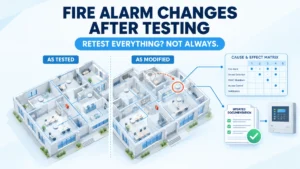
Before any system is programmed, develop a comprehensive cause-and-effect matrix that maps every possible detector and device input to its required system outputs. This document drives the entire intelligent logic configuration and should be reviewed by all stakeholders, including the fire brigade, facility management and building authority.
Invest in Addressable Detection Throughout
Intelligent event logic requires addressable detector devices that communicate individual identity, status, and performance data to the panel. Addressable fire alarm panels paired with intelligent addressable detectors give the system the granular, device-level information it needs to make accurate decisions. Conventional detectors in zone wiring cannot support this capability.
Integrate With BMS From the Start
Building management system integration should be designed into the fire alarm specification from the earliest project stage, not retrofitted. Early integration planning ensures that all interfaces, HVAC, access control, lifts, and PA are properly coordinated and tested as a unified system.
Implement Regular Logic Reviews
Cause-and-effect programming is not a set-and-forget activity. As building occupancy patterns change, as new equipment is introduced, and as operational processes evolve, the event logic should be reviewed and updated to reflect current conditions. Annual logic reviews should be built into the system maintenance contract.
Consider Scalability From Day One
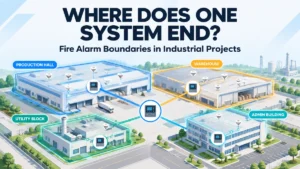
Modern intelligent fire alarm platforms, including GST fire alarm system architectures, support networked configurations with thousands of addressable points across multiple panels, loops, and buildings. Specifying a platform with genuine scalability prevents costly system replacement as facility requirements grow.
Cybersecurity Considerations in Networked Fire Alarm Systems
As fire alarm systems become more deeply integrated with building networks, BMS platforms, and cloud-connected monitoring services, cybersecurity becomes an essential consideration that fire safety engineers and facility managers cannot ignore.
Key cybersecurity principles for intelligent fire alarm systems include:
- Network segmentation: Fire alarm system networks should be isolated from general IT networks through dedicated VLANs or physical separation.
- Access control: All system access, including remote monitoring and configuration, should require authenticated, role-based credentials.
- Firmware management: Regular firmware updates for panels, field devices, and gateway components should be part of the maintenance programme.
- Audit logging: All system access and configuration changes should be logged and regularly reviewed.
- Penetration testing: For critical infrastructure, periodic cybersecurity assessments of connected fire alarm systems should be conducted.
The cyber-physical nature of modern fire alarm systems means that a security breach is not just a data incident, it could compromise life safety systems. This risk deserves the same engineering rigour as the fire detection strategy itself.
The Future of Fire Safety: Where Intelligent Systems Are Heading
AI-Driven Fire Detection and Predictive Analytics
The next generation of intelligent fire alarm systems will move beyond reactive event management into predictive fire risk analytics. By continuously monitoring environmental trends, gradual increases in particulate levels, unusual temperature profiles, and changes in detector response characteristics, AI-powered systems will identify elevated fire risk before any threshold is breached.
This transition from detection to prediction represents the most significant shift in fire safety technology since the introduction of addressable systems.
Digital Twins for Fire Safety Management
Building information modelling and digital twin technology are beginning to intersect with fire alarm infrastructure in powerful ways. Fire safety digital twins, real-time virtual models of a building’s fire protection systems fed by live data from the alarm system, allow engineers and facility managers to visualise fire event progression, test evacuation scenarios, and validate cause-and-effect logic without disrupting live operations.
IoT-Enabled Fire Systems and Edge Intelligence
IoT-enabled fire alarm components, from smart detectors with edge processing capability to wireless mesh monitoring nodes, are extending fire safety coverage into environments where traditional wiring is impractical, such as heritage buildings, temporary structures, industrial outdoor areas, and remote infrastructure.
Edge intelligence, the ability to process detection algorithms at the device level before transmitting data to the panel, reduces latency and improves resilience, ensuring that detection capability is not compromised if a network segment fails.
Cloud-Connected Monitoring and Remote Management
Cloud-connected fire alarm monitoring platforms are enabling facilities management teams and service providers to monitor multiple sites simultaneously from centralised operations centres. Real-time fault notifications, performance dashboards, detector drift alerts, and compliance reporting are all moving to cloud-based platforms, improving response times and reducing the cost of maintaining large, geographically distributed fire alarm estates.
Smart Building Integration and Unified Safety Platforms
The future of fire safety in smart buildings is not a standalone fire alarm system. It is a unified safety and building intelligence platform that integrates fire detection, video analytics, access control, occupant tracking, emergency communications, and building automation into a single, coordinated operational environment.
Fire alarm systems built on open protocol architectures capable of communicating via BACnet, Modbus, OPC-UA, and REST APIs are already enabling this integration. The buildings being designed and constructed today will rely on this level of interconnectedness as standard.
Read Also: Why Advanced Fire Alarm Systems Still Fail in Real Scenarios
Read Also: Failure of Smart Fire Systems: New Types of Risks