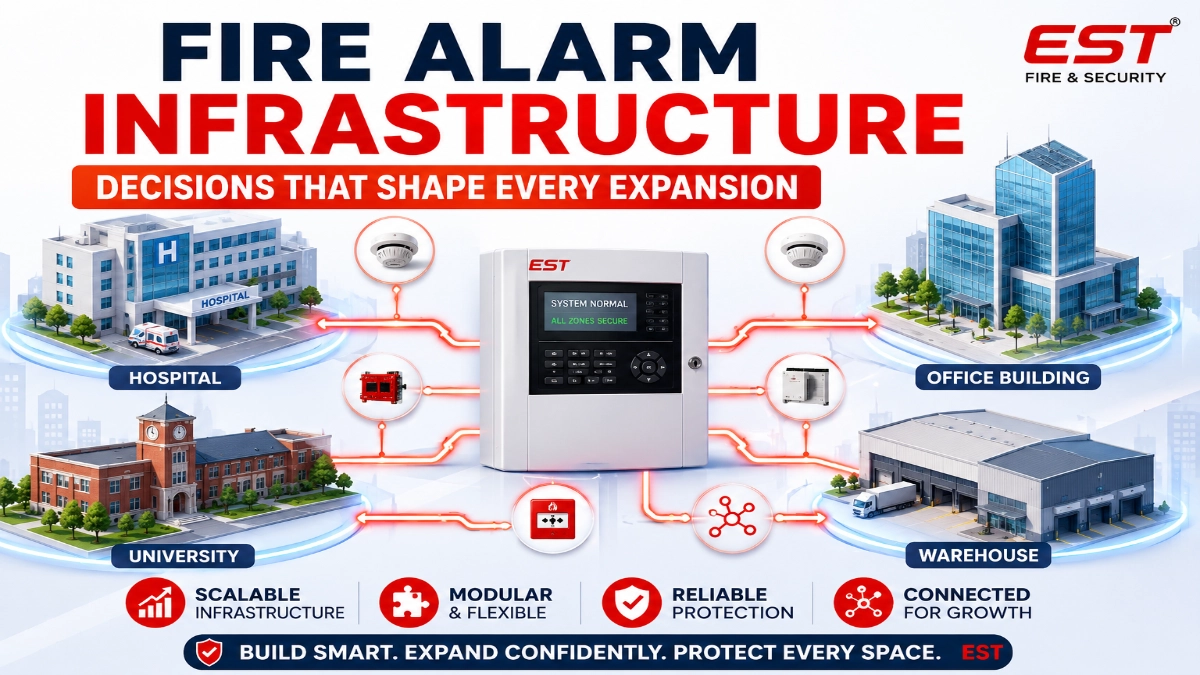
Many organisations assume that expanding a fire alarm system is as simple as adding more detectors or installing another panel. In reality, expansion costs are often determined years earlier during the original infrastructure design. Decisions about network architecture, spare capacity, device standardisation, and communication topology can either simplify future growth or make every expansion more expensive and disruptive.
Introduction
Buildings rarely stay static. Campuses add wings, hospitals open new departments, industrial plants commission new production lines, and commercial developments phase in additional towers over several years. Fire alarm infrastructure has to keep pace, yet it is frequently designed only for the building’s opening-day occupancy.
This is where long-term thinking separates a functional installation from a genuinely scalable one. An enterprise fire alarm infrastructure built with foresight adequate loop capacity, a coherent network topology, standardised devices, and clear documentation allows future phases to connect smoothly. A system designed only for today’s floor plan almost always requires costly rework the moment a new building enters the picture. The engineering decisions made before the first detector is mounted quietly determine how expensive, or how simple, every future expansion will be.
Why does fire alarm infrastructure planning matter for future expansion? Network architecture, spare capacity, and device standardisation are difficult and expensive to change after installation. Planning for growth during initial design rather than reacting later reduces retrofit costs, minimises downtime, and ensures new buildings integrate into the existing fire alarm network without redesigning core infrastructure.
Why Infrastructure Planning Is More Important Than Equipment Selection
Equipment selection gets most of the attention during design reviews, but infrastructure decisions carry more long-term weight. A fire alarm control panel can be replaced. A detector can be swapped. A poorly planned network topology, undersized conduit run, or non-expandable panel architecture, however, is embedded in the building and far harder to correct.
Consultants who think in terms of lifecycle planning rather than single-project deliverables treat the fire alarm system as infrastructure something touched repeatedly over a 15–25 year building lifespan. This mindset shifts the design question from “what does this building need today” to “what will this campus need after three more expansion phases.” That shift in framing often separates a scalable system from one that requires a forklift upgrade five years later.
The Infrastructure Decisions That Matter Most
Network Architecture
The topology chosen at the design stage star, loop, or distributed peer-to-peer networking determines how easily new buildings and panels can join later. A distributed fire alarm architecture allows new nodes to be added with minimal disruption, while a rigid, centralised design often forces re-engineering of the entire network for each expansion.
Spare Loop Capacity
Reserving spare loop capacity at each panel is one of the simplest, most cost-effective decisions a consultant can make. Loops filled to their rated limit on day one leave no room for additional smoke detectors, heat detectors, or modules without adding new panels.
Panel Capacity Planning
Selecting a fire alarm control panel with headroom for future points, rather than sizing exactly to current device count, avoids premature replacement. Platforms with modular card-based architecture, such as the EST3 Fire Alarm Panel and EST4 Fire Alarm Panel, offer engineering flexibility for phased growth.
Device Standardization
Using consistent detector and module families across a campus simplifies procurement, spare-parts inventory, and technician training. Standardising on a single family of EST Detectors and Devices reduces the complexity of maintaining mixed technologies across multiple buildings.
Modular System Design
Modular design allows component panels, network cards, and power supplies to be added incrementally rather than replaced wholesale, forming the foundation of any strategy for fire alarm expansion.
Cable Pathways & Conduit Planning
Oversized conduit runs and accessible cable pathways cost little extra during construction but save substantial demolition and re-routing expense during future fit-outs.
Building-to-Building Networking
Multi-building campuses need a defined strategy for inter-building communication from day one: fibre backbone routes, network switches, and addressing schemes so new structures can be networked without disrupting existing life-safety operations.
Integration with BMS and Other Building Systems
Early integration planning with the Building Management System (BMS), access control, and HVAC interfaces prevents costly custom interfacing work as more subsystems are added with each expansion phase.
Documentation & Asset Management
Accurate, updated as-built documentation, device schedules, and network diagrams allow a consultant years later to expand the system confidently instead of re-surveying the entire installation.
The Cost of Poor Infrastructure Planning
Poor infrastructure planning rarely shows its cost immediately. It surfaces later, during the first expansion project, as:
- Expensive retrofits to replace undersized panels or loops.
- Limited expansion capability, forcing parallel systems instead of one network.
- Increased downtime, since outdated architecture can’t be modified live.
- Complex maintenance from mixed device generations and inconsistent documentation.
- Operational disruptions when expansion work interferes with occupied areas.
- Higher lifecycle costs, since reactive upgrades cost more than planned capacity.
- Inconsistent system performance across buildings using different standards.
A common example: a facility installs a panel sized exactly to its opening device count. Three years later, a new wing requires 40 additional points. Because no spare capacity exists, the project requires an entirely new panel, additional network licensing, and reprogramming costs that would have been a fraction of the size had spare capacity been reserved initially.
Infrastructure Designed for Expansion vs Infrastructure Designed for Today
| Design for Today | Design for Future Growth |
|---|---|
| Panel Capacity sized to current devices | Spare Capacity reserved for growth |
| Closed Architecture | Modular Architecture |
| Fixed Loops at rated limits | Expandable Loops with headroom |
| Limited Documentation | Digital Asset Documentation |
| Independent Buildings | Enterprise Networking |
| Reactive Expansion after the fact | Planned Expansion built into design |
Each row is a compounding decision. A system designed for today may work perfectly at handover, but every future project inherits the constraints baked in at that first design stage.
How EST3 and EST4 Support Long-Term Expansion
Enterprise-grade platforms are engineered around the assumption that buildings will grow. The EST3 Fire Alarm Panel and EST4 Fire Alarm Panel support modular card-based expansion, intelligent networking between panels, and distributed system architecture that allows additional buildings to join an existing fire alarm network without redesigning the core system.
This architecture supports device scalability, adding intelligent detectors, monitor modules, control modules, and notification appliances incrementally while simplifying maintenance because technicians work within one consistent platform rather than a patchwork of legacy and new equipment. For consultants managing multi-phase developments, this reduces the engineering burden of each subsequent phase and supports genuine enterprise lifecycle planning rather than one-off installations.
Real-World Expansion Scenarios
- University Campus: A phased master plan adds academic buildings over a decade. Distributed network topology with reserved loop capacity lets each new building connect without disturbing existing dormitories or lecture halls.
- Hospital Network: New wings require zero downtime during expansion. Modular panel architecture with spare capacity allows new zones to be commissioned without interrupting life-safety coverage in occupied wards.
- Industrial Manufacturing Plant: Production lines expand in stages. Standardised EST Detectors and Devices across the facility simplify maintenance and reduce spare-parts inventory as new process areas come online.
- Logistics Park: Multiple warehouse buildings are added as tenancy grows. Building-to-building networking planned from the outset avoids installing isolated systems per building.
- Commercial Office Campus: Tenant fit-outs happen continuously. Reserved loop capacity per floor allows improvements without panel-level rework.
- Airport Expansion: New terminals connect into an existing enterprise network. Documentation and standardised device families make integration predictable rather than a custom exercise each time.
Consultant Framework for Expansion-Ready Fire Alarm Design
- Understand the long-term building master plan, not just the current phase.
- Estimate future device growth per building and floor.
- Design network topology to support additional nodes.
- Reserve panel and loop capacity beyond current requirements.
- Standardise devices across the campus or portfolio.
- Plan integration requirements with BMS and other systems early.
- Create expansion-ready documentation, including as-built diagrams.
- Review infrastructure capacity at every expansion phase, not just handover.
Common Expansion Mistakes
- Designing strictly for current occupancy with no growth margin.
- Leaving no spare network capacity for additional panels or nodes.
- Poor or outdated documentation that forces re-surveying later.
- Mixing device technologies across buildings without a standardisation plan.
- Limited communication pathways between buildings.
- Ignoring enterprise-wide standardisation in favour of project-by-project decisions.
- No phased expansion strategy agreed with the owner in advance.
Consultants should treat each of these as a design review checkpoint, not an afterthought raised once the next expansion is already underway.
Expert Insights
- Infrastructure decisions often carry a greater financial impact over a building’s lifecycle than the equipment brand selected at handover.
- Reserving spare loop and panel capacity is one of the most cost-effective engineering decisions available, since incremental design cost is small compared to later retrofit costs.
- Standardised devices across multiple buildings simplify procurement, training, and long-term maintenance contracts.
- Network architecture, not panel specifications alone, determines how far a system can scale before requiring a redesign.
- Documentation should be a living asset, updated with every expansion phase rather than created once and left static.
- Enterprise fire alarm systems should be managed as long-term infrastructure assets, like structural or electrical systems, rather than one-time construction deliverables, improving both operational resilience and portfolio-wide financial efficiency.
Key Takeaways
- Infrastructure decisions at the design stage shape every future expansion.
- Spare loop and panel capacity reduce retrofit costs significantly.
- Network topology determines how easily new buildings can be added.
- Device standardisation simplifies maintenance across a portfolio.
- Documentation must evolve alongside the building, not remain static.
- Modular architecture supports incremental growth without full replacement.
- Early BMS integration planning prevents costly custom work later.
- Treat fire alarm systems as long-term infrastructure, not a single project.
Read Also: The Engineering Behind High-Availability Fire Alarm Systems
Read Also: Why Fire Alarm Infrastructure Should Be Designed Like Enterprise IT Networks