Fire alarm maintenance is essential, but in an occupied hospital, factory, data centre, or commercial campus, poorly planned maintenance can disrupt operations. The solution is not to reduce maintenance; it is to engineer the infrastructure so testing, upgrades, troubleshooting, and expansion can happen with minimal unnecessary disruption.
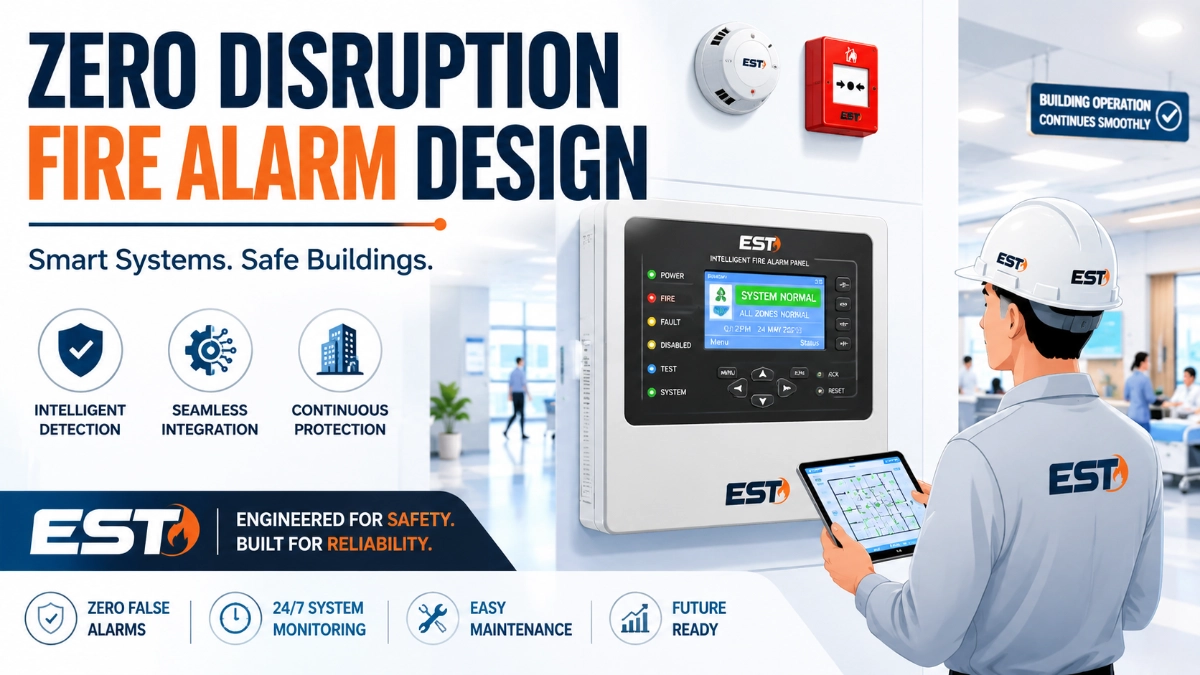
Buildings rarely stand still. Tenants change, production lines expand, hospital wings get renovated, and data halls grow in phases. A fire alarm system installed without maintainability in mind becomes a liability the moment any of that happens; every device replacement turns into a scavenger hunt through outdated drawings, and every fault investigation stalls production or patient care. None of this is inevitable. Engineers who treat maintainability as a design requirement, not an afterthought, can build systems where required testing and servicing happen on a predictable schedule without pulling the rest of the building into chaos.
Fire alarm system design minimises operational interruptions through distributed architecture, intelligent diagnostics, modular expansion, spare capacity, standardized devices, and accurate documentation. These decisions let technicians isolate work areas and perform testing or upgrades in controlled work windows, without reducing required life safety testing, inspection, or maintenance.
Why Fire Alarm Systems Can Disrupt Building Operations
Interruptions rarely come from the alarm event itself but from how the surrounding infrastructure was designed and maintained. Common contributors include:
- False alarms from poor detector selection or contaminated chambers.
- Unplanned testing triggered by missing records.
- Fault investigation that drags on because device locations aren’t documented.
- Difficult device access in ceilings, risers, or occupied rooms.
- Poor documentation, forcing technicians to trace circuits manually.
- System-wide shutdowns for work that only needed one zone.
- Complex configuration changes without a structured process.
- Unplanned expansion that exceeds panel or loop capacity.
- Ageing infrastructure with obsolete components.
- Lack of maintenance planning, turning routine work into emergencies.
Not every interruption comes from equipment failure; many trace back to decisions made, or skipped, years earlier at the design stage.
The Design Principles Behind Low-Disruption Fire Alarm Infrastructure
1. Distributed Architecture
A distributed fire alarm architecture spreads intelligence and control across multiple networked panels, letting technicians isolate a building, floor, or zone for work without affecting protection elsewhere. On a multi-building campus, this is often the single most valuable design decision for continuity.
2. Intelligent Diagnostics
Modern addressable systems report device-level status: dust accumulation, drift, wiring faults, communication errors before a device fails, letting teams diagnose the specific device at fault rather than isolating an entire zone.
3. Modular System Design
Modularity means panels, power supplies, and network modules can be added, replaced, or reconfigured without redesigning the system, limiting the scope of any single maintenance activity.
4. Spare Capacity
Planned spare capacity extra addressable points, unused loop capacity, cabinet space means future device additions rarely require a new panel or full recircuiting. Facilities that outgrow their original design face higher disruption during expansion.
5. Device Standardisation
Standardising EST Detectors and Devices across a portfolio simplifies technician training, spare inventory, replacement, and troubleshooting. Mixed detector families cost teams time relearning device behaviour and sourcing compatible spares.
6. Accessible Documentation
Accurate, current documentation separates a two-hour fault investigation from a two-day one: as-built drawings, device schedules, network diagrams, cause-and-effect matrices, and maintenance history, treated as a living deliverable rather than a one-time handover binder.
7. Planned Integration
BMS integration and other connections should be scoped during initial design, not bolted on later. Systems that anticipate integration avoid the disruptive rework of retrofitting interfaces into infrastructure never built for them.
Planned Maintenance vs Reactive Intervention
| Reactive Approach | Planned Approach |
|---|---|
| Fault discovered unexpectedly | Condition monitored regularly |
| Emergency troubleshooting | Scheduled maintenance |
| Limited documentation | Current documentation |
| Unplanned disruption | Controlled work window |
| Difficult spare availability | Planned inventory |
| Higher operational uncertainty | Predictable maintenance |
Preventive and predictive maintenance give facility teams visibility into system condition before a fault forces an unplanned response. This does not reduce required testing; it changes when and how that work happens, shifting it from an emergency into a scheduled activity.
How to Maintain Fire Alarm Systems in Occupied Buildings
Maintaining life safety systems in an occupied facility takes coordination as much as technical skill:
- Work-window planning aligned with occupancy and critical operations.
- Stakeholder communication so departments know what to expect.
- Temporary protection measures, where required, per applicable codes.
- Isolation procedures limiting impairment to the smallest zone.
- Testing coordination to avoid unnecessary evacuations.
- Permit-to-work processes for life-safety-affecting activity.
- Documentation of every impairment and compensating measure.
- Post-maintenance verification confirming full restoration.
Any temporary impairment must be managed per applicable codes, standards, and authority having jurisdiction requirements, verified before maintenance is planned.
Designing Fire Alarm Systems for Phased Upgrades
Modernising an existing system in a continuously occupied facility is rarely a single weekend project, and treating it that way usually creates more disruption than it prevents. A phased approach includes:
- Building-by-building or zone-by-zone work, so protection is never compromised site-wide.
- Panel replacement strategy sequenced around lowest-impact areas.
- Network migration planned to maintain communication during transition.
- Device compatibility assessment for devices that can remain in service.
- Temporary arrangements to maintain coverage during transition.
- Commissioning phases tied to each completed zone.
- Final system validation once all phases are integrated.
Modernisation is an engineering project with its own design and commissioning plan, not simply a hardware swap.
The Role of EST3 and EST4 in Operational Continuity
The EST3 Fire Alarm Panel and EST4 Fire Alarm Panel are examples of networked, addressable platforms built around intelligent devices, modular expansion, and enterprise-scale event management. Their architecture lets panels and zones be addressed independently, supporting phased maintenance, while device-level diagnostics help teams narrow fault locations efficiently.
These characteristics support operational continuity as a design outcome; they do not eliminate downtime or guarantee uninterrupted operation. Any platform still requires disciplined maintenance planning and skilled technicians. An EST Fire Alarm System evaluated as part of an enterprise strategy should be assessed on how its architecture supports a facility’s own requirements, not on manufacturer claims alone.
Real-World Scenarios
- Hospital: Maintenance is scheduled around clinical activity, with zone isolation limited to the smallest practical area and fire watch measures where required.
- Manufacturing Plant: Aligning maintenance windows with planned production downtime avoids interrupting active lines for testing that could wait for a pause.
- Data Centre: Planned maintenance, redundant monitoring paths, and rigorous documentation reduce the risk of unplanned impairment in high-availability environments.
- University Campus: Phased, building-by-building modernisation keeps academic operations uninterrupted elsewhere on campus.
- Commercial Office Campus: Upgrading shared infrastructure while tenants remain occupied requires careful zone isolation and tenant communication.
8 Design Decisions That Reduce Future Operational Disruption
- Design for Maintainability: Consider technician access during initial layout.
- Plan Spare Capacity: Build in addressable points and loop headroom for unscoped growth.
- Use Appropriate Network Architecture: Match distributed topology to the building’s structure.
- Standardise Devices: Reduce distinct device types across a portfolio.
- Maintain Accurate Documentation: Treat as-built records as a continuously updated asset.
- Plan Integration Early: Scope BMS and access control during design, not retrofit.
- Design for Phased Expansion: Structure panels so zones can be added independently.
- Establish a Lifecycle Strategy: Plan for obsolescence before it’s an emergency.
Common Fire Alarm Design Mistakes That Increase Disruption
| Problem | Operational Impact | Better Design Approach |
|---|---|---|
| Designing only for current requirements | Forces retrofits later | Build in spare capacity upfront |
| No spare capacity | New panels needed mid-operation | Reserve loop and cabinet capacity |
| Poor device accessibility | Longer maintenance windows | Plan access during layout |
| Incomplete documentation | Extended fault investigation | Maintain living as-built records |
| No phased upgrade strategy | Large-scale disruptive replacement | Sequence modernisation by zone |
| Inconsistent device selection | Complex training, spares inventory | Standardise device families |
| Poor network planning | Wider impairment during work | Use segmentable architecture |
| Reactive maintenance | Unplanned emergency response | Shift to scheduled maintenance |
| Ignoring future integration | Disruptive BMS retrofit | Scope integration early |
| Treating commissioning as project end | Documentation gaps | Carry records into O&M |
Expert Insights
- Maintainability should be stated in the specification, not left to a contractor’s discretion.
- The best infrastructure isn’t the one with the longest feature list; it’s the one a technician can service safely years later.
- Spare capacity earns its cost the first time a building renovates outside the original plan, which happens more often than owners expect.
- Documentation quality has a direct effect on fault investigation time, one of the most underinvested areas in lifecycle planning.
- Standardising devices across a portfolio pays off less in installation and more in the years of maintenance that follow.
- In occupied facilities, phased modernisation is usually more practical than large-scale replacement.
- Reducing operational interruption should never mean less required testing; the goal is better planning, not less work.
Key Takeaways
- Treat maintainability as a core design requirement from the earliest stage.
- Use distributed architecture for zone-level isolation during maintenance.
- Build in spare capacity for growth that hasn’t been scoped yet.
- Standardise devices to simplify training, spares, and troubleshooting.
- Keep documentation current, not just complete at handover.
- Scope BMS and system integration early in the design process.
- Plan modernisation in phases aligned with building occupancy.
- Never reduce required testing or maintenance to avoid disruption; improve planning instead.
Sourcing decisions also affect long-term maintainability. When planning procurement and technical support, working with an experienced EST Fire Alarm System Distributor in India can align product availability, spares planning, and lifecycle support with a facility’s continuity goals. A fire alarm system that minimises disruption isn’t defined by any single component; it’s the result of deliberate decisions in architecture, documentation, and maintenance planning made consistently across the system’s life.
Read Also: How Design Decisions Affect Fire Alarm Lifecycle Costs
Read Also: Digital Fire Alarm Records: A New Standard for Enterprise Facilities