CCTV systems have changed significantly over the last decade. Traditional surveillance depended heavily on security operators watching multiple camera feeds, reviewing recorded footage, and responding when someone noticed something unusual. Modern video intelligence adds another layer: software can analyse video, identify predefined events, filter irrelevant activity, and help operators focus on situations that actually require attention.
This shift matters because adding more cameras does not automatically create better security. A facility may have hundreds of cameras, but if operators cannot effectively monitor every feed, important events can still be missed.
So, what is the difference between video intelligence and traditional CCTV monitoring?
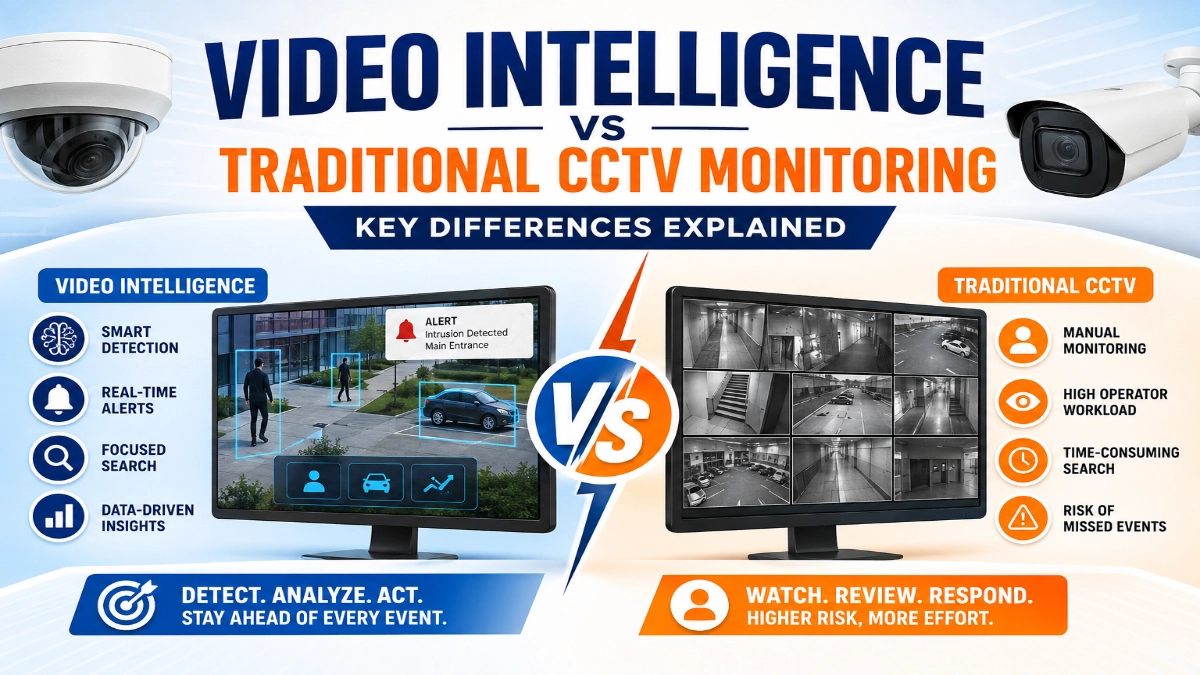
Traditional CCTV primarily records and displays video for human observation. Video intelligence uses analytics to interpret video streams and generate useful information, alerts, or event-based searches. In practice, video intelligence does not necessarily replace security personnel. Instead, it can help them prioritise the footage and events that deserve attention.
For engineers, consultants, facility managers, and system integrators, the real question is not whether one approach is universally better. The better question is:
Which surveillance architecture provides the right balance of detection capability, operator workload, storage, network performance, reliability, and cost for the site?
This article compares both approaches and explains where video intelligence can provide a practical advantage.
Video Intelligence vs Traditional CCTV Monitoring
Traditional CCTV monitoring depends primarily on people watching live feeds and reviewing recorded footage. The cameras capture video, while operators identify suspicious activity.
Video intelligence adds software-based analytics to the surveillance system. Depending on the platform, analytics can help identify people, vehicles, movement patterns, intrusion events, line crossings, or other predefined conditions.
The key difference is therefore how the video is used:
| Factor | Traditional CCTV Monitoring | Video Intelligence |
|---|---|---|
| Primary function | Capture and display video | Analyse video and identify events |
| Human involvement | High | More focused |
| Live monitoring | Operator watches feeds | Analytics can prioritize events |
| Event detection | Primarily manual | Can be automated |
| Video search | Often manual | Can be analytics-assisted |
| False alarms | Depends heavily on operator judgment | Analytics can help filter selected events |
| Scalability | Operator workload increases quickly | Analytics can help manage larger deployments |
| Storage | Primarily video recording | Video plus event/metadata capabilities depending on system |
| Response | Human identifies event | System can generate an event for operator review |
| Best use | Basic monitoring and recording | Monitoring plus intelligent event detection |
The important point is that video intelligence complements CCTV rather than making cameras unnecessary.
What Is Traditional CCTV Monitoring?
Traditional CCTV monitoring is the conventional approach to video surveillance.
A typical system includes:
- CCTV cameras
- Network switches or transmission infrastructure
- Network Video Recorder (NVR) or recording platform
- Monitoring displays
- Storage
- Security operators
- Management software
The cameras continuously capture video. The NVR or recording platform stores the footage, and security personnel monitor selected camera feeds.
When an incident occurs, operators may identify it through live monitoring or investigate the recorded footage afterwards.
For example, imagine a warehouse with 40 cameras.
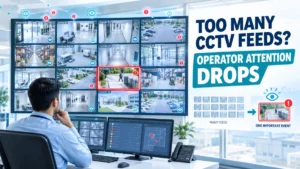
An operator may have access to all 40 feeds, but realistically cannot give equal attention to every camera at every moment. The operator may focus on entrances, loading bays, restricted areas, or other high-risk zones.
If an incident occurs on another camera while the operator is looking elsewhere, the system may still record the event, but nobody may notice it immediately.
That is one of the fundamental limitations of conventional CCTV:
The camera can record everything, but the human operator cannot continuously interpret everything.
What Is Video Intelligence?
Video intelligence refers to surveillance systems that use software-based analytics to extract meaningful information from video.
Instead of treating every video frame equally, the system can analyse the footage according to configured rules or detection capabilities.
Depending on the camera, NVR, VMS, or analytics platform, applications may include:
- Person detection
- Vehicle detection
- Intrusion detection
- Line-crossing detection
- Region-based monitoring
- Object classification
- Loitering detection
- Direction-based movement detection
- People or vehicle counting
- Unusual activity detection
- Event-based video search
The exact capabilities depend on the hardware and software architecture.
Modern surveillance products increasingly combine high-resolution cameras with smart detection capabilities. For example, official Honeywell product documentation describes IMPACT by Honeywell IP cameras as offering smart detection capabilities, while its NVR platforms provide analytics-oriented features for video surveillance.
This creates a fundamental change in the role of CCTV.
Instead of asking only:
“What happened on this camera?”
Security teams can increasingly ask:
“Did a relevant event happen, and where should I look?”
That difference can significantly improve operational efficiency.
How Does Video Intelligence Work?
A simplified video intelligence workflow looks like this:
Camera → Video Processing → Analytics → Event Detection → Alert/Metadata → Operator Response
The camera captures the scene first.
The analytics engine then processes the video. Depending on the architecture, this processing may happen:
- Inside the camera
- On an NVR
- On an edge device
- On a dedicated analytics server
- Within a centralised video management platform
- Through a combination of these components
When the system detects an event that matches a configured rule, it can generate an alert or a metadata record.
For example:
Camera detects movement → Analytics identifies a person → Person enters restricted zone → Rule is triggered → Event is generated → Operator reviews the relevant video
The operator still makes the final operational decision.
This distinction is important.
Video intelligence should generally be viewed as a decision-support layer, not as a complete replacement for security personnel.
Traditional CCTV vs Video Intelligence: The Biggest Difference
The biggest difference is not the camera itself.
It is the amount of interpretation performed automatically before the video reaches the operator’s attention.
Traditional monitoring often follows this model:
See → Notice → Investigate → Respond
Video intelligence can change it to:
Detect → Classify → Alert → Verify → Respond
That can reduce the amount of irrelevant footage that operators need to examine.
Consider a large parking facility.
A conventional CCTV system records vehicles entering and leaving. If management wants to investigate whether a vehicle entered a restricted area at 2:30 AM, someone may need to search through recorded footage.
With analytics-enabled surveillance, the system may allow the security team to filter events based on configured criteria, making the investigation more targeted.
The advantage is not simply “AI.”
The advantage is turning large volumes of video into operationally useful events and information.
Why Traditional CCTV Monitoring Still Matters
It would be a mistake to assume that traditional CCTV has become obsolete.
Recording remains one of the most important functions of a surveillance system.
Even advanced analytics depend on reliable video capture.
Traditional CCTV provides several important benefits:
1. Continuous Recording
A properly configured recording system provides historical evidence that can be reviewed after an incident.
2. Visual Verification
Human operators can verify whether an alert represents a genuine event.
3. Evidence Collection
Recorded footage can support investigations, incident reviews, insurance claims, and internal security assessments, subject to applicable laws and organisational policies.
4. Simpler Deployments
A smaller facility may not require sophisticated analytics. A straightforward camera-and-NVR architecture may be sufficient.
5. Predictable Architecture
Traditional CCTV systems are easier to understand, troubleshoot, and maintain because their primary purpose is straightforward: to capture, transmit, display, and record video.
For a small office, retail outlet, residence, or low-risk facility, adding advanced analytics to every camera may provide limited practical value.
Where Traditional Monitoring Starts to Struggle
The main challenge appears when the number of cameras increases.
Suppose a security control room has:
- 100 cameras
- 3 operators
- Multiple monitors
- 24/7 surveillance requirements
No matter how experienced the operators are, human attention has limits.
Operators can experience:
- Monitoring fatigue
- Reduced attention over long shifts
- Information overload
- Difficulty prioritising simultaneous events
- Time-consuming video searches
- Missed events outside their immediate field of attention
The problem becomes even more significant when organisations expand their surveillance footprint.
Adding 50 more cameras increases the amount of video available. It does not automatically increase the number of people available to monitor it.
This is where intelligent analytics can become valuable.
How Video Intelligence Helps Security Operators
Video intelligence can act as a filter between the camera network and the operator.
Instead of presenting every movement as equally important, analytics can focus on configured events.
For example, consider a manufacturing facility.
A camera overlooking a restricted production area may detect:
- A person entering after operating hours
- A vehicle entering a restricted zone
- Movement across a defined boundary
- Activity in a normally empty area
The operator can then investigate the relevant event rather than continuously watching the entire scene.
This does not eliminate the need for human judgment.
Instead, it can shift the operator’s role from continuous observation toward event verification and response.
That is a major operational advantage.
Video Intelligence Can Reduce Irrelevant Alerts
One of the biggest challenges in surveillance is not generating alerts.
It is generating useful alerts.
Basic motion detection can trigger because of:
- Moving trees
- Shadows
- Rain
- Insects
- Headlights
- Reflections
- Small animals
- Changing lighting conditions
If every movement produces an alarm, operators can quickly become overwhelmed.
More advanced analytics can classify detected objects or apply rules that are more specific to the operational requirement.
For example:
Basic motion rule:
Motion detected in parking area.
More specific analytics rule:
Person detected entering restricted zone outside configured operating hours.
The second event provides more context.
However, engineers should not assume that analytics eliminate false alarms. Performance depends on camera placement, lighting, scene complexity, configuration, firmware, environmental conditions, and the specific analytics technology.
Good system design remains essential.
Camera Selection Still Matters
Video intelligence cannot compensate for poor camera placement.
A sophisticated analytics platform may still perform poorly if the camera:
- Has insufficient resolution
- Is incorrectly positioned
- Faces strong backlighting
- Has excessive glare
- Is mounted too high
- Has an unsuitable lens
- Experiences excessive vibration
- Does not cover the required area
- Produces poor night-time images
This is why surveillance design should start with the operational requirement rather than simply choosing the highest-resolution camera.
For example, Impact by Honeywell bullet cameras can be considered where a bullet form factor and the required field of view suit the application. Honeywell’s current Value Series IP Bullet Camera documentation lists multiple lens options and 2MP and 5MP variants.
For indoor areas, entrances, corridors, or locations where a dome form factor is more appropriate, Impact by Honeywell dome cameras are another option. Honeywell’s Value Series dome documentation similarly lists multiple lens options and 2MP and 5MP models.
The correct engineering approach is therefore:
Application → Scene → Coverage → Lens → Resolution → Lighting → Analytics → Recording
Not:
Resolution → Camera → Installation
The Role of NVRs in Intelligent Surveillance
The NVR remains a critical component even when video intelligence is introduced.
Modern NVRs can provide much more than basic video recording.
Depending on the model and architecture, they may support:
- Multiple camera channels
- High-resolution recording
- Video compression
- Analytics
- Alarm inputs and outputs
- Storage management
- Multiple hard drives
- Redundancy options
- Remote access
- Event-based search
For example, Honeywell’s Value Series IP NVR documentation describes configurations from 16 to 256 channels, support for multiple HDD configurations, high-resolution video, and multiple AI capabilities.
This makes Impact by Honeywell NVR’s relevant to discussions about surveillance architecture where recording capacity and intelligent video functions need to work together.
The important engineering consideration is to verify the actual analytics, channel, resolution, storage, throughput, and compatibility specifications for the selected NVR rather than assuming that every NVR supports every analytics function.
Video Intelligence vs Traditional CCTV: A Practical Comparison
1. Monitoring
Traditional CCTV:
Operators manually watch selected camera feeds.
Video intelligence:
Analytics can identify configured events and bring them to the operator’s attention.
Winner for large deployments: Video intelligence.
2. Incident Detection
Traditional monitoring depends heavily on human observation.
Video intelligence can automatically detect defined conditions.
Winner: Video intelligence for suitable, well-configured use cases.
3. Investigation
Traditional systems require operators to search through recorded footage.
Analytics-enabled systems may provide event-based filtering or metadata-assisted searches.
Winner: Video intelligence.
4. System Complexity
Traditional CCTV generally has a simpler operational concept.
Advanced analytics can introduce additional configuration, software dependencies, processing requirements, and cybersecurity considerations.
Winner: Traditional CCTV for simplicity.
5. Cost
Traditional CCTV may have a lower initial system complexity.
Video intelligence can require additional processing capability, licensing, compatible cameras, storage, or software.
However, organisations should evaluate total cost of ownership, not just equipment purchase price.
Winner: Depends on the application.
6. Scalability
Traditional monitoring becomes increasingly difficult as the camera count grows.
Analytics can help reduce the amount of continuous human attention required.
Winner: Video intelligence for larger and more complex sites.
When Should You Choose Traditional CCTV?
Traditional CCTV may be appropriate when:
- The site is relatively small.
- Camera count is limited.
- Security requirements are straightforward.
- Continuous recording is the primary requirement.
- Operators can realistically monitor the important feeds.
- Advanced event detection is not necessary.
- The organisation wants a simpler architecture.
Examples may include:
- Small offices
- Small retail stores
- Residential properties
- Small warehouses
- Low-risk commercial facilities
The goal should always be to avoid unnecessary complexity.
When Should You Choose Video Intelligence?
Video intelligence becomes more attractive when the facility has:
- A large number of cameras
- Multiple security zones
- Restricted areas
- High-value assets
- Large warehouses
- Industrial facilities
- Parking facilities
- Multiple entry and exit points
- Large campuses
- 24/7 security operations
- A requirement for faster incident investigation
- Limited operator resources
For these environments, the question changes from:
“Can we record everything?”
to:
“Can we identify what matters quickly?”
That is where intelligent surveillance can provide significant operational value.
Video Intelligence for Warehouses
Warehouses are a good example of where analytics can add practical value.
A typical warehouse may include:
- Loading docks
- Employee entrances
- Vehicle movement
- Restricted storage areas
- Perimeter zones
- Parking areas
- High-value inventory
- Multiple shifts
Traditional CCTV can record all these areas.
But security teams may need more than recording.
Analytics can potentially help identify predefined events such as:
- Unauthorized entry
- Vehicle movement in restricted zones
- People entering specific areas
- Activity outside normal operating hours
The exact capabilities depend on the selected system.
The engineering challenge is to define the event first and then design the camera and analytics configuration around it.
Video Intelligence for Industrial Facilities
Industrial environments introduce additional challenges.
Camera selection must consider:
- Lighting variation
- Dust
- Outdoor exposure
- Long viewing distances
- Moving machinery
- Restricted zones
- Network reliability
- Integration requirements
- Environmental conditions
In such environments, video intelligence can help security teams prioritise specific events.
However, analytics should never be treated as a substitute for physical safety controls, access control, operational procedures, or applicable safety systems.
CCTV is one layer of a broader security architecture.
Video Intelligence and Network Design
Engineers should also consider the network impact.
IP cameras continuously transmit video traffic. Higher resolutions, frame rates, compression settings, and camera counts can increase bandwidth requirements.
When analytics are added, the architecture may introduce additional processing and data flows.
A properly designed system should consider:
- Camera bandwidth
- Network uplinks
- PoE capacity
- Switch capacity
- VLAN architecture
- Storage bandwidth
- NVR throughput
- Redundancy
- Remote viewing requirements
- Cybersecurity controls
For larger deployments, surveillance traffic should be designed as an engineered network rather than simply connecting cameras to available switch ports.
Storage Planning Becomes More Important
Video intelligence does not eliminate the need for storage.
A surveillance system still needs to retain the footage required by the organisation’s operational and legal requirements.
Storage calculations should consider:
Number of cameras × Resolution × Frame rate × Compression × Recording hours × Retention period
Additional considerations include:
- Continuous vs event-based recording
- Motion-triggered recording
- Key camera retention
- Redundancy
- RAID configuration
- Backup requirements
- Critical incident export
Some modern NVR platforms support multiple HDD configurations and RAID options. Honeywell’s Value Series NVR documentation, for example, lists multiple HDD configurations and RAID support.
However, engineers should always validate the specific NVR’s supported storage architecture before finalizing the design.
Is Video Intelligence the Same as AI CCTV?
Not necessarily.
The terms are often used interchangeably in marketing, but technically they can describe different capabilities.
Video analytics is the broader concept of extracting useful information from video.
AI-based video analytics can use machine-learning or deep-learning techniques to classify objects and recognise more complex patterns.
A system can therefore have analytics without every feature necessarily being based on the same AI technology.
For procurement and engineering decisions, it is better to ask:
- What objects can the system detect?
- What events can it identify?
- Where is the processing performed?
- What accuracy information is available?
- What environmental limitations exist?
- What camera models are supported?
- What licenses are required?
- Can the analytics operate at the required resolution and frame rate?
This is much more useful than selecting a product simply because it carries an “AI” label.
How Engineers Should Evaluate a Video Intelligence System
Before specifying an intelligent CCTV system, evaluate these eight areas.
1. Detection Requirement
Define exactly what the system needs to detect.
2. Scene Conditions
Assess lighting, shadows, weather, viewing angles, and environmental conditions.
3. Camera Performance
Select the lens, resolution, sensor, IR capability, and form factor according to the scene.
4. Analytics Capability
Confirm that the required analytics are actually supported.
5. Processing Architecture
Determine whether analytics run on the camera, NVR, server, edge device, or cloud platform.
6. Network Capacity
Calculate bandwidth, PoE, uplink, and storage requirements.
7. Storage
Determine retention requirements and calculate capacity accordingly.
8. Cybersecurity
Secure cameras, NVRs, networks, user accounts, firmware, remote access, and management interfaces.
This process produces a much stronger design than simply selecting cameras based on megapixel count.
The Best Approach May Be Hybrid
Many organisations do not need advanced analytics on every camera.
A hybrid architecture can make more engineering and financial sense.
For example:
Standard cameras:
General corridors, low-risk areas, routine recording.
Analytics-enabled cameras:
Perimeter, entrances, restricted zones, loading bays, high-value areas.
This approach focuses intelligent capabilities where they provide measurable value.
It can also help manage system cost and operator workload.
The objective is not to make every camera “smart.”
The objective is to make the overall surveillance system more effective.
Impact by Honeywell and the Shift Toward Intelligent CCTV
The evolution from conventional surveillance to intelligent video is also visible in current IP surveillance product lines.
The Impact by Honeywell CCTV portfolio includes IP camera and NVR solutions designed for modern surveillance requirements. Honeywell’s product documentation describes smart detection capabilities within its Value Series IP cameras.
For example, the product range includes both bullet and dome camera form factors, allowing system designers to select hardware based on the physical environment and coverage requirement.
The NVR portfolio also supports higher-channel configurations and analytics-oriented functionality, which can be useful when designing larger surveillance environments.
For organisations evaluating these solutions, the important point is to match the specific camera and NVR capabilities to the project’s requirements rather than treating the product brand as a substitute for engineering design.
Organisations looking for an Impact by Honeywell distributor in India should also verify current product availability, specifications, compatibility, and commercial terms with the relevant authorised distribution channel before procurement.
Common Mistakes When Implementing Video Intelligence
Mistake 1: Choosing Analytics Before Defining the Problem
Do not start with:
“We need AI cameras.”
Start with:
“What security event are we trying to detect?”
Mistake 2: Poor Camera Positioning
Analytics cannot reliably compensate for a poorly designed field of view.
Mistake 3: Ignoring Lighting
Daytime performance does not automatically guarantee reliable night-time analytics.
Mistake 4: Treating Every Alert as an Alarm
An analytics event may require verification before triggering a critical response.
Mistake 5: Ignoring Network Capacity
High-resolution IP cameras can create substantial network traffic.
Mistake 6: Underestimating Storage
Long retention periods can significantly increase storage requirements.
Mistake 7: Assuming All AI Features Work Everywhere
Analytics performance depends on the camera, scene, configuration, software, and environmental conditions.
Mistake 8: Forgetting Cybersecurity
A connected camera is a network endpoint.
Security teams should therefore consider:
- Strong credentials
- Role-based access
- Firmware updates
- Network segmentation
- Secure remote access
- Device inventory
- Logging
- Appropriate firewall controls
Video Intelligence Is an Evolution of CCTV, Not a Replacement for It
The comparison between video intelligence and traditional CCTV monitoring should not be framed as a simple choice between old technology and new technology.
Traditional CCTV remains valuable because reliable video capture and recording are fundamental requirements for surveillance.
Video intelligence adds another layer by helping organisations interpret large volumes of video and identify events that deserve attention.
For small deployments, traditional monitoring may provide everything required.
For larger environments, intelligent analytics can help security teams manage increasing camera counts without relying entirely on continuous manual observation.
The most effective architecture is usually the one that combines:
Good camera design + reliable recording + appropriate analytics + strong network architecture + effective storage + trained operators.
For engineers, this leads to a more useful design philosophy:
Do not specify intelligence simply because it is available. Specify it where it solves a measurable security or operational problem.
That principle keeps surveillance systems practical, scalable, and easier to manage.
As organisations move from simply recording video toward extracting useful information from it, the future of CCTV will increasingly focus not just on what cameras can see, but on what the surveillance system can help people understand and act upon.
Read Also: How Industrial CCTV Improves Supply Chain Visibility