A fire alarm system that costs less to install can sometimes cost significantly more to operate, maintain, expand, and modernise. The reason is simple: many of the costs an organisation pays over the next 10–20 years are determined by design decisions made before the first detector is installed.
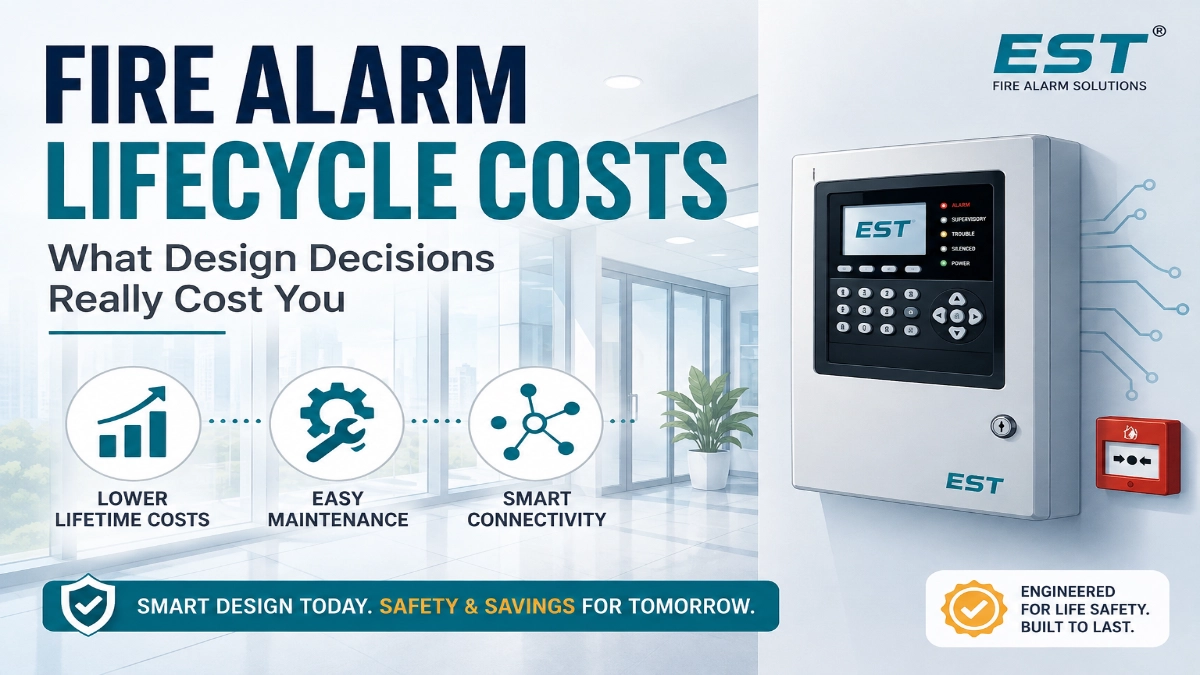
Most procurement conversations focus on the initial quotation: panel cost, device cost, cabling, and labour. But fire alarm systems are long-lived infrastructure. A hospital, data centre, or manufacturing campus will operate its fire alarm system for two decades or more, through renovations, expansions, staff turnover, and technology change. The architecture, device selection, documentation quality, and expansion planning chosen at the design stage quietly determine how expensive or how manageable that ownership period becomes. Engineers, consultants, and facility decision-makers who evaluate systems only on installation price are, in effect, deferring costs rather than avoiding them.
How Do Design Decisions Affect Fire Alarm Lifecycle Costs?
Fire alarm design decisions system architecture, device standardisation, spare capacity, diagnostics, documentation, and integration planning determine how easily a system can be maintained, expanded, and modernised. Systems designed only for current requirements often need costly retrofits, additional labour, and premature replacement, while lifecycle-oriented designs distribute cost more predictably over the system’s operating life.
What Is Fire Alarm Lifecycle Cost?
Fire alarm lifecycle cost covers every phase a system passes through, not just the purchase transaction:
- Design
- Procurement
- Installation
- Commissioning
- Operation
- Preventive maintenance
- Repairs
- Expansion
- Modernization
- Replacement/end of life
It helps to separate three related but distinct financial concepts:
- CAPEX: The capital spent on panels, devices, cabling, and installation at project start.
- OPEX: The recurring cost of testing, inspection, maintenance, spare parts, and troubleshooting.
- Lifecycle Cost / Total Cost of Ownership (TCO): The combined CAPEX and OPEX across the system’s full operating life, including eventual modernisation or replacement.
What is Total Cost of Ownership in fire alarm systems? TCO is the sum of every cost a fire alarm system generates from design through decommissioning, installation, maintenance labour, spare parts, training, integration changes, expansion, and eventual modernisation rather than the purchase price alone.
Why Initial Purchase Price Can Be Misleading
Two fire alarm proposals with nearly identical quotations can produce very different ownership experiences. One system may use standardised, well-documented components with straightforward diagnostics; another may rely on mismatched devices, minimal documentation, and a rigid architecture that resists change. The difference rarely shows up in year one; it appears when a technician spends extra hours locating a fault, when an expansion requires unplanned panel replacement, or when a discontinued device forces an unscheduled retrofit.
Why is the cheapest fire alarm system not always the cheapest to own? Because installation price reflects only equipment and labour at handover. It does not account for future maintenance effort, spare parts availability, troubleshooting time, documentation quality, expansion flexibility, or how easily the system adapts to building changes over its operating life.
8 Design Decisions That Shape Lifecycle Costs
1. System Architecture
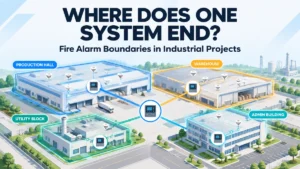
Centralised, distributed, or networked architectures affect how maintenance teams access, troubleshoot, and expand a system. A distributed fire alarm architecture with networked panels typically isolates faults faster and allows phased expansion, while a single, tightly centralised design can make later changes disruptive.
2. Device Standardisation
Using a consistent family of detectors, modules, and notification devices across a facility or across a multi-building campus simplifies procurement, inventory, technician training, and replacement. Standardising EST Detectors and Devices across multiple facilities can simplify inventory management, technician training, and replacement planning, particularly for organisations managing several sites under one maintenance contract.
3. Spare Capacity
Designing a panel, loop, or network strictly to today’s device count often forces a costly retrofit the moment a building adds space or occupancy changes. Spare capacity in panel slots, loop addresses, network nodes, power supplies, and physical pathways is inexpensive to include at design stage and expensive to add later.
4. Intelligent Diagnostics
Addressable fire alarm systems with device-level diagnostics let maintenance teams identify a failing sensor, ground fault, or communication issue remotely, reducing the time technicians spend physically tracing circuits.
5. Documentation
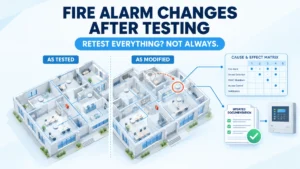
Accurate as-built drawings, device lists, cause-and-effect matrices, network diagrams, and maintenance records are not physical assets, but they carry real operational value. Poor documentation forces every future technician to rediscover the system from scratch, increasing troubleshooting time and consultant fees for years.
6. Integration Strategy
Planning early for building management system integration, access control, elevator recall, and other emergency systems is almost always cheaper than retrofitting integration after commissioning. BMS integration planned during design avoids duplicated wiring and conflicting protocols later.
7. Scalability & Expansion
A modular architecture allows a campus to add buildings, zones, or devices without replacing the core platform. Facilities that expect phased construction should treat scalability as a core design requirement, not an afterthought.
8. Obsolescence & Modernisation Planning
Selecting a platform with a defined technology migration path, backward compatibility, and available replacement parts reduces the risk of forced, unplanned replacement. Consultants should ask about a manufacturer’s upgrade path before finalising a fire alarm control panel selection.
Design for Today vs Design for the Full Lifecycle
| Design for Today | Lifecycle-Oriented Design |
|---|---|
| Lowest initial cost | Optimised total cost |
| Current capacity only | Spare capacity |
| Product-focused | Infrastructure-focused |
| Reactive maintenance | Planned maintenance |
| Limited documentation | Complete digital records |
| Difficult expansion | Scalable architecture |
| Isolated systems | Planned integration |
| Short-term procurement | Long-term lifecycle strategy |
The engineering significance is straightforward: a “design for today” approach optimises a single number, the installation quote, while a lifecycle-oriented approach optimises the total cost curve across ten or more years of ownership, testing, and adaptation.
Where Lifecycle Costs Usually Appear After Handover
Several cost categories are routinely underestimated during procurement: maintenance labour, troubleshooting time, replacement devices, spare parts inventory, technician training, software or licensing requirements, system expansion, documentation updates, integration modifications, modernisation projects, and dependency on a single contractor familiar with a nonstandard installation. Because these costs surface months or years after commissioning, they rarely influence the original purchasing decision, which is precisely why they should be evaluated during design, not after.
How EST3 and EST4 Fit Into Lifecycle-Oriented Fire Alarm Design
The EST3 Fire Alarm Panel and EST4 Fire Alarm Panel are examples of intelligent, networkable platforms built around modular expansion and device-level management. Their architecture illustrates several lifecycle-relevant principles: networked panels that allow phased building addition, addressable device management that supports diagnostics-driven maintenance, and a platform structure designed to accommodate future device and software updates rather than a single fixed configuration.
For organisations evaluating an intelligent enterprise platform, an EST Fire Alarm System can be considered as part of a broader lifecycle-oriented infrastructure strategy, one where architecture, diagnostics, and modularity are treated as design requirements alongside code compliance. This is an educational observation about platform characteristics relevant to lifecycle planning, not a claim of superiority over any specific alternative.
Real-World Lifecycle Scenarios
- Hospital Campus: Continuous operation, phased renovations, and strict access requirements make maintainability, clear documentation, and networked architecture essential; downtime during fault-finding carries outsized operational risk.
- Manufacturing Facility: Production areas are frequently reconfigured. Spare loop and panel capacity avoids re-engineering the fire alarm network every time a process line moves.
- University Campus: Multiple buildings under one maintenance team benefit heavily from device standardisation, since technicians and spare parts serve the entire campus rather than one building.
- Data Centre: High-availability requirements make diagnostics, redundancy, and rapid fault isolation more valuable than marginal upfront savings on device selection.
- Logistics / Warehouse Campus: Future building additions are common; a scalable, networked architecture avoids replacing the core system each time a new warehouse comes online.
Consultant Framework for Reducing Lifecycle Costs
- Define the Building’s Long-Term Requirements: Occupancy changes, expansion plans, and renovation timelines.
- Evaluate Risk and System Architecture: Match centralised, distributed, or networked topology to facility complexity.
- Calculate Future Capacity Requirements: Panel, loop, network, and power headroom.
- Standardise Devices: Across buildings and, where relevant, across an entire portfolio.
- Plan Integration Early: Coordinate BMS, access control, and emergency systems during design, not after commissioning.
- Design for Maintainability: Prioritise diagnostics and serviceable architecture.
- Document the System Properly: As-built drawings, device lists, and cause-and-effect matrices as deliverables, not afterthoughts.
- Create a Modernisation Strategy: Understand the manufacturer’s upgrade path before selecting a platform.
Common Fire Alarm Design Decisions That Increase Long-Term Costs
| Problem | Long-Term Consequence | Better Approach |
|---|---|---|
| No spare capacity | Costly retrofit at first expansion | Design panel/loop headroom upfront |
| Selecting solely on price | Higher maintenance and troubleshooting cost | Evaluate lifecycle cost, not just quotation |
| Ignoring future expansion | Core system replacement | Choose modular, networkable architecture |
| Inconsistent device selection | Complex inventory, training gaps | Standardise devices across facility/portfolio |
| Poor network planning | Difficult fault isolation | Design distributed, diagnostic-capable network |
| Weak documentation | Repeated re-discovery cost | Maintain complete as-built records |
| No modernization strategy | Forced emergency replacement | Confirm manufacturer upgrade path early |
| Overlooking integration | Expensive retrofits | Plan BMS/access control integration during design |
Expert Insights
- The lowest CAPEX option frequently produces the highest OPEX once maintenance labour and troubleshooting time are counted honestly.
- Spare capacity is best understood as an investment in future flexibility, not as wasted budget.
- Documentation has measurable operational value even though it never appears on an equipment schedule.
- Standardisation matters most for organisations managing several buildings under one maintenance contract, where inconsistent devices multiply training and inventory burden.
- Maintainability should be written into the specification as a design requirement, not left to chance during commissioning.
- Integration planned during design is almost always simpler and less disruptive than integration bolted on after a system is live.
- Lifecycle thinking changes how competing architectures should be compared; the right question is not “what does this cost to install” but “what will this cost to own.”
Key Takeaways
- Evaluate fire alarm proposals on lifecycle cost, not installation price alone.
- Build spare capacity into panels, loops, and network infrastructure at design stage.
- Standardise devices across buildings to reduce training and inventory complexity.
- Treat documentation as a deliverable with real operational value.
- Choose architecture that supports diagnostics-driven, rather than reactive, maintenance.
- Plan BMS and third-party integration during design, not after commissioning.
- Confirm a platform’s modernisation and upgrade path before selecting it.
- Involve facility and maintenance teams early, since they inherit the design decisions engineers make.
Read Also: Digital Fire Alarm Records: A New Standard for Enterprise Facilities
Read Also: Why Fire Alarm Specifications Matter More Than Product Brochures