Many enterprise facilities invest heavily in advanced fire alarm systems but continue managing critical documentation through paper files, spreadsheets, and disconnected folders. During maintenance, inspections, audits, or emergency troubleshooting, finding the right drawing or testing record can take valuable time. Digital fire alarm records are transforming how organisations manage life safety infrastructure by making essential information accessible, accurate, and easier to maintain throughout the system’s lifecycle.
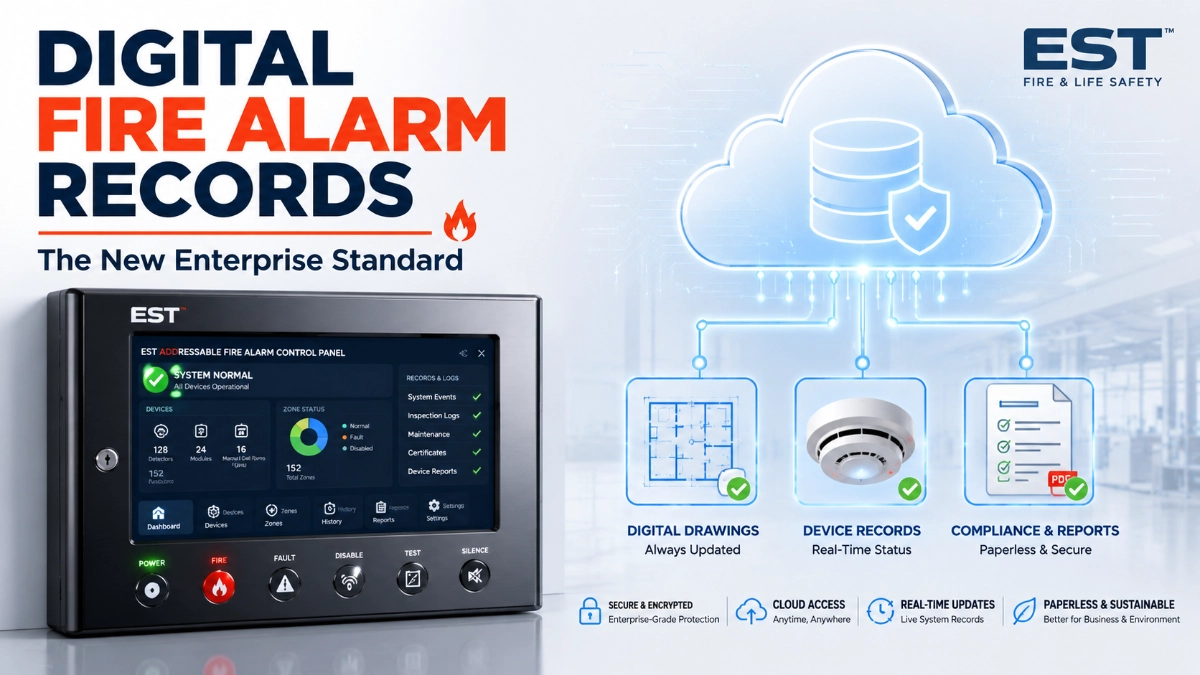
As buildings grow more complex, spanning multiple floors, wings, or entire campuses, an intelligent fire alarm system generates a growing volume of technical data: device locations, wiring architecture, testing history, and firmware versions. A fire alarm control panel is only as effective as the documentation behind it. When that documentation lives in scattered binders, even a well-engineered addressable fire alarm system becomes harder to maintain, audit, and expand. This is why consultants and facility managers are shifting to centralised digital documentation as a core part of lifecycle planning.
Digital fire alarm records are transforming enterprise life safety management by centralising drawings, device inventories, inspection reports, and maintenance history into searchable, secure digital systems. This reduces retrieval time during audits and emergencies, minimises documentation errors, supports predictive maintenance, and improves long-term lifecycle planning across single buildings and multi-site enterprise portfolios alike.
What Are Digital Fire Alarm Records?
Digital fire alarm records are structured, centralised repositories of every document associated with a fire alarm system’s design, installation, commissioning, and ongoing operation. Instead of paper folders stored in a facility office, digital fire alarm documentation lives in a searchable database or digital asset management platform, accessible to authorised personnel across departments and sites.
This differs from traditional paper records in three key ways: accessibility, accuracy, and continuity. Paper documentation is tied to a single physical location and a single copy. Digital records support multi-user access, version control, and real-time updates, so an as-built drawing revised after an expansion project is immediately available to the next technician who opens a device panel not buried under an older, outdated version.
What Information Should Digital Fire Alarm Records Include?
As-Built Drawings
As-built drawings reflect the fire alarm system exactly as installed, including any field changes made during commissioning. These are the foundation for future troubleshooting and expansion planning.
Fire Alarm Network Architecture
Documentation of panel networking, addressable loops, and communication paths helps engineers understand how signals travel between devices and the fire alarm control panel during diagnostics.
Device Inventory
A complete device inventory of smoke detectors, heat detectors, manual call points, monitor modules, and control modules with addresses and locations prevents guesswork during maintenance visits.
EST Detectors and Devices Records
For facilities using EST detectors and devices, maintaining device-specific records (model, address, installation date, calibration history) supports accurate lifecycle tracking and warranty management.
Inspection & Testing Reports
Routine inspection reports and testing records demonstrate compliance and reveal patterns, such as recurring faults on a specific loop, that might otherwise go unnoticed.
Preventive Maintenance History
A documented maintenance history shows what was serviced, when, and by whom, essential for both compliance and long-term system health.
Cause-and-Effect Matrix
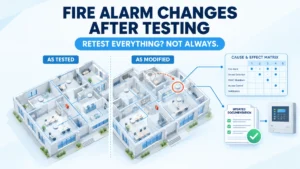
The cause-and-effect matrix defines how the system responds to specific alarm conditions. Digitising this document ensures it stays synchronised with any programming changes.
Commissioning Documents
Commissioning documents verify that the system was installed and tested in accordance with the design intent, establishing a baseline for all future modifications.
Firmware & Software Version History
Tracking firmware and software versions across panels and field devices helps consultants plan upgrades and avoid compatibility issues during expansions.
Expansion & Modification Records
Every addition, relocation, or modification should be logged so that the documentation always reflects the system’s current state rather than its original design.
Why Enterprise Facilities Are Moving to Digital Documentation
Enterprise organisations manage more complexity than single-building operators. A hospital network or industrial group may operate dozens of fire alarm systems across sites, each with its own history. Digital documentation addresses several recurring pain points:
- Faster maintenance: Technicians can pull device history and wiring diagrams on-site instead of returning to an office archive.
- Easier compliance audits: Inspection reports and testing records are retrievable in minutes, not days.
- Better asset visibility: Facility managers can see the full device inventory and its condition across a portfolio.
- Reduced documentation errors: Centralised records eliminate conflicting paper copies.
- Faster troubleshooting: During an active fault, engineers need the cause-and-effect matrix and network architecture immediately, not after a search through storage rooms.
- Improved lifecycle planning: Firmware history and maintenance trends inform when a panel or device family should be modernised.
- Multi-site standardisation: A shared digital format allows consistent documentation practices across every facility.
- Better knowledge transfer: When personnel change, digital records preserve institutional knowledge that would otherwise leave with a retiring engineer.
Paper Records vs Digital Fire Alarm Records
| Paper Documentation | Digital Fire Alarm Records |
|---|---|
| Manual filing | Centralized database |
| Difficult retrieval | Instant search |
| Higher risk of loss | Secure backups |
| Static information | Real-time updates |
| Limited collaboration | Multi-user access |
| Harder lifecycle tracking | Complete asset history |
The long-term engineering impact is significant. Paper systems degrade in reliability as a facility ages and staff turns over, while digital systems retain accuracy and accessibility indefinitely, provided records are consistently maintained.
How EST3 and EST4 Support Modern Documentation Practices
Enterprise-grade fire alarm control panels increasingly generate the underlying data that digital documentation depends on. The EST3 Fire Alarm Panel and EST4 Fire Alarm Panel platforms, for example, maintain event logs, device diagnostics, and system history that can be exported and organised into a facility’s broader digital record set. This data complements rather than replaces externally maintained documentation such as as-built drawings and inspection reports.
For consultants managing lifecycle planning, panel-level history alongside centralised documentation makes it easier to correlate device faults with maintenance trends and plan firmware updates. This is particularly valuable for organisations working with an EST Fire Alarm System across multiple buildings, where consistent panel data and documentation practices go hand in hand.
Consultant Framework for Creating Digital Fire Alarm Records
- Digitise existing documentation: Scan and organise legacy paper records first.
- Standardise file naming: Apply consistent naming conventions across sites.
- Build a device inventory: Catalogue every smoke detector, heat detector, manual call point, and module.
- Link drawings to assets: Connect as-built drawings directly to device records.
- Maintain inspection history: Log every inspection and testing report chronologically.
- Record every system modification: No change should go undocumented.
- Secure backup and version control: Protect records against loss and prevent outdated versions from circulating.
- Review documentation regularly: Schedule periodic audits of the digital record set itself.
Real-World Enterprise Scenarios
- Hospital Campus: Phased expansions make an accurate device inventory essential for access-restricted, infection-sensitive zones.
- Airport: Large addressable systems benefit from digital network architecture records when coordinating with the building management system (BMS) during terminal expansions.
- Manufacturing Plant: Industrial fire protection relies on precise cause-and-effect documentation where fire alarm outputs interact with process shutdown systems.
- Data Centre: Firmware history and commissioning documents are critical where unplanned panel downtime is unacceptable.
- University: Distributed buildings with varying installation eras benefit from standardised records that unify decades of modifications.
- Commercial Office Complex: Frequent tenant fit-outs require continuously updated as-built drawings and device inventories.
Common Documentation Mistakes
- Missing as-built drawings after expansion projects.
- Outdated device inventory that no longer matches field conditions.
- Untracked system modifications made during minor repairs.
- Scattered maintenance records across multiple contractors.
- No version control, leading to conflicting document copies.
- Inconsistent naming conventions across buildings or sites.
- No digital backup strategy, risking permanent data loss.
Consultants should treat documentation gaps as seriously as physical system deficiencies, since both directly affect a facility’s ability to respond to and recover from an emergency. Organisations sourcing components through an EST Fire Alarm System Distributor in India should request commissioning documents and device records at handover, rather than reconstructing them later.
Expert Insights
- Documentation is critical infrastructure, not project paperwork, and should be resourced and audited with the same discipline as the physical system.
- Digital records reduce troubleshooting time during emergencies, since engineers can pull network architecture and cause-and-effect data instantly.
- Lifecycle documentation grows more valuable as buildings expand, since each addition compounds complexity only accurate records can manage.
- Standardised digital records simplify multi-site management, letting a central team oversee documentation quality across a portfolio.
- Digital documentation improves contractor handovers, reducing institutional knowledge loss when personnel or vendors change.
- Predictive maintenance depends on accurate historical records; without consistent testing history, failure trends stay invisible.
- Digital records support better modernisation investment decisions by clarifying which panels or devices are approaching end of life.
Essential Digital Fire Alarm Records for Enterprise Facilities
| Record Type | Purpose |
|---|---|
| As-Built Drawings | Reflect actual installed system layout |
| Device Inventory | Track every detector, module, and appliance |
| Cause-and-Effect Matrix | Define system response logic |
| Inspection & Testing Reports | Demonstrate ongoing compliance |
| Commissioning Documents | Establish system performance baseline |
| Firmware & Software History | Guide upgrade and compatibility planning |
| Expansion & Modification Logs | Keep documentation current with the field |
Key Takeaways
- Treat fire alarm documentation as critical infrastructure.
- Digitise legacy paper records as a first step.
- Maintain a complete, current device inventory.
- Keep as-built drawings synchronised with field changes.
- Log every inspection, test, and modification.
- Use version control to prevent outdated documents from circulating.
- Leverage panel-level data from platforms like EST3 and EST4 to support broader documentation.
- Review and audit documentation practices on a regular schedule.
Read Also: Why Fire Alarm Specifications Matter More Than Product Brochures
Read Also: Fire Alarm Infrastructure Decisions That Affect Every Future Expansion