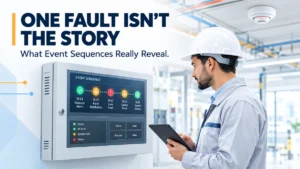
A fire alarm panel reports a device fault. A technician inspects the device and finds nothing wrong. The fault is reset. Several hours later, another event appears in the same area. Later still, a communication-related event shows up on the same loop.
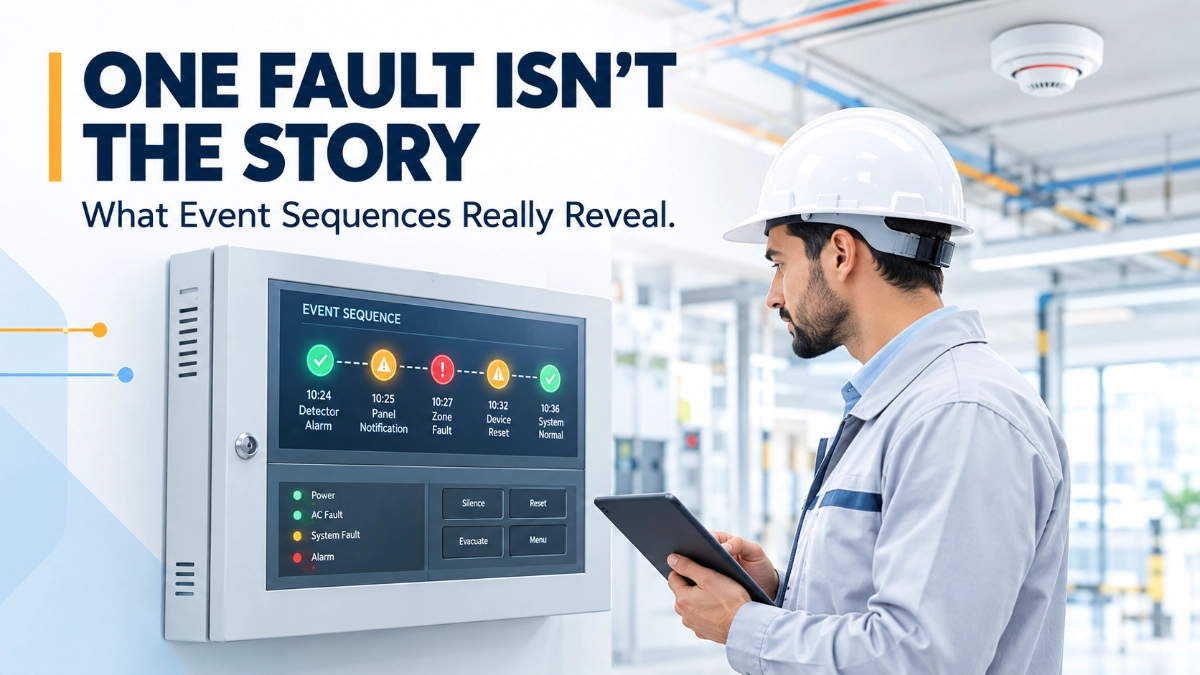
Treated individually, each of these looks like a minor, unrelated nuisance. Reviewed as a sequence, they suggest something different: a condition that may not live inside the last device that alarmed at all.
This is the core problem with reading fire alarm events one message at a time. A single fault tells you what happened. It rarely tells you why, or whether it is connected to anything else. Fire alarm event history sequence, timing, location, frequency, recurrence, and the relationship between events often carry the information that a single alarm message cannot.
Experienced engineers do not stop at “what does this fault mean?” They ask what came before it, what followed it, where else it occurred, and what changed in the system shortly beforehand. This article explains how to read a fire alarm event sequence with that discipline without treating any pattern as automatic proof of root cause.
What Can a Fire Alarm Event Sequence Reveal?
The order, timing, location, frequency, and relationship between fire alarm events can expose patterns that a single fault message cannot. Repeated communication events followed by device faults, for example, may justify investigating the communication path, power conditions, or shared wiring rather than replacing individual devices. Sequences can point toward device-level, loop/circuit-level, communication-related, power-related, environmental, configuration-related, or system-level conditions. Event history provides diagnostic direction, not confirmed root cause; physical inspection and testing remain required.
What Is a Fire Alarm Event Sequence?
An event sequence is simply a set of related fire alarm system events viewed in the order they occurred, rather than as isolated entries in a log.
It helps to distinguish four things:
- A single event: One fault, trouble, or supervisory condition with no established relationship to anything else yet.
- A sequence of related events: Events connected by time, location, or circuit that appear to be linked.
- A recurring pattern: The same event type reappearing under similar conditions.
- A time-based pattern: Events clustering around a specific time, activity, or system state.
A simple conceptual structure looks like this: Event A → Event B → Event C. The order matters because Event A may represent a condition that influenced B, and B may have influenced C. Reading only C, the last visible fault, discards the context that A and B provide.
This is not about assuming causation. It is about preserving the information needed to test whether a causal relationship exists.
Why the First Event Is Not Always the Real Problem
A common troubleshooting mistake is anchoring on the final, most visible fault instead of asking what happened immediately before it.
Consider an illustrative pattern: a communication abnormality occurs, followed shortly by a device-related event, followed by a repeated fault on the same device. It is tempting to treat the device as defective and replace it. But the sequence suggests a different question worth asking first: did the communication condition contribute to, mask, or coincide with the device behaviour?
This is an illustrative diagnostic pattern only, not proof that communication caused the device fault. The point is that the investigation should start with the full sequence, not the last line in the log.
Five Questions Engineers Should Ask When Reviewing Event History
A useful framework for reading fire alarm event history is built around five questions.
1. WHAT happened? Identify the exact event type recorded: fault, trouble, supervisory, or restoral, without assuming severity or cause from the label alone.
2. WHERE did it happen? Note the device, loop, zone, or panel involved. Recurrence in the same physical area points toward a shared condition rather than an isolated device defect.
3. WHEN did it happen? Record the timestamp precisely. Time of day, proximity to other events, and elapsed time since the last occurrence all carry information.
4. HOW OFTEN did it happen? A single occurrence and a recurring one call for different investigation depth. Frequency helps distinguish an intermittent condition from a one-time anomaly.
5. WHAT CHANGED before it started? Review recent maintenance, electrical work, ELV modifications, equipment changes, or environmental shifts. Fire alarm problems frequently begin at the point of a change, even when the change appears unrelated.
Applied consistently, these five questions turn a list of alarms into an investigation framework.
What Event Timing Can Tell You
Timing does not prove causation, but it narrows where to look next. Consider:
- Events appearing immediately after system or wiring changes.
- Events clustering at specific times of day.
- Events recurring shortly after a reset.
- Events coinciding with equipment start-up.
- Events tracking environmental changes such as temperature or humidity swings.
- Multiple events clustered within a short window.
- Long, irregular gaps between recurring events.
None of these confirms a cause on its own. What timing does is help an engineer decide which evidence to pull next: maintenance records, electrical drawings, HVAC schedules, or loop diagnostics.
What Repeated Event Sequences Can Reveal
A single event and a repeated one call for different responses. It also matters whether a repeating pattern stays fixed or shifts across the system.
| Pattern | What It May Suggest | What Engineers Should Investigate |
|---|---|---|
| Same event repeatedly | Recurring condition | Device, wiring, environment, configuration |
| Multiple devices in same area | Shared dependency | Loop/circuit, cable route, environment |
| Events after a modification | Change-related condition | Recent work, wiring, configuration |
| Communication events followed by device events | Possible broader dependency | Network/path, power, system conditions |
| Events at similar times | Environmental/operational correlation | HVAC, machinery, temperature, site activity |
| Fault disappears before inspection | Intermittent condition | History, environment, connections, timing |
These are starting hypotheses, framed cautiously. A pattern “may suggest” or “could indicate” a condition; it should prompt investigation, not a conclusion.
Device-Level Problem or System-Level Problem?
Event patterns help engineers scope the investigation correctly before committing time and resources.
A device-level pattern typically shows one device, repeated faults at the same location, and no broader relationship to other system activity.
A system-level pattern typically shows multiple devices, multiple locations, related communication events, power-related events, or faults occurring simultaneously or in close sequence across different parts of the fire alarm network.
Recognising which pattern is present changes where the investigation should begin, but neither pattern, by itself, confirms root cause. It only indicates appropriate scope.
How Event History Can Expose Problems That Resetting Hides
Resetting a panel clears the visible fault condition. It does not necessarily resolve the underlying cause. This matters most with intermittent conditions, which can disappear before an engineer arrives on site.
Repeated resets without documentation create a specific risk: the pattern that would have revealed a recurring or system-level condition is erased along with the fault. Over time, this can leave a facility with an undocumented history of the same issue reappearing under different-looking symptoms.
Resets should always follow approved operating and maintenance procedures. Where a fault has occurred more than once, documenting the event before clearing it preserves the sequence data needed for proper investigation.
EST3 and EST4 — Why Event Sequence Analysis Matters
On EST3 and EST4 platforms, engineers reviewing event history should focus on the documented event information available to them: what was logged, where it occurred, when it occurred, and how it relates to the broader system architecture and wiring configuration.
Rather than assuming specific diagnostic behaviour, engineers should refer to current official manufacturer documentation for platform-specific event handling. The underlying investigation discipline sequence, timing, location, recurrence, and context apply regardless of platform, but claims about specific event-log capabilities should not be made without verified documentation.
How the EST Fire Alarm System Should Be Investigated Using Event Patterns
When event patterns suggest more than an isolated device issue, investigation on an EST Fire Alarm System should move to system level. This typically involves reviewing panel events, device events, communication events, power-related events, and network events together, alongside fault recurrence history, maintenance records, and any recent system changes.
The objective is to identify cause-and-effect relationships between what was observed and what changed in the system, always combined with physical inspection and technical documentation, not as a substitute for them.
What EST Detectors and Devices Can Tell Engineers Through Event Patterns
Recurring events tied to a specific detector or module, viewed through EST Detectors and Devices, can help identify where an investigation should start. This does not mean the device itself is defective.
Possible areas to examine include device condition, wiring integrity, terminal connections, environmental exposure, installation conditions, loop or circuit behaviour, and any recent modifications near that device or circuit. A recurring event is a starting point for inspection, not a confirmed diagnosis.
Common Mistakes When Reading Fire Alarm Event History
- Looking only at the latest event discards the context that preceding events provide.
- Ignoring the order of events can indicate a possible chain of cause and effect.
- Ignoring timestamps narrows which conditions are worth checking.
- Treating every event as independent misses shared dependencies across devices.
- Replacing devices before analysing patterns is costly and may not resolve the actual condition.
- Ignoring recent electrical or ELV modifications is a frequent, overlooked trigger point.
- Ignoring environmental conditions temperature, moisture, and dust can drive recurring events.
- Clearing history without documenting the investigation erases evidence needed for future troubleshooting.
- Assuming correlation proves causation: a pattern is a hypothesis, not a conclusion.
- Failing to compare event history with maintenance records misses context that explains the pattern.
Event Sequence ≠ Root Cause
Event sequence is evidence. Root cause is a conclusion supported by investigation. The correct chain looks like this:
Event → Pattern → Hypothesis → Verification → Root Cause → Corrective Action → Verification
A communication event followed by multiple device events should become a hypothesis: investigate whether communication, power, wiring, configuration, or another shared dependency could explain the pattern. It should not become a statement that the communication failure definitely caused all device faults. Event history generates testable hypotheses; verification confirms or eliminates them.
A Practical Fire Alarm Event Investigation Workflow
- Preserve event history
- Record timestamps
- Identify affected locations
- Group related events
- Look for sequence patterns
- Check recent changes
- Review maintenance history
- Inspect the relevant system area
- Test according to approved procedures
- Confirm the suspected cause
- Apply corrective action
- Verify the system afterwards
- Document the result
When Should Engineers Escalate an Event Pattern?
Escalation is warranted when multiple devices are affected, communication events repeat, faults appear across different areas, the same problem returns after correction, issues follow electrical modifications, intermittent behaviour remains unexplained, critical operational areas are affected, or the event history cannot reasonably be explained by a single device.
Documentation Makes Event Analysis More Valuable
Event history becomes significantly more useful when compared against as-built drawings, device schedules, the cause-and-effect matrix, network diagrams, maintenance records, modification records, commissioning records, and previous fault investigations. Without this context, even a well-read sequence has limited diagnostic value.
Why Technical Supplier Support Can Matter During Complex Investigations
For complex or ambiguous patterns, support from an EST Fire Alarm System Distributor in India can be useful for product identification, current documentation, system architecture review, product compatibility verification, expansion planning, replacement decisions, commissioning coordination, and access to manufacturer documentation. Supplier support is one input into a broader engineering investigation; it does not replace on-site diagnosis.
Fire Alarm Event Sequence Investigation Checklist
Event Data
- Timestamp recorded?
- Event type recorded?
- Location identified?
- Sequence preserved?
Pattern
- Repeated?
- Multiple devices?
- Multiple locations?
- Communication-related?
- Power-related?
- Time-dependent?
Context
- Recent maintenance?
- Electrical modification?
- Environmental change?
- New equipment?
- Configuration change?
Verification
- Physical inspection completed?
- Relevant testing performed?
- Root cause confirmed?
- Corrective action verified?
- Investigation documented?
Key Takeaways
- A fire alarm event history should be treated as a sequence of evidence, not merely a list of alarms and faults.
- The order, timing, location, recurrence, and context can help engineers identify where to investigate, but the final root cause must be verified through appropriate engineering investigation.
- Focusing on the last event alone discards useful diagnostic context.
- Recurring or clustered events often point toward shared dependencies, not isolated device defects.
- Timing narrows the search; it does not confirm the cause.
- Resets without documentation can erase the evidence needed to catch recurring problems.
- Device-level and system-level patterns call for different investigation scope.
- Event history is most valuable when combined with maintenance records, drawings, and physical inspection.
Read Also: How to Prevent Single Points of Failure in a Networked Fire Alarm System
Read Also: When Does an Industrial Project Need a Networked EST Fire Alarm System?