Industrial environments face security challenges that most commercial buildings do not. A warehouse storing high-value goods across 50,000 square feet, a manufacturing plant running three shifts around the clock, and a distribution centre processing thousands of parcels every day, each demands surveillance that goes far beyond a basic camera setup.
The numbers tell a stark story. Cargo theft, internal pilferage, unauthorised access, and workplace accidents cost industrial businesses billions annually. At the same time, regulatory bodies increasingly require documented evidence of safety compliance, audit trails, and incident records. Without robust video surveillance, businesses are exposed on multiple fronts: financial loss, compliance risk, and reputational damage.
Intelligent surveillance has therefore moved from a ‘nice to have’ to a core operational requirement. But not all CCTV systems are built for the demands of factories and warehouses. Dusty conveyors, vibrating floors, extreme temperature swings, sprawling layouts, and low-light loading bays all push standard commercial cameras to their limits.
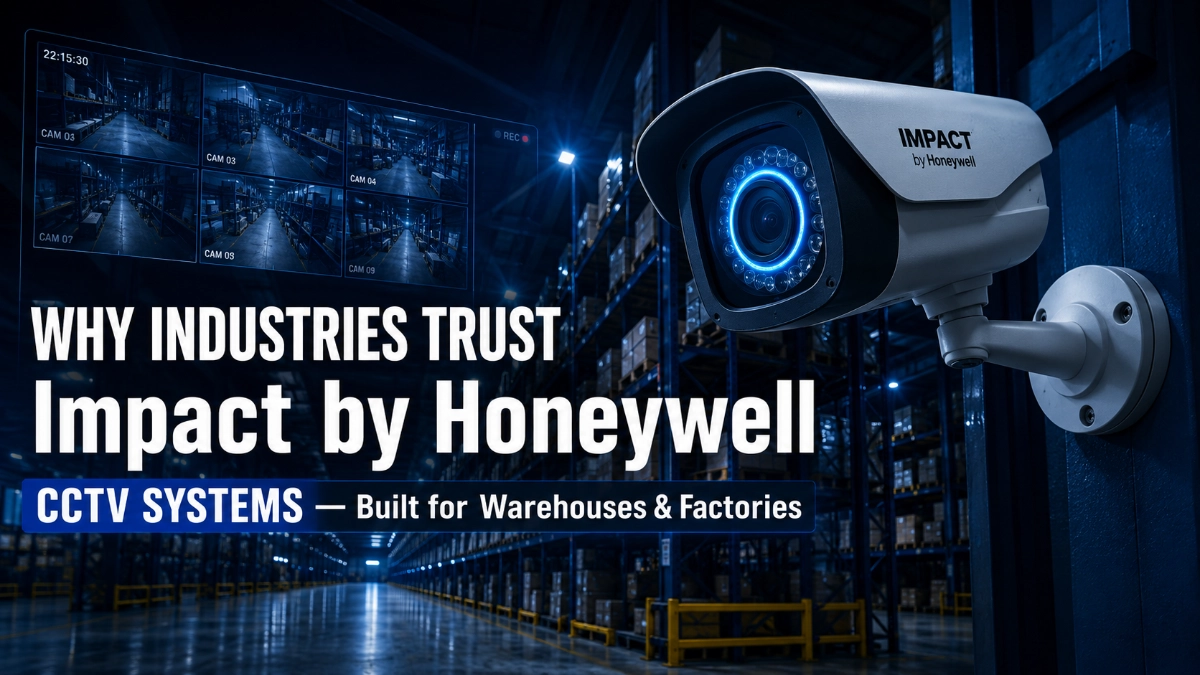
This is precisely why industrial businesses increasingly turn to Impact by Honeywell CCTV systems’ purpose-built surveillance solutions designed to perform in exactly these kinds of challenging environments. This article explains what sets these systems apart, why warehouses and factories prefer them, and what industrial security decision-makers should know before deploying any surveillance infrastructure.
What Makes Industrial Surveillance Different?
Most businesses think of CCTV as cameras, cables, and a monitor in a security room. In an industrial setting, that framing misses the complexity by a wide margin. Industrial surveillance must solve a fundamentally different set of problems.
Large Facility Coverage Requirements
A mid-sized warehouse can span 30,000 to 100,000 square feet across a single floor. Factories may stretch across multiple buildings, outdoor yards, and mezzanine levels. Coverage at this scale demands high-resolution cameras with wide-angle capabilities, strategic placement to eliminate blind spots, and a video management system (VMS) capable of handling dozens to hundreds of simultaneous feeds without performance loss.
Low-Light and Night Monitoring Challenges
Loading docks operate at all hours. Perimeters need monitoring after dark. Many production areas have uneven lighting. Standard cameras struggle in low-light environments. Industrial surveillance systems must include cameras with infrared (IR) night vision or low-light sensors capable of producing usable footage even in near-darkness.
High-Value Inventory and Asset Protection
Warehouses often hold inventory worth millions. Cargo theft, internal theft, and shrinkage can devastate margins. Surveillance must cover storage aisles, high-value zones, cage areas, and dispatch points. Cameras must produce footage clear enough to identify faces, read barcodes, and document individual transactions.
Worker Safety Monitoring
Factories and warehouses are physically hazardous environments. Forklifts, conveyor belts, moving machinery, heavy goods, and elevated platforms all present injury risks. CCTV plays a critical role in monitoring adherence to safety zones, identifying near-miss incidents, and documenting accidents for investigation and legal compliance.
Loading Dock Surveillance
The loading dock is the gateway between internal operations and the external world. It is also one of the highest-risk areas for theft, damage claims, and unauthorised access. Surveillance here must cover vehicle movements, goods handover, driver identity, and timestamp accuracy, all essential for resolving disputes and verifying deliveries.
Perimeter Protection
Industrial facilities typically have large perimeters that include fencing, vehicle gates, pedestrian entrances, and service access points. Outdoor cameras must withstand weather, resist tampering, and deliver clear imagery across distances that indoor cameras never face.
Compliance Requirements
Many industries, such as pharmaceutical, food and beverage, chemicals, and automotive, operate under strict regulatory frameworks that require documented safety protocols and audit-ready evidence. CCTV footage often serves as proof of compliance during external audits or regulatory inspections.
Remote Monitoring Needs
Industrial operators frequently manage multiple sites. Corporate security teams, operations managers, and plant heads need the ability to view live feeds and review footage from any location, on any device, at any time, without compromising security or image quality.
Understanding Impact by Honeywell CCTV Systems
Impact by Honeywell is a range of IP-based video surveillance products designed specifically for commercial and industrial applications. The product line sits within Honeywell’s broader security and building technology portfolio, a portfolio built on decades of experience across some of the most demanding industrial environments in the world.
The Impact range includes IP cameras of various types: dome, bullet, PTZ (pan-tilt-zoom), and fixed-lens models, along with network video recorders (NVRs), video management software, and related accessories. These components are designed to work together as an integrated ecosystem, though they are also compatible with industry-standard VMS platforms.
Industrial-Grade Surveillance Capabilities
What distinguishes an industrial-grade camera from a standard commercial one is its ability to perform reliably across the conditions that define industrial environments: temperature extremes, humidity, dust ingress, vibration, and 24/7 operational demands. Impact by Honeywell cameras are built to meet rigorous IP (Ingress Protection) and IK (impact resistance) ratings, ensuring sustained performance where lesser systems degrade.
Scalability and Ecosystem Integration
One of the practical advantages of the Impact by Honeywell ecosystem is its scalability. A small warehouse can start with a handful of cameras and expand incrementally as operations grow or requirements change. The IP-based architecture means cameras connect over existing network infrastructure, reducing the cost and complexity of large-scale deployments.
The system also integrates with access control platforms, alarm systems, and building management systems, enabling a unified security operation rather than isolated point solutions.
Video Management Capabilities
The quality of video management software determines how useful a surveillance system actually is in daily operations. The Impact by Honeywell VMS provides centralised management of camera feeds, recording schedules, storage allocation, event-triggered recording, and user access controls. Security personnel can retrieve footage quickly, apply filters by time or camera, and export clips for investigation purposes.
Why Warehouses Prefer Impact by Honeywell CCTV Systems
1. Large Area Coverage
Warehouses present a significant spatial challenge for surveillance. Impact by Honeywell offers cameras with wide-angle lenses and high optical zoom capability, allowing operators to cover large floor areas with fewer devices. PTZ cameras can track movement across wide zones, while fixed cameras provide constant oversight of specific areas such as high-value storage bays, cash offices, and server rooms.
High-resolution imaging, including 4K options, means that a single camera can cover an area that might otherwise require multiple lower-resolution devices, reducing installation costs and simplifying maintenance.
2. Enhanced Inventory Protection
Shrinkage is a persistent challenge in warehouse operations. Whether caused by external theft, internal pilferage, or unaccountable stock discrepancies, it directly impacts profitability. CCTV surveillance provides a documented record of who accessed inventory areas, when they accessed them, and what occurred during that access.
Impact by Honeywell cameras provide footage clarity sufficient to read product labels, identify individuals, and document the handling of goods. This capability serves as both a deterrent, as staff aware of surveillance are less likely to engage in dishonest behaviour, and as an evidence tool when incidents do occur.
| Real-World Scenario: A distribution centre handling FMCG goods noticed discrepancies between stock records and physical counts. After deploying cameras covering all shelving aisles and dispatch zones, management identified the source of shrinkage within two weeks of reviewing footage, a process that previously took months of manual auditing. |
3. Better Loading Dock Surveillance
The loading dock is where goods change hands, and disputes about missing or damaged goods are common. Impact by Honeywell cameras deployed at dock doors, weigh stations, and vehicle approach areas creates a continuous visual record of every delivery and dispatch.
Time-stamped footage allows logistics managers to verify delivery accuracy, resolve carrier disputes, and confirm driver identities. This directly reduces the administrative burden of claims processing and the financial exposure of disputed consignments.
4. Improved Operational Visibility
Warehouse managers cannot be everywhere simultaneously. CCTV systems extend a manager’s line of sight across the entire operation. Live feeds accessible from a desktop, tablet, or smartphone allow supervisors to monitor workflow efficiency, identify bottlenecks, and ensure that standard operating procedures are being followed.
This operational visibility has value beyond security. It enables better workforce management, faster response to incidents, and data-driven decisions about layout, staffing, and process design.
5. Remote Monitoring Capabilities
For businesses operating multiple warehouse sites, regional distribution hubs, satellite stores, or outsourced 3PL facilities, remote monitoring transforms the security model. Instead of requiring on-site security personnel at every location, a central monitoring team can oversee all sites simultaneously.
Impact by Honeywell systems supports secure remote access over encrypted connections, ensuring that camera feeds are accessible only to authorised users regardless of where they log in from. Multi-site dashboards consolidate all locations into a single management interface.
6. Reliable Performance in Challenging Conditions
Warehouses are not gentle environments. Forklifts vibrate floors, industrial doors create draughts, dust circulates constantly, and temperature variations between loading areas and climate-controlled storage zones can be significant. Cameras that fail under these conditions become expensive liabilities.
Impact by Honeywell cameras are rated for industrial conditions. Dust-tight and splash-resistant enclosures (IP66/IP67 ratings), operating temperature ranges suitable for cold storage and high-heat environments, and vandal-resistant housings ensure that cameras remain operational regardless of what the environment throws at them.
Why Factories Choose Impact by Honeywell CCTV Systems
Worker Safety Monitoring
Factories carry significant liability exposure related to workplace safety. CCTV systems serve as a continuous safety monitoring tool documenting whether workers are using personal protective equipment (PPE), staying within designated safe zones, following lockout-tagout procedures, and maintaining safe distances from hazardous machinery.
When accidents occur despite precautions, footage provides an objective record that supports fair investigation and helps employers defend against unjustified compensation claims.
Production Area Surveillance
Production lines are the economic core of a manufacturing facility. Monitoring production areas helps identify where bottlenecks form, how machine downtime affects workflow, and whether quality control procedures are being followed at each stage. CCTV footage becomes a management tool, not just a security tool.
Compliance and Audit Support
Regulated industries, such as pharmaceuticals, food processing, medical devices, and chemicals, require extensive documentation of manufacturing conditions. CCTV footage provides time-stamped evidence that processes were followed correctly, cleanroom protocols were observed, or hazardous material handling met regulatory standards. This footage can be critical during FDA inspections, ISO audits, or regulatory investigations.
Incident Investigation
When a product defect, equipment failure, or workplace accident occurs, management needs answers quickly. CCTV footage allows investigators to review exactly what happened in the moments before an incident, identifying root causes without relying solely on witness accounts, which are often incomplete or subjective.
Access Control Integration
Factories typically have restricted zones, research and development areas, server rooms, chemical storage, and executive offices. Impact by Honeywell systems integrates with access control platforms, allowing security teams to correlate badge swipe events with camera footage automatically. If an unauthorised access event is triggered, the system can pull up the relevant footage instantly.
Perimeter Security
Industrial facilities, especially those operating in remote or semi-industrial zones, face perimeter threats ranging from opportunistic trespass to organised theft of plant and equipment. Outdoor Impact by Honeywell cameras with IR night vision and motion-triggered recording provide effective perimeter protection without requiring constant human monitoring.
24/7 Monitoring Requirements
Factories that run continuous production, automotive assembly, chemical processing, and paper manufacturing cannot afford surveillance gaps. Impact by Honeywell systems supports continuous recording with redundant storage, ensuring that no period of operation goes undocumented. Scheduled health checks and system alerts notify administrators of camera outages before they become blind spots.
Industrial Features That Matter Most
The following table maps key industrial surveillance requirements to the business benefits they deliver for warehouse and factory operators.
| Feature | Industrial Requirement | Business Benefit |
| High-Resolution Imaging (4K / HD) | Identify faces, read labels, document transactions | Faster investigations, stronger evidence, fewer disputes |
| IR Night Vision | 24/7 coverage, including zero-light environments | No surveillance gaps, complete perimeter protection |
| AI-Powered Video Analytics | Automated anomaly detection, crowd monitoring | Proactive alerts, reduced reliance on manual monitoring |
| Motion Detection & Smart Alerts | Event-triggered recording, real-time notifications | Faster response, reduced storage consumption |
| Remote Access (Mobile & Desktop) | Multi-site viewing from any authorised device | Centralised oversight, reduced on-site staffing costs |
| Flexible Storage (NVR / Cloud / Hybrid) | Customisable retention periods and storage redundancy | Compliance-ready archives, disaster recovery capability |
| Scalable IP Architecture | Add cameras over existing network infrastructure | Lower expansion costs, investment protection |
| Industrial IP / IK Ratings | Dust, moisture, and impact resistance | Longer camera lifespan, fewer replacements, lower TCO |
| Access Control Integration | Correlate badge events with camera footage automatically | Instant evidence retrieval, stronger access security |
Real-World Use Cases Across Industrial Sectors
Manufacturing Plants
A large automotive component manufacturer deploys Impact by Honeywell cameras across its production floor, including robotic welding stations, assembly lines, and quality control inspection bays. Cameras feed into a central VMS that allows the plant manager to monitor production throughput and safety compliance simultaneously. When a machinery fault causes a near-miss incident, footage is retrieved within minutes, enabling an immediate investigation without halting production.
Logistics Hubs and Distribution Centres
A national logistics hub handles parcels across 80,000 square feet of floor space. High-resolution cameras at every conveyor junction, sorting station, and dispatch gate create a comprehensive audit trail. When a high-value parcel disappears, footage review narrows the investigation from hundreds of suspects to a single zone within two hours.
Cold Storage Facilities
Cold storage warehouses present unique camera challenges, including condensation, sub-zero temperatures, and restricted access zones. Impact by Honeywell cameras rated for low-temperature operation maintain reliable performance in freezer rooms and chilled storage areas, ensuring that temperature-sensitive goods are monitored without equipment failures.
FMCG Warehouses
Fast-moving consumer goods warehouses deal with high volumes, multiple product SKUs, and rapid stock rotation. Cameras positioned above shelving aisles, at goods-in desks, and along dispatch lanes provide a complete record of stock movement. Shrinkage reduction of 30 to 50 per cent is commonly reported after comprehensive CCTV deployment in these environments.
Pharmaceutical Manufacturing
Pharmaceutical plants operate under rigorous GMP (Good Manufacturing Practice) guidelines. CCTV footage documents cleanroom access, material handling procedures, and batch manufacturing steps. During regulatory inspections, this footage provides inspectors with objective evidence of protocol compliance, streamlining audit processes and reducing inspection timescales.
Automotive Assembly Facilities
Automotive factories manage expensive tooling, precision components, and just-in-time supply chains. Surveillance covers tool cribs, parts storage areas, and finished vehicle zones. Cameras integrated with the access control system ensure that restricted areas, such as prototype development bays, for example, are accessible only to authorised personnel, with every access event recorded.
Impact by Honeywell CCTV vs Standard Commercial CCTV
Many businesses start their surveillance journey with standard commercial CCTV system products designed for retail, office, or hospitality environments. These systems work well in their intended contexts but often fail to meet the demands of industrial environments. The table below illustrates the key differences.
| Criterion | Impact by Honeywell CCTV | Standard Commercial CCTV |
| Coverage Capability | Wide-area, multi-zone, PTZ options | Limited to defined, smaller coverage areas |
| Durability | Industrial IP66/IP67, IK10 rated | Standard IP ratings, not rated for vibration or dust |
| Analytics | AI-powered: motion, crowd, anomaly detection | Basic motion detection only in most systems |
| Scalability | Fully scalable IP architecture, 100s of cameras | Limited scalability, often analogue-based |
| System Integration | Access control, alarms, BMS integration | Largely standalone, limited integration |
| Industrial Suitability | Designed for factories, warehouses, harsh environments | Designed for retail, hospitality, offices |
| Maintenance Requirements | Lower — robust build, system health monitoring | Higher — less durable, more frequent failures |
| Remote Monitoring | Secure multi-site access, mobile and desktop | Often limited or requires additional hardware |
How CCTV Contributes to Business Continuity
Security is often framed as a cost. A more accurate framing is that effective surveillance is a business continuity investment. The returns extend well beyond preventing theft.
Risk Reduction
Visible, comprehensive surveillance deters opportunistic crime. Would-be thieves, vandals, and trespassers are significantly less likely to act when they can see active cameras. This deterrent effect reduces the frequency of incidents before they happen, a cost-saving that never appears on any incident report because the incidents never occur.
Faster Incident Response
When something does go wrong, an accident, a theft, a fire, an unauthorised access event, video surveillance enables an immediate, informed response. Security teams can assess the situation in real time from the VMS dashboard and deploy the appropriate response without wasting time establishing the facts on the ground.
Reduced Operational Downtime
In a manufacturing context, downtime costs money. When a production issue, equipment fault, or safety incident disrupts operations, CCTV footage helps investigators identify the root cause quickly. Faster root cause analysis means faster remediation and a faster return to full production capacity.
Insurance Benefits
Many commercial insurers now recognise comprehensive CCTV coverage as a risk-reduction measure and reflect this in premium assessments. Beyond premium reduction, video evidence of an insured event, fire, theft, vandalism, dramatically accelerates claims processing and reduces the risk of disputed claims.
Operational Efficiency
Beyond security, CCTV provides management with an objective view of operational workflows. Footage review sessions have been used by warehouse and factory managers to identify process inefficiencies, improve dock turnaround times, and optimise workforce deployment tangible operational returns that compound over time.
The Future of Industrial Surveillance
Industrial security technology is advancing rapidly. Decision-makers investing in surveillance systems today should understand where the technology is heading, to ensure that today’s deployment remains capable and relevant over the next five to ten years.
AI Video Analytics
Artificial intelligence is transforming what surveillance systems can do. Beyond recording, AI-enabled cameras can recognise objects, detect anomalous behaviour patterns, identify PPE compliance failures, and trigger contextual alerts. These capabilities are already available in current Impact by Honeywell systems and will continue to develop in sophistication. The shift is from reactive security reviewing footage after an incident to proactive security that identifies potential incidents before they escalate.
Smart Warehouses and Integrated Security
The warehouse of the future is a connected environment. Automation systems, WMS platforms, IoT sensors, and CCTV will share data on a unified infrastructure. Surveillance will trigger automated responses locking doors, alerting supervisors, or stopping conveyor systems based on detected events, without requiring human intervention.
Cloud-Connected Monitoring
Cloud connectivity is becoming the default model for enterprise surveillance. Cloud-based storage offers redundancy, scalability, and accessibility without the capital expenditure of server infrastructure. Remote monitoring through cloud platforms allows businesses to scale their security operations without scaling their physical security headcount proportionally.
Predictive Security
Combining historical footage analysis with AI pattern recognition, future surveillance systems will identify risk indicators before incidents occur. A vehicle that repeatedly circles a perimeter at night, a door that is opened at unusual times, or a pattern of access that deviates from normal behaviour; these signals will be flagged automatically, enabling pre-emptive intervention.
Hybrid Surveillance Ecosystems
The future is not a single monolithic security system, but a connected ecosystem of overlapping technologies, CCTV, access control, alarms, fire detection, environmental monitoring, and cybersecurity, all sharing a common data platform and managed through a unified interface. Impact by Honeywell’s ecosystem-ready architecture positions it well for this integrated future.
Conclusion: Choosing Surveillance Built for the Industrial World
Warehouses and factories do not simply need cameras. They need surveillance systems that can perform reliably across the scale, conditions, and operational demands that define industrial environments. A camera that works in a retail store may fail within weeks in a cold storage facility. A VMS designed for a small office cannot manage 200 feeds across a multi-site distribution network.
Impact by Honeywell CCTV systems has established its position in industrial surveillance not through marketing claims, but through the practical demands of industrial operators who need reliability above all else. Wide-area coverage, industrial-grade durability, AI-powered analytics, scalable architecture, and deep integration capability address the real-world challenges that warehouse managers, plant heads, and security officers face every day.
The long-term value of industrial surveillance extends far beyond crime prevention. It supports operational efficiency, regulatory compliance, insurance positioning, incident investigation, and the management visibility that drives better business decisions. For industrial businesses serious about protecting assets, ensuring worker safety, and maintaining operational continuity, investing in surveillance systems designed specifically for industrial environments is not a luxury; it is a strategic necessity.
When evaluating surveillance infrastructure for your next project, ask not just what a system can do in ideal conditions, but whether it will perform in your conditions. The answer to that question is what separates industrial-grade surveillance from everything else.
Read Also: What Makes Impact by Honeywell CCTV So Popular?
Read Also: How Impact by Honeywell Became a Trusted CCTV Brand