Fire safety in large commercial buildings is not just a regulatory requirement. It is a responsibility that directly affects lives, property and business continuity. From corporate offices and shopping malls to hospitals, airports and warehouses, every second counts when a fire incident occurs.
In these environments, traditional alarm systems often fall short. They may detect fire, but they rarely tell you exactly where the problem started. That delay can cost precious minutes.
This is why addressable fire alarm systems have become the gold standard for modern commercial safety infrastructure. They offer precise detection, faster response, easier maintenance and smarter integration with other ELV systems.
In this article, we will explain:
- What an addressable system is
- Why does it outperform legacy solutions
- Why large facilities must adopt it
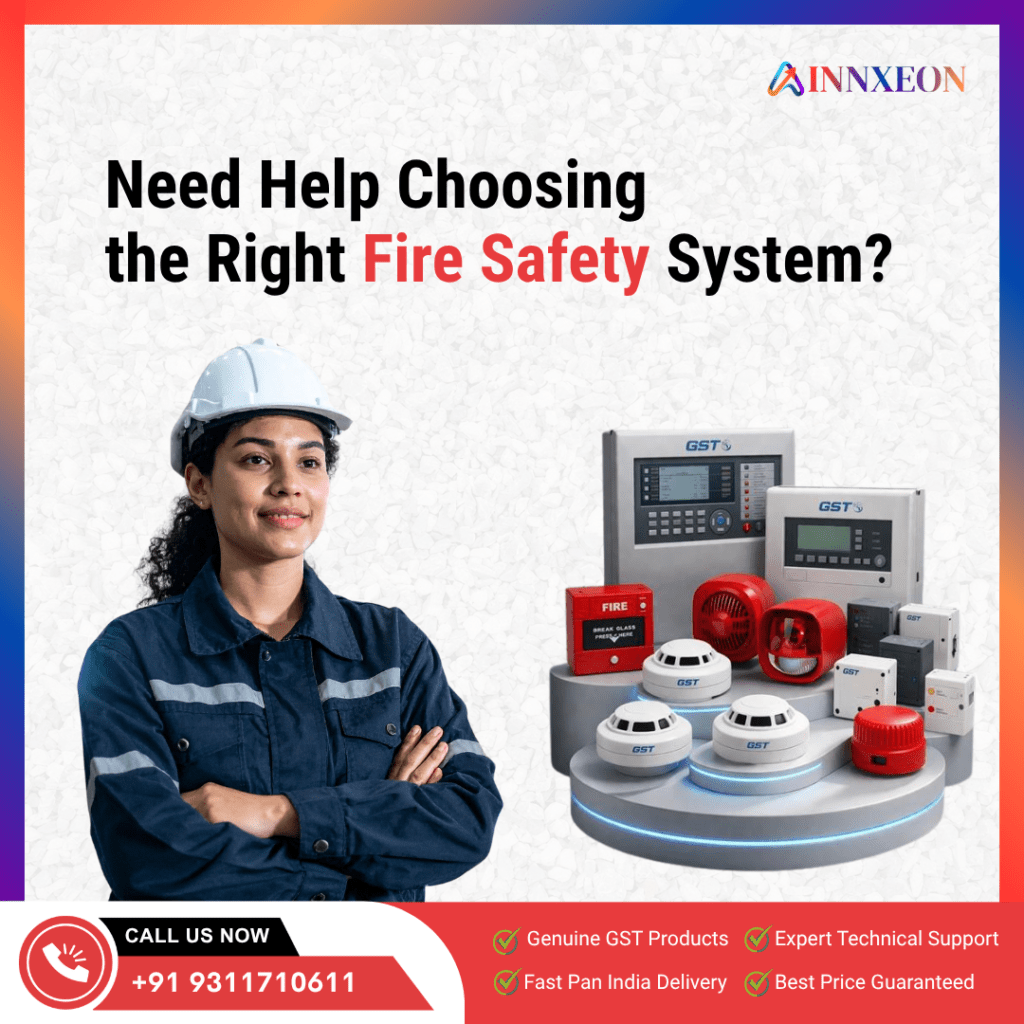
- How the Gulf Security Technology (GST) platform provides reliable, scalable solutions
Let’s break it down in simple terms.
What Is an Addressable Fire Alarm System?
An addressable fire alarm system assigns a unique digital address to every device on the network. Each detector, call point and module becomes individually identifiable.
Instead of saying:
“Fire in Zone 3”
It tells you:
“Smoke detected – 3rd Floor – Server Room – Detector #27”
That level of precision dramatically improves emergency response.
Key Components
- Addressable fire alarm panel
- Addressable detectors (smoke, heat, multi-sensor)
- Manual call points
- Sounders and strobes
- Control/monitor modules
- Communication loops
Each device communicates directly with the control panel using intelligent protocols.
Why Large Commercial Buildings Need Addressable Systems
1. Faster Fire Identification
In large buildings, finding the exact source of fire can be challenging.
Imagine a 20-floor corporate tower. A conventional fire alarm panel might only indicate “Floor 8 – Zone B.” Staff must manually inspect multiple rooms.
An addressable system instantly pinpoints:
- Exact detector
- Device type
- Location
- Time of activation
Result:
- Faster evacuation
- Faster firefighting
- Reduced damage
Speed saves lives.
2. Reduced False Alarms
False alarms waste time and money. They also reduce trust in the system.
Addressable detectors use:
- Intelligent algorithms
- Sensitivity adjustment
- Drift compensation
- Multi-sensor verification
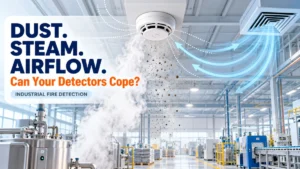
These features reduce nuisance triggers from:
- Dust
- Steam
- Cooking fumes
- HVAC airflow
Facility managers get accurate alerts, not unnecessary panic.
3. Ideal for Large & Complex Layouts
Commercial buildings today include:
- Multi-level parking
- Data centers
- Warehouses
- Retail spaces
- Office blocks
Each space has different fire risks.
Addressable systems allow:
- Custom programming
- Device grouping
- Flexible zoning
- Cause-and-effect logic
You can trigger:
- Specific evacuation areas
- Selective announcements
- Elevator control
- HVAC shutdown
- Fire doors
This level of control is impossible with conventional systems.
4. Easier Maintenance & Troubleshooting
Maintenance becomes much simpler with addressable architecture.
Instead of checking every device manually, the panel shows:
- Device faults
- Dirty detector alerts
- Open circuits
- Communication failures
Technicians know exactly which device needs service.
Benefits:
- Lower maintenance cost
- Faster repairs
- Less downtime
- Higher reliability
For large campuses, this saves hundreds of man-hours annually.
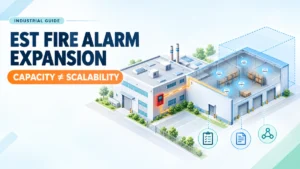
5. Scalability for Future Expansion
Commercial buildings grow.
You may add:
- New floors
- Extra offices
- Additional warehouses
With addressable loops, you simply add devices without replacing the entire system.
This makes it:
- Cost-effective
- Future-proof
- Upgrade-friendly
Conventional systems often require complete rewiring for expansion.
6. Seamless Integration with ELV Systems
Modern safety requires integration, not isolation.
Addressable systems easily connect with:
- CCTV
- Access control
- BMS
- PAVA
- Smoke management
For example:
- Fire detected → CCTV shows live camera feed
- Fire alarm → Doors unlock automatically
- Alarm → Voice evacuation message plays
This creates a smart building ecosystem.
Addressable vs Conventional: Quick Comparison
| Feature | Addressable fire alarm panel | Conventional fire alarm panel |
|---|---|---|
| Device ID | Individual | Zone-based |
| Accuracy | Exact location | General area |
| Maintenance | Easy | Manual |
| Scalability | High | Limited |
| False alarms | Low | Higher |
| Integration | Advanced | Basic |
For small shops, conventional may work.
For large commercial buildings, addressability is essential.
Why Choose a GST Fire Alarm System?
When it comes to reliability and performance, the GST fire alarm system stands out.
What makes GST ideal for large projects?
Advanced Addressable Technology
High-speed communication with precise device identification.
Long Loop Capacity
Supports hundreds of devices per loop, reducing wiring costs.
Smart addressable detectors
Self-diagnostics and environmental compensation.
Global Compliance
Designed to meet international safety standards.
User-Friendly Interface
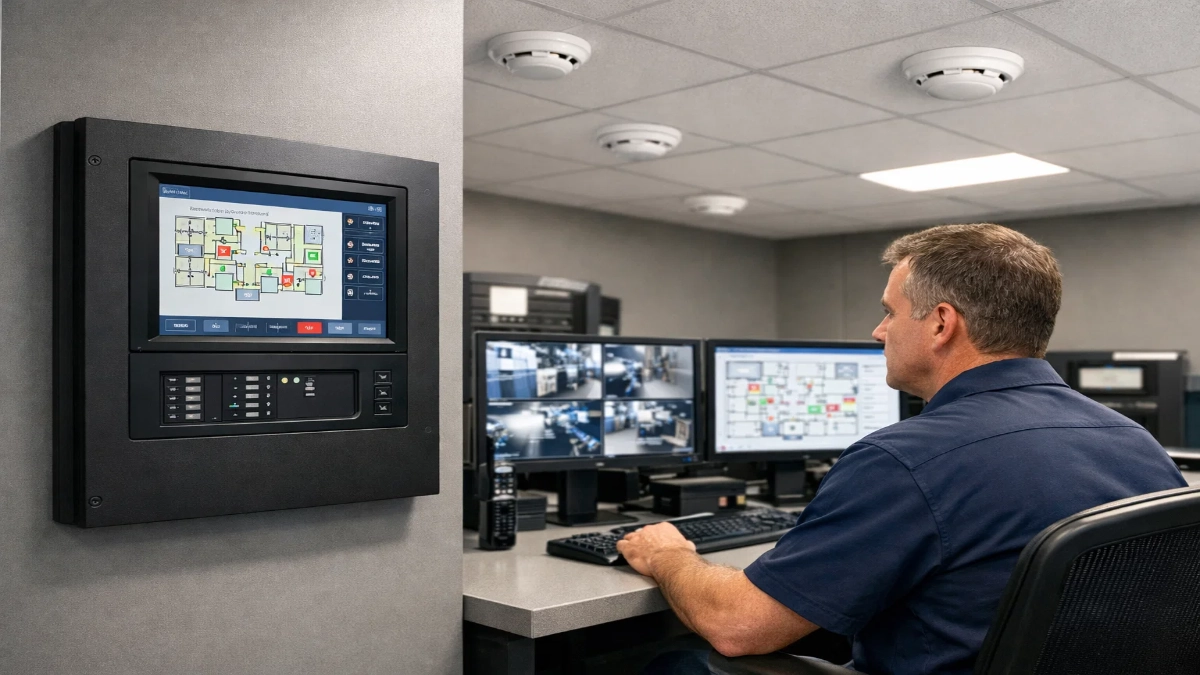
Touchscreen panels with graphical mapping.
Integration Ready
Works smoothly with BMS, PAVA and CCTV.
Cost-Effective for Enterprises
Premium performance without premium pricing.
For consultants, system integrators and facility managers, GST delivers both performance and ROI.
Real-World Applications
Addressable systems are ideal for:
- Airports
- Hospitals
- Malls
- IT parks
- Hotels
- Manufacturing plants
- Educational campuses
These environments need:
- High accuracy
- Fast response
- Minimal downtime
- Centralized monitoring
Addressable technology checks every box.
Why Location-Based Safety Matters
Large facilities operate across multiple geographies. Regulations differ by city and country.
Addressable systems allow:
- Multi-site monitoring
- Remote diagnostics
- Central command centres
This helps companies maintain compliance across regions without increasing operational complexity.
Best Practices for Implementation
To get maximum benefit:
1. Use intelligent design
Plan loop layouts carefully.
2. Choose quality devices
Prefer certified addressable detectors.
3. Integrate early
Connect with ELV systems from the start.
4. Train staff
Ensure operators understand the panel interface.
5. Schedule preventive maintenance
Use diagnostics to reduce failures.
Final Thoughts
Large commercial buildings cannot rely on outdated safety systems.
When a fire occurs, you need:
- Immediate detection
- Exact location
- Fast evacuation
- Reliable integration
- Easy maintenance
Addressable fire alarm systems provide all of this.
They are not a luxury anymore. They are a necessity.
And when you combine addressable intelligence with the reliability of a GST fire alarm system, you get a solution that protects people, assets and operations with confidence.
If you manage or design large facilities, upgrading to addressable technology is one of the smartest safety investments you can make today.
Read Also: Interface Challenges Between Fire Alarm Systems and Other ELV Networks
Read Also: Fire Alarm Control Panels as the Brain of ELV Systems