Walk into any large commercial tower, mixed-use development, or business park in India or globally, and you will almost always find the same problem hidden behind a professional facade: a surveillance system that was never truly designed for the environment it serves.
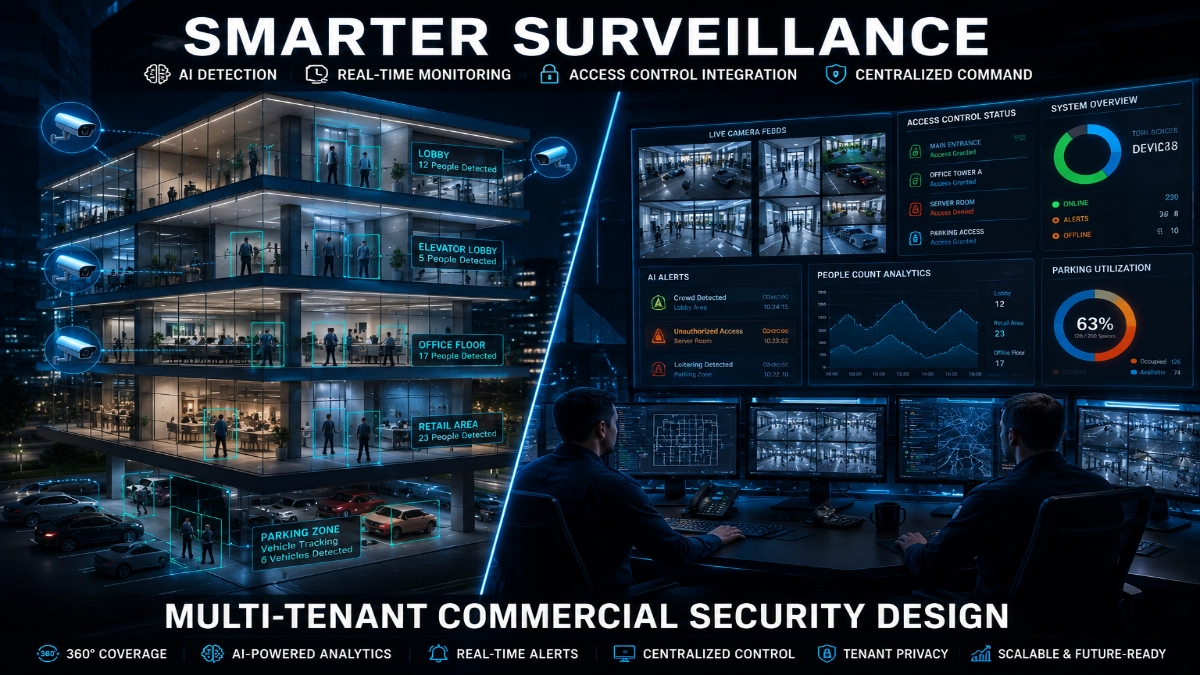
Cameras are installed floor by floor, tenant by tenant, often without a unified strategy. Blind spots appear at handoff zones between tenant spaces and common areas. Visitor management runs on paper or disconnected software. Parking surveillance covers wide areas but misses critical entry and exit events. The security operations team, if one exists, struggles to monitor dozens of disconnected feeds across multiple buildings from a single screen.
This is not a technology failure. It is a design failure.
Multi-tenant commercial facilities are architecturally and operationally complex environments. They serve multiple independent businesses simultaneously, host hundreds or thousands of daily visitors, operate 24 hours across multiple floors and zones, and must respect each tenant’s privacy and data sovereignty, all while maintaining a unified, centrally managed security posture.
Designing surveillance for these environments requires a fundamentally different approach from standard commercial CCTV deployment. This article explains exactly what that approach looks like, why it matters, and how security consultants, system integrators, facility managers, and commercial developers can implement it effectively.
1. What Is Multi-Tenant Surveillance Architecture?
Multi-tenant surveillance architecture is a structured approach to designing, deploying, and managing CCTV and security systems in commercial properties that serve multiple independent occupants simultaneously.
Unlike standard commercial CCTV deployment, which typically installs cameras based on physical floor plans and individual tenant requests, multi-tenant surveillance architecture plans coverage based on operational zones, user categories, shared access pathways, and security risk profiles.
The architecture is built around five core principles:
- Zone-based camera deployment aligned with operational and tenant boundaries.
- Logical separation of surveillance feeds per tenant, even within shared infrastructure.
- Integration with access control, visitor management, and building management systems.
- Centralised video management with role-based access for different stakeholders.
- Scalable, IP-based infrastructure designed for future expansion and technology upgrades.
In practical terms, this means that a commercial tower with 30 tenants does not simply deploy 30 independent CCTV systems. It deploys one unified, intelligently segmented infrastructure that gives each tenant visibility into their own space while giving the facility management team complete oversight of every shared zone, entrance, exit, and common area.
2. Understanding the Unique Surveillance Challenges in Multi-Tenant Facilities
Before designing a surveillance system for a multi-tenant commercial property, security professionals must understand the specific challenges these environments create. Most of these challenges do not exist in single-occupant buildings, and they cannot be solved by simply adding more cameras.
2.1 Shared Access Points With Multiple User Categories
Commercial facilities serve employees, visitors, delivery personnel, contractors, emergency responders, and facility staff, all using the same lobbies, elevators, corridors, and parking areas. Each user category carries a different security risk profile and requires different monitoring logic.
2.2 Tenant Privacy and Data Separation
Each tenant in a commercial building is an independent legal entity with its own employees, business data, and privacy obligations. A law firm on the 12th floor cannot have its internal camera feeds visible to the retail tenant on the ground floor or to the facility management team, unless required for a specific incident. Surveillance design must respect these boundaries through logical feed segmentation and role-based access control.
2.3 The Common Area Problem
Lobbies, corridors, stairwells, food courts, parking decks, and service areas are shared by all tenants but owned by the facility. These zones require continuous, comprehensive coverage but without intruding on tenant-specific spaces. Designing this boundary cleanly is one of the most technically demanding aspects of multi-tenant surveillance.
2.4 Visitor Volume and Footfall Complexity
A busy commercial tower or retail mall may receive thousands of visitors per day, each arriving through multiple entry points, proceeding to multiple destinations, and leaving through multiple exits. Tracking and managing this volume requires intelligent visitor management integration, not just cameras pointed at doors.
2.5 Elevator and Vertical Movement Monitoring
Vertical circulation elevators, escalators, and stairwells present a unique surveillance challenge in multi-floor facilities. These zones are transitional by nature: occupants pass through quickly, often in groups, and the risk of tailgating, unauthorised floor access, or concealed movement is high. Standard camera placement often misses these dynamics.
3. Key Surveillance Design Considerations for Multi-Tenant Commercial Properties
3.1 Shared Lobby and Primary Access Monitoring
The main lobby is the highest-traffic, highest-risk zone in any commercial facility. Surveillance design here must achieve several simultaneous objectives: identifying and recording all entrants, supporting visitor check-in workflows, detecting tailgating at access-controlled doors, and providing real-time visibility to the security desk.
Best-practice lobby surveillance deploys a layered camera strategy: wide-angle overview cameras that capture the full lobby footprint, directional cameras focused on reception and security checkpoints, and high-resolution cameras that cover access control readers and turnstiles. PTZ (pan-tilt-zoom) cameras add flexibility for real-time operator response.
3.2 Tenant-Specific Surveillance Segmentation
Each tenant space should operate as a logically independent surveillance zone within the shared infrastructure. This means tenant-facing feeds are accessible only to authorised personnel from that tenant (typically via a dedicated login to the VMS), while facility management retains read-only or incident-based access for emergency purposes.
Network segmentation using VLANs and access control lists ensures that surveillance traffic from one tenant cannot be intercepted or accessed by another tenant’s IT infrastructure, even when both share the same physical network backbone.
3.3 Common Area Coverage Strategy
Common areas require the most systematic coverage planning. Security designers should conduct a thorough footfall analysis before deploying cameras, identifying peak traffic periods, natural gathering points, high-risk transition zones, and operational blind spots.
Coverage should be designed for overlap: every common area zone should be visible from at least two camera angles to eliminate single-point-of-failure blind spots and support multi-angle forensic review. Camera placement should also anticipate crowd behaviour during emergency evacuations, not just normal operations.
3.4 Visitor Management Integration
Modern multi-tenant surveillance systems integrate directly with visitor management software (VMS). When a visitor registers at the lobby desk or via a pre-registration portal, their identity data is linked to a time-stamped camera record. If the visitor proceeds to a specific floor or tenant area, the camera system can automatically flag that movement against the registered destination.
This integration creates a complete visitor lifecycle audit trail from entry to exit without requiring manual operator intervention. In high-security tenancies (financial institutions, data centres, government agencies), this capability is increasingly a baseline requirement rather than a premium feature.
3.5 Parking Surveillance Workflows
Parking areas generate a disproportionate share of security incidents in commercial facilities, including vehicle theft, vandalism, assault, unauthorised vehicle access, and hit-and-run events. Yet parking surveillance is frequently under-designed, relying on wide-angle cameras that capture too little detail for useful forensic investigation.
Effective parking surveillance integrates License Plate Recognition (LPR) cameras at all entry and exit points, zone-based cameras covering every parking bay row, and perimeter cameras covering walkways and pedestrian access routes. Integration with access control barriers allows the system to automatically flag unauthorised vehicles or vehicles that remain beyond permitted dwell times.
3.6 Elevator and Corridor Monitoring
Elevator cabins require dedicated interior cameras, typically wide-angle or fisheye lenses, positioned to capture all occupants’ faces and any carried items. Elevator lobby cameras should cover both the elevator doors and the floor access corridor, capturing who exits at each floor and in which direction they proceed.
Corridor surveillance should follow a relay logic: cameras are positioned so that any person moving through a corridor is continuously visible from at least one camera angle, with no gap between coverage zones. This relay design is essential for forensic investigation, where tracking a person’s movement path through a building may be critical to resolving an incident.
3.7 AI-Assisted Analytics for Crowd Behaviour
In high-footfall commercial environments, retail malls, transportation hubs, food courts, and event spaces, manual monitoring becomes practically impossible during peak periods. AI-powered video analytics solve this by enabling automated detection of specific behavioural patterns: crowd density thresholds, loitering, perimeter intrusions, abandoned objects, and directional flow anomalies.
These analytics run at the camera edge or on central AI servers, generating real-time alerts that direct operator attention to specific events rather than requiring constant feed monitoring. The result is a dramatic improvement in situational awareness with no increase in monitoring headcount.
3.8 Multi-Floor Command Visibility
Facility security teams managing multi-floor commercial properties need a unified operational view, a single screen (or screen array) that shows the current status of every critical zone across every floor. Modern video management systems support this through configurable dashboards that display camera feeds, access control events, analytics alerts, and system health indicators in a single integrated interface.
For large commercial portfolios with multiple buildings, this command view can extend to a centralised Security Operations Centre (SOC) that monitors all properties simultaneously, enabling economies of scale, faster incident escalation, and consistent security standards across the portfolio.
3.9 Access Control Integration
Surveillance and access control are most powerful when integrated as a unified system. When an access control event occurs, a badge denial, a forced door alarm, or a tailgating detection, the integrated system automatically pulls up the relevant camera feed for the operator, creating an immediate visual context for the event.
This video-verified access control capability eliminates the time lag between event detection and operator response, and it creates an automatic evidence record for every access-related incident, an essential capability for post-incident investigation and insurance claims.
3.10 Video Retention Management
Video retention is both an operational and a compliance issue in multi-tenant commercial facilities. Different tenants may have different regulatory requirements for how long video footage must be stored. Financial institutions and healthcare tenants typically have longer mandatory retention periods than retail tenants.
Intelligent surveillance architecture supports per-tenant retention policies within a shared infrastructure, using automated retention scheduling, tiered storage (on-site NVR for recent footage, cloud archive for long-term storage), and automatic purge workflows that ensure compliance without manual intervention.
3.11 Privacy and Compliance Considerations
Multi-tenant commercial facilities operate under a complex overlay of privacy obligations. In India, the emerging Personal Data Protection framework, along with sector-specific regulations applicable to financial and healthcare tenants, creates specific requirements for how surveillance footage is collected, stored, accessed, and deleted.
Surveillance design must address these requirements proactively: camera placement must avoid capturing private spaces such as washrooms, prayer rooms, and medical areas; access to footage must be restricted and audited; and data subject access request workflows must be documented and executable.
3.12 Network Segmentation for Surveillance Traffic
IP-based surveillance systems generate significant network traffic. A 4K camera operating at 30 frames per second can consume 8 to 25 Mbps of bandwidth. In a commercial facility with hundreds of cameras, this traffic must be carefully managed to avoid impacting tenant business networks.
Best practice deploys surveillance cameras on dedicated VLANs, physically or logically separated from tenant data networks. Core network infrastructure switches, routers, and fibre runs should have dedicated capacity reserved for surveillance traffic, and Quality of Service (QoS) policies should prioritise surveillance streams during peak periods.
3.13 Centralised SOC and NOC Integration
For large commercial portfolios, surveillance operations are most efficiently managed from a centralised Security Operations Centre (SOC) that integrates camera feeds, access control, building management system alerts, fire and safety systems, and IT network monitoring.
This convergence of physical and digital security operations, sometimes called Physical Security Information Management (PSIM), gives security teams a single operational picture of the entire facility, enabling faster threat detection, more coordinated incident response, and more efficient use of monitoring personnel.
3.14 Remote Tenant Monitoring Options
Many enterprise tenants in commercial facilities operate their own internal security teams and require remote access to their dedicated surveillance feeds, for instance, a financial institution that needs its head office security team to monitor its branch office camera feeds in real time.
Modern IP-based surveillance platforms support secure remote access via encrypted client applications or web portals, with role-based access controls that limit each tenant to their own feeds. This capability adds significant value for enterprise tenants and becomes a differentiator in commercial leasing negotiations.
3.15 Emergency Event Coordination
During fire evacuations, medical emergencies, or security incidents, the surveillance system becomes a critical operational tool for emergency coordinators. The system should support rapid override modes that give emergency responders full visibility across all camera feeds, bypassing normal tenant segmentation, during declared emergencies.
Integration with the building’s fire alarm system, intercom network, and public address system creates a unified emergency response platform. When an alarm triggers, the surveillance system can automatically display the affected zone’s camera feeds on the operations desk, accelerating initial assessment and response.
4. Deployment Examples Across Commercial Property Types
Commercial Office Towers
In a Grade A office tower housing 20 to 50 corporate tenants, surveillance design focuses on lobby management, elevator bank monitoring, floor-level access control integration, and tenant floor segmentation. AI-assisted occupancy tracking helps facility managers optimise cleaning schedules and energy management, demonstrating how surveillance data creates operational value beyond security.
Retail Malls and Shopping Complexes
Retail environments require dense camera coverage across high-footfall concourses, queue management at key retail clusters, loss prevention integration with individual store systems, and parking deck LPR coverage. Heat mapping analytics identify peak traffic zones, helping retailers optimise store placement and promotional positioning.
Mixed-Use Developments
Mixed-use properties combining retail, hospitality, residential, and commercial office spaces present the most complex surveillance design challenge. Each use type carries different security requirements, operating hours, and privacy obligations. Surveillance zoning must cleanly separate these domains while maintaining shared infrastructure efficiency. Platforms offering flexible zone configuration and independent retention policies are essential in these environments.
Business Parks and IT Campuses
Campus environments spread across multiple buildings require distributed camera networks with central management. Inter-building pathways, service roads, server rooms, and data centre access corridors all require dedicated coverage. Perimeter surveillance using long-range cameras, thermal imaging, and AI-powered intrusion detection is increasingly standard in these environments.
Co-Working Facilities
Co-working spaces serve transient, often anonymous occupants, making visitor tracking and access control integration especially critical. Hot-desking areas, meeting rooms, and private offices require camera coverage that supports dispute resolution without creating a surveillance environment that discourages occupancy.
Hospitality Complexes
Hotels and serviced apartment complexes within commercial developments add a 24-hour residential dimension to the surveillance challenge. Guest privacy must be balanced against security requirements, with coverage focused on public areas, car parks, service corridors, and delivery zones rather than guest-facing private spaces.
5. Traditional CCTV vs. Intelligent Multi-Tenant Surveillance Architecture
The following table compares the key differences between a traditional commercial CCTV deployment and an intelligent multi-tenant surveillance architecture.
| Feature | Traditional CCTV Deployment | Intelligent Multi-Tenant Architecture |
| Camera Planning | Floor-by-floor, no zoning strategy | Zone-based, tenant-segmented deployment |
| Access Control Integration | Standalone, siloed systems | Unified, real-time integrated platform |
| Tenant Privacy | Shared feeds, no separation | Logical segmentation per tenant zone |
| Visitor Management | Manual sign-in, no camera linkage | Integrated VMS with camera-triggered alerts |
| Analytics | Basic motion detection only | AI-powered behavior, crowd, and anomaly analytics |
| Remote Monitoring | On-site only or limited VPN | Cloud-enabled, multi-tenant SOC access |
| Parking Coverage | Generic wide-angle cameras | LPR-integrated, zone-mapped coverage |
| Scalability | Difficult, expensive re-cabling | IP-based, edge-ready, plug-and-expand |
| Video Retention | Single NVR, shared storage | Tenant-specific retention policies, cloud backup |
| Incident Response | Manual review, slow forensics | AI-indexed search, instant clip export |
| Cybersecurity | Flat network, shared credentials | Segmented VLANs, role-based access control |
| Compliance | Ad hoc, manual documentation | Automated audit trails, GDPR/local law-ready |
6. Common Surveillance Design Mistakes in Multi-Tenant Properties
Even experienced system integrators make critical errors when designing surveillance for multi-tenant commercial facilities. Understanding these mistakes is the first step to avoiding them.
Mistake 1: Designing for Individual Floors Instead of Operational Zones
The most common error is treating each floor as an independent deployment unit. In reality, security risks do not respect floor boundaries. A visitor who tailgates through the ground floor lobby will move through corridors, take an elevator, and arrive on a tenant floor, and every step of that movement should be part of a connected monitoring workflow.
Mistake 2: Ignoring Common Area Handoff Points
The boundaries between tenant spaces and common areas, where a private office corridor meets a shared elevator lobby, for instance, are consistently under-monitored. These handoff zones are where unauthorised access events most frequently occur.
Mistake 3: Deploying Cameras Without Analytics Planning
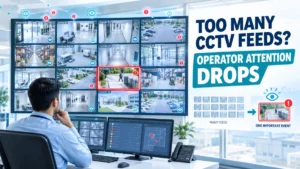
Cameras without analytics are passive recording devices. In a high-footfall commercial environment, passive recording has limited operational value because nobody can realistically review 200 simultaneous feeds. Analytics planning, defining what behaviours the system should detect and alert on, should happen before camera placement, not after.
Mistake 4: Using Flat Network Architecture for Surveillance Traffic
Placing surveillance cameras on the same network as tenant business systems creates both cybersecurity vulnerabilities and bandwidth conflicts. A compromised camera can become an entry point into a tenant’s business network if proper segmentation is not in place.
Mistake 5: Not Planning for Scalability
Many commercial surveillance deployments are designed for the property as it exists today, with no consideration for future expansion, additional floors, new tenant categories, technology upgrades, or portfolio growth. Designing for scalability from the outset using IP infrastructure, modular VMS platforms and standardised camera specifications avoids costly rip-and-replace scenarios later.
Mistake 6: Treating Video Retention as a Storage Problem
Video retention is a compliance, operational, and legal issue, not just a storage capacity question. Designing retention policies without consulting the facility’s legal team, understanding tenant-specific regulatory requirements, and implementing automated purge workflows creates significant liability exposure.
7. How Intelligent Surveillance Design Improves Commercial Security Operations
When surveillance design is executed correctly in a multi-tenant commercial environment, the operational benefits extend far beyond traditional security functions.
Faster Incident Response
Integrated systems that combine surveillance, access control, and building management alerts dramatically reduce the time between event detection and operator response. When a door alarm triggers, the relevant camera feed appears immediately on the operator’s screen, with no manual camera navigation required.
Improved Forensic Investigation Capability
AI-indexed video archives enable investigators to search footage by object type, colour, movement pattern, or time window rather than manually scrubbing through hours of recorded video. What previously took hours can be accomplished in minutes with higher accuracy and more complete results.
Better Tenant Security Management
Enterprise tenants increasingly evaluate the quality of a building’s security infrastructure when making leasing decisions. A well-designed, intelligently managed surveillance system is a genuine commercial differentiator, particularly for financial institutions, technology companies, and government agencies with elevated security requirements.
Reduced Monitoring Complexity
AI-assisted analytics shift security operations from reactive monitoring to proactive alert management. Instead of watching feeds and hoping to notice something, operators respond to specific, pre-defined alerts, dramatically reducing monitoring fatigue and improving the quality of detection.
Enhanced Operational Oversight
Beyond security, surveillance data supports facility operations: occupancy counts inform cleaning and maintenance schedules; footfall analytics guide retail tenant placement; parking utilisation data optimises space allocation; and crowd behaviour analytics support emergency planning.
Improved Scalability
IP-based, modular surveillance architectures scale efficiently as commercial properties grow. Adding cameras, expanding storage, or extending monitoring to new buildings or floors does not require replacing core infrastructure; it requires adding capacity to an existing, well-designed platform.
8. Enterprise Surveillance Platforms for Multi-Tenant Commercial Environments
The complexity of multi-tenant commercial surveillance demands enterprise-grade platforms designed for exactly these environments. Generic consumer or small-business CCTV solutions cannot provide the tenant segmentation, scalable analytics, integration depth, and compliance capabilities that large commercial properties require.
Impact by Honeywell represents this category of purpose-built enterprise security infrastructure. Designed for complex commercial environments, these platforms provide unified video management, access control integration, AI-powered analytics, and scalable architecture in a single, centrally managed ecosystem. For commercial developers and facility managers in India, Impact by Honeywell distributors in India provides localised deployment expertise, regional support, and in-country hardware and software integration capabilities, ensuring that enterprise-grade surveillance design is accessible across the Indian commercial real estate market.
When evaluating enterprise surveillance platforms for multi-tenant environments, security consultants should assess: multi-tenant VMS architecture with logical feed segmentation; native integration with access control, visitor management, and BMS platforms; edge AI capability for on-camera analytics; flexible retention scheduling per tenant zone; SOC-ready dashboard and alert management; and open API architecture for third-party system integration.
9. The Future of Commercial Surveillance: Intelligence, Edge, and the Cloud
AI-Powered Commercial Surveillance
Artificial intelligence is fundamentally changing what commercial surveillance systems can do. Beyond basic motion detection, modern AI analytics can identify specific object types, recognise behavioural patterns, detect anomalies in crowd movement, and predict emerging security situations before they escalate. For multi-tenant facilities, AI enables proactive security rather than reactive monitoring.
Edge AI Surveillance
Edge AI cameras process video analytics locally on the camera itself rather than sending raw video to a central server. This approach reduces network bandwidth requirements, lowers latency for real-time analytics, and creates a more resilient surveillance architecture that continues to function even if central server connectivity is interrupted.
Cloud-Based Video Management
Cloud video management is transforming how commercial portfolios manage surveillance infrastructure. Cloud platforms eliminate the need for large on-site NVR hardware rooms, enable instant scalability as property portfolios grow, and provide anywhere access for authorised stakeholders from facility managers to tenant security teams to remote SOC operators.
Smart Building Security Integration
The boundaries between surveillance, access control, fire safety, HVAC, lighting, and building management are dissolving. Smart building platforms integrate all of these systems into a single operational interface, enabling security events to trigger automated building responses (locking down HVAC to prevent smoke spread during a fire, for instance) and operational data to inform security planning.
Predictive Threat Analytics
Machine learning models trained on historical incident data can identify patterns that precede security events, specific combinations of access control anomalies, crowd behaviour changes, and environmental conditions that correlate with incident risk. These predictive models allow security teams to intervene before incidents occur rather than responding after the fact.
Occupancy Intelligence
Real-time occupancy data derived from surveillance analytics, access control records, and sensor data is becoming a core operational metric for commercial facilities. Occupancy intelligence informs everything from emergency evacuation planning to lease pricing to retail tenant performance benchmarking.
Unified Commercial Security Ecosystems
The ultimate vision for commercial surveillance is a fully unified security ecosystem: a single platform that integrates every physical security system, every building management function, and every tenant-facing security tool into one coherent, AI-orchestrated operational environment. This vision is already being realised in the most advanced commercial developments globally, and the infrastructure decisions made today will determine how quickly each property can reach this level of operational capability.
Read Also: CCTV Workflow Engineering for Emergency Operations Teams
Read Also: Identifying Hidden Performance Bottlenecks in Surveillance Systems