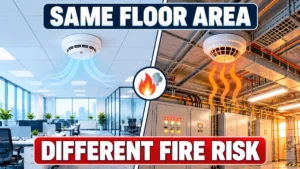
Industrial facilities have always operated at the intersection of high value and high risk. A pharmaceutical cleanroom, a petrochemical processing plant, a large-scale logistics hub, or a hyperscale data centre each presents a distinct set of fire hazards. It demands a fire detection strategy as sophisticated as the facility itself.
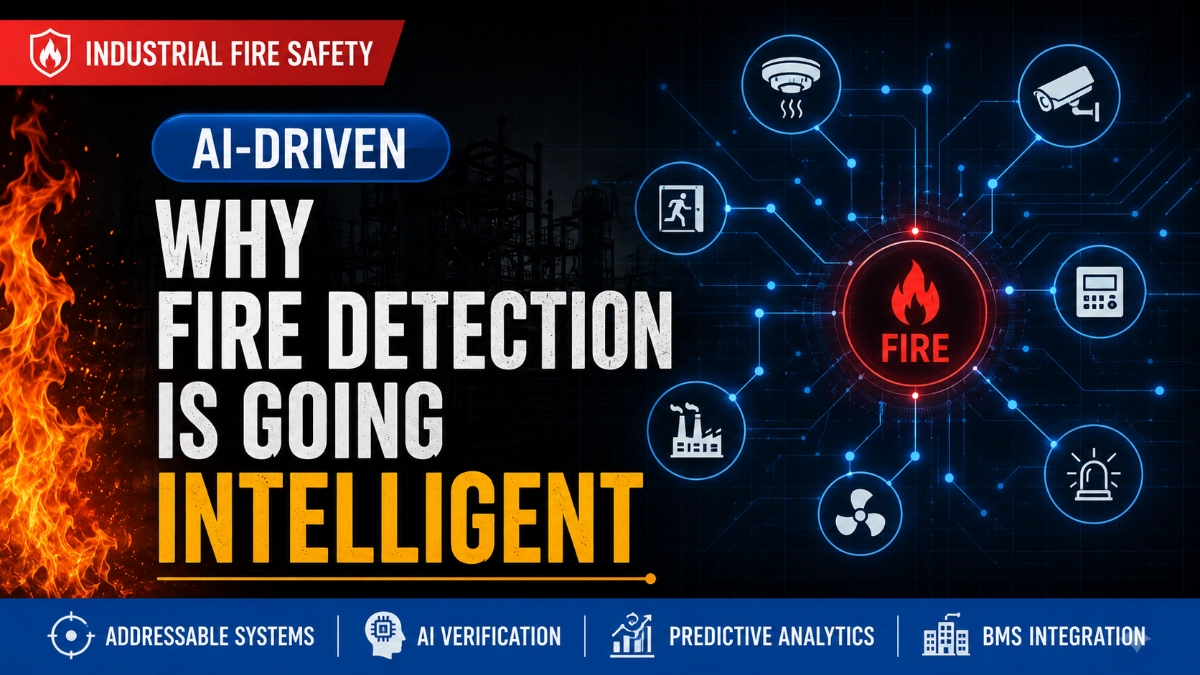
For decades, industrial fire alarm systems followed a predictable model: detect smoke or heat, trigger an alarm, alert occupants, and notify emergency services. This model worked reasonably well when facilities were simpler, processes were slower, and buildings operated in relative isolation. But those conditions no longer describe modern industrial environments.
Today, industrial facilities are deeply automated, highly interconnected, and increasingly complex. A single petrochemical campus may span dozens of buildings, integrate with SCADA systems, host thousands of process sensors, and operate continuously around the clock. A single missed detection or a poorly timed false alarm can cascade into multi-million-dollar losses, safety incidents, or regulatory breaches.
This is the reality driving a fundamental shift in how the industry thinks about fire detection. The question is no longer simply: how fast can we detect fire? It is: how intelligently can we detect, verify, respond to, and manage fire events across a complex, interconnected industrial environment?
The answer is intelligent fire detection infrastructure, a networked, data-driven, analytically capable ecosystem that elevates fire safety from a reactive alarm system to a proactive, operationally integrated layer of industrial intelligence.
What Is Intelligent Fire Detection Infrastructure?
Intelligent fire detection infrastructure is a networked fire safety ecosystem that goes far beyond detecting smoke or heat. It combines addressable technology, real-time data analytics, AI-assisted event verification, intelligent cause-and-effect logic, predictive maintenance diagnostics, and seamless integration with building and industrial management systems.
At its core, intelligent fire infrastructure replaces the traditional alarm-only model with a continuously active, data-generating, decision-supporting platform. Every detector, every panel, every communication node becomes a source of operational intelligence, not just an alarm trigger.
| Definition Intelligent fire detection infrastructure: A networked, addressable fire safety ecosystem that combines real-time monitoring, AI-assisted event verification, predictive analytics, and integrated emergency response logic to deliver superior detection reliability, false alarm reduction, and operational continuity across complex industrial environments. |
How Traditional Fire Alarm Systems Operate
Conventional fire alarm systems relied on zone-based detection. A conventional fire alarm panel would receive a signal from a detection zone and activate an alarm, but it could not identify which specific detector triggered the event or why. Conventional detectors communicated in a binary way: alarm or no alarm. Fault identification was approximate at best.
This approach had significant limitations in industrial settings. A single wiring fault could take down an entire zone. False alarms from dust, steam, or process emissions were common and difficult to filter. Maintenance teams had no way to remotely monitor detector health or predict failures before they occurred. And when an alarm did trigger, the system offered no intelligent guidance on how to respond beyond a generic evacuation signal.
Why Traditional Fire Detection Models Are Failing in Modern Industry
Modern industrial environments have evolved far beyond what conventional fire alarm architecture was designed to handle. Several converging factors make traditional detection models increasingly inadequate.
1. Escalating Environmental Complexity
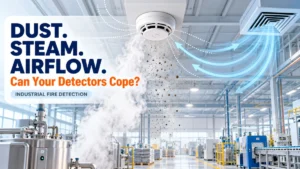
Industrial processes today generate a wide range of airborne particles, aerosols, gases, and thermal variations that conventional detectors struggle to differentiate from genuine fire signatures. In manufacturing environments with high particulate loads, food processing facilities with steam and grease, or pharmaceutical plants with chemical vapours, traditional smoke detectors generate an unacceptable volume of false alarms.
2. Scale and Multi-Building Operations
A modern industrial campus may include dozens of individual buildings, each with its own process areas, storage zones, utility rooms, and control centres. Conventional fire alarm systems cannot coordinate effectively across these environments. Each panel operates in isolation, making campus-wide emergency management impossible without intelligent networking.
3. Integration Gaps
Industrial facilities increasingly rely on Building Management Systems (BMS), SCADA platforms, and industrial automation networks to manage their operations. Conventional fire alarm panels offer no meaningful integration with these systems. When a fire event occurs, there is no automatic coordination with HVAC damper controls, production line shutdowns, access control systems, or emergency communication platforms.
4. Maintenance Blind Spots
Without remote monitoring and diagnostics, conventional fire alarm systems depend entirely on periodic manual inspections. Detector contamination, wiring degradation, and battery failures often go undetected between inspection cycles, creating dangerous gaps in fire detection coverage.
5. Compliance and Audit Burden
Regulatory frameworks for industrial fire safety are becoming more stringent. Manual log-keeping and paper-based inspection records are increasingly difficult to defend during audits. Compliance-driven organisations need automated, timestamped, digital audit trails that conventional systems simply cannot generate.
Intelligent Fire Infrastructure: Core Capabilities
Networked Addressable Fire Alarm Systems
The foundation of intelligent fire infrastructure is the addressable fire alarm panel. Unlike conventional panels that communicate zone-level signals, an addressable fire alarm panel communicates individually with each device on its loop. Each addressable detector, module, and sounder has a unique address, enabling the panel to identify precisely which device has triggered and exactly where it is located within the facility.
Multiple addressable fire alarm panels can be networked together across a campus using high-speed data loops or Ethernet-based infrastructure. This creates a unified fire alarm network where every device across every building is visible from a single management interface.
Real-Time Event Synchronisation
In a networked intelligent fire system, alarm events, fault notifications, and maintenance alerts propagate in real time across the entire network. A fire event detected in Building 3 of an industrial campus instantly notifies the central monitoring station, the site emergency coordinator, the local fire brigade interface, and the BMS simultaneously. Event data is timestamped, logged, and accessible for immediate review.
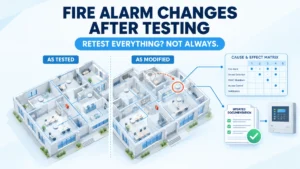
Intelligent Cause-and-Effect Programming
One of the most powerful features of intelligent fire infrastructure is programmable cause-and-effect logic. Rather than simply triggering a generic alarm, the system can execute a precisely defined sequence of actions based on the specific detection event, its location, and the facility’s operational state.
For example, a fire detection event in a pharmaceutical cleanroom might automatically trigger: isolation of the HVAC zone, activation of clean agent suppression, evacuation of the affected floor only, notification to the site fire team, and suspension of the production line, all within seconds, without human intervention.
AI-Assisted Fire Event Verification
Modern intelligent fire systems increasingly incorporate AI-assisted verification algorithms that analyse detector signals before confirming an alarm. Multi-criteria detection combining smoke, heat, CO, and optical signals from addressable detectors enables the system to cross-reference multiple data points and distinguish genuine fire signatures from nuisance sources.
AI-assisted verification dramatically reduces false alarm rates without slowing genuine alarm response. In environments like data centres, airports, and pharmaceutical facilities, where false alarms carry high operational costs, this capability alone justifies the transition to intelligent infrastructure.
Predictive Maintenance and Detector Health Monitoring
Intelligent fire systems continuously monitor the health status of every connected device. Addressable detectors report contamination levels, sensitivity drift, communication quality, and battery status in real time. The system flags devices approaching failure thresholds before they fail, enabling predictive maintenance that eliminates the surprise faults that compromise conventional systems.
Maintenance teams receive automated work orders, location-specific device status reports, and replacement scheduling recommendations, all without manual inspection rounds. This capability is transformative in large industrial facilities where manual inspection of thousands of devices is logistically challenging.
Multi-Building Fire Coordination
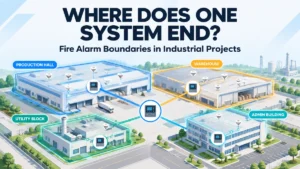
Intelligent fire infrastructure enables coordinated fire management across multi-building industrial campuses. Networked addressable fire alarm panels share event data, trigger coordinated evacuation sequences, and manage interdependent cause-and-effect actions across building boundaries. A fire in one building can automatically trigger lockdown of adjacent hazardous areas, reroute escape paths, and notify building-specific response teams, all driven by pre-programmed intelligent logic.
Integration with BMS and Industrial Automation
Intelligent fire infrastructure is designed to integrate with Building Management Systems, industrial SCADA platforms, and process automation networks. Through open protocol interfaces BACnet, Modbus, OPC-UA, and proprietary integration gateways, fire events can directly control HVAC systems, process shutdowns, emergency lighting, access control, and suppression systems.
This integration eliminates the dangerous gap between fire detection and operational response that exists in conventional isolated systems. The entire facility responds intelligently to a fire event, not just the fire alarm system.
Smart Evacuation Workflows
Conventional fire alarms evacuate everyone, everywhere, all at once. Intelligent fire infrastructure enables staged, zone-specific evacuation driven by the location and nature of the detected event. Voice evacuation systems with pre-recorded and live-announcement capability, combined with addressable zone control, allow emergency coordinators to direct occupants precisely and avoid unnecessary panic or operational disruption.
Cloud-Connected Monitoring and Remote Supervision
Cloud-connected fire infrastructure platforms enable authorised supervisors, maintenance teams, and remote monitoring centres to access complete system status from any location. Real-time dashboards display device health, event history, active alarms, and maintenance schedules across single or multiple sites.
For organisations managing fire safety across multiple industrial facilities, oil refineries, logistics networks, and manufacturing chains, cloud-connected monitoring creates a unified operational picture that was previously impossible to achieve.
Edge-Based Fire Analytics
In addition to cloud connectivity, modern intelligent fire infrastructure incorporates edge-based analytics capabilities. Processing fire event data at the panel or gateway level rather than relying solely on cloud-based analysis reduces latency, ensures reliable operation even during network outages, and enables faster local decision-making.
Redundant Communication Architecture
Mission-critical industrial facilities cannot tolerate communication failures in their fire detection network. Intelligent fire infrastructure is designed with redundant loop architecture, dual communication pathways, and failover protocols that ensure fire alarm signals reach their destinations even if a primary communication path fails. Class A loop wiring, redundant network switches, and dual-path cellular and Ethernet monitoring connections all contribute to system resilience.
Intelligent Zoning and Segmentation
Rather than broad, undifferentiated zones, intelligent fire systems implement granular detection zones aligned with operational areas, process equipment groupings, and fire compartment boundaries. This precision enables more accurate event location, more targeted response actions, and more meaningful alarm management.
Conventional vs. Intelligent Fire Infrastructure: Comparison
The following table summarises the key differences between conventional industrial fire alarm systems and modern intelligent fire infrastructure.
| Feature | Conventional System | Intelligent Infrastructure |
| Detection Logic | Zone-based, binary alarm | Addressable, multi-criteria AI-verified |
| Event Data | Alarm/fault only | Rich event logs, analytics, trends |
| False Alarm Handling | High false alarm rates | Intelligent cross-verification reduces false alarms |
| Maintenance | Manual periodic inspection | Remote diagnostics, predictive health monitoring |
| Integration | Standalone, isolated | BMS, SCADA, industrial automation integration |
| Scalability | Fixed panel capacity | Networked multi-panel, campus-wide architecture |
| Remote Access | On-site access only | Cloud-connected remote supervision |
| Evacuation | Generic sounders only | Smart evacuation with voice, zoning, sequencing |
| Redundancy | Single point of failure | Redundant loops, communication paths |
| Compliance Reporting | Manual log books | Automated audit trails and digital reports |
| Multi-Site Coordination | Not supported | Centralised multi-site fire management |
| Cybersecurity | Not applicable | Encrypted communication, access controls |
| Digital Twin Support | None | Integration-ready for digital twin platforms |
How Intelligent Infrastructure Changes Industrial Fire Safety Strategy
From Reactive to Proactive
Intelligent fire infrastructure fundamentally changes the orientation of industrial fire safety strategy. Rather than waiting for a fire to occur and then reacting, intelligent systems continuously monitor detector health, process environmental data, and identify deteriorating conditions before they escalate.
From Isolated to Integrated
Fire safety is no longer a standalone function. In intelligent infrastructure, fire detection is an integrated layer within the facility’s broader operational intelligence platform. Fire events inform production decisions, maintenance priorities, and emergency protocols across the entire organisation.
From Manual to Automated
Maintenance scheduling, compliance documentation, alarm verification, evacuation management, and response coordination are increasingly automated within intelligent fire platforms. This reduces the burden on facility teams, eliminates human error at critical moments, and creates verifiable, defensible records for regulatory compliance.
From Single-Site to Enterprise-Wide
Intelligent fire infrastructure supports enterprise-wide fire safety management. Industrial organisations with multiple sites, facilities, or campuses can centralise fire safety oversight, standardise detection configurations, and coordinate emergency response across their entire operational footprint from a unified management platform.
Practical Deployment Examples Across Industrial Environments
Manufacturing Facilities
In large-scale manufacturing plants, intelligent fire infrastructure integrates with production line automation to enable targeted equipment shutdown upon fire detection, preventing fire spread while preserving maximum production continuity. Addressable detectors throughout production areas, raw material stores, and finished goods warehouses provide granular coverage with predictive maintenance, reducing unplanned outages.
Oil and Gas Plants
Petrochemical environments present extreme fire and explosion risks. Intelligent fire systems in these settings combine multi-criteria flame and gas detection with cause-and-effect logic that triggers emergency isolation valves, initiates foam suppression systems, and coordinates evacuation across hazardous zones, all within precisely defined response timelines.
Warehouses and Logistics Hubs
High-rack storage facilities and logistics distribution centres require fire detection systems capable of covering vast floor areas with complex storage configurations. Networked addressable fire alarm systems with beam detectors, aspirating smoke detectors, and intelligent panel networks provide comprehensive coverage with centralised management and rapid alarm-to-response workflows.
Airports and Transport Infrastructure
Airports integrate intelligent fire infrastructure with passenger flow management, access control, and emergency communication systems. Intelligent cause-and-effect programming enables precise evacuation zone management, smoke control activation, and coordination with airport operations centres, minimising disruption while maximising safety.
Data Centers
Data centres demand near-zero false alarm rates to avoid costly emergency shutdowns. Intelligent fire systems with AI-assisted alarm verification, aspirating smoke detection (ASD) technology, and precise addressable detector networks minimise false activation risk while providing the earliest possible warning of genuine fire conditions.
Pharmaceutical Facilities
GMP-compliant pharmaceutical facilities require fire detection systems with full audit trails, validated performance records, and cleanroom-compatible detection technology. Intelligent fire infrastructure provides automated compliance reporting, contamination-resilient addressable detectors, and precise cause-and-effect coordination with cleanroom pressurisation and HVAC systems.
Power Plants
Power generation facilities manage high-voltage electrical equipment, cable tunnels, transformer bays, and fuel storage areas, all presenting distinct fire risks. Intelligent fire infrastructure segments these high-risk zones with independent detection networks while enabling cross-zone coordination for campus-wide emergency management.
Smart Industrial Campuses
Multi-building smart industrial campuses benefit from unified intelligent fire management platforms that consolidate fire alarm panels, BMS integration, and remote monitoring into a single operational interface. The GST fire alarm system and similar advanced platforms are purpose-built for this type of multi-panel, campus-wide intelligent fire management.
Operational Benefits of Intelligent Fire Detection
The shift to intelligent fire infrastructure delivers measurable operational benefits across every dimension of industrial fire safety performance:
- Detection Reliability: Detection reliability improves through multi-criteria sensor fusion, addressable device precision, and AI-assisted alarm verification.
- False Alarm Reduction: False alarm rates drop significantly through intelligent cross-verification, environmental compensation algorithms, and programmed nuisance source filtering.
- Response Coordination: Emergency response coordination is faster and more precise through automated cause-and-effect programming and multi-system integration.
- Operational Continuity: Operational continuity improves because targeted response logic minimises facility-wide shutdowns and unnecessary evacuations.
- Scalability: Infrastructure scalability is built into intelligent systems that expand seamlessly by adding panels, loops, and devices to the network.
- Maintenance Efficiency: Maintenance efficiency improves through continuous device health monitoring, predictive fault detection, and automated maintenance scheduling.
- Compliance Management: Compliance management is simplified through automated audit trails, digital inspection records, and real-time regulatory reporting.
- Firefighter Awareness: Firefighter situational awareness improves through graphical fire mimic displays, device-level alarm location data, and integrated emergency communication.
- System Resilience: System uptime and resilience improve through redundant communication architecture, failover protocols, and Class A loop wiring.
Cybersecurity Considerations in Connected Fire Infrastructure
As fire detection systems become increasingly networked and cloud-connected, cybersecurity must be treated as an integral design consideration, not an afterthought. Connected fire infrastructure that shares data with BMS platforms, cloud monitoring services, and industrial automation networks creates potential attack surfaces that require active management.
Key cybersecurity requirements for connected industrial fire systems include:
- Encrypted communication channels between panels, network nodes, and cloud monitoring platforms.
- Role-based access control for remote management interfaces and cloud dashboards.
- Network segmentation to isolate fire alarm networks from the general IT infrastructure.
- Firmware update protocols with digital signature verification.
- Audit logging of all configuration changes, remote access events, and system interactions.
- Intrusion detection at network gateways serving fire infrastructure connections.
Fire system integrators and facility managers should work with cybersecurity specialists to ensure that intelligent fire infrastructure meets both safety performance standards and cyber-resilience requirements, particularly in critical infrastructure sectors where cyber-physical threats are a recognised operational risk.
The Future of Industrial Fire Safety Infrastructure
AI-Driven Fire Analytics
Next-generation intelligent fire platforms will leverage AI-driven analytics engines that continuously process multi-sensor data streams to identify pre-fire conditions and environmental risk indicators before visible combustion begins. Machine learning models trained on historical fire event data will progressively refine detection sensitivity across facility-specific operational contexts.
Predictive Fire Intelligence
Predictive fire intelligence platforms will integrate fire system data with operational and environmental data streams, process temperatures, equipment vibration signatures, electrical load profiles, and atmospheric conditions, to generate predictive fire risk assessments. Facility managers will receive actionable risk intelligence before equipment failures or process deviations escalate into fire events.
Digital Twins for Fire Safety
Digital twin technology is beginning to transform fire safety planning and operations. A fire safety digital twin creates a dynamic, real-time virtual model of the facility’s fire detection network, fire compartment configuration, escape routes, and suppression systems. Fire engineers can simulate fire scenarios, test cause-and-effect programming logic, and validate emergency response plans within the digital twin before implementing changes in the physical facility.
IoT-Connected Fire Ecosystems
IoT-connected fire ecosystems will blur the boundary between traditional fire detection and broader operational sensing networks. Environmental sensors, occupancy detectors, wearable safety devices, and process monitoring instruments will feed data into unified fire intelligence platforms, enriching fire risk assessment with a far broader operational picture than fire-specific sensors alone can provide.
Autonomous Emergency Coordination
As AI capability in industrial fire systems matures, autonomous emergency coordination will become increasingly viable. Intelligent fire platforms will make real-time decisions about evacuation sequencing, suppression system activation, utility isolation, and resource deployment without waiting for human authorisation, reducing emergency response times from minutes to seconds.
Cloud-Native Fire Monitoring
Cloud-native fire monitoring platforms will enable instant, enterprise-wide visibility of fire system status across unlimited sites and geographies. Fire safety managers, compliance officers, and emergency coordinators will access live dashboards, predictive health reports, and regulatory audit tools from any device, anywhere in the world.
Cyber-Physical Fire Infrastructure Integration
The integration of cyber and physical fire safety systems will deepen as industrial facilities adopt smart infrastructure at scale. Fire detection will become a fully embedded layer of the cyber-physical operational environment, sharing data, responding to operational state changes, and contributing to enterprise-wide risk intelligence platforms in real time.
Deployment and Maintenance Recommendations
For facility managers, fire safety consultants, and system integrators planning intelligent fire infrastructure deployments, the following practical recommendations apply:
- Conduct a thorough site risk assessment that maps fire hazard zones, process areas, escape routes, and BMS integration requirements before specifying detection technology.
- Specify addressable fire alarm panels and addressable detectors as the baseline technology for all new industrial fire detection projects, reserving conventional fire alarm panels only for genuinely simple, low-risk auxiliary applications.
- Design cause-and-effect logic in consultation with facility operations teams to ensure automated response actions are operationally validated and aligned with emergency response plans.
- Plan for scalability from the outset, select intelligent fire platforms with sufficient network capacity, loop expansion capability, and integration headroom to accommodate future facility growth.
- Establish a remote monitoring and maintenance programme using the cloud-connected capabilities of the intelligent fire platform to move from reactive to predictive maintenance cycles.
- Integrate cybersecurity requirements into fire system design specifications from the beginning of the project, not as a post-installation addition.
- Develop digital audit trails from day one, ensuring the intelligent fire system captures timestamped inspection records, test results, and maintenance logs in a format suitable for regulatory submission.
- Plan for regular cause-and-effect logic review cycles as facility operations evolve, ensuring emergency response programming remains aligned with current process configurations.
Read Also: Fire Alarm Network Segmentation Strategy for Mega Industrial Facilities
Read Also: Real-Time Fire Event Synchronisation Across Multiple Buildings