Buildings grow. Organizations expand. What starts as a modest warehouse or a single-floor office can evolve into a sprawling multi-wing facility over time. Yet fire alarm systems are often installed with only the present in mind, not the future.
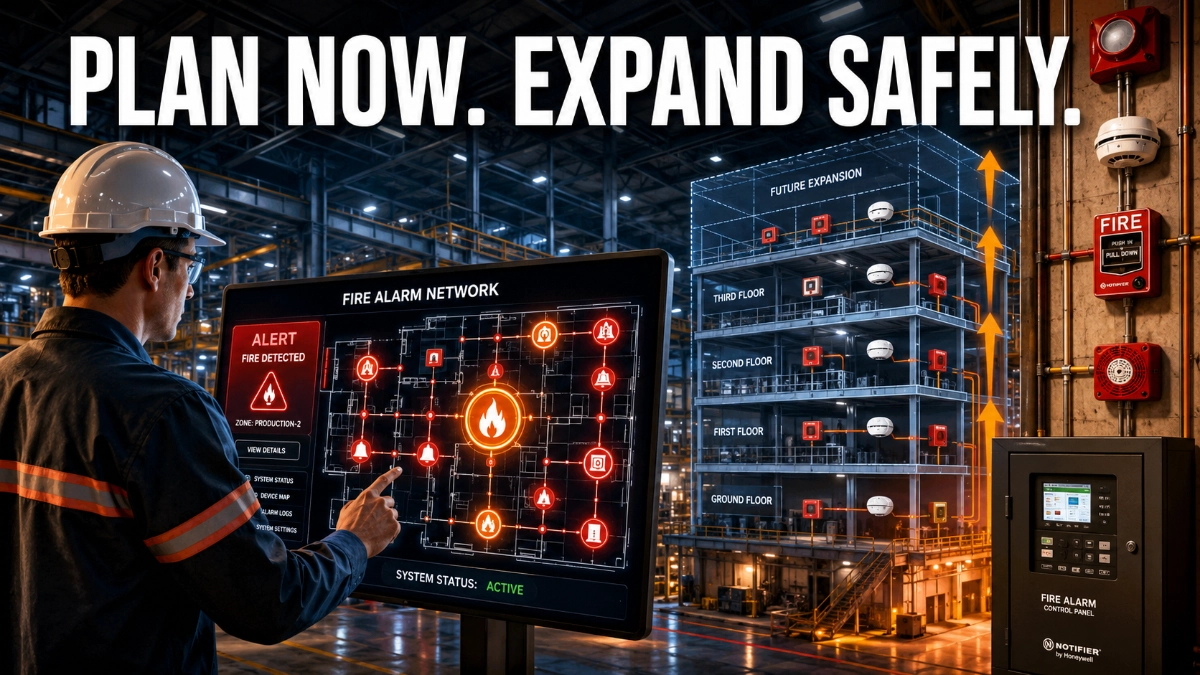
When expansion occurs without a scalable fire protection strategy, facility managers face a painful choice: either disrupt operations for a full system overhaul or risk operating with a patchwork of incompatible components that fail to meet modern safety codes.
This guide helps facility managers, safety consultants, project engineers, and building owners understand why scalability must be built into fire alarm planning from day one and how to make decisions that protect both people and long-term investment.
What Does Fire Alarm System Scalability Mean?
Fire alarm system scalability refers to a system’s ability to grow, adapt, and integrate new components without replacing the entire infrastructure.
A basic installation connects detectors, sounders, and a control panel to protect a fixed area. A scalable system does all of that and also supports additional devices, expanded loop capacity, new communication protocols, and remote monitoring as the facility evolves.
Think of it as the difference between building a dead-end road versus building a highway with on-ramps already designed into the blueprint.
Why Future Expansion Should Be Considered During Initial System Design
The most expensive fire alarm upgrade is the one you didn’t plan for. Here are the key reasons to think ahead at the design stage:
- Building extensions: A manufacturing plant may add a new production wing. Without expansion-ready architecture, adding detection coverage requires a new standalone panel, creating integration headaches.
- Increased occupancy: A school campus that adds student housing, or a hospital expanding its ward capacity, needs more alarm zones and more addressable detectors, ideally on the existing loop.
- Additional floors: Multi-storey developments that phase construction across years must have control panels with sufficient loop capacity to absorb each new level.
- New departments or functions: A commercial complex adding a food court or data centre needs zone-specific detection types, such as heat detectors, aspirating systems that should slot into the existing architecture.
- Regulatory updates: Fire safety codes evolve. Systems installed today must accommodate future compliance requirements without full replacement.
- Technology upgrades: Cloud-based monitoring, smart building integration, and predictive analytics are rapidly becoming standard. Scalable systems can adopt these without hardware replacement.
Key Components That Affect Scalability
Not all fire alarm components are created equal when it comes to future growth. Here is what to evaluate:
- Control panels: The panel is the brain of the system. Choose panels such as an addressable fire alarm panel with high device capacity and software-upgradeable firmware.
- Detection devices: Addressable detectors allow individual device identification and flexible placement, unlike conventional detectors that only report by zone.
- Loop capacity: Each loop can support a finite number of devices. Ensure the system supports multiple loops or expansion cards.
- Network architecture: Peer-to-peer or networked panel configurations allow multiple buildings to share a single management system, which is essential for industrial parks and educational campuses.
- Communication protocols: Open-protocol systems are compatible with third-party devices and future integrations. Proprietary systems can lock you into a single vendor.
- Power requirements: Larger systems need greater power supply capacity. Plan cabling and power distribution to accommodate additional loads from day one.
- Monitoring integration: Systems that support remote monitoring platforms, BMS integration, and cloud dashboards provide long-term operational value.
Risks of Choosing a Non-Scalable Fire Alarm System
A system that cannot grow with your building creates compounding problems:
- Higher upgrade costs: Replacing an entire panel, rewiring zones, and retraining staff costs significantly more than expanding an existing scalable system.
- Operational disruption: System changeovers require downtime. For hospitals, data centres, or 24/7 manufacturing plants, this is not just expensive, it is dangerous.
- Compatibility issues: Mixing legacy equipment with new components introduces failure points. A conventional fire alarm panel from a decade ago may not support modern addressable detectors or cloud interfaces.
- Compliance challenges: Non-scalable systems may fall out of code compliance when regulations change, exposing organisations to legal liability.
- Reduced return on investment: Every rupee spent on a replacement system is money that a scalable design would have preserved.
How Addressable Systems Support Future Growth
The clearest divide in scalability lies between addressable and conventional fire alarm systems. Here is how they compare:
| Feature | Addressable System | Conventional System | Scalable Verdict |
| Device ID | Each device has a unique ID | Zone-level only | ✅ Addressable wins |
| Expansion | Add devices to the existing loop | New panel/zone required | ✅ Addressable wins |
| Fault Isolation | Pinpoint accuracy | Zone-wide alert only | ✅ Addressable wins |
| Integration | BMS, cloud, remote access | Limited | ✅ Addressable wins |
| Initial Cost | Higher upfront | Lower upfront | ⚠️ Conventional, cheaper short-term |
A GST fire alarm system, for example, is built on an addressable architecture that supports multi-loop expansion, networked panel configurations, and integration with building management systems, making it a practical choice for facilities planning long-term growth.
Unlike conventional detectors, which report only a zone-level fault, addressable detectors identify the exact device in alarm. This precision simplifies fault diagnosis and speeds up emergency response, two factors that grow in importance as a building expands.
Real-World Expansion Scenarios
Manufacturing Plants
A plant installs an addressable system covering its main production floor. Three years later, a new assembly wing is added. The existing addressable fire alarm panel has unused loop capacity; technicians simply add new addressable detectors to the loop and update the software map. No new panel. No rewiring from scratch.
Hospital Campuses
A hospital expands from one building to a four-wing complex over a decade. A networked panel architecture means each new wing connects to the existing management system. Alarm data flows to a central monitoring station in real time, critical for quick evacuation decisions across a large site.
Warehouses and Logistics Hubs
High-bay warehouses that expand their footprint or add mezzanine levels need detection at multiple heights. Scalable systems accommodate beam detectors, aspirating systems, and standard smoke detectors on a single loop without separate panels for each section.
Educational Campuses
Universities that add student accommodation, sports centres, or teaching blocks need consistent alarm integration across all zones. A campus-wide networked system ensures that an alarm in one building triggers controlled responses campus-wide.
Commercial Complexes and Multi-Building Facilities
Shopping centres, business parks, and industrial parks benefit from peer-to-peer panel networking. Centralised monitoring across dozens of buildings reduces staffing requirements while improving emergency coordination.
Checklist: Questions to Ask Before Investing in a Fire Alarm System
Use this checklist during the procurement and planning phase:
- Does the control panel support future loop or zone expansion without hardware replacement?
- Is the system based on open protocols or proprietary standards?
- Can the panel network with other panels across multiple buildings?
- Does the system support both addressable detectors and conventional detectors within the same network?
- What is the maximum device count per loop, and does it cover 150% of current needs?
- Is remote monitoring and cloud integration available and certified?
- Does the supplier provide long-term firmware support and spare parts availability?
- Has the system been tested against applicable fire safety codes for your jurisdiction?
- Can the system integrate with existing building management or security systems?
- What is the total cost of ownership over 10–15 years, including expansion and maintenance?
Future Trends in Scalable Fire Protection
Fire alarm technology is evolving rapidly. Scalable systems position organisations to adopt these advancements without system replacement:
- Smart building integration: Modern addressable systems communicate directly with HVAC, access control, and lighting systems, enabling coordinated emergency responses that go beyond sound alerts.
- Remote monitoring: Facility managers can view real-time system status, receive fault alerts, and review event logs from a mobile device or centralised dashboard regardless of physical location.
- Predictive maintenance: AI-powered analytics can detect sensor drift or degradation before a device fails, reducing false alarms and preventing gaps in coverage.
- Cloud-based supervision: Cloud platforms aggregate alarm data from multiple sites, enabling centralised oversight for organisations managing geographically distributed facilities.
- Advanced analytics: Data collected from fire alarm systems feeds into broader safety intelligence platforms, helping organisations identify patterns, reduce risk, and meet ESG reporting requirements.
| IN SHORT: A scalable fire alarm system grows with your building instead of holding it back. By choosing addressable architecture, open protocols, and expansion-ready control panels at the outset, facility managers avoid disruptive overhauls and protect long-term safety investment. The best time to plan for expansion is before installation, not after. |
Conclusion
Fire safety is not a static commitment. Buildings evolve, occupancy grows, regulations change, and technology advances. A fire alarm system that cannot keep pace with these realities becomes a liability rather than an asset.
Planning for scalability at the design stage is the single most cost-effective decision a facility manager or project engineer can make. It preserves investment, reduces operational disruption, maintains compliance, and most importantly, protects the people inside.
Whether you are securing a single warehouse or designing fire protection for a sprawling industrial park, the principles are the same: choose expandable architecture, demand open protocols, and partner with suppliers who offer long-term system support.
GST fire alarm system solutions are designed with this philosophy, offering addressable architecture, multi-loop expansion capability, and integration-ready platforms that serve facilities at every stage of growth.
Read Also: The Growing Demand for Intelligent Fire Detection and Surveillance in India
Read Also: Why Most Industrial Facilities Are Upgrading Their Fire Alarm Infrastructure
Key Takeaways
- Scalability means a fire alarm system can grow without full replacement.
- Plan for at least 150% of the current device capacity during initial design.
- Addressable systems consistently outperform conventional systems for scalability.
- Non-scalable systems create higher long-term costs, compliance risks, and operational disruption.
- Open protocols, networked panels, and cloud integration are the hallmarks of a future-ready system.
- Real-world facilities from hospitals to industrial parks benefit significantly from scalable fire alarm architecture.