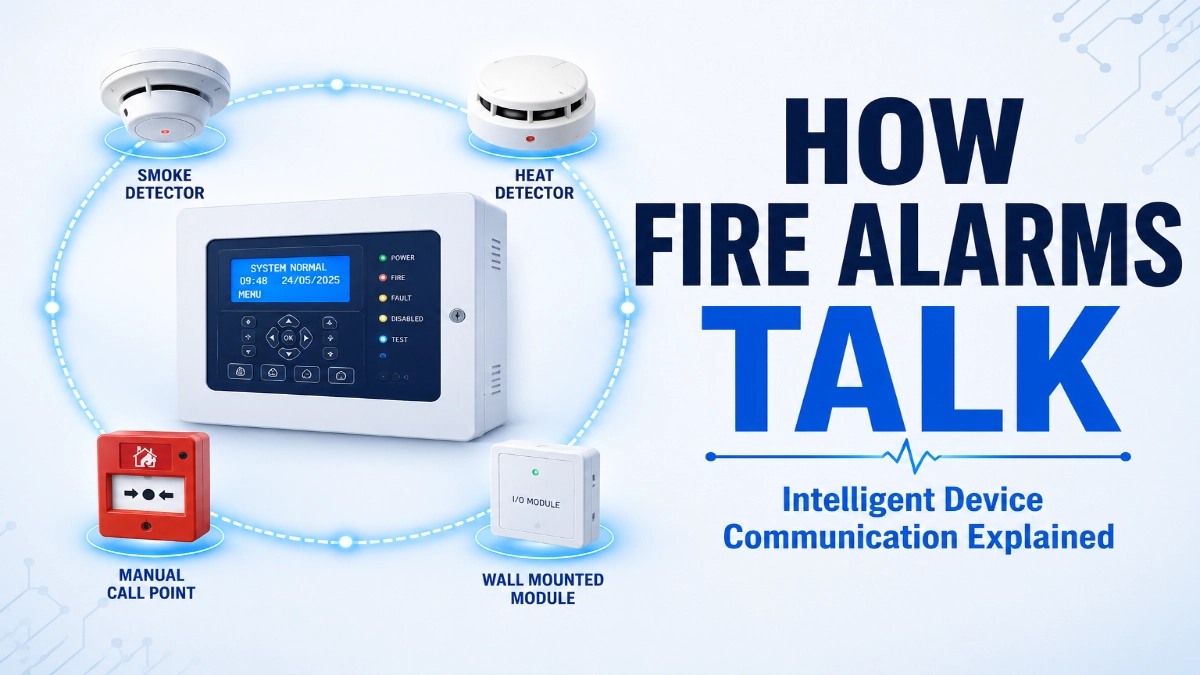
When a smoke detector activates, the fire alarm control panel doesn’t simply receive an alarm signal; it begins a continuous exchange of intelligent information. Modern fire alarm systems rely on advanced communication among detectors, modules, and control panels to detect events, monitor device health, and improve emergency response. Understanding this communication is essential for anyone responsible for designing, specifying, or maintaining reliable fire protection systems.
Introduction
Every fire alarm system, at its core, is a communication network. The panel needs to know what is happening at every device, in every zone, at every moment, not just when smoke or heat crosses a threshold. This requirement has shaped the evolution of fire detection technology over the past four decades.
Conventional fire alarm systems wired detectors into zones with no individual identity. If a device activated or failed, the panel could only report the zone, leaving technicians to search dozens of devices to find the source physically. As buildings grew taller, more complex, and more critical to business continuity, this approach became impractical.
Intelligent, addressable communication solved that problem. Each device on a fire alarm loop is assigned a unique digital address, allowing the control panel to identify, monitor, and diagnose it individually. This is not a marketing distinction; it is a fundamental shift in how fire detection infrastructure operates, and it directly affects detection speed, false alarm reduction, and maintenance efficiency.
EST Fire Alarm Systems are a widely deployed example of this intelligent, addressable architecture in commercial and industrial applications. Rather than treating EST as a product to promote, this article uses it as a practical reference point to explain how intelligent device communication actually works, the addressing schemes, polling cycles, diagnostic reporting, and network design principles that engineers need to understand regardless of which manufacturer’s panel they specify.
By the end of this guide, you should have a clear, vendor-neutral understanding of why intelligent communication has become the standard for enterprise fire alarm systems, and how to apply that understanding to real design and maintenance decisions.
Intelligent device communication is the continuous digital exchange between addressable fire alarm devices smoke detectors, heat detectors, modules, and notification appliances and the fire alarm control panel. Each device carries a unique address, allowing the panel to poll it individually, verify its status, and receive precise alarm, fault, or supervisory data. This differs fundamentally from conventional zone-based wiring, where the panel only knows that something happened somewhere in a zone. Intelligent communication improves detection accuracy, shortens response time, simplifies troubleshooting, and supports large-scale, expandable fire detection infrastructure making it the standard approach for enterprise fire alarm systems, including platforms like EST Fire Alarm Panels.
What Is Intelligent Device Communication?
Intelligent device communication refers to the structured, two-way digital exchange of data between individual field devices and a fire alarm control panel over a communication loop. It rests on six core principles.
- Device addressing: Every smoke detector, heat detector, manual call point, monitor module, and control module on an intelligent fire alarm loop is programmed with a unique address similar to a house number on a street. The panel uses this address to communicate with that specific device and no other.
- Digital communication: Instead of a simple on/off electrical signal, intelligent devices exchange coded digital messages with the panel. This allows far more information to travel over the same pair of wires than a conventional system could ever carry.
- Continuous monitoring: The panel doesn’t wait for an alarm. It repeatedly checks in with every device on the loop, confirming that each one is present, powered, and functioning correctly.
- Device identification: Because each device has its own address, the panel can report precisely which detector, module, or call point triggered an event down to the exact location, not just a general zone.
- Status reporting: Devices report more than alarm conditions. They send back data on sensitivity levels, contamination, drift compensation, and general health.
- Event transmission: Alarms, faults, and supervisory conditions are transmitted as distinct, identifiable message types, so the panel and connected building systems can respond appropriately to each.
A useful analogy: a conventional fire alarm zone is like a landline party line where everyone on the circuit hears the same ring, and no one knows who’s actually calling. An intelligent loop is more like a modern network where every device has its own address and can be reached, questioned, and answered individually.
How Intelligent Fire Alarm Devices Communicate with the Control Panel
The communication process between an intelligent device and the fire alarm control panel follows a repeatable sequence. Understanding this sequence is essential for engineers designing or troubleshooting an addressable fire alarm system.
How Intelligent Communication Works: Step-by-Step Process Flow
- Device polling: The fire alarm control panel continuously and sequentially polls every device address on the loop, typically completing a full scan of the loop within a few seconds, depending on loop length and device count.
- Address verification: Each device responds with its unique address, confirming to the panel that it is present, powered, and communicating correctly.
- Status reporting: Along with its address, the device reports its current condition: normal, pre-alarm, fault, or supervisory.
- Alarm event transmission: If a detector crosses its alarm threshold, it transmits an alarm message tagged with its specific address, allowing the panel to pinpoint the exact device and location.
- Fault reporting: If a device is disconnected, damaged, contaminated beyond compensation limits, or otherwise malfunctioning, it reports a fault condition rather than a false alarm.
- Supervisory condition reporting: Devices monitoring auxiliary conditions (such as sprinkler valve position or water flow via a monitor module) report supervisory states distinct from fire alarms.
- System response: The panel processes the incoming data, activates the appropriate notification appliances, updates the building management system if integrated, and logs the event with a timestamp and device address for later review.
This cycle repeats continuously, which is why an intelligent fire alarm control panel can detect a wiring fault or a failed detector during routine operation long before an actual fire event would require that device to work.
Components Involved in Intelligent Communication
An intelligent fire alarm loop is a system of specialised components, each playing a distinct communication role.
Fire Alarm Control Panels
The fire alarm control panel is the central intelligence of the system. It manages polling cycles, interprets incoming data, prioritises alarm conditions, and coordinates the response across notification appliances and connected building systems. An EST fire alarm panel, for example, manages multiple communication loops simultaneously, each supporting a defined number of addressable devices.
Smoke Detectors
Addressable smoke detectors continuously report their sensitivity readings to the panel, not just binary alarm states. This allows the panel and maintenance teams to track gradual contamination or drift over time, which is a leading indicator of nuisance alarms before they occur.
Heat Detectors
Heat detectors report temperature-related data using the same addressable communication protocol, distinguishing between rate-of-rise and fixed-temperature alarm conditions and transmitting that distinction to the panel.
Manual Call Points
Manual call points (pull stations) are addressed individually as well, so activation of a specific call point is reported with its exact location, speeding up manual response and investigation.
Monitor Modules
Monitor modules translate conventional signals such as sprinkler flow switches, tamper switches, or third-party detection devices into the addressable communication protocol, allowing non-addressable equipment to participate in an intelligent loop.
Control Modules
Control modules perform the reverse function, receiving commands from the panel to activate external equipment such as fan shutdown relays, door releases, or elevator recall systems.
Notification Appliances
Horns, strobes, and speakers on an addressable notification circuit can be individually supervised and, in many designs, individually addressed, allowing the panel to confirm each device is functioning before it’s ever needed in an emergency.
Communication Loops
The fire alarm loop is the physical and logical backbone connecting all of these devices to the control panel. Loop design wiring topology, device count, and cable specification directly determine communication reliability and response time, which is why loop planning deserves careful engineering attention.
Conventional vs Intelligent Communication
| Criteria | Conventional Systems | Intelligent Addressable Systems |
|---|---|---|
| Device identification | Zone-level only | Individual device address |
| Fault detection | Limited; often undetected until failure | Continuous automatic self-diagnostics |
| Expansion capability | Requires new zone wiring | Devices added to existing loop within capacity |
| Diagnostics | Manual, device-by-device inspection | Remote diagnostics via panel or software |
| Maintenance | Time-consuming, trial-and-error | Precise, address-based troubleshooting |
| Reliability | Susceptible to undetected wiring faults | Continuous loop supervision |
| Response time | Zone-level response only | Device-specific, faster response |
| Scalability | Poor for large or evolving buildings | Well-suited to large, multi-building campuses |
| Operational efficiency | Higher long-term labor cost | Lower long-term maintenance cost |
This comparison illustrates why enterprise fire alarm systems in hospitals, data centres, airports, and large commercial campuses have largely moved toward intelligent, addressable fire detection infrastructure rather than conventional zone wiring.
Why Intelligent Communication Improves Fire Safety
- Faster event identification: Because each device reports its own address, the panel identifies the exact source of an alarm instantly, rather than a broad zone that may cover an entire floor.
- Accurate device location: Precise addressing means responding personnel and fire wardens can go directly to the affected area rather than searching an entire zone during an active event.
- Improved diagnostics: Continuous self-monitoring means degraded devices, dusty smoke detectors, damaged wiring, and disconnected modules are flagged as faults during normal operation, not discovered during an actual emergency.
- Reduced maintenance time: Technicians can identify the specific device requiring service from the panel or software interface, cutting troubleshooting time from hours to minutes in many cases.
- Better operational awareness: Facility managers gain visibility into system health trends, not just alarm events, supporting more informed maintenance planning.
- Reliable emergency response: Because notification appliances and control modules are supervised individually, the system can confirm that evacuation signals and life safety functions door releases, HVAC shutdown, elevator recall will actually activate when needed.
Real-World Applications
- Hospitals rely on intelligent communication to pinpoint alarm locations precisely, minimising disruption to patient care areas that don’t require evacuation while ensuring rapid response where it’s genuinely needed.
- Data centres depend on early, accurate fault and pre-alarm reporting to protect critical infrastructure without triggering unnecessary suppression events that could damage sensitive equipment.
- Manufacturing plants use intelligent loops to cover large, often hazardous floor areas where pinpointing an exact device address speeds up both detection and post-incident investigation.
- Commercial buildings benefit from simplified expansion as tenant spaces change, since new devices can typically be added to an existing loop without rewiring entire zones.
- Educational institutions use precise device addressing to support faster, more targeted emergency response across sprawling campus layouts.
- Warehouses with high ceilings and long detection runs benefit from loop-based diagnostics that reduce the need for physical inspection of hard-to-reach devices.
- Airports integrate intelligent fire alarm networking with broader building management systems, coordinating fire detection with public address, access control, and HVAC systems across enormous facilities.
- Hotels rely on individually addressed manual call points and detectors to manage large numbers of independent rooms and corridors efficiently.
Common Misconceptions About Intelligent Fire Alarm Communication
- “Intelligent systems are too complex.” In practice, intelligent systems simplify operation for end users. The complexity lives in the addressing and polling logic, which is transparent to facility staff who interact with a straightforward panel interface.
- “Addressable systems are only for large buildings.” While intelligent communication offers the greatest advantage in large or complex facilities, addressable panels are available in configurations suited to small and mid-sized commercial buildings as well.
- “More devices always slow communication.” Loop polling speed is primarily a function of loop design and device count relative to panel capacity, not an inherent limitation of intelligent communication itself. Properly engineered loops maintain fast polling cycles even with substantial device counts.
- “Intelligent systems require excessive maintenance.” The opposite is generally true. Continuous self-diagnostics reduce the need for manual, exploratory maintenance, since the system itself flags devices that require attention.
Best Practices for Designing Reliable Communication Networks
- Loop planning: Design loops with device counts well within panel capacity limits, leaving room for future expansion without requiring a new loop or panel.
- Device addressing: Maintain a clear, documented addressing scheme during installation and commissioning, so future maintenance teams can quickly correlate addresses with physical locations.
- Cable routing: Route loop wiring to minimise exposure to physical damage, electromagnetic interference, and environmental extremes, and follow manufacturer specifications for cable type and distance limits.
- Expansion planning: Anticipate future building modifications by leaving spare loop capacity and panel card slots during initial design, rather than retrofitting later.
- Redundancy considerations: For critical facilities, consider Class A (looped) wiring topology, which maintains communication even if the loop is cut at a single point, rather than Class B configurations alone.
- Periodic testing: Schedule regular functional testing of devices and communication paths in line with applicable codes and standards, not just visual inspection.
- Preventive maintenance: Use the diagnostic data intelligent devices already provide sensitivity drift and fault history- to plan maintenance proactively rather than reactively.
Future Trends in Intelligent Fire Alarm Communication
Intelligent device communication continues to evolve alongside broader building technology trends.
- AI-assisted diagnostics are beginning to analyse historical device data to flag anomalies before they become faults, extending the predictive value of existing self-monitoring capabilities.
- Predictive maintenance models use trend data from addressable devices to forecast when a detector is likely to require cleaning or replacement, reducing unplanned service visits.
- IoT integration is expanding how fire alarm data is shared with other building systems, extending intelligent communication principles beyond the fire alarm loop itself.
- Cloud-connected monitoring allows remote visibility into system status across multiple sites, which is particularly valuable for organisations managing distributed facility portfolios.
- Smart buildings increasingly treat fire detection infrastructure as one data source among many, feeding a unified operational picture alongside HVAC, security, and energy systems.
- Digital twins of building systems, including fire alarm networks, are emerging as tools for design validation and lifecycle management, allowing engineers to simulate loop performance before installation.
- Enterprise-wide life safety ecosystems are the logical endpoint of these trends: networks of intelligent devices, panels, and software working together across entire portfolios rather than single buildings.
Expert Recommendations
- For consultants: Specify addressable communication protocols and loop topology early in the design process, and document addressing schemes clearly for the owner’s long-term facility records.
- For engineers: Validate loop capacity and polling performance against manufacturer specifications during design, not after installation, to avoid costly rework.
- For facility managers: Use the diagnostic and status reporting features of intelligent devices actively, rather than treating the panel as an alarm-only interface. Trend data is a maintenance asset.
- For system integrators: Coordinate fire alarm control panel outputs with building management systems early, since intelligent communication protocols are designed to support this integration.
- For building owners: Factor loop expansion capacity into procurement decisions, particularly for facilities likely to undergo renovation, tenant changes, or phased construction.
Key Takeaways
- Intelligent device communication replaces zone-level guesswork with precise, individual device identification.
- Every addressable device on a fire alarm loop carries a unique digital address used for polling and reporting.
- Continuous polling allows faults and degraded devices to be identified before an emergency, not during one.
- Fire alarm control panels distinguish between alarm, fault, and supervisory conditions through distinct message types.
- Monitor modules and control modules extend intelligent communication to conventional equipment and building systems.
- Loop topology, particularly Class A versus Class B wiring, directly affects communication reliability during faults.
- Intelligent communication significantly reduces troubleshooting and maintenance time compared to conventional systems.
- Enterprise facilities such as hospitals, data centres, and airports rely on intelligent communication for both safety and operational efficiency.
- Proper loop planning and documented addressing schemes are essential for long-term system reliability and expansion.
- Emerging trends: AI diagnostics, IoT integration, and cloud monitoring are extending intelligent communication principles beyond the traditional fire alarm loop.
Intelligent device communication is not a peripheral feature of modern fire detection; it is the foundation that makes accurate detection, efficient maintenance, and scalable design possible. Systems built on this principle, such as EST Fire Alarm Systems, illustrate how addressable communication translates into practical, measurable advantages for enterprise fire protection. Engineers and facility teams evaluating fire alarm control panels, EST detectors and devices, or a qualified EST Fire Alarm System distributor in India should weigh these communication fundamentals as carefully as any other specification, since they ultimately determine how a system performs when it matters most.
Read Also: Edwards Fire Alarm Systems for Data Centres: Planning for Continuous Operations
Read Also: How Edwards Fire Alarm Systems Support Long-Term Infrastructure Planning