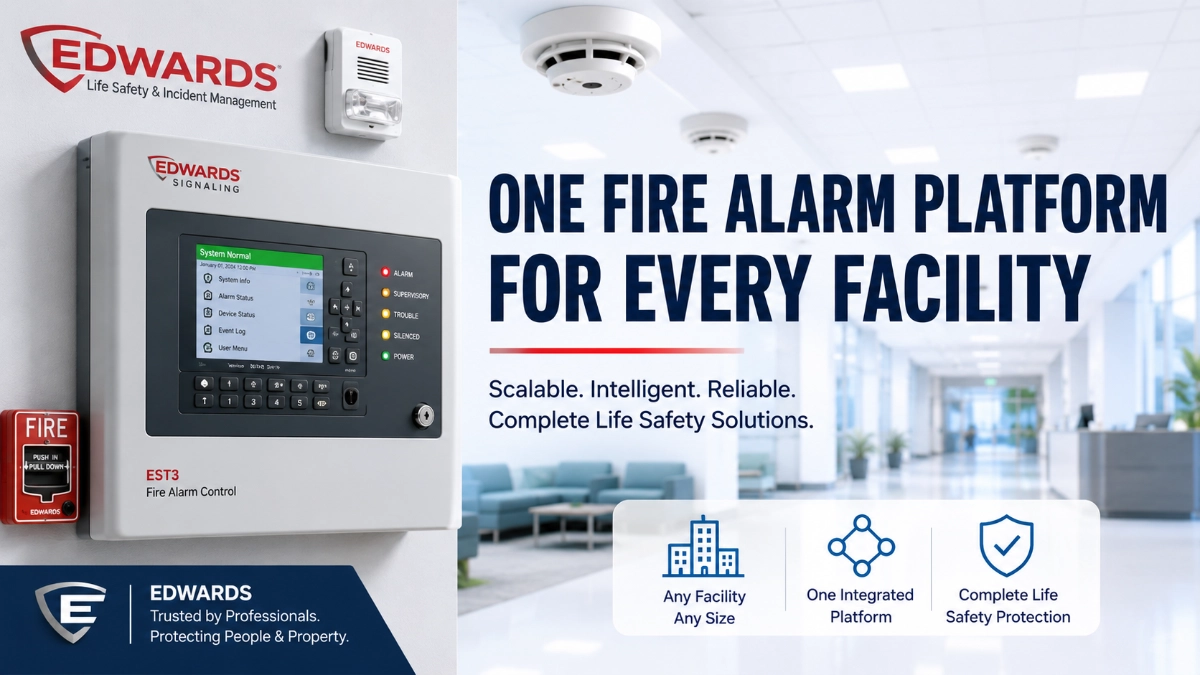
As organisations expand across multiple offices, factories, warehouses, hospitals, or campuses, managing different fire alarm systems from multiple manufacturers can create unnecessary complexity. Different control panels, different programming logic, different spare parts, and different service contracts turn a life safety function into a fragmented operational burden. Many enterprise organisations are now adopting a standardised fire alarm platform to simplify maintenance, improve operational consistency, and support long-term infrastructure planning.
Introduction
Large organisations rarely manage a single building. A hospital network operates across multiple wings and satellite clinics. A manufacturer runs several plants across different states or countries. A commercial real estate group manages dozens of leased and owned properties, each with its own history of renovations, tenant improvements, and vendor decisions. Over time, this growth often produces a patchwork of fire alarm systems: different brands, different generations of technology, and different service providers, each added because it was convenient at the time rather than because it fit a broader strategy.
This patchwork creates real operational friction. Facility teams must learn multiple programming interfaces. Spare parts inventories multiply. Testing and inspection procedures vary from site to site, making it harder to enforce a consistent life safety standard across the portfolio. When an incident occurs, response teams may be working with unfamiliar equipment, which adds risk during the moments that matter most.
Platform standardisation addresses this directly. Rather than treating each fire alarm installation as an isolated purchasing decision, enterprise organisations increasingly treat fire detection infrastructure as a long-term, portfolio-wide asset planned, budgeted, and maintained the same way they would plan a network backbone or a building management system. An intelligent enterprise fire alarm platform, deployed consistently across facilities, becomes part of the organisation’s broader life safety and business continuity strategy rather than a series of disconnected vendor relationships.
This article examines why that shift is happening, what operational and engineering advantages standardisation provides, and how consultants and facility leaders can evaluate whether it makes sense for their own portfolio.
Large organisations standardise on one fire alarm platform to reduce operational complexity, lower lifecycle costs, and maintain a consistent life safety standard across every facility. A single platform means fewer spare parts categories, one training curriculum for technicians, unified testing procedures, and centralized documentation for compliance audits. It also simplifies scalability, new buildings can be added to an existing fire alarm network using familiar devices and programming logic, rather than starting from scratch with an unfamiliar system each time.
What Does Fire Alarm Platform Standardisation Mean?
Standardisation does not mean replacing every existing fire alarm control panel overnight, and it does not mean locking into a single product line without room for updates. It means adopting one consistent fire alarm platform one architecture, one device ecosystem, one set of engineering standards as the default for new installations, major renovations, and system replacements across the organisation.
A few distinctions matter here:
- Standardisation vs. product replacement: Standardisation is a forward-looking policy, not a mandate to rip out functioning systems. Existing panels can often remain in service until end-of-life, while new work follows the standardised platform. Migration happens gradually, aligned with capital planning cycles.
- Platform consistency: A standardised platform means the same fire alarm control panel family, the same addressable devices, and the same programming conventions are used site to site. A technician trained at one facility can walk into another and recognise the system architecture immediately.
- Unified infrastructure: Standardisation extends to how panels communicate through consistent fire alarm networking protocols that allow multiple buildings on a campus, or multiple sites across a region, to be monitored from a common point.
- Common device ecosystem: Smoke detectors, heat detectors, manual call points, monitor modules, and control modules are drawn from the same compatible product family, which simplifies both installation and long-term servicing.
- Operational alignment: Testing schedules, inspection checklists, documentation formats, and technician certifications follow one methodology across the portfolio, rather than a different process for every site.
A practical example: a logistics company operating twelve distribution centres might have accumulated four different fire alarm brands over fifteen years of expansion. Standardising means every new distribution centre and every major upgrade at an existing one adopts a single enterprise fire alarm platform, such as an EST Fire Alarm System, so that the fire detection infrastructure across all twelve sites eventually converges on one architecture.
Why Large Organizations Prefer One Fire Alarm Platform
Simplified Maintenance
When every facility runs the same platform, maintenance contracts, service technicians, and troubleshooting procedures become interchangeable across sites. A service provider familiar with one location’s panel configuration can service another location without a learning curve. This reduces downtime during fault diagnosis and shortens the time between fault detection and resolution.
Consistent Training
Facility engineers and in-house technicians only need to master one system architecture. Instead of separate certification tracks for three or four different manufacturers, an organisation can build a single internal training curriculum. New hires reach competency faster, and cross-site staff transfers become far less disruptive.
Easier Spare Parts Management
A multi-vendor environment forces facility teams to stock overlapping but incompatible inventories of smoke detectors, heat detectors, modules, and notification appliances. Standardisation consolidates this into a single parts catalogue. A regional facilities team can hold a shared spares inventory that covers every site running the same platform, reducing both stockholding costs and emergency procurement delays.
Standardised Testing Procedures
Fire codes require periodic testing and inspection of every device on a fire alarm system. When each site runs different equipment, testing checklists, forms, and even the interpretation of test results can vary. A standardised platform allows one testing protocol to be applied consistently, which also makes it easier to benchmark testing time and cost across the portfolio.
Centralized Documentation
As-built drawings, device schedules, cause-and-effect matrices, and commissioning records are far easier to manage when they follow one format. Centralised documentation also supports faster audits, insurance reviews, and authority-having-jurisdiction (AHJ) inspections, since every site’s records follow the same structure.
Improved Operational Consistency
Perhaps most importantly, a standardised platform means life safety response, how the system behaves during an alarm, how it integrates with notification appliances, and how it interacts with building management systems are predictable across every site. Facility staff, security teams, and emergency responders encounter the same alarm behaviour wherever they are in the portfolio.
Business Benefits Beyond Fire Safety
Standardisation is often initiated by fire protection engineers, but its financial impact extends well beyond the life safety budget line.
- Reduced lifecycle costs: Consolidated maintenance contracts, shared spare parts inventories, and fewer specialised service vendors typically reduce the total cost of ownership over a system’s 15–20-year lifecycle, compared to managing several disconnected platforms.
- Procurement efficiency: Enterprise procurement teams can negotiate volume-based agreements with a single distributor or panel of qualified vendors, rather than running separate sourcing processes for each brand in use.
- Faster maintenance response: A technician dispatched to any site already understands the system, cutting diagnostic time and reducing the mean time to repair.
- Lower training costs: One curriculum, one certification path, and one set of reference materials replace the cost of training staff on multiple platforms.
- Better inventory control: Shared spares reduce both overstocking (holding parts for systems no longer in use) and understocking (missing a critical part for a rarely serviced legacy panel).
- Business continuity: For organisations where a fire alarm outage can affect operations a hospital, a data centre, a manufacturing line- a familiar, well-documented platform shortens the time to restore full system function.
- Long-term infrastructure planning: Capital planning teams can budget system replacements and expansions predictably, because every site follows the same replacement cycle and cost model, rather than negotiating each project as a one-off exercise.
A useful way to see this is a lifecycle cost comparison.
Lifecycle Cost Comparison Framework: Multi-Platform vs Standardised Platform
| Cost Category | Multi-Platform Environment | Standardized Platform |
|---|---|---|
| Technician training | Separate certification per brand, repeated per hire | Single curriculum, reusable across sites |
| Spare parts inventory | Multiple incompatible catalogues, higher holding cost | Shared catalogue, lower holding cost |
| Service contracts | Multiple vendors, variable SLAs | Consolidated vendor relationships, consistent SLAs |
| Documentation | Inconsistent formats across sites | Centralised, audit-ready format |
| System expansion | Often requires new design per site | Extends existing network architecture |
| Fault diagnosis time | Longer, due to unfamiliar systems | Shorter, due to system familiarity |
| Compliance audits | Site-by-site variation increases audit time | Uniform process reduces audit time |
This is a directional framework rather than a fixed formula; actual savings depend on portfolio size, facility age, and regional labour costs, but the pattern consultants observe consistently is that fragmentation adds cost at nearly every stage of the system lifecycle, not just at initial installation.
Engineering Advantages of Platform Standardisation
Beyond operations and cost, there are genuine engineering reasons enterprise organisations gravitate toward one platform.
Modular architecture: Modern addressable fire alarm control panels are built around modular hardware, expandable loop cards, network interfaces, and power supplies that allow a single panel family to scale from a small building to a large campus without a redesign.
Scalability: An enterprise fire alarm platform is typically designed to grow with the organisation. Additional loops, additional panels, and additional buildings can be added to an existing fire alarm network without replacing the core architecture.
Device compatibility: When every site draws from the same range of EST detectors and devices smoke detectors, heat detectors, manual call points, monitor modules, and control modules engineers can design new installations using known, tested combinations rather than re-validating compatibility for each project.
Intelligent diagnostics: Addressable systems report device-level status, allowing facility teams to identify a specific failing sensor rather than isolating a fault to a general zone. Standardised diagnostics tools make this consistent across the portfolio.
Networked communication: Multi-building fire alarm systems rely on robust networking between panels. A standardised platform simplifies this by using one consistent protocol and topology across sites, rather than requiring gateways or translation layers between mismatched systems.
Expansion flexibility: Because the underlying architecture is familiar, adding a wing to a hospital, a new production line to a factory, or an additional building to a campus becomes an extension project rather than a new system design.
Enterprise monitoring: Centralised monitoring from a security operations centre or a building management system is far more straightforward when every site reports through the same platform and protocol.
Platforms designed for this kind of scale, such as the EST4 or EST3 fire alarm panel families, or smaller-footprint options like the EST IO Series, illustrate how a single vendor’s product line can span from a standalone building to a large networked enterprise deployment. This is offered as a contextual example of how platform architecture supports standardisation, not as a claim that any single product suits every environment.
Industries That Benefit Most from Standardisation
Manufacturing
Plants often run continuous or near-continuous operations where an unplanned fire alarm outage affects production. Standardised platforms reduce downtime risk and allow maintenance teams to service multiple plants with one skill set.
Healthcare
Hospitals face some of the strictest life safety compliance requirements of any occupancy type. A consistent platform across wings, satellite clinics, and support buildings simplifies Joint Commission and AHJ inspections and ensures alarm behaviour is predictable in life-critical environments.
Airports
Airports combine terminals, concourses, cargo facilities, and administrative buildings under one authority. A standardised fire detection infrastructure allows centralised monitoring across a sprawling, high-occupancy environment.
Data Centres
Data centres require tightly integrated life safety and business continuity systems, often tied into building management systems and suppression controls. Standardisation reduces the risk of integration errors between fire alarm and critical infrastructure systems.
Warehouses
Large logistics networks add new distribution centres frequently. A standardised platform means each new facility can be commissioned faster, using proven designs and familiar equipment.
Universities
Campuses combine dozens of buildings of varying ages and occupancy types. Standardisation allows a central facilities department to manage life safety systems consistently, even as individual buildings are renovated on different timelines.
Commercial Campuses
Corporate campuses with multiple office buildings benefit from centralised monitoring and a single facilities team capable of servicing every building without vendor-specific training.
Hospitality
Hotel groups operating multiple properties benefit from consistent guest safety systems and simplified brand-wide compliance reporting, particularly when properties are added through acquisition or franchise agreements.
Potential Challenges and How to Overcome Them
Standardisation is a sound long-term strategy, but it is not without real-world obstacles.
- Legacy systems: Many organisations have functioning legacy panels with years of remaining service life. The practical approach is a phased migration tied to renovation cycles and panel end-of-life, not a forced replacement.
- Multi-vendor environments: Portfolios built through acquisitions often inherit several fire alarm brands at once. A facility audit (see the framework below) helps prioritise which sites to migrate first, typically starting with the highest-risk or highest-cost-to-maintain locations.
- Budget planning: Standardisation requires upfront investment even though it reduces long-term costs. Framing the transition as a multi-year capital plan, aligned with existing renovation and lifecycle replacement schedules, spreads the cost rather than requiring a single large outlay.
- Migration strategy: A clear sequencing plan which buildings migrate first and why prevents disruption and allows lessons learned at early sites to improve later rollouts.
- Staff training: Transitioning technicians from multiple legacy systems to one platform takes time. Building the training curriculum before the first major installation, rather than after, shortens the overall transition period.
- Expansion planning: Organisations sometimes standardise without leaving room for growth. Selecting a platform with proven scalability from the outset avoids a second migration a decade later.
A Consultant’s Framework for Selecting a Standardised Fire Alarm Platform
Consultants advising on enterprise-wide fire alarm strategy typically work through eight structured steps.
| Step | Focus | Key Questions |
|---|---|---|
| 1. Facility Audit | Inventory existing systems | What platforms, ages, and conditions exist across the portfolio? |
| 2. Risk Assessment | Identify highest-exposure sites | Which facilities carry the greatest life safety or business continuity risk? |
| 3. Infrastructure Review | Assess networking and power | What networking, wiring, and power infrastructure already exists? |
| 4. Scalability Evaluation | Confirm growth headroom | Can the platform support future buildings and expansions? |
| 5. Device Compatibility Assessment | Confirm device ecosystem breadth | Does the platform offer a full range of detectors, modules, and notification appliances? |
| 6. Lifecycle Cost Analysis | Model long-term cost | What is the projected 15–20-year cost versus the current fragmented approach? |
| 7. Maintenance Planning | Define service model | Will maintenance be in-house, outsourced, or hybrid across the portfolio? |
| 8. Future Expansion Strategy | Plan for new facilities | How will new sites be brought onto the standardised platform going forward? |
This framework is deliberately sequential: risk assessment should follow the facility audit, since it is difficult to prioritise migration without first knowing what exists. Consultants who skip the audit step often end up recommending standardisation in the abstract, without a concrete rollout sequence for the client to act on.
Future Trends in Enterprise Fire Alarm Standardisation
Several developments are shaping how enterprise organisations will approach fire alarm platforms over the next decade.
- Smart buildings: Fire alarm systems are increasingly expected to integrate with broader smart building ecosystems access control, HVAC, and building management systems rather than operating as an isolated life safety silo.
- AI-assisted diagnostics: Pattern recognition in device-level data is beginning to support earlier identification of failing sensors and nuisance-alarm sources, reducing false alarms and unnecessary truck rolls.
- Predictive maintenance: Rather than fixed-interval testing alone, data from networked panels is starting to inform condition-based maintenance schedules, prioritising attention where it is actually needed.
- IoT integration: Fire detection infrastructure is increasingly one node in a broader network of connected building sensors, sharing data with environmental monitoring and energy management systems.
- Cloud-based monitoring: Centralised, cloud-connected monitoring platforms allow facility and security teams to oversee multiple buildings from a single dashboard, regardless of physical location.
- Digital twins: Some enterprise organisations are beginning to model their fire detection infrastructure within digital twin environments, allowing engineers to simulate alarm behaviour and test system changes before deploying them in the field.
- Enterprise-wide life safety management: The long-term direction is toward treating fire alarm data as part of a unified enterprise risk and life safety dashboard, rather than a system that only becomes visible during an alarm event.
Enterprise Fire Alarm Standardisation Maturity Model
Organisations tend to move through four recognisable stages as they mature toward full standardisation.
| Stage | Characteristics | Typical Challenge |
|---|---|---|
| 1. Basic | Multiple brands, no coordinated strategy, site-by-site decisions | No visibility into portfolio-wide risk or cost |
| 2. Developing | Awareness of fragmentation, informal preference for one platform on new projects | Legacy systems still dominate; no formal migration plan |
| 3. Managed | Formal standardisation policy, phased migration plan in place | Execution pace limited by capital budget cycles |
| 4. Optimised | Majority of portfolio on one platform, centralised monitoring, predictive maintenance in use | Focus shifts to continuous improvement and new technology adoption |
Most large organisations sit somewhere between Developing and Managed. Reaching the Optimised stage typically takes multiple capital planning cycles, not a single project.
Multi-Site Fire Alarm Governance Checklist
- Maintain a current inventory of every fire alarm platform in use across the portfolio, including panel age and firmware version.
- Assign a single internal owner (or team) responsible for fire alarm strategy across all sites, not just individual building managers.
- Require new construction and major renovation projects to use the standardised platform by default.
- Maintain a shared spare parts inventory across geographically clustered sites.
- Standardise testing, inspection, and documentation templates across every facility.
- Review the migration roadmap annually against capital planning cycles.
- Track lifecycle cost data by site to validate and refine the standardisation business case over time.
- Build technician training into the standardisation plan from day one, not as an afterthought.
Decision Matrix: When Standardisation Makes Strategic Sense
| Organizational Trait | Standardization Value |
|---|---|
| Operates 3+ facilities | High |
| Facilities span multiple regions | High |
| Portfolio growing through new construction or acquisition | High |
| High regulatory scrutiny (healthcare, aviation, data centres) | High |
| Single-site organisation with no expansion plans | Low |
| Facilities near end-of-life with no renovation budget | Moderate – plan for next replacement cycle |
| Recently acquired portfolio with mixed legacy systems | High, but requires phased migration |
Top 10 Mistakes Organisations Make When Managing Multiple Fire Alarm Platforms
- Allowing each site to select vendors independently, with no portfolio-wide strategy.
- Failing to track which panels are approaching end-of-life across the portfolio.
- Maintaining duplicate spare parts inventories for incompatible systems.
- Training technicians on only one platform, then assigning them to sites running different systems.
- Treating documentation as a site-level responsibility instead of a centralised function.
- Underestimating the cost of emergency service calls for rarely used legacy platforms.
- Standardising on a platform without confirming its long-term scalability.
- Migrating sites in a random order instead of prioritising by risk.
- Excluding facilities teams from platform selection decisions made at the corporate level.
- Treating standardisation as a one-time project rather than an ongoing governance process.
Expert Recommendations
- For consultants: Begin every standardisation engagement with a facility audit, not a product recommendation. The audit determines the migration sequence; the platform choice should come after the risk picture is clear.
- For engineers: Design new installations with headroom for expansion. A panel sized exactly for current device count will require a costly upgrade the first time the building is renovated.
- For facility managers: Push for centralised documentation early. It is far easier to standardise records as systems are installed than to reconstruct them years later during an audit.
- For procurement teams: Evaluate total cost of ownership, not just unit price. A slightly higher panel cost is often offset many times over by lower training, spares, and service costs across a multi-site contract.
- For enterprise decision-makers: Treat fire alarm standardisation as part of broader enterprise infrastructure and business continuity planning reviewed alongside network infrastructure and building management systems, not siloed within a single facilities budget line.
Key Takeaways
- Fire alarm platform standardisation is a long-term infrastructure strategy, not a single purchasing decision.
- Multi-vendor environments increase training, spare parts, and documentation costs over a system’s lifecycle.
- A standardised platform simplifies maintenance by making every site familiar to any qualified technician.
- Centralised documentation speeds up compliance audits and AHJ inspections.
- Engineering advantages include modular architecture, scalability, and consistent device compatibility.
- Healthcare, aviation, data centres, and manufacturing see some of the highest returns from standardisation.
- Legacy systems don’t need to be replaced overnight; phased migration aligned with renovation cycles works best.
- A structured framework: audit, risk assessment, infrastructure review, scalability evaluation should precede any platform decision.
- Future trends point toward AI-assisted diagnostics, predictive maintenance, and cloud-based enterprise monitoring.
- Standardisation is most valuable for organisations operating three or more facilities, especially across multiple regions.
Read Also: Choosing Between Expansion and Replacement in Fire Alarm Modernisation
Read Also: Understanding Intelligent Device Communication in Edwards Systems