When a smoke detector activates inside a modern commercial building, far more happens than a simple alarm. Within seconds, doors may unlock, elevators return to the ground floor, HVAC systems shut down, smoke control fans activate, emergency messages begin playing, and responders receive precise location information. Behind this coordinated response is Cause-and-Effect programming, the intelligence that allows a fire alarm system to orchestrate life safety actions rather than simply ring a bell.
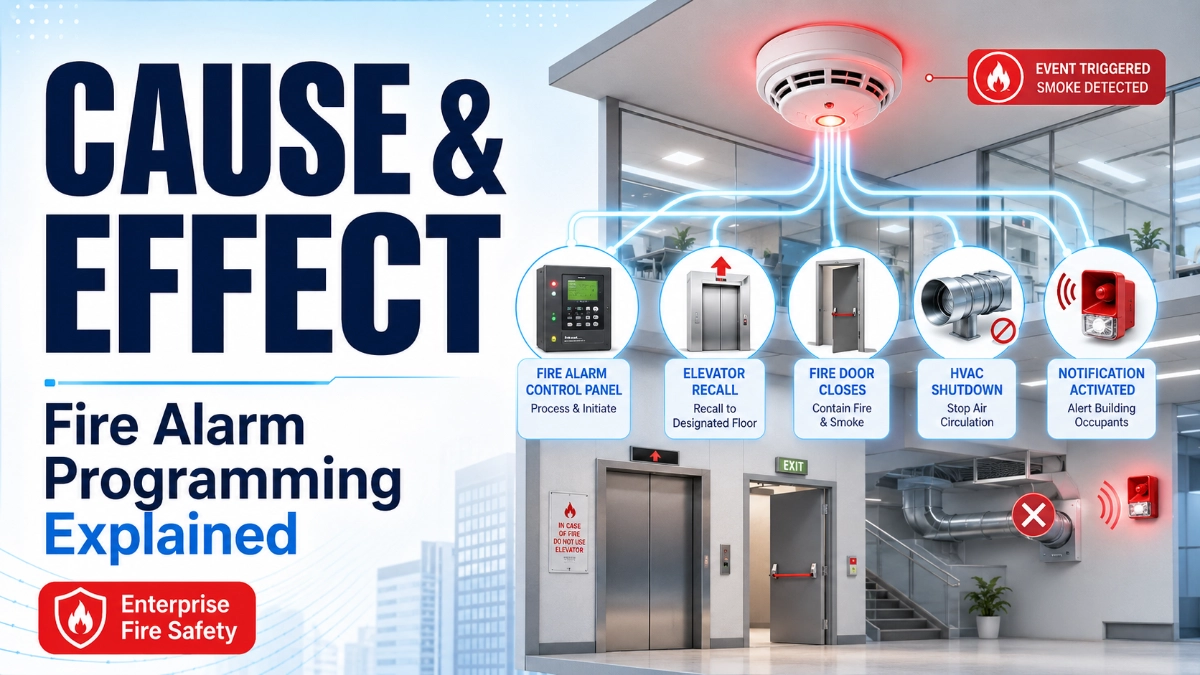
For engineers, consultants, and facility managers working with enterprise-scale buildings, hospitals, airports, data centres, and high-rises, understanding how Cause-and-Effect logic is designed, programmed, and validated is essential. It is the difference between a fire alarm system that merely detects a fire and one that actively manages the building’s response to it.
Cause-and-Effect programming is the logic layer inside an intelligent fire alarm control panel that defines how the system should respond when specific input events occur. A “cause” is a triggering event such as a smoke detector going into alarm, and an “effect” is the automated response, such as sounding notification appliances, releasing fire doors, shutting down HVAC, or recalling elevators. This logic is programmed device-by-device and zone-by-zone, allowing an addressable fire alarm system to execute a coordinated, building-specific emergency sequence instead of a single, undifferentiated alarm signal. In enterprise environments, Cause-and-Effect programming is what transforms a fire alarm control panel from a passive detection device into an active life safety management system.
Why Intelligent Fire Alarm Systems Require Programmable Logic
Conventional fire alarm systems were built around a simple premise: a device detects smoke or heat, and the panel sounds an alarm. There was no differentiation between zones, no sequencing, and no ability to trigger secondary building systems in a controlled way. For a small building, that simplicity was tolerable. For a hospital, airport terminal, or data centre, it is not.
Enterprise buildings have layered risks. A fire on one floor of a hospital may require a different response than the same event in a mechanical room. An alarm in an airport concourse may need to trigger smoke control fans in one zone while leaving adjacent zones in normal operation to support evacuation routes. This is why addressable fire alarm systems, where every device has its own identity on the fire alarm loop, evolved to include programmable Cause-and-Effect logic.
The evolution from conventional alarms to intelligent automation reflects a broader shift in fire protection engineering: life safety systems are no longer isolated. They are expected to interface with building management systems (BMS), elevator controllers, HVAC systems, access control, and voice evacuation systems. Cause-and-Effect programming is the mechanism that makes this interfacing possible in a predictable, testable, and code-compliant way.
What Is Cause-and-Effect Programming?
Cause-and-Effect programming is the configurable logic within an intelligent fire alarm control panel that links input events (causes) to automated output actions (effects). It allows engineers to define exactly which devices activate, in what sequence, and under what conditions, so the fire alarm system responds appropriately to the specific location and nature of an emergency rather than triggering a blanket, building-wide alarm every time.
At its core, Cause-and-Effect logic is a set of conditional statements: if this event happens, then these actions occur. In an intelligent fire alarm system, each initiating device a smoke detector, heat detector, manual call point, or monitor module has a unique address on the fire alarm loop. This addressability is what makes granular programming possible. Instead of the panel knowing only that “a device somewhere is in alarm,” it knows precisely which device, in which zone, on which floor.
The “effect” side of the logic is executed through output devices, notification appliances, relay modules, and interfaces to systems like smoke control, HVAC shutdown, and elevator recall. The programming defines the relationship between cause and effect, and it is this relationship, not the hardware alone, that determines how intelligently a building responds to fire.
This is also where platforms like the EST Fire Alarm System are commonly referenced as examples of enterprise-grade intelligent platforms, since panels such as the EST3 Fire Alarm Panel and EST4 Fire Alarm Panel are built around addressable architectures that support this kind of granular, zone-based Cause-and-Effect logic.
How Cause-and-Effect Programming Works
Cause-and-Effect logic follows a repeatable operational sequence inside the fire alarm control panel. Understanding this sequence helps engineers design logic that is both reliable and maintainable.
1. Event Detection
An initiating device, a smoke detector, heat detector, or manual call point, senses a condition that meets its alarm threshold and transmits a signal to the panel over the fire alarm loop.
2. Device Identification
Because the system is addressable, the panel identifies the exact device, its physical location, and its assigned zone. This precision is what separates modern intelligent fire alarm systems from older conventional zone-based panels.
3. Logic Processing
The panel’s programming engine evaluates the event against the Cause-and-Effect logic table. It checks for conditions, dependencies, and cross-zone rules; for example, whether a second detector in the same zone must also activate before certain effects (like full evacuation) are triggered.
4. Decision Making
Based on the programmed logic, the panel determines which outputs should activate, in what order, and with what timing. This may include staged alarm responses, such as an alert tone in the zone of origin followed by a general evacuation signal if the alarm is not acknowledged within a set time.
5. Action Execution
The panel commands the relevant output devices, notification appliances, relay modules, monitor module interfaces, and BMS integration points to execute their assigned functions. This can include HVAC shutdown, fire door release, elevator recall, and smoke extraction fan activation.
6. Continuous Monitoring
Throughout the event, the panel continues to monitor the fire alarm network for additional inputs, verifying device status and maintaining supervision of circuits and modules.
7. System Reset
Once the emergency condition is cleared and investigated, an authorised operator resets the system, returning all devices and outputs to normal supervisory status in accordance with the programmed reset sequence.
Common Cause-and-Effect Scenarios
The table below illustrates typical Cause-and-Effect relationships found in enterprise fire alarm programming. These are simplified examples; actual sequences depend on the building’s fire strategy, local code requirements, and approved cause-and-effect matrix.
| Cause (Trigger Event) | Effect (System Response) |
|---|---|
| Smoke detector activates | Notification appliances (horns/strobes) operate in the affected zone |
| Smoke detector activates in a return-air duct | HVAC shutdown for the associated air handling unit |
| Alarm confirmed in a zone | Elevator recall to the designated floor |
| General alarm condition | Fire doors release to allow controlled closure |
| Alarm in a stairwell pressurisation zone | Smoke extraction and pressurization fans start |
| Multiple detectors activate across zones | Voice evacuation message initiates building-wide |
| Waterflow switch activates | Alarm confirmation and sprinkler-zone notification |
| Manual call point operated | Full evacuation sequence begins per programmed logic |
Each of these scenarios can be adjusted in complexity. In a hospital, for instance, a “defend-in-place” strategy may mean the effect of a smoke detector activation is contained to a smaller zone with staged notification, rather than a building-wide alarm, to avoid unnecessary patient relocation.
Components Involved in Cause-and-Effect Programming
Cause-and-Effect logic connects several categories of devices and systems, each playing a distinct role.
Fire Alarm Control Panel: The processing core where Cause-and-Effect logic resides. It receives inputs, executes programmed logic, and commands outputs.
Smoke Detectors: Primary initiating devices for early fire detection, commonly the trigger for HVAC shutdown and notification sequences.
Heat Detectors: Used in areas where smoke detectors are unsuitable, such as kitchens or dusty industrial spaces, and programmed with their own cause-and-effect responses.
Manual Call Points: Human-activated initiating devices that typically trigger a more immediate, less conditional response, such as full evacuation.
Relay Modules: Provide the physical output interface that allows the panel to control external equipment such as fire dampers, door holders, and HVAC controllers.
Monitor Modules: Supervise external contacts (such as sprinkler tamper switches or waterflow switches) and feed their status back into the Cause-and-Effect logic as inputs.
Notification Appliances: Horns, strobes, and speakers that execute the audible and visual “effect” of an alarm condition.
Voice Evacuation Systems: Deliver pre-recorded or live emergency voice alarm messages, often staged by zone, floor, or building phase.
Building Management Systems (BMS): Receive signals from the fire alarm system to coordinate broader building responses, such as pressurisation systems, access control unlocking, and central monitoring dashboards.
Enterprise projects typically source these components: EST Smoke Detectors, EST Heat Detectors, EST Manual Call Points, EST Monitor Modules, EST Relay Modules, and EST Notification Appliances as part of a unified, listed device ecosystem under the broader category of EST Detectors and Devices, which is designed to work natively with the panel’s Cause-and-Effect engine.
Benefits of Cause-and-Effect Programming
- Faster emergency response: Automated sequencing removes the delay inherent in manual, human-triggered building responses.
- Reduced human intervention: Life safety actions occur automatically, reducing dependency on operators making correct decisions under stress.
- Better evacuation outcomes: Staged and zoned notification reduces panic and congestion compared to blanket, building-wide alarms.
- Improved property protection: Automated HVAC shutdown and smoke control limit fire and smoke spread, reducing damage to structure and contents.
- Operational reliability: Because the logic is pre-engineered and tested, the system behaves predictably during every real event, not just during drills.
- Better maintenance visibility: Well-documented Cause-and-Effect logic makes it easier for facility teams to diagnose issues, plan modifications, and maintain code compliance over the building’s lifecycle.
Engineering Best Practices
Designing Cause-and-Effect logic well requires more than technical knowledge of the panel; it requires disciplined engineering practice.
- Zoning: Define detection zones and effect zones based on the building’s fire strategy, not simply on floor plan convenience. Zoning drives almost every downstream programming decision.
- Device grouping: Group devices logically so that effects can be triggered by zone, floor, or functional area without excessive one-off programming exceptions.
- Redundancy: Critical effects such as elevator recall or stairwell pressurisation should have redundant triggering paths where practical, so a single device failure does not disable a life-safety function.
- Programming hierarchy: Establish a clear hierarchy of alarm conditions (alert, alarm, general alarm) so that effects escalate logically rather than triggering the most severe response on every event.
- Documentation: Maintain a formal cause-and-effect matrix as a living document, updated whenever the panel programming changes. This matrix should be treated as part of the fire strategy documentation, not just the programming file.
- Validation: Cross-check every programmed cause against its intended effect before commissioning, verifying against the approved fire strategy and local authority requirements.
- Acceptance testing: Conduct a full functional test of every cause-and-effect relationship, not just a sample, before building handover.
Fire Alarm Logic Design Framework
A structured approach to Cause-and-Effect design generally follows five stages:
- Fire Strategy Review: Understand the building’s approved fire and life safety strategy, including phased evacuation, defend-in-place zones, and smoke control philosophy.
- Zone Mapping: Translate the fire strategy into detection zones and effect zones on the fire alarm network.
- Cause-and-Effect Matrix Development: Document every input-to-output relationship in a structured matrix, including conditions, delays, and dependencies.
- Panel Programming: Translate the matrix into panel logic, using the programming tools of the intelligent fire alarm control panel.
- Validation and Commissioning: Test each relationship individually and in combination, confirming behaviour matches the documented matrix.
Common Programming Mistakes
Even experienced teams introduce errors into Cause-and-Effect logic. The most frequent issues include:
- Poor zoning: Zones that do not align with the building’s actual fire compartmentation lead to effects triggering in the wrong areas, or failing to trigger where needed.
- Overly complex logic: Excessive conditional layering makes the system difficult to test, document, and later modify, increasing the risk of unintended behaviour.
- Missing dependencies: Failing to account for cross-system dependencies such as a fire door release depending on a specific relay module status can leave critical effects unprogrammed.
- Incorrect priorities: When multiple events occur simultaneously, poorly defined priority logic can cause the system to execute a less critical effect while delaying a more critical one.
- Lack of documentation: Undocumented changes to panel programming create a gap between the as-built system and the approved fire strategy, complicating future maintenance and audits.
- No testing strategy. Commissioning without a structured, matrix-based test plan risks leaving errors undiscovered until a real emergency occurs.
Common Programming Errors and Their Operational Impact
| Programming Error | Operational Impact |
|---|---|
| Zones misaligned with fire compartments | Effects trigger in unintended areas or fail to activate where required |
| Excessive nested conditional logic | Difficult to troubleshoot; higher risk of unpredictable behaviour |
| Unprogrammed device dependency | Critical output (e.g., damper closure) fails to execute during real alarm |
| Undefined alarm priority | Lower-priority effect executes before a higher-priority life-safety action |
| No as-built documentation | Facility team cannot verify or safely modify system post-handover |
| Untested effect combinations | Conflicting outputs (e.g., pressurization vs. extraction) go unnoticed until an incident |
Real-World Example: Office Building Emergency Sequence
Consider a mid-rise commercial office tower. A smoke detector on the 12th floor activates:
- The panel identifies the exact device and zone (12th floor, east wing).
- Notification appliances sound an alert tone on the 12th floor and a pre-alarm indication on the floors immediately above and below.
- HVAC shutdown occurs for the air handling unit serving the 12th floor to prevent smoke migration through ductwork.
- Elevators serving that bank are recalled to the ground floor lobby, bypassing the 12th floor.
- If a second detector activates within a defined time window, the system escalates to a general alarm, and voice evacuation instructions begin building-wide, directing occupants to the nearest stairwell.
- Fire doors along the egress path release to allow controlled closing as occupants pass.
This staged response rather than an immediate building-wide evacuation from a single detector reflects a common Cause-and-Effect strategy for office towers, balancing rapid response with minimising unnecessary disruption from false or minor alarms.
Real-World Example: Hospital Emergency Sequence
A hospital’s fire strategy typically follows a “defend-in-place” or phased evacuation philosophy, since moving patients is high-risk. A smoke detector activates in a patient ward:
- The panel identifies the device and confirms the specific fire compartment (smoke zone) within the ward.
- A local alert notifies staff within the ward and adjacent nurse station, without sounding a public alarm that could cause panic among patients.
- Fire doors between smoke compartments release automatically, containing smoke spread without requiring evacuation.
- HVAC shutdown and smoke control activate for the affected compartment only.
- Elevators are recalled, but only bed-transport elevators may be reassigned for controlled horizontal patient movement between compartments, based on the hospital’s specific fire strategy.
- If fire is confirmed by a second detector or manual call point, escalation logic triggers wider notification and initiates the hospital’s phased evacuation protocol.
This example illustrates why Cause-and-Effect programming must be tailored to occupancy type; a logic set appropriate for an office building would be inappropriate and potentially dangerous in a hospital setting.
Industry Applications
- Hospitals rely on Cause-and-Effect logic to support defend-in-place strategies, smoke compartmentation, and controlled patient movement rather than immediate mass evacuation.
- Airports use zoned Cause-and-Effect programming to manage large open concourses, smoke control in atriums, and coordinated response across multiple interconnected buildings on a single fire alarm network.
- Data centres depend on precise, fast-acting logic to shut down non-essential HVAC, isolate affected zones, and interface with clean-agent suppression systems while protecting continuous operations elsewhere in the facility.
- Manufacturing facilities use Cause-and-Effect programming to isolate process equipment, shut down ventilation in specific process areas, and coordinate with industrial fire safety systems unique to hazardous operations.
- Warehouses apply zoned logic to manage large, open storage areas, often coordinating sprinkler zone confirmation with smoke extraction and notification sequencing.
- Universities use building-specific and campus-wide logic layers, since a networked fire alarm system may span dozens of buildings with different occupancy risks.
- Hotels rely on staged notification and elevator recall logic tailored to guest room corridors and public assembly areas.
- High-rise buildings depend heavily on phased evacuation logic, stairwell pressurisation sequencing, and floor-by-floor notification to manage large occupant populations safely.
Future of Cause-and-Effect Programming
Cause-and-Effect programming continues to evolve alongside broader trends in building technology.
- AI-assisted programming is beginning to support engineers in identifying gaps or inconsistencies in cause-and-effect matrices before commissioning, though final validation remains a human engineering responsibility.
- Predictive logic may eventually incorporate sensor trend data rather than only threshold-based alarms to adjust effect sequencing based on how quickly a condition is developing.
- Smart building integration is deepening the relationship between fire alarm systems and building management systems, allowing more granular, real-time coordination between life safety and building operations.
- IoT integration is expanding the range of inputs available to Cause-and-Effect logic, from environmental sensors to occupancy data.
- Cloud monitoring allows remote visibility into system status and event history, supporting faster diagnostics and more consistent maintenance across multi-building portfolios.
- Digital twins are increasingly used during design to simulate Cause-and-Effect sequences virtually before physical commissioning, reducing on-site testing time and catching logic errors earlier in the project lifecycle.
Expert Insights
- A cause-and-effect matrix is a fire strategy document first and a programming reference second; treat it with the same document-control rigour as structural or MEP drawings.
- The most common source of commissioning delays is not device wiring but undocumented changes made during panel programming that were never reflected in the matrix.
- Effect sequencing timing (delays between alert and general alarm) is often left at default values, when it should be deliberately engineered around occupant evacuation modelling for the specific building.
- Cross-zone dependencies are the leading cause of “it worked in testing but not in the real event” failures, because isolated zone testing does not reveal multi-zone interaction issues.
- Elevator recall logic is frequently under-tested because it requires coordination with the elevator contractor, not just the fire alarm integrator a scheduling gap that often gets missed.
- HVAC shutdown logic should be reviewed jointly with the mechanical engineer, since fire alarm programmers do not always have visibility into duct smoke detector placement rationale.
- Voice evacuation message content and sequencing deserve as much engineering attention as the trigger logic itself, since poorly worded staged messages can cause occupant confusion during phased evacuation.
- Redundant triggering paths for life-critical effects are often value-engineered out late in a project; this is one of the highest-risk cost-cutting decisions on a fire alarm scope.
- A cause-and-effect matrix should be versioned and tied to as-built drawings; mismatches between the two are a common finding during fire safety audits years after handover.
- Testing every individual cause-and-effect relationship is necessary but not sufficient; combination testing, where multiple causes occur close together, reveals the majority of real-world logic gaps.
Cause-and-Effect Decision Matrix
Use this simplified framework when scoping a new cause-and-effect design:
| Decision Point | Key Question | Engineering Consideration |
|---|---|---|
| Detection type | Which device type best suits this area? | Smoke vs. heat detection based on environment |
| Zone definition | Does this align with fire compartmentation? | Zoning must match architectural fire strategy |
| Escalation trigger | Single or multiple device confirmation? | Reduces false alarm impact vs. response speed |
| Effect scope | Zone-only or building-wide response? | Depends on occupancy type and evacuation strategy |
| System interface | Which external systems are affected? | HVAC, elevators, BMS, access control, smoke control |
| Priority handling | What happens if multiple events occur together? | Define escalation and override hierarchy |
| Reset condition | What must occur before system reset? | Investigation, clearance, and authorised reset procedure |
Key Takeaways
- Cause-and-Effect programming is the logic layer that connects fire alarm inputs to automated building responses.
- It transforms an intelligent fire alarm control panel from a detection device into an active life safety management system.
- Addressability is what makes granular, zone-specific Cause-and-Effect logic possible.
- Effects can include notification, HVAC shutdown, elevator recall, fire door release, and smoke control activation.
- Different occupancy types require fundamentally different Cause-and-Effect strategies; a hospital and an office tower should not share the same logic philosophy.
- A documented cause-and-effect matrix is a fire strategy artefact, not just a programming reference.
- Poor zoning and undocumented programming changes are among the most common sources of commissioning and audit failures.
- Redundancy for life-critical effects should not be treated as optional value engineering.
- Combination testing across multiple simultaneous events reveals gaps that individual device testing misses.
- As building technology evolves, Cause-and-Effect logic is increasingly integrated with BMS, IoT sensors, and digital twin simulation tools.
Cause-and-Effect programming is, in many respects, the most consequential engineering decision made on an enterprise fire alarm project. The hardware detectors, panels, modules, and notification appliances provide the physical capability. The logic determines whether that capability translates into a coordinated, life-saving response or a disorganised one. For engineers and consultants working on addressable fire alarm systems, treating Cause-and-Effect design with the same rigour as structural or life safety drawings is not optional. It is the foundation of a building’s actual emergency performance.
Read Also: Why Large Organizations Standardize on One Fire Alarm Platform
Read Also: Choosing Between Expansion and Replacement in Fire Alarm Modernisation