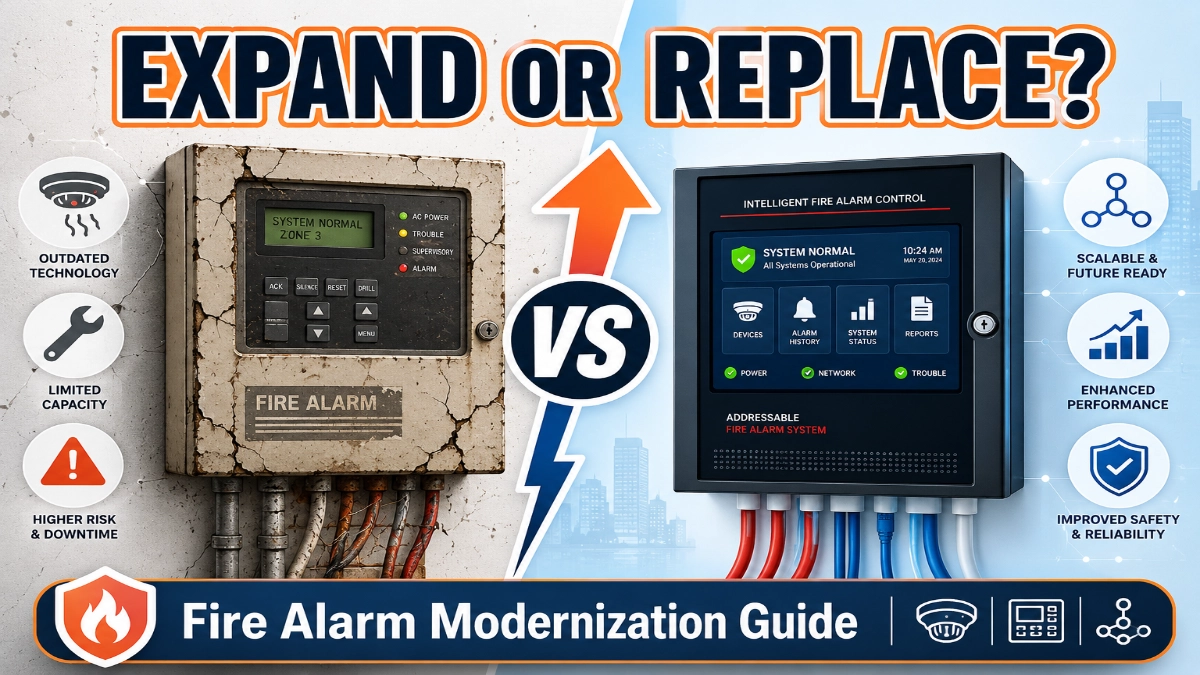
Many commercial and industrial facilities continue operating with fire alarm systems installed decades ago. While these systems may still function, growing buildings, changing occupancy patterns, evolving technologies, and long-term maintenance challenges often raise an important question: should the system be expanded or replaced entirely? The answer depends on far more than the age of the equipment.
Introduction
Fire alarm modernisation has become a pressing concern for facility managers, EPC contractors, and building owners across commercial and industrial sectors. As buildings grow, occupancy patterns shift, and safety expectations rise, the fire alarm systems installed years ago are increasingly asked to do more than they were originally designed for.
Ageing fire detection infrastructure creates real operational challenges. Discontinued components become harder to source. Panels reach the end of manufacturer support. Wiring topologies that once suited a single building no longer accommodate multi-building campuses or phased construction. Even when a system still “works,” it may no longer align with how the facility actually operates.
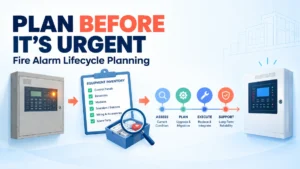
This is why modernisation decisions should never be based on equipment age alone. A ten-year-old panel with strong parts availability, adequate capacity, and a stable maintenance history may be an excellent candidate for expansion. A five-year-old panel from a discontinued product line may already be a replacement candidate. The right decision depends on a structured evaluation of condition, capacity, compatibility, and long-term lifecycle cost.
Intelligent, addressable fire alarm platforms such as EST Fire Alarm Systems are increasingly used as a reference point for this kind of long-term infrastructure planning, because their modular, network-capable architecture is designed to accommodate growth without requiring a full system replacement every time a facility changes. Understanding how these platforms are structured helps clarify what “expandable” actually means in engineering terms, and this article uses that framework to build a vendor-neutral decision-making guide.
Expansion is typically the right choice when the existing fire alarm control panel has spare capacity, the addressable devices remain supported, and the facility change is incremental, such as a new floor, wing, or production line. Replacement becomes the better option when the panel or devices are obsolete, spare parts are unavailable, fault rates are rising, or the facility requires capabilities the existing architecture cannot support. Most modernisation decisions fall between these extremes and require a structured technical and financial evaluation rather than a single rule of thumb.
Why Fire Alarm Modernisation Matters
Fire alarm modernisation sits at the intersection of life safety, operational continuity, and capital planning. Facilities that delay these decisions often do so because the existing system appears to be functioning normally, but “functioning” and “fit for purpose” are not the same thing.
- Ageing infrastructure: Conventional and early-generation addressable panels were engineered for the building loads and code requirements of their era. As components age, insulation degrades, contacts wear, and firmware falls out of support. The risk is not always sudden failure; it is often a slow decline in reliability that shows up as nuisance alarms or delayed fault detection.
- Facility expansion: New floors, wings, warehouses, or production lines add detection points that the original system may or may not have room for. Every addressable loop and panel has a finite device capacity, and exceeding it without proper planning leads to poorly engineered, unsupportable workarounds.
- Business continuity: For industrial plants and commercial facilities that cannot tolerate downtime, an unplanned fire alarm failure is not just a life safety issue; it can trigger occupancy restrictions, insurance complications, and production stoppages. Modernisation planned proactively avoids reactive, disruptive emergency replacements.
- Operational resilience: Modern facility teams increasingly expect fire detection infrastructure to integrate with broader building operations from Building Management Systems (BMS) to centralised monitoring, rather than operating as an isolated legacy subsystem.
- Technology evolution: Detector sensitivity, multi-criteria sensing, network diagnostics, and device-level addressability have advanced considerably. Systems designed before these capabilities existed cannot simply have them “added on.”
- Compliance considerations: Life safety code requirements evolve, and facilities are generally expected to maintain systems that meet applicable standards for their occupancy type. Because code requirements vary by jurisdiction and are subject to change, facility teams should confirm current obligations with a qualified local authority or fire protection engineer rather than relying on general guidance.
Expansion vs Replacement: What’s the Difference?
Before comparing scenarios, it helps to define the modernisation pathways clearly. These are not always mutually exclusive; many real projects combine elements of more than one.
- System expansion means adding new devices, loops, or panels to an existing fire alarm network without replacing the core infrastructure. This assumes the existing fire alarm control panel has spare addressable capacity, supported firmware, and compatible device technology. Expansion is typically the fastest and least disruptive path, provided the underlying platform supports it.
- Partial modernisation involves upgrading specific components such as replacing an obsolete detector line, adding a new notification circuit, or updating a single building’s panel, while leaving the rest of the system intact. This is common in phased renovation projects where budget or occupancy constraints prevent a full-facility upgrade in one phase.
- Hybrid upgrades combine expansion and partial modernisation: new devices are added using current-generation technology while older, still-functional devices remain in service, bridged through a networked or gateway architecture. This approach is often used when a facility wants to begin transitioning toward a more capable platform without a single disruptive cutover.
- Complete replacement means retiring the existing control panel, field devices, and often the wiring architecture, and installing a new addressable system from the ground up. This is reserved for cases where the existing infrastructure can no longer reliably or cost-effectively support the facility’s life safety requirements.
| Pathway | What Changes | Typical Trigger |
|---|---|---|
| Expansion | New devices/loops added to existing panel | Facility growth, spare panel capacity |
| Partial Modernization | Specific components upgraded | Localised obsolescence or renovation |
| Hybrid Upgrade | Mixed old/new devices on networked architecture | Phased transition strategy |
| Complete Replacement | Panel, devices, and often wiring replaced | Obsolescence, major renovation, capacity limits |
Five Key Factors That Should Drive the Decision
Current System Condition
The starting point of any evaluation is an honest technical audit of the existing system’s condition, not its age. Key indicators include fault history, frequency of nuisance alarms, firmware support status, and whether the manufacturer still services the panel platform. A system with a clean maintenance record and active manufacturer support is a stronger expansion candidate than one with recurring, unresolved faults, regardless of installation date.
Expansion Requirements
Not all growth is equal from an engineering standpoint. Adding twenty devices to a loop with spare capacity is a straightforward expansion. Adding an entire new building that requires new panel-level intelligence, additional power supplies, and new network nodes is a much larger undertaking that may approach the cost and complexity of partial replacement. The scale and location of planned growth should be mapped against the existing system’s architecture before a direction is chosen.
Device Availability
Addressable systems rely on protocol compatibility between the control panel and field devices: smoke detectors, heat detectors, manual call points, monitor modules, and notification appliances. If the original device family has been discontinued or is no longer supported by the panel manufacturer, expansion becomes difficult even if the panel itself still has capacity. This is one of the most common points of failure in poorly planned modernisation projects.
Operational Downtime
Facilities that operate hospitals, data centres, and manufacturing plants must weigh the operational cost of downtime heavily. Expansion projects can often be executed in phases with minimal disruption to occupied areas, while full replacement typically requires more extensive shutdown windows, temporary fire watch arrangements, and coordinated commissioning. Downtime tolerance is frequently the deciding factor even when the technical case for replacement is strong.
Long-Term Lifecycle Cost
The cheapest immediate option is not always the most cost-effective over a ten- to fifteen-year horizon. Expansion projects that repeatedly patch an ageing platform can accumulate higher lifecycle costs than a single well-planned replacement, once technician hours, obsolete parts sourcing, and reduced reliability are factored in. Lifecycle cost analysis should account for acquisition cost, maintenance cost, expected remaining service life, and the cost of eventual replacement if expansion is chosen now.
Decision Matrix: Expand or Replace?
| Evaluation Criteria | Favors Expansion | Favors Replacement | Recommendation |
|---|---|---|---|
| Building age | Structure stable, no major renovation planned | Undergoing major renovation or rewiring | Align fire alarm scope with construction scope |
| Existing panel capacity | Spare loop/device capacity available | Panel at or near maximum capacity | Expand if capacity allows; replace if exhausted |
| Detector compatibility | Current device family still supported | Devices discontinued or unsupported | Replace if compatibility cannot be restored |
| Spare parts availability | Manufacturer actively supports platform | Parts sourced from secondary/gray market | Replace where supply chain risk is high |
| Future expansion plans | Growth is incremental and predictable | Growth is large-scale or uncertain | Evaluate networked, modular platforms |
| Maintenance complexity | Low fault rate, straightforward servicing | Frequent faults, complex troubleshooting | Replace if maintenance burden is rising |
| Integration requirements | Minimal integration with BMS/enterprise systems | Requires deep BMS or enterprise integration | Replace if legacy platform lacks integration support |
| Operational risk | Life safety performance remains reliable | Reliability actively declining | Prioritise replacement where risk is elevated |
| Budget strategy | Capital budget limited, phased spending preferred | Capital available for one-time investment | Align with organisational financial planning |
| Lifecycle value | Remaining useful life exceeds 5–7 years | Remaining useful life under 3–5 years | Base decision on total cost of ownership, not sticker price |
This matrix is a starting framework, not a substitute for a facility-specific engineering assessment. In practice, most projects will show a mix of “expand” and “replace” signals, which is why a weighted, documented evaluation rather than a single criterion should guide the final recommendation.
Common Scenarios Where Expansion Makes Sense
- Additional floors: Vertical expansion within an existing building, where the panel and network already have spare loop capacity, is one of the clearest expansion scenarios.
- New warehouse: A new storage structure added adjacent to an existing facility can often be integrated as a new networked node if the existing platform supports multi-panel networking.
- Office extension: Incremental office space added to a commercial building typically requires only additional detection and notification devices, not a new control platform.
- New production line: Industrial facilities adding a production line within an existing building envelope can usually extend detection coverage without disturbing the core panel architecture, provided device compatibility is confirmed.
- Additional laboratory: Specialised spaces such as laboratories often require additional detection zones and monitor modules, which addressable systems can typically accommodate without a full system change.
- Campus expansion: Multi-building campuses that already use a networked, addressable architecture are well suited to expansion, since new buildings can often be added as additional nodes on the existing fire alarm network rather than as isolated standalone systems.
In each of these cases, expansion is appropriate because the underlying platform architecture, device compatibility, and available capacity all support incremental growth without compromising system integrity or serviceability.
Common Scenarios Where Replacement Is the Better Choice
- Obsolete technology: Conventional (non-addressable) systems, or early-generation addressable panels no longer manufactured, cannot be meaningfully expanded and are strong replacement candidates.
- Unsupported hardware: When a manufacturer discontinues firmware updates or parts production for a panel line, continued reliance on that platform introduces long-term risk regardless of current functionality.
- Frequent faults: Recurring, unexplained faults, particularly ground faults, communication errors, or intermittent device dropouts, often indicate degrading wiring or ageing electronics that expansion will not resolve.
- Poor scalability: Panels with limited network capacity, restrictive addressing schemes, or proprietary architectures that cannot accommodate modern device families limit long-term flexibility.
- Major building renovation: When a facility undergoes substantial renovation involving new wiring, ceiling systems, or occupancy reclassification, it is often more efficient to modernise the fire alarm system concurrently rather than retrofit around legacy infrastructure.
- Enterprise integration requirements: Facilities seeking centralised, multi-site monitoring, deeper Building Management Systems (BMS) integration, or enterprise-level reporting may find that legacy platforms simply lack the architecture to support these requirements, making replacement with a modern intelligent platform the practical path forward.
Vendor-neutral evaluation should always confirm these conditions through direct inspection and manufacturer documentation rather than assumption, since apparent obsolescence is sometimes reversible through targeted component upgrades.
How Intelligent Addressable Platforms Simplify Modernisation
Intelligent, addressable fire alarm platforms are structured specifically to reduce the frequency with which full replacement becomes necessary. Several architectural characteristics make this possible:
- Modular architecture: Rather than a single monolithic control unit, modern platforms use modular panel components, power supplies, network modules, and loop controllers that can be added or upgraded independently as facility needs change.
- Network scalability: Multi-panel networking allows individual buildings or zones to operate as nodes on a shared fire alarm network, so campus growth can be addressed by adding nodes rather than replacing the entire system.
- Intelligent diagnostics: Device-level diagnostic reporting allows maintenance teams to identify degrading sensors or wiring issues before they cause faults, extending the useful service life of existing components and informing more precise expansion or replacement decisions.
- Flexible expansion: Addressable loops with spare capacity allow new smoke detectors, heat detectors, manual call points, monitor modules, and relay modules to be added without rewiring the entire facility.
- Device-level monitoring: Because each device reports its own status individually rather than as part of a zone, facility teams gain far more granular visibility into system health, supporting both preventive maintenance and phased modernisation planning.
- Simplified maintenance: Standardised, well-documented device families reduce the technical burden on maintenance teams and lower the risk of compatibility issues during future expansion.
EST Fire Alarm Systems are frequently referenced in this context as an example of an addressable, network-scalable platform designed around these principles, offering a useful illustration of how architectural decisions made at installation directly affect how easily a system can be expanded years later. Facility teams evaluating EST Detectors and Devices as part of a modernisation plan should confirm compatibility with their specific panel generation before finalising a scope of work, and organisations sourcing components locally can typically do so through an authorised EST Fire Alarm System Distributor in India or equivalent regional partner.
A Consultant’s Fire Alarm Modernisation Framework
Experienced fire protection consultants generally follow a structured, repeatable process when evaluating modernisation projects. The steps below reflect that framework.
| Step | Objective | Key Questions |
|---|---|---|
| 1. Facility Assessment | Understand building use, occupancy, and layout | What is the current and planned use of the facility? |
| 2. Risk Analysis | Identify life safety and operational risk factors | Where are the highest-consequence failure points? |
| 3. Infrastructure Audit | Document existing panel, devices, and wiring | What is the condition and capacity of current equipment? |
| 4. Device Evaluation | Confirm compatibility and support status | Are existing devices still supported and serviceable? |
| 5. Expansion Feasibility | Determine whether spare capacity exists | Can the panel and network absorb planned growth? |
| 6. Lifecycle Cost Analysis | Compare total cost of expansion vs. replacement | What is the cost over a 10–15 year horizon? |
| 7. Future Growth Planning | Anticipate facility changes beyond the current project | What expansion is realistically anticipated in 5–10 years? |
| 8. Final Recommendation | Deliver a documented, justified decision | Which pathway best balances risk, cost, and continuity? |
This framework produces a documented rationale that facility owners, insurers, and authorities having jurisdiction can review, which is important, since modernisation decisions are often scrutinised well after the project is complete.
Common Modernisation Mistakes
- Upgrading only the panel: Replacing the control panel while leaving incompatible legacy field devices in place often creates a system that technically functions but loses key diagnostic and addressability benefits.
- Ignoring detector compatibility: Assuming that any addressable device will work with any addressable panel is a frequent and costly error. Protocol and manufacturer compatibility must be confirmed before specification.
- Underestimating future growth: Sizing a modernisation project only for current needs, without margin for reasonably anticipated expansion, often leads to a second disruptive project within a few years.
- Choosing the lowest-cost option: The lowest upfront bid does not always reflect the lowest lifecycle cost. Poor-quality components, undersized panels, or inadequate documentation can increase long-term maintenance expense significantly.
- Poor documentation: Incomplete as-built drawings, device schedules, or programming records make future expansion and troubleshooting far more difficult and expensive than necessary.
- Delayed modernisation: Postponing modernisation decisions until a system fails removes the option of a planned, phased approach and typically forces a rushed, more expensive replacement under emergency conditions.
Avoiding these mistakes generally comes down to one principle: treat fire alarm modernisation as an infrastructure investment decision, not a reactive maintenance task.
Future Trends in Fire Alarm Modernisation
Fire detection technology continues to evolve alongside broader trends in building automation and industrial monitoring.
- AI-assisted diagnostics are beginning to help maintenance teams distinguish between genuine developing faults and normal sensor drift, reducing unnecessary service calls.
- Predictive maintenance models use device-level historical data to forecast component degradation before failure occurs, shifting fire alarm maintenance from reactive to proactive.
- Smart buildings increasingly expect life safety systems to communicate with broader building automation, rather than operating as isolated subsystems.
- IoT integration is extending device-level connectivity beyond the traditional fire alarm network, enabling richer data collection without necessarily requiring proprietary infrastructure.
- Cloud-connected monitoring allows multi-site organisations to oversee fire alarm status across geographically distributed facilities from a centralised dashboard.
- Digital twins of fire detection infrastructure are emerging as a planning tool, allowing engineers to model expansion scenarios before committing capital.
- Enterprise life safety ecosystems where fire detection, access control, and Building Management Systems (BMS) operate on a shared data layer represent the long-term direction for large commercial and industrial portfolios.
These trends reinforce a central theme of this guide: modernisation decisions made today should account for where fire detection infrastructure is heading, not only where it stands currently.
Expert Recommendations
- For consultants: Document every modernisation recommendation with a clear technical rationale tied to the decision matrix criteria, not just a cost comparison. This protects the client and the consultant if the decision is later reviewed.
- For engineers: Prioritise architectural flexibility over short-term cost savings when specifying new infrastructure. A slightly higher upfront investment in a modular, networkable platform typically pays back through easier future expansion.
- For facility managers: Maintain accurate, current as-built documentation and device inventories. This single practice has the greatest impact on how efficiently future modernisation projects can be scoped and priced.
- For procurement teams: Evaluate total lifecycle cost, including projected maintenance and eventual replacement, rather than comparing only initial equipment and installation pricing.
- For building owners: Treat fire alarm modernisation as part of overall capital planning, aligned with anticipated renovations or expansions, rather than as an isolated line item addressed only when something breaks.
Key Takeaways
- Modernisation decisions should be based on system condition, capacity, and compatibility, not equipment age alone.
- Expansion is generally viable when the existing panel has spare capacity and devices remain supported.
- Replacement becomes necessary when hardware is obsolete, unsupported, or exhibiting rising fault rates.
- A documented decision matrix improves accountability and supports future audits or insurance review.
- Downtime tolerance often determines project feasibility as much as technical requirements do.
- Lifecycle cost analysis, not upfront price, should guide final procurement decisions.
- Intelligent, addressable, network-scalable platforms reduce how often full replacement becomes necessary.
- Device-level diagnostics support both preventive maintenance and better-informed modernisation planning.
- Poor documentation and underestimated future growth are among the most common causes of failed modernisation projects.
- Fire alarm modernisation should be planned as a long-term infrastructure strategy, not reactive maintenance.
Read Also: Understanding Intelligent Device Communication in Edwards Systems
Read Also: Edwards Fire Alarm Systems for Data Centres: Planning for Continuous Operations