Picture a bustling parking complex in Pune, forty electric vehicles charging overnight, a logistics hub nearby humming with e-bike deliveries, and a residential tower with three charging points in the basement. Each of these scenes is now common across Indian cities. Yet very few of these facilities have fire protection systems designed for the specific risks that electric vehicles bring.
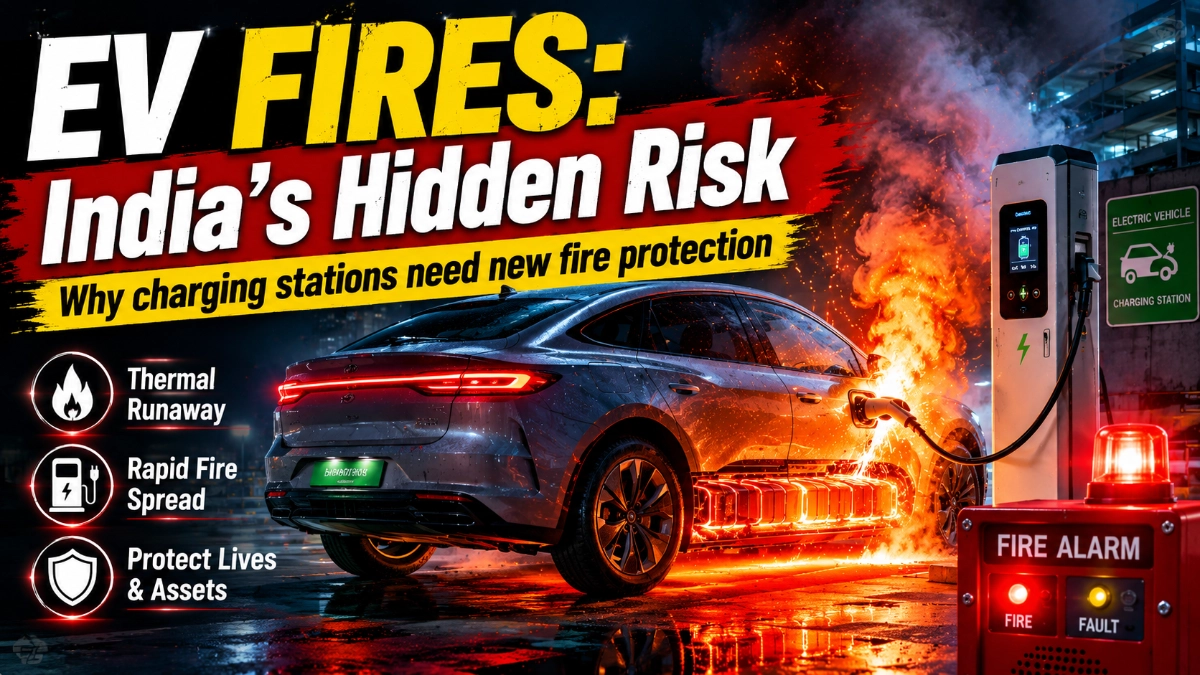
India’s electric vehicle revolution is accelerating. But alongside the excitement of cleaner mobility, a serious and under-discussed challenge is emerging: EV fire protection. Lithium-ion battery fires behave very differently from conventional vehicle fires, and the fire safety infrastructure that protects most Indian commercial buildings today was simply not built with EV risks in mind.
This article examines why India’s growing EV ecosystem demands a new approach to fire detection, suppression, and safety planning and what facility managers, EV operators, and safety professionals can do about it right now.
India’s EV Boom and Emerging Safety Concerns
India is one of the fastest-growing EV markets in the world. According to the Society of Indian Automobile Manufacturers (SIAM), EV sales crossed 1.5 million units in FY2023-24, with two-wheelers and three-wheelers leading the surge. The government’s FAME-II scheme, combined with PLI incentives for battery manufacturing, has pushed EV adoption far beyond metro cities into Tier 2 and Tier 3 towns.
With this growth comes an expanding web of infrastructure: public charging stations, battery swapping hubs, EV showrooms, dedicated parking decks, and large-format battery energy storage systems (BESS). Each of these environments introduces specific fire risks that Indian safety standards have not yet fully addressed.
As of 2024, India has over 12,000 public EV charging stations, a number expected to reach 1,00,000 by 2030 under the National Electric Mobility Mission Plan. The question is not whether these facilities will face fire incidents, but whether they will be prepared when they do.
Why Lithium-Ion Batteries Present Unique Fire Risks
Traditional vehicle fires involve petrol or diesel fuels that burn hot but respond predictably to water and foam suppression. Lithium-ion battery fires are fundamentally different.
Lithium-ion cells store enormous amounts of energy in a chemically reactive state. When something goes wrong, whether due to overcharging, physical damage, manufacturing defects, or extreme temperatures, the result can be a process called thermal runaway, which is both self-sustaining and extremely difficult to extinguish.
| Risk Factor | Conventional Vehicle Fire | EV Battery Fire |
| Ignition source | External spark or fuel leak | Internal chemical reaction |
| Temperature | Up to 600°C | Can exceed 1,000°C locally |
| Response to water | Generally effective | Limited; can reignite |
| Toxic gases | Minimal | Hydrogen fluoride, CO, others |
| Re-ignition risk | Low | Very high — hours or days later |
| Suppression time | Minutes | Hours to days |
Understanding Thermal Runaway
Thermal runaway is the most critical fire hazard associated with lithium-ion batteries. It occurs when heat generated inside a battery cell exceeds the cell’s ability to dissipate it, causing a cascade of self-reinforcing chemical reactions.
What Causes Thermal Runaway?
- Overcharging or undercharging beyond safe limits
- Mechanical damage, such as puncture, crush, or deformation from accidents
- Manufacturing defects such as internal short circuits
- Extreme ambient temperatures, especially in Indian summers, exceeding 45°C
- Contamination or degradation of the battery electrolyte
- Rapid charging at high current without adequate thermal management
Why It Is So Dangerous
Thermal runaway in a single cell can rapidly propagate to adjacent cells, turning a small incident into a catastrophic fire within seconds. The process releases flammable and toxic gases, including hydrogen fluoride, carbon monoxide and methane, before any visible flame appears. This makes early gas detection a critical line of defence that traditional fire alarm systems often miss entirely.
Modern addressable fire alarm panels connected to multi-gas detectors can identify these pre-combustion signatures far earlier than smoke-only detection systems, giving evacuation and suppression teams the time they need to respond.
Common EV Fire Scenarios in India
The following real-world scenarios represent the most likely EV fire situations that Indian facility managers and safety professionals will encounter.
- Overnight charging fire in a residential basement: An e-scooter left on charge develops a thermal event, igniting nearby vehicles in a confined space with poor ventilation.
- EV showroom incident: A display vehicle’s battery pack catches fire due to ambient temperature extremes, spreading smoke throughout a high-traffic public space.
- Charging station short circuit: A faulty charging unit causes an arc fault, igniting battery cells in a vehicle connected to the charger.
- Logistics warehouse fire: A fleet of electric delivery bikes, charging simultaneously in a poorly ventilated warehouse, experiences cascading thermal runaway.
- Battery storage facility incident: A BESS installation at a commercial building loses thermal management control, resulting in sustained battery fires lasting over 24 hours.
Fire Risks at EV Charging Stations
EV charging stations are arguably the highest-risk touchpoint in the EV ecosystem for fire incidents. Multiple vehicles charge simultaneously, often unattended, in environments that may lack adequate fire detection, ventilation, or suppression.
Key risks include: overloading of electrical infrastructure not designed for sustained high-current draw; arc faults from damaged connectors or cables; inadequate grounding leading to voltage surges; and the cumulative heat buildup in enclosed or semi-enclosed charging bays.
Conventional smoke detectors are frequently inadequate for these environments. EV battery pre-fire gases are colourless and odourless and will not trigger a standard photoelectric or ionisation smoke detector until combustion is already underway.
Facilities that have deployed addressable detectors, including hydrogen gas sensors, CO sensors, and thermal imaging, have consistently detected thermal events at an earlier stage than those relying on conventional smoke detection alone. A well-configured GST fire alarm system with multi-sensor detection capability is increasingly being specified for new EV charging infrastructure projects across India.
Challenges in Parking Garages and Residential Complexes
Underground and multi-level parking structures present a particular challenge for EV fire protection. They are typically enclosed, have limited ventilation, and are designed with fire detection systems scaled for conventional vehicle fires.
In a confined parking garage, an EV battery fire can rapidly overwhelm the space with toxic gases and heat before sprinkler systems or detectors respond. The 1,000°C-plus temperatures generated by severe lithium-ion fires can also exceed the thermal tolerance of conventional sprinkler heads, causing failures in the suppression system itself.
For residential complexes, particularly high-rise buildings in cities like Mumbai, Bengaluru, and Delhi, the risks are compounded by residents charging e-bikes and scooters in common areas, stairwells, and even individual apartments. India’s fire codes have not yet caught up with this reality, leaving residents and building managers largely without clear guidance.
Building managers should work with fire safety consultants to assess whether their existing detection and suppression systems are adequate for EV charging loads, and should consider upgrading to multi-zone detection with dedicated EV charging area coverage.
Risks in EV Manufacturing and Battery Storage Facilities
Battery manufacturing plants and BESS installations face some of the most severe fire protection challenges in the EV ecosystem. These environments store large quantities of lithium-ion cells in various states of charge, a scenario that demands purpose-built fire detection and suppression strategies.
Standard warehouse fire protection sprinklers and conventional smoke detectors are often insufficient for these facilities. A BESS fire can sustain combustion for days even after apparent extinguishment, because the electrochemical energy stored in undamaged cells continues to fuel the reaction.
Leading safety consultants now recommend that battery storage facilities deploy addressable fire alarm panels with early-warning gas detection (HF, CO, VOCs), combined with automated suppression systems designed specifically for lithium-ion environments. Facilities sourcing detection infrastructure through a reputable GST fire alarm system distributor in India can access multi-sensor addressable solutions tested against EV fire scenarios.
Why Early Detection Is Critical
With conventional fires, the window between ignition and dangerous fire growth is typically measured in minutes. With EV battery fires, the pre-combustion phase, the period in which gases are released before flames appear, can last even longer, but goes completely undetected by standard smoke detectors.
Early gas detection is the single most important differentiator in EV fire protection. Detecting hydrogen fluoride, CO, or elevated temperature in a battery compartment before thermal runaway fully develops gives occupants time to evacuate and gives suppression systems the best possible chance of limiting damage.
In large EV facilities, a conventional fire alarm panel is typically unable to provide the zone-level granularity needed to pinpoint the location of a pre-fire event. Addressable systems in which each detector has a unique address and can report independently provide the precision that EV environments require.
Role of Modern Fire Alarm Systems in EV Infrastructure
The shift from conventional to addressable fire detection architecture is the single most important upgrade that EV facilities can make to their fire protection systems.
| Feature | Conventional Fire Alarm Panel | Addressable Fire Alarm Panel |
| Detection granularity | Zone-level (entire loop) | Device-level (each detector) |
| Pre-fire gas detection | Not supported | Supported with right sensor |
| False alarm isolation | Difficult | Precise device isolation |
| Scalability | Limited | Easily expanded |
| EV suitability | Basic | Recommended for EV facilities |
| Maintenance visibility | Limited | Full diagnostics per device |
Both conventional fire alarm panels and addressable fire alarm panels have a role in EV fire safety, but the scale and complexity of EV facilities generally demand addressable architectures. A GST fire alarm system is an example of a modern detection infrastructure that supports multi-sensor inputs, zone mapping, and remote monitoring capabilities that are highly relevant for EV charging and storage environments.
Best Practices for EV Fire Protection
The following recommendations reflect current international best practices adapted for Indian EV infrastructure environments.
- Conduct an EV-specific fire risk assessment before deploying charging infrastructure; existing assessments designed for conventional buildings are often inadequate.
- Install multi-sensor early warning detection, including hydrogen fluoride gas sensors, CO sensors, and thermal cameras in charging areas and battery storage rooms.
- Upgrade to addressable fire detection systems that provide device-level granularity and can integrate with BEMS (Building Energy Management Systems).
- Ensure adequate ventilation in enclosed charging spaces. Minimum air changes per hour should be calculated based on the number and type of EVs charging simultaneously.
- Establish clear emergency response protocols for EV fires, including extended monitoring periods post-suppression to prevent re-ignition.
- Train on-site fire wardens and security personnel specifically on EV battery fire behaviour. Standard fire warden training does not cover this.
- Coordinate with the local fire brigade to ensure they have the knowledge and equipment to respond to EV fires at your facility.
- Review your fire insurance terms; many standard commercial policies have exclusions or limitations for EV battery fire damage.
Safety Checklist for Facility Managers
- EV-specific fire risk assessment completed and documented.
- Multi-sensor gas detection is installed in all EV charging areas.
- Addressable fire alarm panel covering EV zones with device-level monitoring.
- Ventilation rates verified for enclosed charging areas.
- Fire suppression system type verified as appropriate for lithium-ion fires.
- The emergency response protocol for EV fires was created and distributed.
- Fire warden team trained on EV-specific fire behaviour.
- Local fire brigade notified of EV infrastructure on premises.
- Insurance policy reviewed for EV battery fire coverage.
- A regular inspection schedule has been established for charging equipment and detection devices.
Future of EV Fire Safety Regulations in India
India’s regulatory landscape for EV fire safety is evolving rapidly, though it still lags behind the pace of EV adoption. The Bureau of Indian Standards (BIS) has begun developing standards specific to EV charging infrastructure safety, and the Ministry of Road Transport and Highways has issued advisories following several high-profile EV fire incidents.
The Central Electricity Authority (CEA) and the National Building Code (NBC) are both under review to incorporate EV-specific guidance. Industry bodies such as CII and ACMA are advocating for mandatory fire detection standards in public charging stations.
Facility managers and safety professionals who proactively adopt best practices today will be well-positioned when these regulations become mandatory and will avoid the costly retrofitting that reactive compliance typically requires.
Key Takeaways
- India’s EV market is growing rapidly, and so are the fire risks associated with lithium-ion batteries in charging, storage, and manufacturing environments.
- Thermal runaway is the defining fire hazard of EV batteries. It is self-sustaining, extremely difficult to extinguish, and releases toxic gases before any visible flame appears.
- Traditional smoke-based fire detection systems are inadequate for EV environments; multi-sensor gas detection is essential.
- Addressable fire alarm systems provide the device-level precision that complex EV facilities require, far exceeding the zone-level detection of conventional panels.
- Practical EV fire protection requires a combination of early detection, adequate ventilation, appropriate suppression, trained personnel, and clear emergency protocols.
- India’s EV fire safety regulations are evolving proactive compliance is strongly preferable to reactive retrofitting.
Conclusion
India’s EV transition is one of the most exciting industrial transformations the country has seen in decades. But the infrastructure protecting these new assets, the charging stations, warehouses, parking structures, and battery facilities that make EVs viable, has not kept pace with the technology they serve.
Fire protection for EV infrastructure is not simply a matter of installing more smoke detectors. It requires a fundamental rethink of detection technology, suppression strategy, emergency planning, and staff training. The risks are real, and the consequences of unpreparedness in lives, assets, and liability are severe.
Facility managers, safety consultants, and EV operators who invest in modern, EV-appropriate fire protection systems today will not only protect their assets and occupants, but they will be ahead of the regulatory curve when India’s EV fire safety standards inevitably tighten. The window to act proactively is now.
Read Also: The Next Decade of Fire Detection: What Will Change First?
Read Also: Key Factors That Influence Fire Alarm System Performance in Industrial Environments