A facility manager once told me his company had just spent a small fortune upgrading every camera on site to 8-megapixel sensors. Three months later, a forklift clipped a support beam in the warehouse at 2 a.m., and nobody could identify the driver. The footage was sharp. The lighting was terrible, the angle was wrong, and the camera was recording at a frame rate too low to catch the motion cleanly. Expensive glass. Useless evidence.
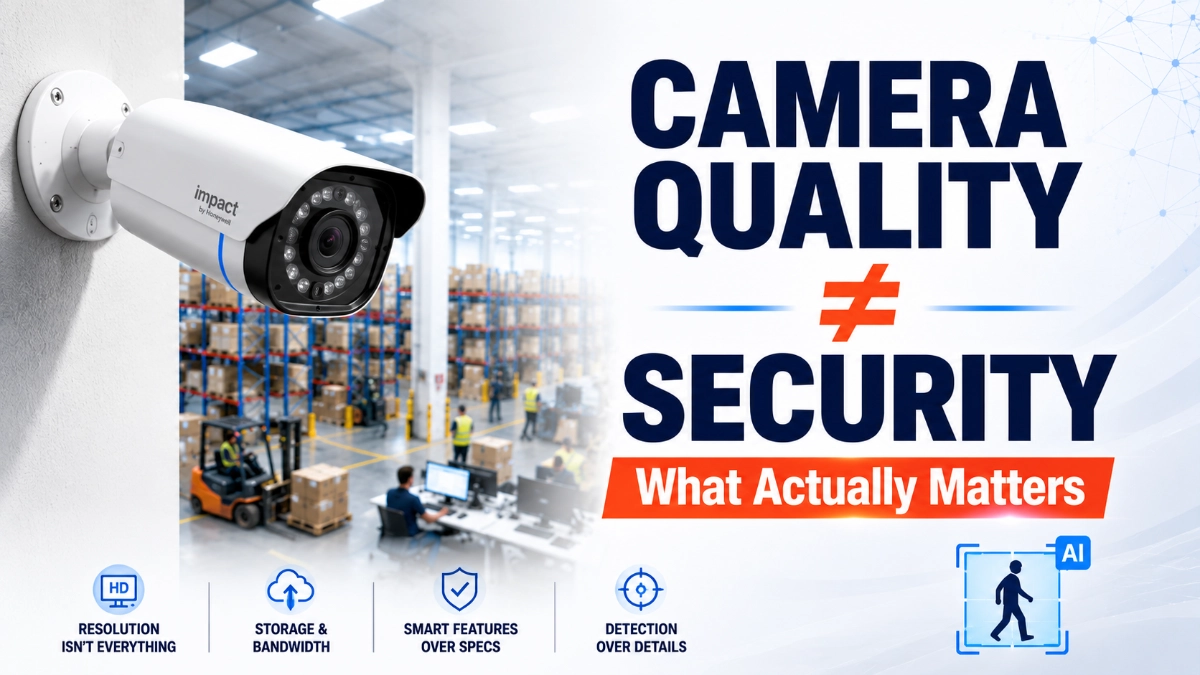
This happens more often than most buyers expect. Surveillance projects fail not because the hardware is bad, but because resolution gets treated as a proxy for performance when it’s really just one variable among a dozen. Understanding the difference is the single biggest lesson in modern CCTV design.
What People Usually Mean by “Camera Quality”
When most buyers say “camera quality,” they’re really describing a bundle of hardware specifications:
- Resolution: The pixel count captured in each frame (e.g., 2MP, 4MP, 4K/8MP)
- Megapixels: Often used loosely, and sometimes marketed, as a stand-in for overall image sharpness
- Lens quality: Glass elements, focal length, and distortion control
- Sensor size: Larger sensors generally gather more light and produce cleaner images
- HDR (High Dynamic Range): The camera’s ability to balance bright and dark areas in the same frame
- Low-light performance: How usable the image remains as ambient light drops
These specifications matter. They set the ceiling for what a camera can capture. But a ceiling isn’t a guarantee; it only defines potential, not outcome. What actually gets recorded depends on everything happening around that sensor.
Why Better Image Quality Doesn’t Always Mean Better Security
A high-resolution sensor can still produce useless footage. Here’s why.
Wrong Camera Placement
A camera mounted too high, too far, or at the wrong angle captures the top of people’s heads instead of faces, or license plates at an angle too steep to read. Resolution doesn’t fix geometry.
Blind Spots
Even a well-specified camera creates blind spots if the coverage plan doesn’t account for pillars, shelving, vehicles, or building corners. Gaps in coverage are gaps in evidence, regardless of sensor size.
Lighting Problems
Backlighting, glare from headlights, or areas with inconsistent illumination can wash out even a high-end sensor. Cameras don’t “see” the way human eyes adapt; strong contrast between light and dark areas in a single frame is one of the most common causes of unusable footage.
Poor Field of View
Choosing the wrong lens for the distance being monitored too wide or too narrow either loses detail across the scene or misses everything just outside the frame.
Incorrect Lens Selection
A fixed lens optimised for a 10-meter hallway will underperform badly across a 40-meter parking lot, no matter how many megapixels sit behind it.
Motion Blur
Fast-moving subjects vehicles, forklifts, running individuals require adequate shutter speed and frame rate. A high-resolution image captured at a low frame rate can still blur past the point of identification.
Compression Issues
Video compression (H.264, H.265) reduces file size for storage and bandwidth efficiency, but aggressive compression settings can strip fine detail from even a native high-resolution stream, especially in low light or high-motion scenes.
The Real Factors That Determine Surveillance Performance
Surveillance performance is an engineering outcome, not a shopping decision. The factors below tend to matter more, in practice, than the resolution number on a spec sheet.
| Factor | Why It Matters |
|---|---|
| Camera positioning | Determines whether the subject of interest is actually inside a usable frame |
| Coverage planning | Prevents blind spots and overlapping redundancy waste |
| AI analytics | Filters relevant events from hours of static footage |
| Video storage | Determines how long footage remains available for investigation |
| Network bandwidth | Insufficient bandwidth causes frame drops and stream degradation |
| Bitrate configuration | Balances image detail against storage and network load |
| Recording quality | Continuous vs. motion-triggered recording changes what’s actually captured |
| Frame rate | Affects whether fast motion is captured cleanly or blurred |
| VMS software | Determines how efficiently footage can be searched and reviewed |
| NVR performance | Processing power limits how many high-resolution streams can run reliably |
| Cybersecurity | Unsecured systems are vulnerable to tampering or disabling |
| Power backup | Determines whether the system keeps recording during outages |
| Regular maintenance | Lens cleaning, firmware updates, and storage checks prevent silent failure |
A system is only as strong as its weakest link in this chain. Camera resolution is one link, not the whole chain.
Real Deployment Examples
Warehouse
High shelving creates blind corners that a single high-resolution camera can’t solve. What actually helps: multiple mid-resolution cameras with overlapping coverage, plus motion analytics tuned to ignore forklift traffic patterns but flag people in restricted aisles.
Manufacturing Plant
Bright welding sparks and dark machinery bays in the same frame overwhelm standard exposure settings. HDR and correct camera placement relative to light sources matter more here than raw pixel count.
Office
Entry and exit points need facial-height framing, not wide establishing shots. A 2MP camera correctly angled at a doorway will outperform an 8MP camera mounted on a ceiling looking straight down.
Retail Store
Point-of-sale areas need close, stable framing to capture transaction-level detail. Wide-angle overview cameras are useful for general coverage but rarely sufficient on their own for loss-prevention investigations.
Parking Area
License plate recognition requires specific lens selection, mounting height, and frame rate; a generic high-resolution dome camera without the right optics will struggle to resolve plates at typical vehicle speeds.
Residential Society
Long perimeter distances mean fewer cameras have to cover more ground. Coverage planning and lighting at entry points typically deliver more security value than upgrading every unit to the highest resolution available.
In each case, the limiting factor wasn’t the camera’s sensor; it was how the system was designed around it.
AI Analytics Matter More Than Resolution
Modern surveillance performance increasingly depends on what the system does with the footage, not just how sharp it looks.
- Human detection: Reduces false alerts from animals, weather, or shadows
- Vehicle detection: Separates relevant traffic from background movement
- Intrusion detection: Flags unauthorised entry into defined zones in real time
- Line crossing: Alerts on boundary breaches without requiring constant monitoring
- Facial recognition (where legally and ethically appropriate) supports identity verification for access control
- Smart search: Lets investigators filter hours of footage by object type, colour, or direction of movement instead of scrubbing manually
- Object classification: Distinguishes between people, vehicles, and other moving objects to cut down on alert fatigue
A lower-resolution camera paired with well-tuned analytics often delivers more actionable security value than a high-resolution camera generating raw footage nobody reviews until after an incident.
Common CCTV Design Mistakes
- Choosing resolution first, coverage plan second: Camera specs should follow a site survey, not precede it.
- Ignoring lighting conditions during installation: Daytime testing hides problems that only appear at night.
- Skipping a formal field-of-view calculation: Guesswork placement leaves predictable gaps.
- Underestimating bandwidth requirements: Multiple high-resolution streams can overwhelm network infrastructure not designed for them.
- Using motion-only recording in critical zones: Some events start before motion triggers activate.
- Overlooking storage retention needs: Investigations often begin days or weeks after an incident.
- Neglecting cybersecurity basics: Default passwords and unpatched firmware remain common entry points for compromise.
- Mixing incompatible hardware without checking interoperability: Standards like ONVIF exist specifically to reduce this risk.
- Failing to plan for power outages: A camera with no backup power stops protecting the site the moment electricity fails.
- Treating installation as a one-time task: Lenses get dirty, firmware ages, and storage drives degrade; systems need scheduled maintenance.
- Overloading NVR processing capacity: Adding cameras beyond a recorder’s rated throughput degrades performance across the entire system.
Comparison Table: High Camera Quality vs. High Surveillance Performance
| Aspect | High Camera Quality | High Surveillance Performance |
|---|---|---|
| Primary focus | Sensor resolution, lens sharpness | End-to-end system design |
| Determines | Image potential | Actual usable outcomes |
| Affected by placement | No | Yes, heavily |
| Affected by lighting | Partially | Yes, significantly |
| Affected by analytics | No | Yes |
| Affected by network design | No | Yes |
| Affected by storage planning | No | Yes |
| Investigation usefulness | Depends on other factors | Directly tied to design quality |
| Cost efficiency | Can be wasted without planning | Maximises value from every rupee spent |
The takeaway: camera quality is an input. Surveillance performance is the output of an entire system working together.
Future of Surveillance
The next phase of CCTV design is shifting emphasis further away from raw hardware specs and toward intelligent systems.
- Edge analytics: Process video directly on the camera or a local device, reducing the bandwidth and latency associated with sending every frame to a central server.
- Cloud integration: Allows remote access, off-site backup, and scalable storage without heavy on-premise infrastructure.
- Intelligent monitoring: Combines multiple data sources access control, analytics alerts, sensor triggers into a single operational view instead of isolated camera feeds.
- Video intelligence: Platforms increasingly prioritise searchable, structured metadata over simply archiving raw footage.
As these technologies mature, the gap between “high-resolution camera” and “high-performance surveillance system” is likely to widen, not shrink, because the systems capable of using that resolution intelligently will pull further ahead of ones that simply record it.
Conclusion
Camera resolution sets a ceiling on image quality, but it says nothing about placement, lighting, network design, storage planning, or analytics the factors that actually determine whether footage helps when something goes wrong. A successful surveillance system is built through thoughtful design, correct planning, proper integration, and ongoing optimisation, not by chasing the highest megapixel count on the shelf.
Projects like Impact by Honeywell CCTV are often evaluated by integrators precisely on this basis, not resolution specs alone, but how well the full system is engineered around a site’s real conditions. Buyers working with any Impact by Honeywell CCTV Distributor in India would do well to ask about coverage planning and analytics configuration with the same seriousness they apply to comparing megapixel ratings.
Read Also: Has Surveillance Technology Advanced Faster Than Surveillance Strategy?
Read Also: How to Secure Your CCTV Network from Cyber Threats