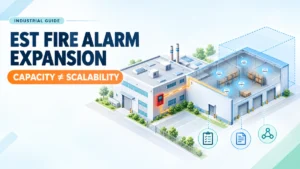
Today’s hospitals, airports, manufacturing campuses and data centres are larger, more connected, and more operationally complex than ever before. As facilities expand, expectations placed on fire alarm systems have shifted from simple detection to intelligent, enterprise-wide life safety management. A single building with a handful of smoke detectors no longer represents the reality that fire protection engineers design for; instead, they are tasked with protecting sprawling campuses, multi-tenant towers and mission-critical infrastructure where downtime is not an option.
This shift has changed what “good” looks like in fire alarm design. Enterprise facilities need systems that scale across buildings, communicate over resilient networks, diagnose their own faults and integrate with the broader building ecosystem. Conventional, standalone fire alarm control panels were never built for this level of complexity.
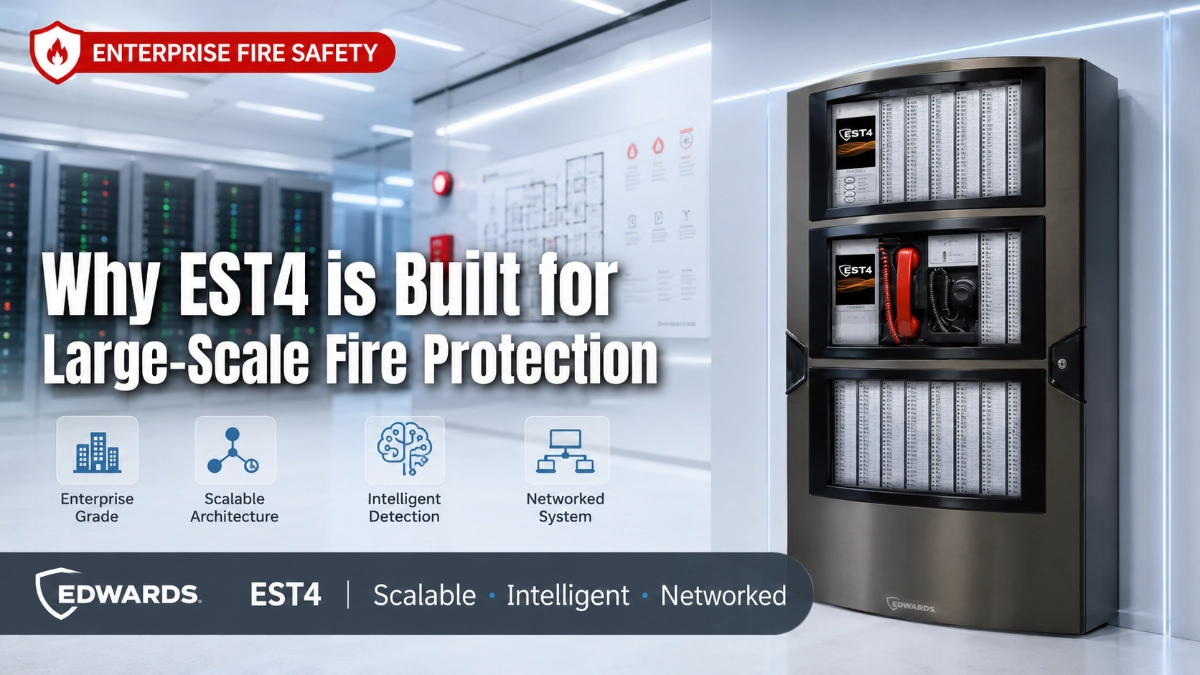
The Edwards EST4 Fire Alarm Panel is frequently specified in large commercial and industrial projects precisely because it was architected around these enterprise demands. Built as an intelligent, addressable fire alarm system, EST4 supports networked operation across multiple buildings, high device capacity, distributed intelligence, and centralised monitoring characteristics that define enterprise-grade fire detection infrastructure rather than basic life safety coverage.
This article examines, from a vendor-neutral engineering perspective, what actually defines an enterprise fire alarm system, how the EST4 control panel architecture aligns with those requirements, and how facility managers, consultants and engineers can evaluate enterprise fire alarm systems for complex, large-scale environments.
What Defines an Enterprise Fire Alarm System?
Not every fire alarm control panel qualifies as “enterprise-grade.” The distinction comes down to architecture, not brand. An enterprise fire alarm system is built to operate reliably across large, distributed and operationally critical environments, rather than serving a single building in isolation.
Several characteristics consistently separate enterprise fire alarm systems from standard commercial panels:
- Scalability means the system can grow from a few hundred device points to several thousand without requiring a platform change.
- Intelligent networking allows multiple panels across different buildings to communicate as one logical system, sharing alarm status, supervisory signals, and event history.
- High device capacity ensures the panel can support dense detector and module populations typical of large facilities.
- Centralised management gives operators a single point of visibility across an entire campus rather than building-by-building monitoring.
- System redundancy protects against single points of failure through backup communication paths and distributed processing.
- Long-term expandability allows the fire detection infrastructure to adapt as a facility adds wings, floors, or entire buildings over time.
| Enterprise Fire Alarm Characteristic | Why It Matters |
|---|---|
| Scalability | Supports facility growth without platform replacement |
| Intelligent Networking | Enables multi-building, campus-wide coordination |
| High Device Capacity | Accommodates dense detector and module deployments |
| Centralized Monitoring | Provides unified visibility for operations teams |
| System Redundancy | Reduces risk of single points of failure |
| Modular Expansion | Allows incremental upgrades aligned with budget cycles |
| Advanced Diagnostics | Speeds up fault isolation and maintenance |
When evaluated against this framework, it becomes clear why facility owners managing large or multi-building properties look beyond basic addressable fire alarm systems toward platforms purpose-built for enterprise-scale fire safety infrastructure.
Understanding the Edwards EST4 Platform
The EST4 control panel is built around a distributed, intelligent architecture rather than a single centralised controller handling every function. Each node on an EST4 network can process detection, control, and notification logic locally, while still communicating with the broader network for system-wide coordination. This design reduces dependency on any single processing point, and supports continued operation of individual zones even if network communication is temporarily disrupted.
System architecture is organised around addressable loops, where each initiating or output device has its own address, allowing the panel to identify the exact location and condition of a device rather than relying on broad conventional zoning. This intelligent addressable architecture is foundational to how EST4 delivers precise, device-level information to operators and responding personnel.
Network capability is a defining element of the platform. EST4 panels can be linked together across a facility or campus using a fire alarm networking architecture that allows shared alarm visibility, event logging, and coordinated life safety functions such as smoke control and mass notification across buildings. This is what allows a single security or fire command centre to monitor an entire enterprise property instead of separate, disconnected panels per building.
Modularity is built into the hardware and software design. Processing, power, and communication modules can be added incrementally, allowing system designers to size an installation for current needs while preserving a clear expansion path. Reliability is reinforced through supervised circuits, redundant communication options, and continuous self-diagnostics that flag degraded conditions before they escalate into failures.
Importantly, this architecture is not marketed as a single “smart” feature; it is the underlying engineering approach that makes large-scale, intelligent fire detection infrastructure possible in the first place.
Key Features That Make EST4 Suitable for Enterprise Fire Safety
Intelligent Addressable Architecture
Every detector, module, and notification circuit on an EST4 system carries its own address, allowing the panel to pinpoint exact device location and status rather than reporting a general zone. In a hospital or manufacturing plant with thousands of devices, this level of precision dramatically reduces response time and search effort during an alarm event.
High Scalability
EST4 panels are designed to expand from a single building installation into a multi-panel, multi-building network without a forklift upgrade. This matters because enterprise facilities rarely stay static; campuses expand, new wings are constructed, and device counts grow well beyond initial design assumptions.
Enterprise Networking
The platform’s networking capability allows panels in separate buildings to operate as a unified fire alarm system, sharing alarm, trouble, and supervisory information across the entire property. For facility managers, this means one operational picture instead of fragmented building-by-building monitoring.
Advanced Diagnostics
Continuous self-monitoring of devices, circuits, and communication paths allows the system to flag degraded sensors, wiring issues, or communication faults before they become safety-critical failures. This proactive diagnostic capability supports predictive maintenance planning rather than reactive troubleshooting.
Modular Expansion
Because the architecture is built from interconnected modules rather than a fixed, monolithic controller, capacity can be added in stages. This allows capital planning to align fire protection investment with actual facility growth rather than over-building upfront.
Faster Incident Response
Device-level addressing, combined with network-wide visibility, allows responding personnel and fire command stations to identify exact alarm locations immediately, which is especially critical in large facilities like airports or hospitals where minutes matter.
Simplified Maintenance
Centralised diagnostics, supervised circuits, and standardised addressable devices reduce the time technicians spend isolating faults, which lowers long-term maintenance costs across a large device population.
Future-Proof System Design
A modular, networked architecture means the fire detection infrastructure can incorporate new device types, expanded notification strategies, and additional integration points over time without requiring a full system replacement.
How EST4 Supports Large and Complex Facilities
Different facility types face distinct fire safety challenges, and enterprise fire alarm systems need to address each context appropriately.
- Hospitals require continuous operation, zoned smoke control, and integration with patient safety protocols across multiple buildings and floors, where any system downtime carries direct life-safety consequences.
- Airports involve vast device counts spread across terminals, concourses, and support facilities, requiring centralised monitoring and rapid, precise alarm location identification.
- Manufacturing plants often combine high ambient heat, dust, and process hazards, demanding heat detection alongside smoke detection and close coordination with process shutdown systems.
- Warehouses present large open volumes and high-value inventory, where early, accurate detection across vast square footage is essential to limit loss.
- Data centres prioritise early-warning detection and tight coordination with suppression and shutdown systems to protect uptime-critical equipment.
- Universities operate as multi-building campuses with varied occupancy types, requiring networked panels that can be centrally managed yet independently zoned.
- High-rise buildings depend on floor-by-floor zoning, voice evacuation coordination, and firefighter command station integration.
- Commercial campuses with multiple tenants need centralised oversight while preserving the ability to isolate alarms and maintenance to individual buildings or tenant spaces.
Across all of these environments, the common requirement is the same: a fire alarm control panel architecture capable of scaling, networking, and adapting to facility-specific risk profiles, which is the operational space enterprise fire alarm systems like EST4 are designed to occupy.
EST4 vs Traditional Fire Alarm Panels
| Capability | Traditional Fire Alarm Panel | Enterprise Platform (e.g., EST4) |
|---|---|---|
| Scalability | Limited to single building or small expansion | Designed for multi-building, campus-wide growth |
| Networking | Typically standalone or limited interconnection | Native support for networked, multi-panel operation |
| Diagnostics | Basic trouble indication | Continuous, device-level self-diagnostics |
| Maintenance | Manual fault isolation, higher labour time | Centralised diagnostics reduce troubleshooting time |
| Device Management | Zone-based or limited addressable capacity | High-capacity intelligent addressable architecture |
| System Intelligence | Centralized, single-point processing | Distributed intelligence across network nodes |
| Expansion Capability | Often requires platform replacement | Modular expansion within the same architecture |
| Operational Efficiency | Building-by-building monitoring | Centralized, campus-wide visibility |
| Lifecycle Value | Shorter effective service life as needs grow | Designed for long-term adaptability |
This comparison is not a judgment on smaller systems; conventional and entry-level addressable panels remain appropriate for many single-building applications. The distinction matters specifically when facility scale, complexity, or criticality exceeds what a standalone panel architecture was designed to handle.
Why Scalability Matters in Enterprise Fire Protection
Facility growth rarely follows the original design assumptions made at construction. Multi-building campuses frequently add structures over a 10–20 year horizon, and a fire alarm platform locked to a single building’s capacity becomes a liability rather than an asset. Future facility expansion, whether through new wings, additional floors, or entirely new buildings, requires a system that can absorb growth without forcing a complete platform replacement.
Device growth follows a similar pattern as occupancy classifications change, renovations occur, or code requirements evolve; device counts tend to increase rather than decrease. Operational continuity also depends on scalability; facilities cannot afford extended downtime during a system overhaul, so an architecture that expands incrementally protects ongoing operations. From a capital planning perspective, scalability represents a long-term investment strategy: spending on fire protection infrastructure that adapts over decades is generally more cost-effective than repeated forklift replacements every time a facility outgrows its panel.
Integration with Modern Building Infrastructure
Enterprise fire alarm systems rarely operate in isolation. Modern facilities expect fire detection infrastructure to coordinate with the broader building ecosystem.
Integration with a Building Management System (BMS) allows fire alarm events to trigger HVAC shutdowns, damper control, and other building-wide responses automatically. Coordination with smoke control systems ensures that pressurisation and exhaust sequences activate correctly based on the specific zone in alarm. Connection to emergency communication systems supports coordinated voice evacuation or mass notification messaging during an event.
Interfacing with access control systems can enable door unlocking sequences along designated egress paths during an emergency. Finally, integration with intelligent monitoring platforms allows facility operations teams to view fire alarm status alongside other critical building systems from a unified interface.
These integrations are conceptual capabilities common to enterprise-grade fire alarm control panel architectures in general, and specific implementation details should always be verified against current product documentation and local code requirements rather than assumed based on general industry practice.
Common Mistakes When Selecting Enterprise Fire Alarm Systems
Facility owners and consultants often run into avoidable problems when specifying fire alarm infrastructure for large or growing properties.
- Designing strictly for today’s needs only without accounting for future device growth is one of the most common errors, leading to forced replacements within a few years.
- Ignoring future expansion plans, even informal ones, results in panels that cannot accommodate new buildings or wings.
- Underestimating networking requirements leads to fragmented systems where buildings cannot share alarm visibility, creating blind spots for operations teams.
- Poor system planning around device addressing, zoning, and circuit loading creates maintenance headaches that compound over the system’s lifecycle.
- Limited scalability in the chosen platform locks facilities into early, costly upgrades.
- Weak lifecycle planning failing to budget for maintenance, firmware updates, and incremental expansion undermines the long-term value of even a well-designed initial installation.
Enterprise Fire Alarm Selection Checklist
A practical checklist for consultants and facility managers evaluating enterprise fire alarm systems:
- Confirm current and projected device point capacity requirements
- Verify multi-building networking capability and architecture
- Assess redundancy options for communication and processing
- Review diagnostic and self-monitoring capabilities
- Confirm modular expansion path and compatible hardware roadmap
- Evaluate integration options with BMS, access control, and smoke control
- Review compliance with applicable local fire and life safety codes
- Assess vendor support, training, and long-term parts availability
- Confirm compatibility with existing or planned notification devices
- Plan for lifecycle maintenance, testing, and firmware update cadence
Future Trends in Enterprise Fire Detection
Enterprise fire alarm systems continue to evolve alongside broader trends in building technology.
- AI-assisted diagnostics are beginning to support earlier identification of device degradation patterns before they trigger trouble conditions.
- Predictive maintenance approaches use historical device performance data to schedule service proactively rather than reactively.
- IoT integration is extending visibility into building systems beyond traditional fire alarm boundaries, supporting richer situational data during events.
- Smart building initiatives increasingly expect fire detection infrastructure to function as a single coordinated layer within a broader automated environment.
- Cloud-based monitoring is expanding remote visibility for multi-site operators managing geographically distributed properties.
- Digital twin modelling is starting to incorporate fire alarm device data into broader facility simulation and planning tools.
- Enterprise analytics platforms are beginning to aggregate fire alarm event history alongside other operational data to support long-term facility risk assessment.
These trends do not replace the fundamentals of sound fire alarm system architecture; scalability, networking, redundancy, and diagnostics remain the foundation upon which these emerging capabilities are built.
Read Also: Understanding the Difference Between EST3, EST4, and IO Series Panels
Read Also: What Makes EST Fire Alarm Systems Different from Standard Fire Alarm Platforms?