As industrial facilities grow larger, more interconnected, and more complex, selecting the right fire alarm platform has become one of the most consequential decisions a project team can make. It’s not simply a question of compliance; it directly shapes a facility’s scalability, integration readiness, long-term maintenance burden, and occupant safety for decades to come.
EST3 vs EST4 vs IO Series — Which Edwards Fire Alarm Panel Fits Your Facility?
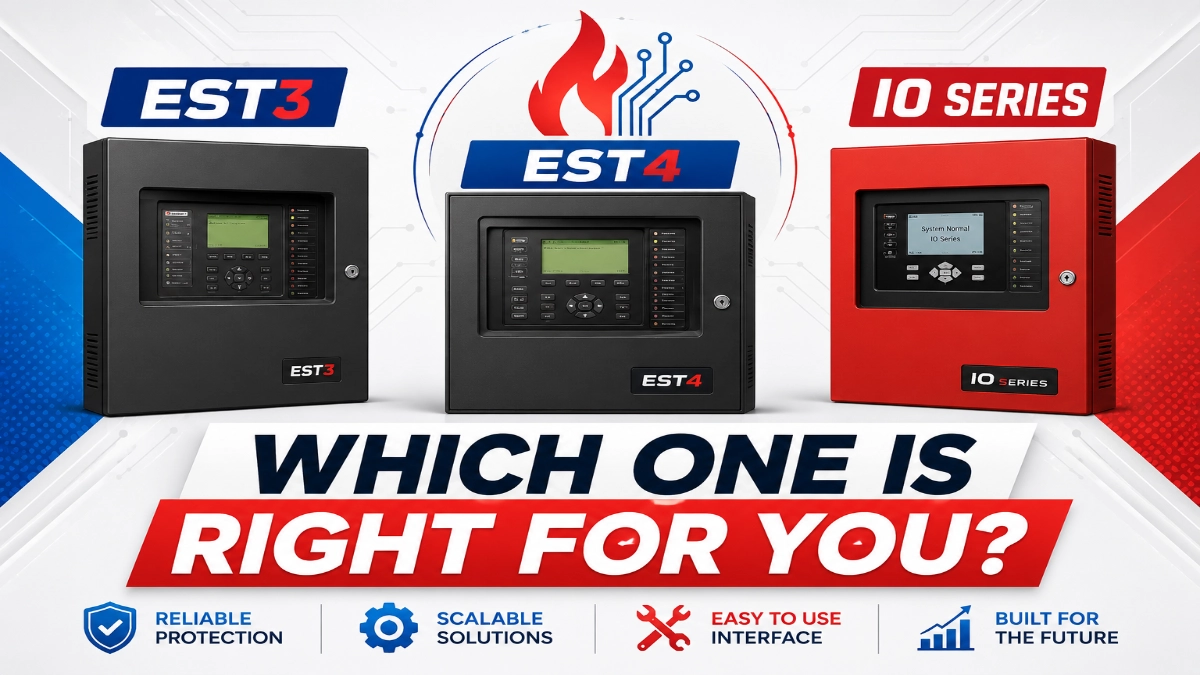
Edwards Fire Safety, a brand with deep roots in intelligent life safety systems, addresses this complexity by offering three distinct control panel families: the EST3, the EST4, and the IO Series. Each platform is engineered for a different set of requirements. Understanding how they differ and where each belongs is essential for fire protection engineers, consultants, EPC contractors, facility managers, and procurement teams specifying or upgrading a fire alarm system.
This article provides a technically grounded, objective comparison of all three platforms. It is written to inform the decision-making process, not to promote any particular product
Understanding the Edwards Fire Alarm Panel Portfolio
Edwards organises its intelligent life safety control panels into a tiered portfolio designed to serve facilities across the entire spectrum of size and complexity:
Edwards Fire Alarm Control Panel Portfolio
─────────────────────────────────────────────────────────
ENTERPRISE / LARGE FACILITY
  └─ EST4         → Large campuses, high-rises, airports,
                    hospitals, data centers, industrial plants

LEGACY ENTERPRISE (End-of-Life — Not for New Installs)
  └─ EST3 / EST3X → Still in service; migration to EST4 recommended

SMALL TO MID-SIZED COMMERCIAL
  └─ IO Series    → iO64 (up to 64 devices)
                    iO500 (up to 500 devices)
                    iO1000 (up to 1,000 devices)
─────────────────────────────────────────────────────────
All three families share the same Signature Series intelligent device ecosystem, including SIGA smoke detectors, SIGA heat detectors, SIGA manual call points, SIGA monitor modules, and SIGA relay modules, which creates meaningful compatibility and investment continuity across the portfolio.
Edwards EST3 Fire Alarm Panel Overview
The EST3 is a modular, software-controlled fire alarm control platform designed for facilities ranging from single-panel standalone systems to large multi-panel networks. Supporting up to 64 networked nodes with up to 2,500 devices each, EST3 integrates fire alarm, security, smoke control and mass notification into a unified platform. Edwards has confirmed EST3 is now at end-of-life and recommends migration to EST4.
Core Capabilities
The EST3 was built around a plug-and-play local rail module architecture. Functions such as fire alarm, security, mass notification, and smoke control were unified within a single enclosure using many shared components, which simplified system layouts and reduced installation complexity. Virtually all operating features were software-controlled through the 3-SDU (System Definition Utility), giving installers a graphical interface to configure the system and define device logic.
The EST3’s token ring network delivered fast alarm response across installations spanning over 300,000 feet of total network length, a critical advantage for large campuses and sprawling industrial sites.
System Architecture and Scalability
Up to 64 nodes networked per system
Up to 2,500 intelligent devices per node
Supports Class A and Class B Signalling Line Circuit (SLC) wiring
Peer-to-peer multi-priority token ring network protocol
Compatible with the full Signature Series device family
Ideal Applications (Historical)
EST3 was widely specified for hospitals, airports, government buildings, university campuses, high-rise towers, and large industrial facilities where unified fire alarm, mass notification, and smoke control were required under one platform.
Important Notice: EST3 End-of-Life
Edwards has officially confirmed that the EST3 platform is at end-of-life. While existing EST3 installations continue to operate, the platform is no longer recommended for new projects. Technology evolution, changing code requirements, and evolving service needs have led Edwards to direct all new enterprise deployments toward EST4.
For facilities currently operating EST3 systems, Edwards has developed a migration path to EST4 that preserves existing Signature Series devices and network cabling, reducing transition cost and operational disruption.
Edwards EST4 Fire Alarm Panel Overview
The EST4 is Edwards’ current flagship fire alarm and emergency communications platform, designed for large, complex, and networked facilities. Built with an all-new network architecture, the EST4 supports fire alarm, mass notification and building integration in a single platform, with advanced cybersecurity, IP-based networking, self-configuring topology, and compatibility with Edwards ConnectedSafety+.
Next-Generation Improvements
The EST4 represents a ground-up redesign of the enterprise fire alarm control panel, not simply an incremental update to the EST3. Key architectural improvements include:
Networking: EST4 uses IP-based communications with a self-configuring network that allows changes from copper to fibre with no system downtime. This flexibility is critical in complex facilities where network topology must adapt during phased construction or renovation.
Cybersecurity: EST4 is designed with built-in cybersecurity protections, including the ability to deploy proxy firewalls that insulate the internal fire network from external threats, a meaningful distinction in an era where connected building systems face increasing cyber risk.
Programming: EST4 uses the 4-CU (Configuration Utility), a more intuitive successor to EST3’s 3-SDU, featuring drag-and-drop configuration, improved visual aids, and simplified access to device settings. This reduces commissioning time and lowers the learning curve for technicians.
Diagnostics: EST4 includes advanced diagnostic utilities with detailed event logs, real-time monitoring, and predictive maintenance capabilities, giving facility teams tools to identify and address issues before they affect system performance.
Backward Compatibility: EST4 supports all Signature Series devices, modules, and service tools, as well as Genesis notification appliances. Existing EST3 network cabling is reusable. This makes EST4 the logical migration destination for facilities transitioning from EST3.
Performance and Scalability
Supports large multi-panel networked configurations
Self-configuring network topology (copper and fibre)
Compatible with Edwards ConnectedSafety+ for remote monitoring and management
Enhanced building system integration with modern protocols and APIs
Supports unified fire alarm, mass notification, and smoke control
Best-Fit Facilities
The EST4 is the recommended choice for:
Hospitals and healthcare campuses
High-rise commercial and residential towers
Airports and transportation hubs
Data centers
University and corporate campuses
Industrial facilities with complex fire suppression or smoke control requirements
Any new large facility requiring a future-ready, networked fire alarm platform
Edwards IO Series Overview
The IO Series is Edwards’ intelligent fire alarm platform for small to mid-sized facilities. Available in three configurations iO64, iO500, and iO1000, the IO Series delivers high-end intelligent processing in a cost-effective, easy-to-install package. Features include electronic addressing, automatic device mapping, and optional Ethernet connectivity for remote diagnostics and central monitoring.
Design Philosophy: Simplicity Without Compromise
The IO Series was developed with a distinct goal: to bring the intelligence of enterprise-grade fire alarm technology to buildings that do not require complex networking or multi-panel architecture. The platform uses the same Signature Series intelligent devices as EST3 and EST4, ensuring detection quality remains high regardless of building size.
Device Capacity by Model
Model
Max Intelligent Devices
SLC Loops
NAC Circuits
iO64
64
1 (Class A or B)
2 (Class B)
iO500
500
Up to 2 loops × 250 addresses
4 (Class A or B)
iO1000
1,000
Multiple loops in 250-point increments
4 (Class A or B)
Key Features
Automatic Device Mapping: The IO Series automatically maps detected devices during startup, reducing commissioning time significantly compared to older conventional systems.
Electronic Addressing: Devices are electronically addressed without the need for mechanical address settings, simplifying installation and reducing the risk of addressing errors.
Optional Ethernet Connectivity: The IO Series supports optional Ethernet connectivity for integration with ESTMobile, Edwards’ remote diagnostics and central monitoring solution.
Retrofit-Friendly: The iO64 in particular is well-suited to retrofit applications. Standard wiring, no shielded cable required, means existing building wiring can often be reused when upgrading from a conventional system.
Remote Annunciation: The iO64 supports up to eight remote annunciators. Both LED and LCD models are available, including graphic annunciation options.
Ideal Applications
The IO Series is most appropriate for:
Small to mid-sized office buildings
Retail stores and shopping centres
Schools and educational facilities (smaller campuses)
Hotels and hospitality (smaller properties)
Clinics and outpatient medical offices
Warehouses and light manufacturing
Multifamily residential buildings
EST3 vs EST4 vs IO Series: Complete Feature Comparison
Feature
IO Series
EST3 (Legacy/EOL)
EST4
Target Facility Size
Small to mid-sized
Large (legacy)
Large / Enterprise
Max Device Capacity
Up to 1,000 (iO1000)
Up to 160,000 (64 nodes × 2,500)
Large multi-panel networks
Networking
Single panel; optional Ethernet
Token ring, up to 64 nodes
IP-based, self-configuring, fibre/copper
Cybersecurity
Basic
Limited
Built-in proxy firewall capability
Programming Tool
Configuration Utility (CU)
3-SDU
4-CU (enhanced, drag-and-drop)
User Interface
Simple LCD
Functional, text-based
Intuitive, advanced visualization
Mass Notification
Not supported
Supported (UL 2572 listed)
Supported
Smoke Control
Not supported
Supported
Supported
BMS Integration
Limited
Via additional interfaces
Native, modern protocols and APIs
Remote Monitoring
ESTMobile (optional Ethernet)
Limited
ConnectedSafety+
Backward Compatibility
Signature Series devices
—
Full Signature Series + Genesis
Firmware Updates
Manual
Manual
OTA / automated
Diagnostics
Basic
Moderate
Advanced predictive diagnostics
Future-Readiness
Moderate
End-of-life
High
Typical Applications
Offices, schools, retail, and small hotels
Hospitals, airports, campuses (existing)
Hospitals, airports, data centres, campuses
New Installation Recommended
Yes
No
Yes
Which Edwards Fire Alarm Panel Is Right for Your Facility?
Matching the right platform to a facility requires an honest assessment of current needs and a realistic projection of future requirements. The following decision framework addresses common facility types.
Facility Type
Recommended Platform
Reasoning
Small office (< 5,000 sq ft)
IO Series (iO64)
Single-loop capacity is more than sufficient, cost-effective, and simple to commission
Medium office building
IO Series (iO500)
500-point capacity handles multi-floor configurations without unnecessary complexity
School (single campus)
IO Series (iO500 or iO1000)
Adequate capacity; Ethernet option enables remote monitoring for facilities teams
Hospital/healthcare campus
EST4
Requires multi-panel networking, mass notification, smoke control, and cybersecurity
Hotel (mid-size)
IO Series (iO1000)
Sufficient for most hotel configurations; mass notification not typically required
Hotel (large / luxury)
EST4
Voice evacuation, mass notification, and BMS integration justify enterprise platform
Shopping mall
EST4
Multi-zone, multi-panel complexity; mass notification common requirement
Manufacturing plant
EST4
Industrial hazard diversity; smoke control and mass notification often required
Warehouse
IO Series or EST4
Depends on scale; large automated warehouses typically warrant EST4
High-rise building
EST4
Multi-panel networking, smoke control, and voice evacuation are standard requirements
Airport/transit hub
EST4
Mass notification, multi-panel integration, and cybersecurity are non-negotiable
Data center
EST4
Precision fire suppression control, BMS integration, and remote monitoring required
Industrial campus
EST4
Multi-building networking, diverse hazard detection, and emergency comms needed
One practical principle: If a facility currently needs the IO Series but may expand to become a multi-building campus within 10 years, the cost of specifying EST4 now is almost always lower than the cost of replacing an IO Series system at that future point.
Upgrade Considerations: EST3 to EST4
When should businesses upgrade from EST3 to EST4?
Facilities currently running EST3 should begin planning migration to EST4 now. Edwards has confirmed EST3 is at end-of-life, meaning the platform will not receive further technology development or long-term manufacturer support. EST4 offers a migration path that reuses existing Signature Series devices and network cabling, minimizing disruption and controlling transition costs.
When Upgrading Makes Sense
Upgrading from EST3 to EST4 is worth prioritising in situations where:
Long-term support is a concern: End-of-life platforms eventually face challenges with parts availability, software support, and code compliance as standards evolve. Planning avoids emergency-driven replacements.
Cybersecurity requirements are increasing: Organisations with IT security policies extending to building systems will find EST4’s proxy firewall capabilities and IP-network architecture a meaningful improvement.
Building expansion is planned: EST4’s enhanced networking flexibility makes it easier to add panels, expand device capacity, and reconfigure wiring topology during construction phases.
Remote monitoring is required: ConnectedSafety+ integration provides centralised visibility and faster service response, valuable for facilities with limited on-site maintenance staff.
Migration Planning
The migration from EST3 to EST4 is designed to minimise disruption:
Existing Signature Series devices and Genesis notification appliances are compatible with EST4.
Existing network cabling is reusable.
Wiring does not need to be replaced.
The EST4’s self-configuring network simplifies the transition for complex topologies.
Phased migration, replacing panel by panel while keeping the system operational, is feasible in most installations, which is an important consideration for occupied facilities like hospitals and schools.
Common Mistakes When Choosing a Fire Alarm Control Panel
Selecting a fire alarm platform based on incomplete analysis leads to expensive corrections later. The following mistakes appear repeatedly in fire alarm system specifications.
Specifying for today, not tomorrow: A facility that needs 200 devices today may need 800 devices after a planned expansion. Selecting an IO Series panel when the facility is on a clear growth path toward a multi-building campus forces an avoidable system replacement.
Overlooking integration requirements: Buildings with HVAC integration, smoke control, security, or access control systems may require a panel capable of handling multi-system coordination. The IO Series does not support these functions. Specifying it for a facility with smoke control requirements creates a costly gap.
Ignoring mass notification needs: Facilities subject to NFPA 72 mass notification requirements, government buildings, transportation facilities, and large assembly occupancies need an EST4. The IO Series does not support mass notification.
Treating upfront cost as the primary criterion: The IO Series costs less than the EST4. But in a facility that requires EST4 capabilities, specifying a lower-tier panel to reduce initial cost guarantees a system replacement at far greater cost within a short timeframe.
Specifying EST3 for new installations: Now that Edwards has confirmed EST3 is end-of-life, specifying it for new construction creates immediate lifecycle risk. New large-facility installations should be specified as EST4 without exception.
Underestimating networking complexity: IP-based networking in EST4 requires proper network design and, in some cases, coordination with the facility’s IT infrastructure. Treating this as an afterthought leads to commissioning delays.
Future Trends in Intelligent Fire Alarm Control Panels
The fire alarm industry is evolving, and the direction is clearly toward greater intelligence, connectivity and predictive capability. Facilities specifying fire alarm systems today should understand how these trends will affect platform selection and long-term investment.
AI-assisted diagnostics and predictive maintenance: Advanced control platforms increasingly use algorithms to analyse device performance data, identify degrading detectors before they fail, and recommend maintenance actions proactively. EST4’s diagnostics capabilities are aligned with this direction.
Cloud connectivity and remote management: Edwards ConnectedSafety+ reflects a broader industry trend toward cloud-connected fire alarm infrastructure. Remote monitoring, diagnostic data aggregation, and over-the-air updates are moving from premium features to standard expectations.
Cybersecurity as a design requirement: As fire alarm systems connect to building networks and the internet, they become potential attack surfaces. EST4’s built-in proxy firewall capabilities represent the industry’s response to this emerging threat. Future platforms will likely embed security features more deeply into the hardware and software architecture.
Building Management System convergence: The boundary between fire alarm systems and Building Management Systems is blurring. Modern facilities increasingly expect fire alarm platforms to exchange data directly with HVAC, access control, lighting, and energy management systems. EST4’s API-based integration capabilities position it well for this convergence.
Digital twins and simulation: Large facility operators are beginning to use digital twin technology to model fire alarm system behaviour, plan evacuation scenarios, and test system changes without affecting live installations. Fire alarm platforms that support data export and integration with simulation tools will be preferred for complex facilities.
IoT-enabled detection devices: The next generation of smoke and heat detectors will increasingly incorporate multi-sensor technology, self-diagnostics, and direct network communication. Fire alarm platforms capable of accommodating these devices will have a longer useful life.
I am Harsh Bohot, a technology content specialist with expertise in fire safety systems, CCTV surveillance, ELV solutions and intelligent building technologies. With a strong technical foundation and a Master's degree in Computer Applications (MCA), I combine analytical thinking with in-depth research to create accurate, practical and easy-to-understand content for the fire and electronic security industry.
My work focuses on fire alarm systems, addressable and conventional detection technologies, CCTV surveillance, AI-powered security solutions, access control, networking and integrated building management systems. I regularly research industry standards, product innovations and emerging technologies to deliver reliable information that helps engineers, consultants, system integrators, facility managers and business owners make informed decisions.
Passionate about simplifying complex technical concepts, I write to bridge the gap between advanced security technologies and real-world implementation. My goal is to provide trustworthy, well-researched insights that support safer, smarter and more secure buildings through modern fire protection and electronic security solutions.
Disclaimer: The information provided here is for general guidance on fire safety systems and may vary based on site conditions and regulations. While we strive for accuracy, discrepancies may occur. For specific requirements, please consult certified professionals. If you find any errors, contact us for review and correction.