Modern hospitals, airports, manufacturing plants, and data centres demand more than just fire alarms; they require intelligent fire detection platforms that reduce downtime, minimise false alarms, and scale with complex infrastructure. As building systems grow more interconnected and regulatory expectations rise, the technology choices made during the design phase shape safety outcomes for decades.
Traditional fire alarm systems were built around a simple principle: detect heat or smoke, trigger an alert. That model served buildings well for many years, but it struggles to keep pace with modern demands. Large campuses with thousands of devices, mission-critical facilities where false evacuations cost millions, and industrial plants where nuisance alarms desensitise staff all expose the limitations of conventional approaches.
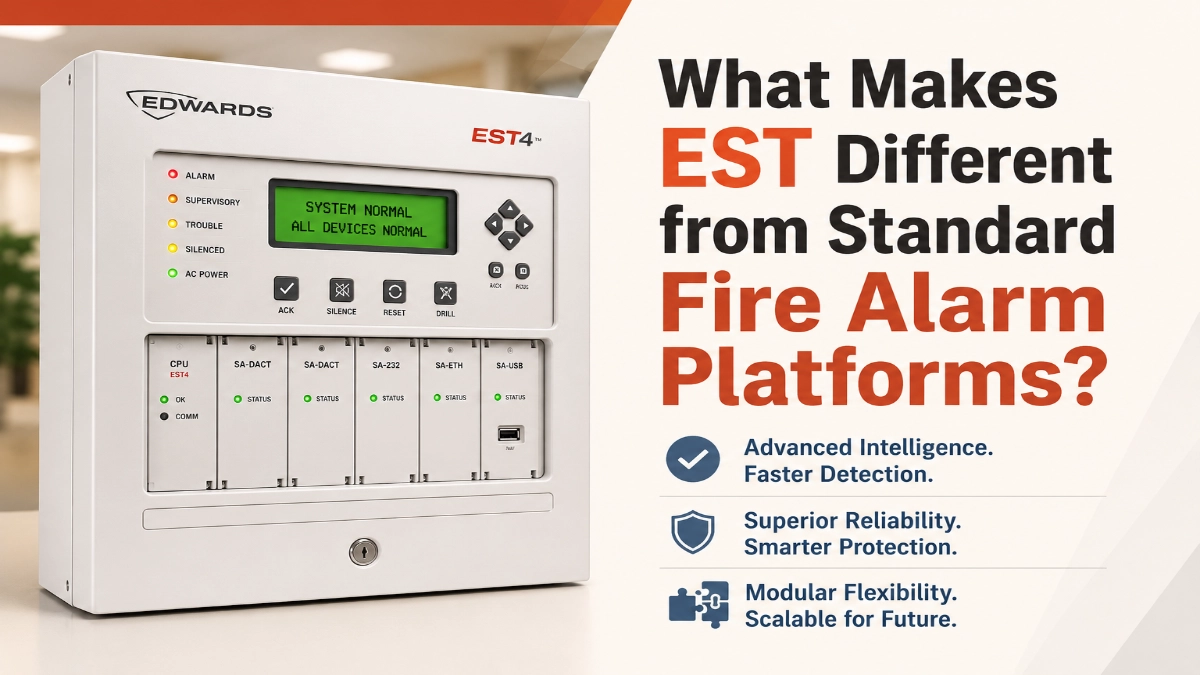
Intelligent fire alarm platforms like the Edwards EST ecosystem take a fundamentally different engineering approach. Rather than treating each detector as a simple switch, they embed logic, diagnostics, and network intelligence throughout the system from the panel to the individual device. Understanding these differences matters not just for procurement decisions but for long-term infrastructure planning, maintenance strategy, and life safety performance.
Understanding What an EST Fire Alarm Platform Is
An EST Fire Alarm System is an intelligent fire detection and notification platform developed by Edwards Fire Alarm System (part of Carrier Global). It uses addressable, digital communication between the fire alarm control panel and individual devices, allowing each detector, module, or notification appliance to be uniquely identified, monitored, and managed. EST platforms support scalable network topologies, multi-panel configurations, and deep integration with building management and emergency response systems.
The Edwards EST ecosystem is built around a philosophy of device-level intelligence. Each detector, whether a smoke, heat, or multi-sensor detector, is not merely a trigger point. It is a node in a networked system, capable of reporting analogue values, environmental data and self-diagnostic information back to the fire alarm control panel (FACP).
Key architectural characteristics of EST platforms:
- Addressable communication loops: Every device on a fire alarm loop has a unique address. The panel knows exactly which device triggered an event, not just which zone.
- Bidirectional signalling: The panel can query devices, adjust sensitivity thresholds, and retrieve environmental readings, not just receive binary on/off signals.
- Modular, scalable design: EST platforms like the Edwards EST4 and Edwards EST3 support modular expansion. A system deployed today can grow to accommodate additional buildings, zones, or network nodes without replacing the core infrastructure.
- Multi-panel networking: Large campuses can link multiple fire alarm control panels into a single logical system, enabling centralised monitoring and coordinated response.
- Integration-ready architecture: EST platforms are designed to communicate with Building Management Systems (BMS), emergency communications networks, and third-party life safety platforms.
The Edwards IO Series panels extend this capability into mid-range industrial and commercial applications, providing addressable intelligence in a more compact form factor.
What Is Considered a Standard Fire Alarm Platform?
Standard fire alarm platforms generally fall into two categories: conventional systems and basic addressable systems.
Conventional fire alarm systems divide a building into zones, with each zone represented by a wired circuit. When a detector in that zone activates, the panel identifies the zone, not the specific device. These systems are straightforward to install and relatively low-cost, making them appropriate for smaller, simpler buildings where precise device identification isn’t critical.
Basic addressable systems improve on this by assigning individual addresses to devices, but many stop there. They identify which device was activated, but don’t offer the deeper diagnostics, onboard intelligence, or network scalability found in enterprise-grade platforms. Signal processing often happens only at the panel level, and expansion is typically limited by the panel’s fixed architecture.
Common limitations of standard platforms:
- Zone-level event reporting (conventional) or limited event detail (basic addressable)
- Minimal or no onboard device diagnostics
- Limited scalability, adding capacity often requires replacing the panel
- Single-panel architecture with limited or proprietary multi-panel networking
- Minimal integration with BMS or external systems
- Higher false alarm susceptibility due to single-sensor triggering logic
Standard platforms are a legitimate, cost-effective solution for small commercial buildings, light retail spaces, and straightforward occupancies. The limitation appears when these systems are applied to complex, high-occupancy, or mission-critical environments where their architectural constraints create safety and operational challenges.
EST vs Standard Fire Alarm Platforms: Key Differences
| Feature | EST Intelligent Platform | Standard Platform |
|---|---|---|
| Architecture | Distributed intelligence, addressable network | Centralised or zone-based |
| Device identification | Individual device address with status data | Zone-level (conventional) or address-only (basic) |
| Communication | Bidirectional digital signalling | Unidirectional or basic polling |
| Onboard device intelligence | Yes—signal processing at device level | Rarely—processing at panel level only |
| Multi-sensor algorithms | Yes—cross-referenced environmental data | Typically single-parameter triggers |
| Self-diagnostics | Continuous—drift, contamination, hardware faults | Limited or manual testing only |
| False alarm management | Algorithm-based filtering at device and panel | Basic threshold triggering |
| Scalability | Modular expansion, multi-panel networking | Fixed capacity, replacement often required |
| Network topology | Peer-to-peer, Class A/B, mesh configurations | Single loop or panel-dependent |
| BMS integration | Native—protocols and gateways included | Limited or unavailable |
| Maintenance efficiency | Remote diagnostics, predictive alerts | On-site testing, reactive maintenance |
| Long-term flexibility | Firmware upgrades, modular hardware expansion | Typically limited by panel architecture |
| Suitable scale | Mid to large commercial, industrial, mission-critical | Small to mid-scale commercial |
How Intelligent Detection Improves Fire Safety Performance
Why do intelligent fire alarm systems outperform traditional systems? Intelligent fire alarm systems outperform traditional platforms because they process environmental data at the device level using multi-parameter algorithms, enabling more accurate event classification. They distinguish between genuine fire conditions and non-fire phenomena like steam, dust, or cooking fumes reducing nuisance alarms. Continuous self-diagnostics catch detector drift before it causes failures, and bidirectional communication enables faster, more precise emergency response by identifying the exact location and nature of an event.
The performance gap between intelligent and conventional detection becomes most visible in three areas:
1. Event accuracy: Intelligent fire detection devices like the Edwards SIGA smoke detectors run onboard algorithms that analyse multiple parameters, such as smoke density, rate of change, ambient temperature, and sometimes CO levels, before classifying an event. A single transient smoke reading from a kitchen won’t trigger the same response as a sustained, growing signal from an electrical room. This distinction is architectural, not just a configuration choice.
2. Reduced nuisance alarms: False alarms in commercial and industrial facilities are not just inconvenient; they disrupt operations, erode staff confidence in alarm systems, and in some environments trigger costly responses from emergency services. Multi-sensor algorithms and device-level intelligence built into Edwards SIGA detectors significantly reduce the rate of non-fire alarm activations without sacrificing sensitivity to real events.
3. Predictive maintenance EST platforms monitor each device’s performance continuously. Detector contamination, calibration drift, and hardware degradation are reported before they cause failures. This shifts maintenance from a reactive schedule to a data-driven process, reducing total maintenance cost and improving system uptime.
How EST Supports Large and Complex Buildings
What industries benefit most from EST systems? EST Fire Alarm Systems are particularly well-suited for healthcare facilities, airports, industrial manufacturing plants, data centers, universities, and high-rise commercial buildings. These environments share common requirements: large device counts, complex occupancy patterns, integration with other building systems, and low tolerance for false alarms or unplanned downtime. EST’s scalable architecture, multi-panel networking, and diagnostic capabilities address these needs directly.
- Healthcare: Hospitals require device-level precision to avoid unnecessary patient evacuations, which carry clinical risk. The Edwards EST4 platform supports complex occupancy-based response plans with different actions for different areas based on time of day, occupancy status, and event severity.
- Airports and transport hubs: Terminal environments with food courts, mechanical spaces, and jet bridges create challenging detection environments. Intelligent multi-sensor detectors reduce false activations while maintaining protection across thousands of devices across multiple buildings connected on a single network.
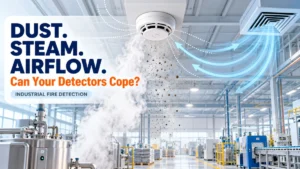
- Manufacturing and industrial plants: Industrial fire protection requires detection in harsh environments, such as dust, heat, fumes, and vibration. Edwards SIGA heat detectors and multi-sensor devices handle these conditions, while the EST platform’s diagnostic tools help maintenance teams manage large device populations across plant floors.
- Data centres: Uptime is the primary asset. A false evacuation costs more than most fire events would. EST’s algorithm-based detection and staged response protocols allow data centres to investigate events before triggering full evacuations, protecting both people and operations.
- Universities and campuses: A multi-building campus can operate as a single fire alarm network using EST’s multi-panel architecture. Facilities teams get a consolidated view of the entire estate from a single interface, simplifying monitoring and response coordination.
- Warehouses and logistics centres: High-bay warehouses with large open volumes and rapid occupancy changes benefit from addressable systems that can precisely locate an event among hundreds of detectors, directing response teams to the right location without searching an entire facility.
The Engineering Philosophy Behind EST Fire Alarm Systems
The design decisions embedded in the EST platform reflect a set of engineering principles that matter specifically for large-scale, long-lifecycle deployments.
- Reliability through redundancy: EST systems support Class A wiring configurations that maintain communication with all devices even when a single wire break occurs. Multi-panel network topologies eliminate single points of failure across campus-wide systems.
- Expandability without replacement: The modular hardware architecture of the EST4 and EST3 panels means that capacity can be added by inserting new modules rather than replacing the entire control unit. This protects the initial capital investment and simplifies future expansion.
- Long lifecycle planning: Enterprise fire alarm systems are typically expected to remain in service for 15–25 years. EST’s firmware upgrade capability and backward compatibility between generations mean that software improvements can extend platform capability without hardware replacement.
- System flexibility: Edwards SIGA modules, including monitor modules and relay modules, allow the system to interface with suppression systems, elevators, HVAC controls, and access control without proprietary gateways, supporting coordinated emergency response at the building level.
When Does an EST Platform Make More Sense?
| Building Type | Standard Platform | EST Intelligent Platform |
|---|---|---|
| Small retail (under 1,000 sqm) | Appropriate—cost-effective, straightforward | May be over-specified |
| Mid-size commercial office (1,000–10,000 sqm) | Viable for simple layouts | Preferred when integration or expansion is anticipated |
| Industrial plant | Limited—diagnostics and harsh-environment detection needed | Recommended—diagnostics, multi-sensor capability, scalability |
| Healthcare facility | Insufficient for complex response requirements | Required—occupancy-based response, device precision |
| High-rise commercial tower | Risk of inadequate scalability | Recommended—multi-panel networking, BMS integration |
| Data centre/mission-critical | High false-alarm risk with standard systems | Strongly recommended—staged response, algorithm-based detection |
| University / multi-building campus | Fragmented system management | Recommended—unified network monitoring |
| Airport / transport hub | Difficult to scale and integrate | Recommended—large device counts, integration-ready |
The decision is not about building prestige; it’s about matching system capability to operational requirements and long-term cost of ownership.
Common Misconceptions About Intelligent Fire Alarm Systems
- “Intelligent systems are only for very large buildings.” False. Mid-size commercial facilities benefit from intelligent detection for the same reasons large ones do: reduced false alarms, device-level diagnostics, and integration capability. The Edwards IO Series brings addressable intelligence to projects that don’t require the full scale of an EST3 or EST4 deployment.
- “They are too complex to maintain.” In practice, the opposite is often true. Remote diagnostics and automated fault reporting reduce the frequency of on-site inspection visits and make those visits more productive. Technicians arrive with specific fault data rather than performing full panel surveys.
- “Conventional systems always cost less over the long term.” Initial hardware costs may favour conventional systems, but lifecycle costs tell a different story. Higher false alarm rates generate direct costs (emergency service callouts, operational disruption), and limited scalability often requires full system replacement when buildings change. Intelligent systems typically deliver better total cost of ownership over a 15+ year lifecycle.
- “Intelligent systems are difficult to expand.” EST’s modular architecture is specifically engineered for expansion. Adding a new building wing, a new floor, or an entirely new facility to an existing EST network is a configuration exercise, not a system replacement.
Future Trends Driving Intelligent Fire Alarm Platforms
The capabilities available in current EST platforms reflect where the broader industry is heading:
- AI-assisted diagnostics: Event pattern recognition that distinguishes between environmental anomalies and genuine fire signatures is already embedded in SIGA detection algorithms. Future iterations will incorporate machine learning trained on large event datasets to further reduce false activation rates.
- Predictive maintenance: Rather than scheduled inspections, systems will generate maintenance recommendations based on real-time device performance data, predicting failures before they occur.
- Digital twin integration: Building information models (BIM) are increasingly paired with live fire alarm data to create real-time digital representations of building safety status, enabling faster and better-informed emergency response.
- Cloud-enabled monitoring: Remote monitoring platforms connected to EST systems allow facility managers and fire safety consultants to track system health across multiple sites from a single dashboard.
- Smart building convergence: As buildings integrate more systems under a unified BMS, fire alarm platforms need to communicate natively with HVAC, access control, lighting, and security systems. EST’s open integration architecture positions it for this convergence.
- IoT connectivity: Edge computing and IoT-enabled devices are expanding the data available to fire alarm platforms, ambient air quality, occupancy patterns, and environmental baselines that improve detection accuracy in context.
Best Practices for Choosing an Intelligent Fire Alarm Platform
For fire protection consultants and facility managers evaluating platforms:
- Define the 15-year scope: Will the facility expand? Add occupancies? Change use? Match platform scalability to anticipated growth.
- Assess false alarm risk: Environments with cooking, dust, steam, or chemical vapours require multi-sensor detection capability, not just standard smoke detectors.
- Evaluate integration requirements: Does the facility have a BMS? An access control system? Emergency communications? Confirm native integration support before specifying.
- Consider the maintenance model: Who will maintain the system? Remote diagnostic capability reduces on-site technician time and lowers ongoing costs.
- Audit wiring topology requirements: Large facilities benefit from Class A loop configurations that survive single-point wire faults. Confirm platform support.
- Check device range depth: A capable panel paired with limited detector options is a constraint. EST’s SIGA device range covers smoke, heat, multi-sensor, manual call points, monitor modules, and relay modules under a single ecosystem.
- Evaluate vendor support infrastructure: For complex systems, the quality of technical support, training, and spare parts availability matters as much as the product specifications. Consider EST Fire Alarm System distributors in India with proven project experience.
- Review compliance alignment: Ensure the platform meets local and national fire codes for the intended occupancy classification.
- Commissioning plan: Intelligent systems offer more commissioning tools (device-level testing, loop diagnostics) but require trained personnel. Factor training into the project plan.
- Understand firmware lifecycle: Confirm the vendor’s commitment to ongoing firmware support and compatibility with future device generations.
Read Also: Edwards Fire Alarm Ecosystem Explained: Panels, Detectors, Modules and Devices
Read Also: Why Edwards Is Considered a Premium Fire Alarm Platform Worldwide