A spark from a faulty conveyor motor. A slow smoulder inside insulation packed near a paint booth. A short circuit hidden behind a control cabinet at 2 a.m., when only two security guards are on site.
These are not rare scenarios. They are the everyday risk profile of a manufacturing plant.
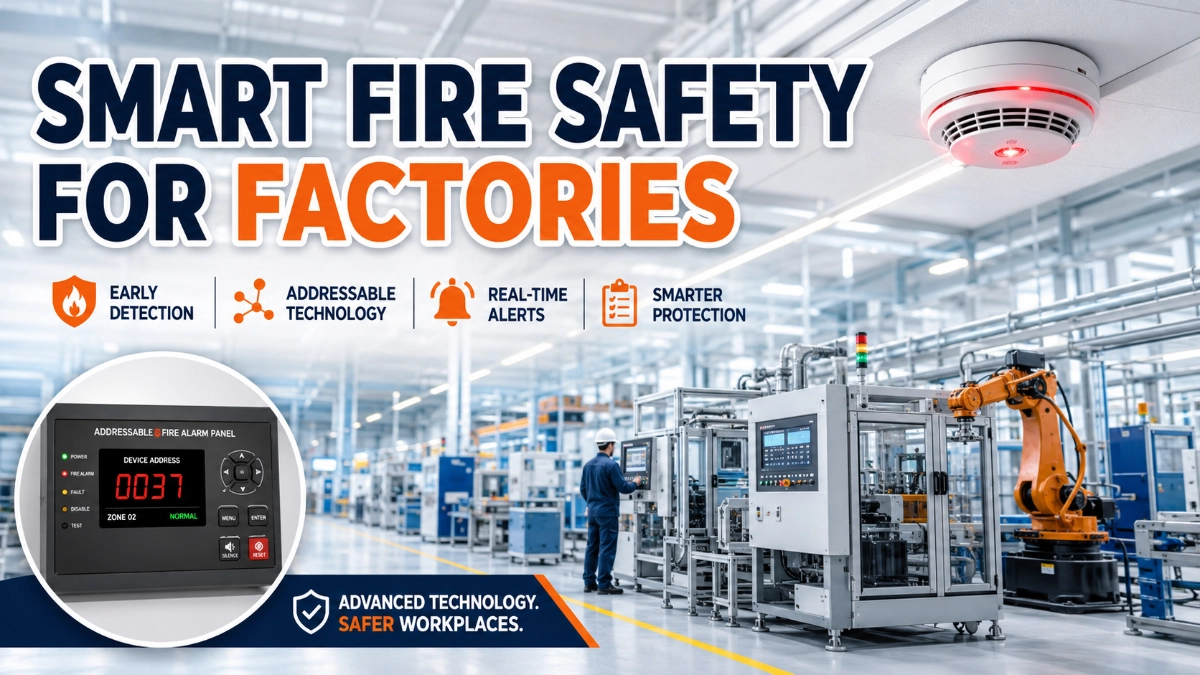
Industrial facilities are different from offices or retail spaces. They combine flammable materials, high electrical loads, continuous machine operation, and large open floor areas where fire can spread before anyone notices. A fire alarm system that tells you “something is wrong somewhere in the building” is not fast enough or precise enough for this kind of environment.
This is why more plant managers, EHS teams, and fire protection engineers are moving toward addressable fire alarm systems for high-risk manufacturing environments.
Unlike older, zone-based systems, an addressable fire alarm system identifies the exact device that detected a problem. That single difference changes how fast a facility can respond, how much damage a fire causes, and how quickly production can safely resume.
In this article, you will learn what addressable fire alarm systems are, how they work, why manufacturing facilities benefit from them, and what to consider when planning, installing, and maintaining one. We will also look at real industrial examples, compliance considerations, and common mistakes to avoid.
Why High-Risk Manufacturing Facilities Need Advanced Fire Detection
Manufacturing environments carry a combination of risks rarely found together in commercial buildings:
- Large, open floor plans with long detection and evacuation distances.
- Continuous or 24/7 operations, often with reduced night-shift staffing.
- Heavy electrical loads from motors, transformers, and control panels.
- Storage of flammable liquids, gases, dust, or packaging materials.
- Complex machinery that can mask early signs of overheating or smoke.
A generic zone alert in a facility this size gives responders very little to act on. Addressable technology solves this by narrowing the search from “somewhere in this 5,000 square meter zone” to “detector 14 on loop 2, near the mixing station.”
That precision directly affects response time, and response time is often the single biggest factor in whether a fire stays small or becomes a major loss.
Common Fire Hazards in Manufacturing Plants
Every manufacturing sector has its own risk pattern, but several hazards repeat across industries:
- Electrical faults in ageing wiring, overloaded panels, or poorly maintained motors.
- Combustible dust from wood, metal, grain, or textile processing.
- Flammable liquids and solvents used in coating, painting, or cleaning.
- Hot work such as welding, cutting, and grinding.
- Overheated machinery from bearing failure or lack of lubrication.
- Improper storage of packaging materials, pallets, or chemicals near ignition sources.
- HVAC and ventilation ducts that can rapidly carry smoke and heat throughout a building.
Understanding these hazards is the starting point for deciding where addressable detectors and devices should be placed.
Industries That Benefit Most
While almost any manufacturing facility benefits from addressable detection, some sectors face particularly high stakes:
| Industry | Primary Fire Risk | Why Addressable Systems Help |
|---|---|---|
| Chemical plants | Flammable vapours, reactive materials | Precise location reduces exposure time for responders |
| Pharmaceutical manufacturing | Cleanroom contamination risk, solvent use | Early detection prevents costly batch loss |
| Automotive factories | Paint booths, welding, large floor areas | Device-level ID speeds response across vast plant floors |
| Electronics manufacturing | Static-sensitive areas, small component fires | Detects small, slow-developing fires before spread |
| Food processing plants | Grease, dust, high-temperature equipment | Reduces contamination and production downtime |
| Textile factories | Combustible fibers, dust accumulation | Fast isolation limits fabric and machine loss |
| Warehouses | Large storage volumes, delayed visual detection | Pinpoints exact rack or aisle location |
| Logistics hubs | High-value goods, continuous throughput | Minimises disruption to time-sensitive operations |
How Addressable Systems Work
Addressable systems work by assigning a unique digital address to every device on a communication loop. The fire alarm panel continuously polls each device, and when smoke, heat, or manual activation is detected, the panel displays the specific device and its exact location.
The process generally follows these steps:
- Detection – A sensor (smoke, heat, or multi-criteria) senses a change in its environment.
- Signal transmission – The device sends its unique address and status to the control panel over the loop.
- Panel processing – The addressable fire alarm panel identifies the device, cross-references its programmed location, and evaluates the signal against pre-set thresholds.
- Alarm or pre-alarm decision – The panel decides whether to issue a pre-alarm (investigation stage) or a full alarm.
- Output activation – Connected systems such as alarms, suppression triggers, HVAC shutdowns, or BMS notifications activate based on programmed cause-and-effect logic.
- Notification – Facility staff, monitoring stations, or emergency services receive location-specific alerts.
This loop-based communication is what separates an addressable fire alarm panel from a conventional fire alarm panel, which can only report which zone, not which device, is triggered.
Intelligent Smoke and Heat Detection
Many addressable detectors use intelligent, multi-criteria sensing. Instead of relying on a single fixed threshold, they combine smoke density, heat rise rate, and sometimes carbon monoxide levels to judge whether a condition is a genuine fire risk or a false alarm source like welding fumes or dust.
This matters enormously in manufacturing, where dust, steam, and exhaust are part of daily operations. Intelligent detection reduces nuisance alarms, which in turn reduces the risk of staff becoming desensitised to alerts, a real and documented safety concern in industrial settings.
Device-Level Identification
Device-level identification means the fire alarm panel can display the precise detector, call point, or module that triggered an event, down to its physical location label, rather than a broad zone description.
For a facility with hundreds of detectors spread across multiple buildings, this level of detail is not a convenience; it is often the difference between a two-minute response and a twenty-minute search.
Zone Monitoring vs Device Monitoring
| Feature | Zone Monitoring (Conventional) | Device Monitoring (Addressable) |
|---|---|---|
| Fault location | General zone only | Exact device |
| Wiring complexity | Higher (per-zone circuits) | Lower (shared loop) |
| False alarm diagnosis | Difficult | Straightforward |
| Scalability | Limited | High |
| Cost per point (large systems) | Can be higher at scale | Generally more efficient |
| Suitability for large plants | Limited | Well suited |
Conventional detectors still have a place in small, low-risk buildings. But once a facility grows beyond a certain size or risk level, device-level monitoring becomes the practical standard.
Faster Emergency Response
Addressable fire alarms reduce downtime by allowing responders to go directly to the affected device instead of searching an entire zone, which cuts investigation time, limits fire spread, and reduces the scope of shutdown needed during an incident.
Faster location identification means:
- Security or fire wardens reach the source faster.
- Emergency services receive precise coordinates on arrival.
- Unaffected areas of the plant may continue operating instead of a full evacuation.
- Smaller fires are caught before they require full suppression system activation.
Integration with Building Management Systems (BMS)
Addressable panels commonly integrate with a facility’s BMS through protocols like BACnet or Modbus. This allows fire event data to appear alongside HVAC, lighting, and access control information on a single monitoring interface.
For plant managers overseeing multiple buildings, this centralised visibility supports faster decision-making without needing to physically check each fire panel location.
Integration with HVAC
Fire and smoke spread rapidly through ductwork if left unmanaged. Addressable systems can trigger automatic HVAC responses, such as:
- Shutting down specific air handling units.
- Closing fire and smoke dampers.
- Activating smoke extraction fans in affected zones only.
Because the system knows exactly which device triggered, it can target the response to the affected air handling zone rather than shutting down ventilation across the entire facility.
Integration with Fire Suppression Systems
In high-risk areas such as server rooms, paint booths, or chemical storage, addressable panels can be configured to trigger suppression systems such as clean agent, water mist, or sprinkler pre-action systems, automatically or after a confirmed second detection stage.
This staged approach, often called “cross-zoning” or “double-knock” detection, helps avoid unnecessary suppression discharge from a single false signal while still acting quickly on genuine fires.
Industrial IoT Compatibility
Modern addressable fire alarm panels increasingly support integration with Industrial IoT platforms. This allows fire event data, device health, and maintenance status to feed into broader plant analytics systems.
For facilities pursuing predictive maintenance strategies, this connectivity extends fire safety monitoring into the same digital ecosystem used for equipment uptime and asset management.
Remote Monitoring Capabilities
Many addressable systems support remote monitoring, allowing EHS managers or system integrators to view panel status, fault conditions, and alarm history from off-site locations. This is particularly valuable for facilities with multiple plants or limited on-site technical staff during night shifts.
Reducing Downtime During Emergencies
Addressable fire alarm systems reduce downtime by enabling targeted response instead of full-facility shutdown. Because the exact device and location are known, unaffected production lines can often continue operating while the affected area is investigated.
Unplanned downtime in manufacturing is expensive, not only from lost production but from restart procedures, quality checks, and potential contract penalties. Precise fault location directly supports business continuity.
Maintenance Advantages
Addressable systems simplify maintenance in several ways:
- Technicians can identify a faulty device without manually testing every unit in a zone.
- Devices can report contamination levels (dust build-up in smoke detectors), prompting cleaning before performance drops.
- Fault history is logged per device, supporting predictive maintenance planning.
- Loop wiring architecture reduces the number of cable runs technicians need to trace.
Compliance with NFPA and International Fire Standards
Fire alarm system design and installation in most jurisdictions must follow recognised codes and standards. Commonly referenced frameworks include:
- NFPA 72 (National Fire Alarm and Signalling Code), published by the National Fire Protection Association, which covers system design, installation, and testing requirements in the United States and is widely referenced internationally.
- EN 54, the European standard series covering fire detection and fire alarm system components.
- ISO 7240, the international standard series for fire detection and alarm systems, often used as a reference outside regions governed by NFPA or EN 54.
- OSHA requirements, where relevant, particularly around workplace fire safety and emergency action plans in the United States.
- Local fire authority regulations, which vary by country, state, or municipality and typically take precedence in final approval and inspection.
Specific compliance requirements vary significantly by jurisdiction, building type, and occupancy classification. Facility teams should always confirm applicable codes with a licensed fire protection engineer or local fire authority rather than relying solely on general guidance.
Scalability for Expanding Manufacturing Facilities
Manufacturing plants rarely stay the same size. Addressable loop architecture makes it comparatively straightforward to add new devices as a facility expands, since additional detectors and modules can often be added to an existing loop up to its rated capacity, without the extensive rewiring that zone-based conventional systems typically require.
This scalability is a major reason system integrators recommend addressable technology for facilities with planned expansion, whether that means a new production line, an additional warehouse bay, or a second building on the same site.
Common Mistakes When Selecting Industrial Fire Alarm Systems
- Underestimating device count needs during initial design, leading to costly loop expansions later.
- Ignoring environmental factors like dust, humidity, or vibration when selecting detector types.
- Ill-fitting integration planning not confirming compatibility with existing BMS or suppression systems early.
- Skipping a proper fire risk assessment before choosing panel capacity and zoning.
- Choosing based on price alone, without factoring in long-term maintenance and scalability.
- Overlooking cause-and-effect programming, which determines how the system responds to different triggers.
- Failing to involve a qualified fire protection engineer in the design phase.
Best Practices for Installation Planning
- Conduct a full fire risk assessment before finalising panel and device selection.
- Map hazardous zones separately from low-risk administrative areas.
- Plan loop architecture with future expansion capacity in mind.
- Coordinate with HVAC, BMS, and suppression system designers early in the project.
- Select detector types matched to specific environmental conditions in each area.
- Document device addressing and location mapping clearly for future maintenance teams.
- Involve local fire authorities early to confirm approval requirements.
Maintenance Checklist
| Task | Recommended Frequency |
|---|---|
| Visual inspection of panel and devices | Monthly |
| Functional test of detectors and call points | Quarterly (or per local code) |
| Battery backup testing | Quarterly |
| Full system test with fire authority notification | Annually |
| Detector sensitivity/contamination check | Annually |
| Cause-and-effect logic verification | Annually or after any system change |
| Documentation and log review | Ongoing |
Testing frequency should always follow applicable local codes and manufacturer recommendations, as requirements vary by jurisdiction and facility risk classification.
Future Trends in Smart Industrial Fire Protection
Fire detection technology in manufacturing is moving toward greater integration and intelligence:
- AI-assisted false alarm filtering, reducing nuisance triggers in dusty or high-humidity environments.
- Predictive analytics using device health data to flag maintenance needs before failures occur.
- Deeper IoT and digital twin integration, linking fire safety data with broader plant operations dashboards.
- Wireless addressable devices for easier retrofits in older facilities.
- Cloud-based remote monitoring, supporting multi-site facility management from a single interface.
These trends point toward fire alarm systems that function less as standalone safety equipment and more as an integrated part of overall plant intelligence.
Conclusion
Manufacturing environments present a fire risk profile that generic detection systems were never designed to handle. Large floor areas, continuous operations, and a mix of electrical, chemical, and combustible hazards all demand faster, more precise detection.
Addressable fire alarm systems address this gap directly. By identifying the exact device and location of an event, they support faster emergency response, more targeted downtime, and easier long-term maintenance advantages that compound as a facility grows.
Looking ahead, the direction is clear: fire detection is becoming more intelligent, more connected, and more integrated with the rest of a plant’s digital infrastructure, from BMS platforms to predictive maintenance tools.
For plant managers, EHS teams, and fire protection engineers evaluating a new or upgraded system, the practical path forward is straightforward. Start with a documented fire risk assessment, involve qualified fire protection professionals early, and select a system architecture, whether an addressable fire alarm panel or, in lower-risk areas, a conventional fire alarm panel that matches the facility’s actual hazard profile and growth plans.
Organisations exploring addressable detectors and GST fire alarm system components for Indian facilities can also consult a GST fire alarm system distributor in India, such as Innxeon Technologies, for product information. As always, installation, commissioning, and ongoing maintenance should be handled by qualified, licensed fire protection professionals in accordance with local codes.
Read Also: How Fire Alarm Networks Handle Multiple Emergency Events Simultaneously
Read Also: Why Fire Alarm Architecture Matters More Than Panel Specifications