Modern buildings rarely remain unchanged throughout their lifecycle. New floors are added, departments move, production lines expand, and safety requirements evolve. Intelligent fire alarm modules provide the flexibility that allows an addressable fire alarm system to adapt to these changes without redesigning the entire infrastructure.
Introduction
Every building owner faces the same challenge: the fire alarm system installed on day one rarely matches the building’s needs five or ten years later. Tenants change, floor plans get reconfigured, and equipment rooms multiply. A conventional, hard-wired fire alarm system treats every change as a construction project: new zones, new wiring runs, new panels.
Intelligent addressable fire alarm systems solve this differently. Instead of dedicating a fixed wiring zone to every device, they use intelligent modules to give each point its own address, diagnostic identity, and place on the fire alarm loop. This design shift is what separates a rigid, zone-based system from a flexible, scalable one. Consultants specifying platforms such as the EST Fire Alarm System rely on intelligent modules because they make phased expansion, retrofits, and third-party integration far easier to manage over the life of the building.
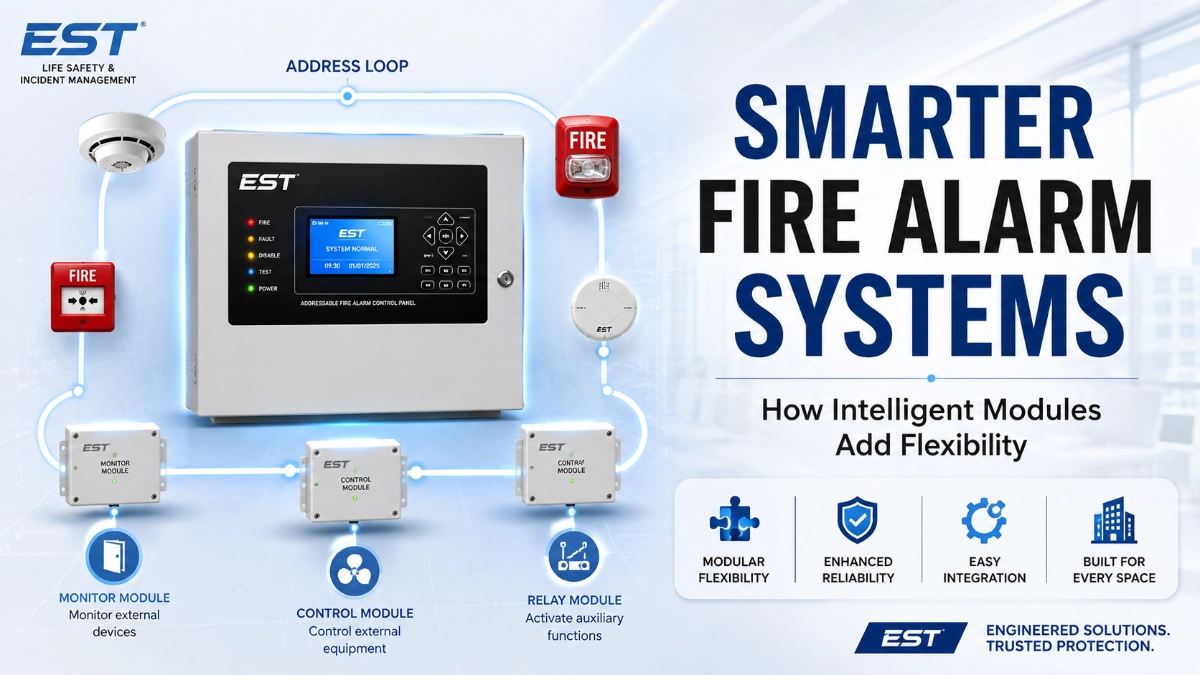
Intelligent modules are addressable devices that connect conventional inputs (detectors, call points, contacts) and outputs (relays, sounders, dampers) to an addressable fire alarm control panel. Each module has a unique address, allowing individual monitoring, diagnostics, and control. This design gives engineers the flexibility to expand, modify, and maintain fire alarm systems without rewiring entire zones.
What Are Intelligent Fire Alarm Modules?
Intelligent fire alarm modules are addressable field devices that interface conventional or third-party equipment with an intelligent fire alarm control panel. They translate signal inputs like smoke or contact closures, and outputs like relay activation into digital addresses the panel can individually identify, monitor, and control over the fire alarm loop.
In a conventional fire alarm system, the panel only knows that something triggered a zone. In an intelligent addressable fire alarm system, every device smoke detector, heat detector, manual call point, monitor module, or control module carries a unique address on the loop. The panel polls each address individually, so it knows exactly which device activated, where it is located, and what its status is (normal, alarm, trouble, or missing).
Intelligent modules extend this addressable architecture to equipment that isn’t inherently addressable: magnetic door holders, fire dampers, sprinkler flow switches, elevator recall relays, and HVAC shutdown circuits. Instead of running each back to the panel on its own dedicated circuit, the module places it on the shared fire alarm loop alongside detectors and notification appliances. This is the foundation that makes system flexibility possible.
Types of Intelligent Modules
Monitor Modules
Monitor modules supervise conventional input devices non-addressable smoke detectors, sprinkler waterflow switches, tamper switches, or dry contacts and report their state (normal, alarm, or trouble) under a unique address. A typical example: bringing a conventional heat detector in a mechanical room onto an addressable loop without a dedicated zone circuit.
Control Modules
Control modules let the panel command an output: switching on a notification circuit, releasing a magnetic door holder, or shutting down an air handling unit. Each is individually addressed, so the panel activates exactly the outputs required for a specific alarm condition.
Relay Modules
Relay modules provide dry contact outputs that interface the fire alarm system with external equipment, elevator controllers, access control, or a Building Management System (BMS) for actions like releasing electromagnetic locks or signalling an HVAC controller.
Input Modules
Input modules are a broader monitor-type category used to bring supervisory signals into the loop, such as a valve tamper switch or generator status contact, letting facility teams track life-safety-relevant conditions from the panel.
Output Modules
Output modules extend control capability to devices requiring supervised power or signalling, such as duct smoke detector fan shutdown, enabling programmable, address-specific responses rather than blanket activation.
How Intelligent Modules Improve Fire Alarm Flexibility
Intelligent modules improve flexibility by allowing devices to be added, relocated, or reprogrammed at the software level instead of through new wiring. Each module operates independently on the fire alarm loop, enabling phased expansion, simplified retrofits, device-level diagnostics, and integration with third-party systems- all without redesigning the panel’s core wiring architecture.
A few practical ways this plays out in real projects:
- Easier system expansion: Adding a module to an existing loop is often a matter of assigning an address and updating the panel’s database, not pulling new home-run wiring.
- Integration with third-party equipment: Relay and control modules act as a translation layer between the panel and elevators, HVAC controllers, access control, and the Building Management System (BMS).
- Device-level control: Because each module has its own address, engineers can program specific cause-and-effect logic, for example, releasing only the door holders on the affected floor.
- Simplified retrofits: Older conventional devices can be brought onto an addressable loop through monitor modules, extending their useful life during a system upgrade.
- Better zoning strategies: Addressable zoning is defined in software, so teams can reorganise zones as layouts change without rerouting conductors.
- Reduced wiring complexity: A single loop can carry dozens of addressable points, cutting conduit runs and home-run cabling.
- Improved maintenance efficiency: Technicians can see exactly which address is in trouble, narrowing troubleshooting to a single device instead of an entire zone.
Real-World Applications
- Hospitals: Patient floors are renovated often, and life-safety interfaces smoke doors, elevator recall, and HVAC smoke control must keep working through construction. Modules let contractors modify one wing at a time without disturbing systems elsewhere.
- Manufacturing plants: Production lines are reconfigured frequently. Control modules tied to process shutdown relays or dust collection systems can be reprogrammed as layouts change, without new conduit runs.
- Warehouses: Racking layouts and sprinkler zones evolve with storage needs. Monitor modules supervising water flow and tamper switches can be relocated as the facility is re-zoned.
- Data centres: Precision requirements around clean-agent suppression, damper control, and power shutdown make control modules essential for coordinating panel outputs with critical infrastructure.
- Universities: Multi-building campuses benefit from networked addressable panels such as the EST3 Fire Alarm Panel and EST4 Fire Alarm Panel where modules on each building’s loop report to a central life safety network.
- Commercial office buildings: Tenant improvement projects are constant. Modules enable reconfiguring notification circuits, door holders, and HVAC interfaces floor by floor as tenants move in and out.
Intelligent Modules vs Conventional Wiring
| Criteria | Intelligent Modules (Addressable) | Conventional Wiring |
|---|---|---|
| Flexibility | Devices reassigned or reprogrammed via software | Physical rewiring required for changes |
| Scalability | New modules added to existing loop | New zone circuits required for expansion |
| Maintenance | Device-level fault identification | Zone-level troubleshooting only |
| Expansion | Minimal disruption, phased rollouts possible | Often requires shutdown of entire zones |
| Diagnostics | Individual address status (normal/alarm/trouble) | Limited to zone-level status |
| Wiring Complexity | Single loop serves many devices | Dedicated home-run wiring per zone |
| Lifecycle Value | Adapts to building changes over decades | Fixed design, costly to modify long-term |
Best Practices for Module Planning
- Module placement: Locate modules close to the equipment they serve, in accessible junction boxes.
- Loop planning: Distribute modules across loops with spare capacity reserved for future devices; 15–20% headroom is a reasonable margin.
- Address allocation: Use a structured addressing scheme (by floor, zone, or system type) so technicians can interpret addresses without checking drawings.
- Documentation: Maintain an up-to-date device schedule mapping every address to its location and function.
- Future expansion: Size the panel and loop capacity for anticipated growth, not just current device count.
- Testing and commissioning: Verify each module’s input/output function individually, not just at the zone level.
Design Checklist
- Loop capacity reviewed against current and future device count
- Modules assigned logical, documented addresses
- Third-party interfaces (BMS, access control, elevators) mapped to relay modules
- Spare loop capacity reserved for expansion
- Device schedule and as-built drawings updated
- Each module tested individually during commissioning
- Cause-and-effect programming verified against life safety intent
Engineering Workflow: How Modules Interact With the Panel
- Field device activates or changes state: A heat detector trips, a waterflow switch closes, or a facility system sends a supervisory signal.
- The connected module detects the change and encodes it as a digital message tied to its unique address.
- The message travels over the fire alarm loop to the addressable fire alarm control panel.
- The panel identifies the exact address by cross-referencing it with the programmed device database to determine its location and type.
- The panel executes cause-and-effect logic, activating notification appliances, sending commands to control modules, or forwarding a signal to the BMS.
- Status is logged and displayed at the panel and any networked annunciators, giving staff device-level visibility.
Expert Insights
- Over-designing module capacity early often reduces total project cost later: Reserving loop capacity during installation is far cheaper than adding a new loop or panel during a future renovation.
- A common specification mistake is treating modules as an afterthought: Sizing loops for current devices only forces costly rework the first time a tenant improvement adds new interfaces.
- Phased building expansions benefit disproportionately from modular design: Campuses and hospitals built in phases can commission each new wing’s modules independently without disturbing devices already in service.
- Lifecycle planning matters more than initial installation cost: A system optimised purely for upfront price often lacks the spare addresses and headroom needed for decades of building change.
- Standardised addressing schemes pay off during emergencies: When responders and facility staff can interpret an address instantly, response time improves compared to arbitrary numbering.
Read Also: How Intelligent Modules Improve Fire Alarm Flexibility
Read Also: How Fire Alarm Networks Improve Operational Visibility