In life safety systems, failure is never an acceptable outcome. Whether protecting a hospital, airport, manufacturing plant, or data centre, modern fire alarm infrastructure is increasingly designed with redundancy to ensure critical functions continue operating even when individual components or communication paths fail. As buildings grow larger, more automated, and more interconnected, the margin for undetected downtime shrinks. This is why redundancy has moved from an optional upgrade to a foundational design principle in enterprise-grade fire alarm systems.
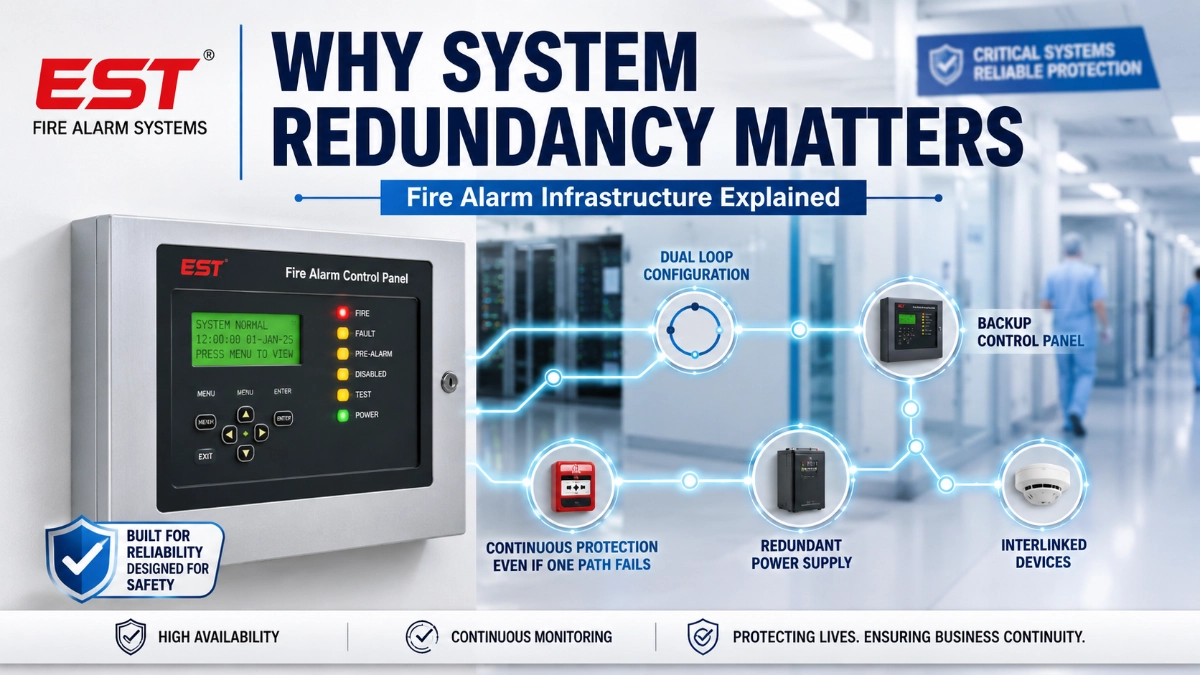
System redundancy in fire alarm infrastructure means designing overlapping components, communication paths, and power sources so that no single failure disables life safety functions. Redundant architecture keeps detection, signalling, and notification operational even during a fault, supporting high availability, fault tolerance, and uninterrupted business continuity in critical facilities.
What Is System Redundancy?
System redundancy is an engineering practice where critical components or pathways are duplicated so that if one fails, another automatically continues the function. In a fire alarm system, this could mean a second communication loop, a backup control panel, or an alternate power supply that activates instantly when the primary source is interrupted.
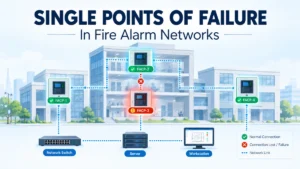
The purpose of redundancy is straightforward: eliminate single points of failure. A single point of failure is any component whose failure alone can bring down an entire system function. In life safety design, this is unacceptable, because a fire alarm system that stops working during a fire defeats its own purpose.
It’s worth distinguishing redundancy from simple duplication. Duplication just means having two of something. Redundancy means the second component is architected to seamlessly take over with automatic fault detection, failover logic, and no loss of monitoring during the transition. A spare panel in storage is duplication. A hot-standby panel continuously synchronised with the primary is redundancy.
A useful analogy: an aircraft carries two engines not because the first is expected to fail, but so it can still fly safely if it does. Fire alarm redundancy works the same way, giving the system fault tolerance and high availability under adverse conditions.
Why Redundancy Matters in Fire Alarm Infrastructure
Fire alarm systems exist to protect lives and assets continuously, not intermittently. Redundancy directly supports that mission in several ways.
- Continuous life safety protection: A redundant architecture ensures detection and notification remain active even if a device, module, or communication link fails, so occupants are never left unprotected during a fault condition.
- Reduced operational risk: Facilities with 24/7 operations, such as hospitals, data centres, and manufacturing lines, cannot tolerate unplanned life safety outages. Redundancy reduces the risk that a single wiring fault or panel issue disrupts protection across an entire building or campus.
- Faster recovery from faults: Redundant systems typically include diagnostic reporting that pinpoints the exact location of a fault, allowing technicians to isolate and repair issues without powering down the entire system.
- Improved business continuity: For facilities where downtime has a direct financial cost, redundant fire alarm networks help ensure that a localised fault doesn’t trigger a full building shutdown or evacuation protocol.
- Regulatory confidence: Life safety codes increasingly expect systems to demonstrate resilience, and a well-documented redundant design gives authorities having jurisdiction (AHJs) and insurers greater confidence in system reliability.
- Enterprise resilience: For multi-building campuses, redundancy at the network level ensures that a fault in one building’s fire alarm network doesn’t compromise visibility or control across the wider enterprise system.
Where Redundancy Is Used
Redundancy can be applied at multiple layers of a fire alarm system. Each layer addresses a different type of risk.
Control Panels
Redundant fire alarm control panels are sometimes configured as primary and standby units, ensuring that if one panel experiences a hardware fault, the other maintains monitoring and control without interruption. This is particularly relevant for large facilities relying on an addressable fire alarm system architecture spanning multiple buildings.
Communication Networks
The fire alarm network connecting panels, workstations, and annunciators benefits from redundant communication paths. If one network segment fails, traffic reroutes through an alternate path, preserving system-wide visibility.
Signaling Loops
Loop redundancy, often implemented as a Class A (looped) wiring configuration, allows a signalling line circuit to continue operating even if a single break occurs in the wiring, since the loop can be powered from both ends.
Power Supplies
Redundant power supplies combining primary AC power, secondary batteries, and in some cases a third backup source ensure that detection and notification remain active during a power interruption.
Network Gateways
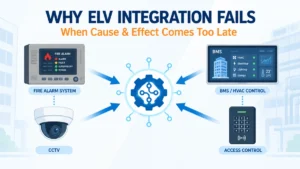
Gateways connecting the fire alarm network to a Building Management System (BMS) or enterprise monitoring platform benefit from redundant connections, so integration failures don’t blind facility teams to fire alarm status.
Notification Systems
Redundant notification appliance circuits ensure that if one circuit is compromised, occupants in the affected zone still receive audible and visual alerts through an alternate path.
System Redundancy vs Standard System Design
| Factor | Standard Design | Redundant Design |
|---|---|---|
| Reliability | Dependent on individual component uptime | Maintained even during component failure |
| Fault Tolerance | Limited; single faults can disable functions | High; automatic failover to backup paths |
| Downtime | Higher risk of extended outages | Minimised through isolated fault handling |
| Maintenance | Often requires partial system shutdown | Can be performed without full outage |
| Expansion | May require redesign as facility grows | Scales more predictably with planned architecture |
| Risk Management | Reactive, addressed after failures occur | Proactive, designed to prevent cascading failure |
| Lifecycle Value | Lower long-term resilience | Higher long-term operational value |
Industries That Benefit Most
- Hospitals operate continuously and house occupants who cannot self-evacuate quickly, making uninterrupted detection and notification essential.
- Airports combine large footprints and high occupant density, requiring fire alarm networks that stay functional across multiple terminals and concourses.
- Data centres depend on business continuity as much as life safety, since an undetected fault can carry significant financial consequences.
- Manufacturing plants often involve hazardous processes where a fire alarm outage could delay detection of a serious incident.
- Commercial campuses with multiple buildings need network-level redundancy so a fault in one structure doesn’t compromise monitoring across the property.
- Government facilities frequently have continuity-of-operations requirements that favour resilient, well-documented fire alarm architecture.
The Role of EST3 and EST4 in Enterprise Fire Alarm Infrastructure
Enterprise-grade platforms such as the EST3 Fire Alarm Panel and EST4 Fire Alarm Panel are commonly referenced in large-scale deployments because their architecture supports the layered redundancy concepts described above. These intelligent fire alarm system platforms are designed to scale from a single building to a multi-building enterprise fire alarm network over time.
Both platforms use addressable technology, meaning each connected device EST Smoke Detectors, EST Heat Detectors, EST Manual Call Points, EST Monitor Modules, EST Control Modules, EST Relay Modules, and EST Notification Appliances reports its individual status back to the panel. This granular diagnostic visibility is what makes redundant architecture practical: faults can be isolated to a specific device or loop segment rather than triggering uncertainty across the whole system.
For consultants specifying an EST Fire Alarm System built around EST Detectors and Devices, evaluating how the EST3 or EST4 platform integrates with redundant networking, standby panels, and BMS connectivity is a core part of the design process. Reviewing current manufacturer documentation and working with an authorised EST Fire Alarm System Distributor in India or regional partner is recommended for project-specific configuration guidance, since exact redundancy capabilities depend on firmware version and system configuration.
Best Practices for Designing Redundant Fire Alarm Systems
Designing effective redundancy requires more than adding extra hardware. Consider the following practices:
- Map single points of failure early: Identify every component whose failure alone would disable a critical function before equipment selection begins.
- Plan redundant communication paths: Design network topology with alternate routing in mind, not as an afterthought.
- Build in power supply resilience: Combine primary, secondary, and, where appropriate, tertiary power sources.
- Design for future scalability: Select an architecture that can expand without redesigning the redundancy scheme.
- Schedule preventive maintenance: Redundancy reduces risk, but it doesn’t eliminate the need for regular inspection and testing.
- Document the redundancy scheme: Ensure future technicians and consultants understand how failover is intended to work.
- Commission with fault-simulation testing: Verify that failover actually occurs as designed, not just on paper.
Redundancy Planning Checklist
- Identify all single points of failure in the proposed design
- Confirm loop redundancy (Class A wiring) where required
- Verify redundant or standby control panel configuration
- Confirm network path redundancy between panels and workstations
- Validate backup power sizing and transfer behaviour
- Test BMS/gateway failover connectivity
- Document all redundant pathways and failover logic
- Include fault-simulation testing in the commissioning plan
- Review maintenance access without requiring full system shutdown
- Plan for future expansion within the existing redundancy scheme
Common Mistakes to Avoid
- Assuming redundancy means duplicate hardware only: True redundancy requires automatic failover logic, not just a spare unit in storage.
- Poor network planning: Redundant panels lose much of their value if the network connecting them has no alternate path.
- Inadequate testing: Redundancy that has never been tested under simulated fault conditions is an assumption, not a verified capability.
- Ignoring ongoing maintenance: Redundant systems still require inspection; neglect can leave a backup path silently non-functional.
- Lack of documentation: Without clear records, future maintenance teams may not understand or trust the failover design.
- Designing without future expansion in mind: Redundancy schemes that can’t scale often need costly redesign as facilities grow.
Expert Insights
- Redundancy should be evaluated during conceptual design, not bolted on after equipment selection; retrofitting is far more disruptive and costly.
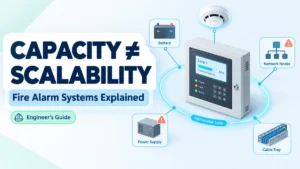
- Resilient architecture often delivers more long-term value than simply increasing panel capacity, since uptime and fault isolation matter more than raw device count.
- Redundancy meaningfully reduces operational downtime during maintenance, since technicians can service one path while the other keeps protecting the facility.
- Infrastructure resilience supports business continuity as much as fire safety; a fault that shuts down monitoring can be as costly to an enterprise as the fire risk itself.
- Consultants should evaluate lifecycle reliability rather than only initial project cost, since a lower upfront price can mean higher long-term risk exposure.
- Diagnostic granularity is what makes redundancy actionable; a system that can’t pinpoint a fault’s location makes failover harder to trust operationally.
- Redundancy decisions should be revisited whenever a facility expands, since added floors, buildings, or occupancy loads can shift where single points of failure exist.
Key Takeaways
- Redundancy eliminates single points of failure across critical fire alarm functions.
- True redundancy includes automatic failover logic, not just duplicate hardware.
- Loop, network, panel, and power redundancy each address different risk categories.
- Redundant architecture supports both life safety and business continuity.
- High-density and continuous-operation facilities benefit most from redundant design.
- Redundancy should be planned during conceptual design, not added later.
- Commissioning must include fault-simulation testing to verify failover behaviour.
- Documentation and preventive maintenance are essential to sustaining redundancy over time.
Read Also: Fire Alarm Infrastructure Trends Every Consultant Should Watch
Read Also: How Fire Alarm Systems Handle Simultaneous Emergency Events