Most enterprise fire alarm systems don’t fail overnight; they gradually become harder to maintain. Replacement parts become scarce, software support ends, expansion becomes difficult, and integration with newer building technologies becomes increasingly limited. Organisations that recognise these warning signs early can modernise strategically rather than react in an emergency.
Introduction
Every fire alarm system has a lifecycle. Panels, detectors, modules, and network components are designed, manufactured, supported, and eventually phased out as technology advances. This is normal in any engineered system, but in life-safety infrastructure, the consequences of ignoring that lifecycle are higher than in most other building systems.
Ageing fire alarm infrastructure creates operational and compliance challenges long before it stops functioning. Spare parts thin out, firmware updates stop, and technicians trained on legacy platforms become harder to find. Insurance and code officials often begin asking pointed questions during inspections.
Proactive lifecycle planning is almost always more effective and less expensive than emergency replacement. Facility owners who treat fire alarm modernisation as a scheduled infrastructure investment avoid the compressed timelines, higher costs, and life-safety exposure that come with reacting only after a critical failure.
Fire alarm system obsolescence occurs when a fire alarm control panel, its detectors, or its supporting software can no longer be reliably maintained, expanded, or supported by the manufacturer. This includes discontinued components, unavailable spare parts, and unsupported firmware. Organisations should manage it proactively through periodic audits, lifecycle budgeting, and phased modernisation rather than waiting for a failure.
What Is Fire Alarm System Obsolescence?
Fire alarm obsolescence describes the point at which a system’s hardware, software, or manufacturer support can no longer keep pace with the operational and safety demands of the building it protects. It is a lifecycle stage, not a single event.
- Product lifecycle: Like most electronic systems, a fire alarm control panel moves through active production, limited support, and eventual discontinuation, with manufacturers typically publishing lifecycle stages for major platforms.
- Hardware obsolescence: Circuit boards, power supplies, and proprietary modules are no longer manufactured, making repairs dependent on refurbished or salvaged stock.
- Software obsolescence: Programming tools, firmware, and diagnostic software eventually stop receiving updates, creating compatibility gaps with newer devices and networked building technologies.
- Support lifecycle: Manufacturer technical support, training, and certified technician availability decline as a platform ages, even if the hardware is still running.
- Ageing vs. obsolete: An ageing system is still supportable if parts are available, firmware is current, and technicians can service it. An obsolete system has crossed into unsupportable territory: at least one of those pillars is gone or going.
Why Fire Alarm Systems Become Obsolete
End of Manufacturer Support
When a manufacturer formally discontinues a fire alarm control panel platform, technical support, documentation updates, and firmware development stop, and facilities relying on it inherit growing risk with every passing year.
Limited Spare Parts Availability
As production winds down, replacement boards, power supplies, and proprietary modules become scarce, pushing facility teams toward secondary markets or cannibalised components and extending repair timelines during emergencies.
Outdated Communication Technology
Legacy systems built around older communication protocols struggle to integrate with modern monitoring services, IP-based reporting, or contemporary building management system (BMS) architectures.
Building Expansion Requirements
Older platforms often have limited addressable device capacity or network expansion options. As buildings add floors, wings, or tenant spaces, legacy panels reach their ceiling quickly.
Software Compatibility Issues
Programming software tied to obsolete operating systems can become difficult to run on current IT infrastructure, complicating routine programming changes and diagnostics.
New Regulatory or Operational Requirements
Updated fire codes, insurance requirements, or corporate safety standards sometimes exceed what a legacy addressable fire alarm system was originally designed to support.
Risks of Delaying Modernisation
Delaying fire alarm modernisation rarely eliminates cost; it usually just shifts it forward and adds risk.
- Higher maintenance costs from sourcing rare parts or paying premiums for legacy expertise.
- Longer repair times when a failed proprietary component has no available replacement.
- Increased downtime, including fire watches, temporary measures, and disrupted operations.
- Limited expansion capability, stalling renovations or tenant fit-outs needing more addressable devices.
- Integration difficulties with modern building management systems, elevator recall, or access control platforms.
- Greater operational risk, since each additional year on an unsupported platform raises the odds of an undetected failure mode.
- Budget uncertainty, as emergency replacements are procured under time pressure at higher cost than a planned project.
A manufacturing plant running a network past its supportable lifespan may face a multi-day production shutdown if a critical panel component fails and no replacement exists an outcome phased modernisation would have avoided.
Upgrade, Expand, or Replace?
Not every ageing system needs full replacement. The right strategy depends on how much of the platform remains supportable.
| Factor | Minor Upgrade | Partial Modernization | Full System Replacement |
|---|---|---|---|
| Cost | Low | Moderate | High |
| Downtime | Minimal | Scheduled, phased | Significant, project-based |
| Scalability | Limited | Improved | Maximized |
| Lifecycle Value | Short-term | Medium-term | Long-term |
| Future Readiness | Low | Moderate | High |
| Operational Impact | Low disruption | Managed disruption | Requires careful sequencing |
A minor upgrade suits systems that are ageing but still supportable, with firmware updates, panel component swaps, or device replacements within the same platform. Partial modernisation fits facilities with a mix of supportable and end-of-life components, allowing targeted replacement of the most critical elements. Full replacement is appropriate when the core fire alarm control panel is discontinued, unsupported, or structurally unable to meet current or future needs.
How EST3 and EST4 Support Long-Term Lifecycle Planning
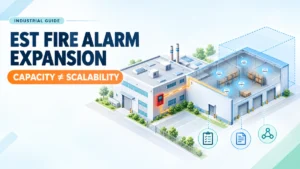
Enterprise-grade platforms illustrate how architecture choices influence long-term lifecycle management. The EST3 Fire Alarm Panel and the EST4 Fire Alarm Panel are examples of intelligent, addressable systems designed with modular expansion and networking in mind characteristics that matter directly for obsolescence planning.
Modular panel architecture allows facility teams to expand device capacity or add network nodes without replacing the entire fire alarm control panel. Intelligent networking capability supports multi-building or campus-wide fire alarm networks, which is particularly relevant for universities, hospitals, and large commercial towers managing several structures under one life-safety strategy.
Flexible device integration spanning smoke detectors, heat detectors, manual call points, monitor modules, control modules, and notification appliances lets facility teams standardise on a consistent device ecosystem across a portfolio of buildings, simplifying spare parts inventory and technician training. Platforms structured this way generally allow a phased system migration rather than a single disruptive cutover, easing integration with an existing EST Fire Alarm System installation and reducing the operational impact typically associated with large-scale replacement projects.
Consultant Framework for Managing Fire Alarm Obsolescence
A structured, repeatable framework helps consultants and facility teams move from reactive maintenance to proactive lifecycle planning.
- Audit existing infrastructure: Document every panel, device, and network component, with age and manufacturer status.
- Evaluate system health: Assess reliability trends, nuisance alarms, and recurring maintenance issues.
- Identify end-of-life components: Flag discontinued panels, modules, or devices no longer supported.
- Assess future building plans: Factor in renovations, expansions, or tenant changes affecting device count.
- Prioritise modernisation phases: Rank upgrades by risk, starting with unsupportable or safety-critical components.
- Budget for lifecycle upgrades: Build multi-year capital plans instead of relying on emergency repair budgets.
- Maintain documentation: Keep as-built drawings, device schedules, and firmware records current.
- Review periodically: Reassess every one to three years, since support timelines shift.
Real-World Enterprise Scenarios
- Hospital: Critical care areas migrate first under a phased plan, minimising disruption to occupied patient floors.
- Airport: Terminal-by-terminal modernisation keeps operations continuous while concourses are upgraded in planned windows.
- Manufacturing plant: Production-critical zones are prioritised early, reducing shutdown risk from an unsupported panel component.
- University campus: A networked, multi-building strategy standardises one addressable fire alarm system architecture across dorms, labs, and administrative buildings.
- Commercial office tower: Modernisation is coordinated with tenant fit-out cycles to limit disruptive after-hours work.
- Data centre: Redundant panel architecture and phased migration protect uptime commitments while legacy components are retired systematically.
Common Obsolescence Management Mistakes
- Waiting until equipment fails instead of budgeting for planned replacement.
- Ignoring firmware and software support timelines until programming tools stop working.
- Mixing incompatible technologies across a fire alarm network without verifying compatibility.
- Skipping lifecycle budget planning, leaving no capital reserved for phased upgrades.
- Incomplete documentation, which slows every future audit and upgrade project.
- Delaying expansion planning, forcing rushed decisions once a renovation is already underway.
Expert Insights
- Lifecycle planning should begin during original system design, not at end-of-life; a clear expansion path pays off a decade later.
- Phased modernisation is often more practical than complete replacement in occupied buildings, limiting impairment windows while keeping life-safety coverage continuous.
- Standardising devices across a facility, or a portfolio, simplifies future procurement, technician training, and spare parts inventory.
- Documentation quality directly influences modernisation success; incomplete as-built records routinely double audit time.
- Evaluate lifecycle costs, not just replacement costs; a cheaper panel with a shorter support window can cost more over fifteen years.
- Treating fire alarm infrastructure as a capital asset class, reviewed on the same cycle as HVAC or electrical systems, produces better outcomes than treating it as a maintenance line item.
Key Takeaways
- Obsolescence is a gradual lifecycle stage, not a sudden failure.
- Track manufacturer support status for every panel in your portfolio.
- Budget for modernisation years before end-of-life, not after.
- Use phased modernisation to reduce downtime in occupied buildings.
- Choose scalable, modular platforms to extend future system life.
- Maintain accurate, current documentation for every fire alarm network.
- Reassess system health on a recurring, scheduled basis.
- Treat obsolescence management as part of infrastructure planning, not a one-time project.
Read Also: Fire Alarm Integration Without Increasing System Complexity
Read Also: Why Large Campuses Need Scalable Fire Alarm Infrastructure