Supply chains have become more complex than ever. Manufacturers, warehouses, logistics providers, distributors, and retailers all depend on accurate, real-time information to keep operations moving. Even a small delay at one point in the chain can create significant disruptions downstream.
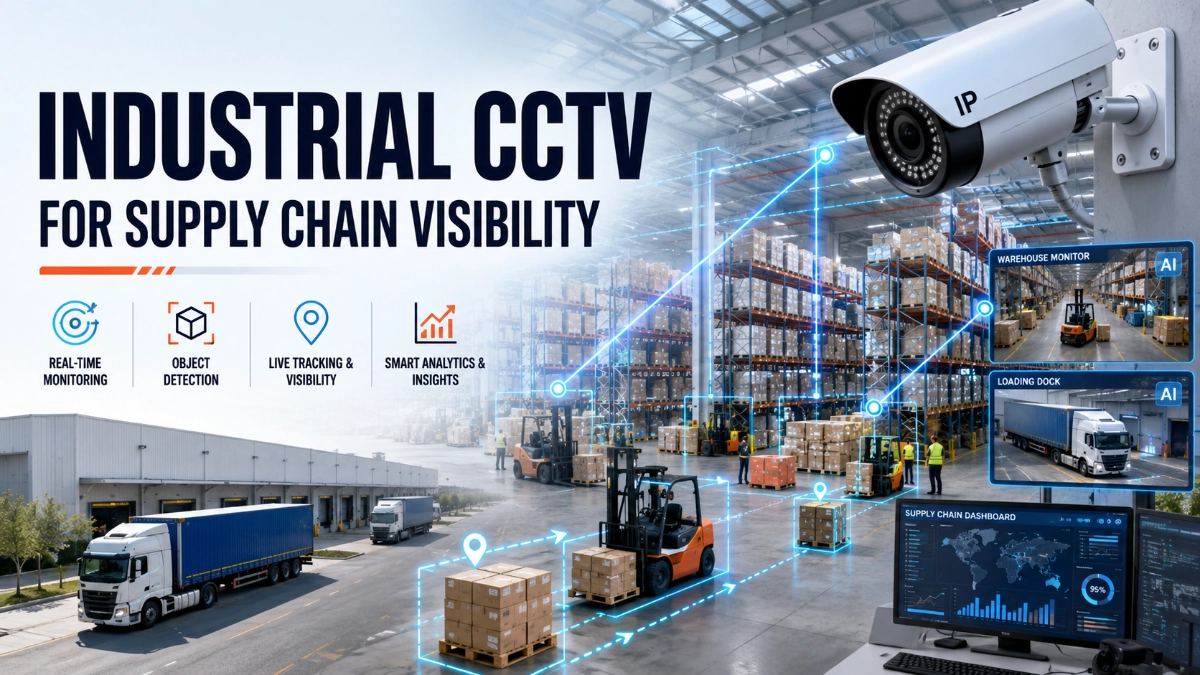
While businesses invest heavily in ERP software, warehouse management systems (WMS), RFID, barcode scanners, and IoT sensors, one technology continues to provide unmatched visual intelligence: industrial CCTV.
Modern industrial CCTV systems do much more than record footage. They deliver real-time operational visibility, improve warehouse efficiency, reduce inventory losses, enhance worker safety, and help managers make faster decisions based on actual visual evidence.
In this article, you’ll learn how industrial CCTV improves supply chain visibility, the technologies behind modern surveillance systems, key deployment areas, business benefits, and best practices for implementation.
Why Supply Chain Visibility Matters
Supply chain visibility refers to the ability to monitor products, assets, vehicles, personnel, and operational activities throughout the entire movement of goods.
Without visibility, organisations face problems such as:
- Inventory discrepancies
- Shipping delays
- Lost shipments
- Theft and pilferage
- Loading mistakes
- Safety incidents
- Poor operational planning
- Customer complaints
Every delay increases operational costs and affects customer satisfaction.
Industrial CCTV provides continuous visual monitoring that complements digital tracking technologies and allows managers to verify exactly what happened during every stage of operations.
What Is Industrial CCTV?
Industrial CCTV is a surveillance solution designed specifically for demanding environments such as:
- Manufacturing plants
- Warehouses
- Logistics hubs
- Cold storage facilities
- Distribution centers
- Ports
- Airports
- Mining operations
- Oil and gas facilities
Unlike conventional surveillance systems, industrial CCTV equipment is built for:
- 24/7 operation
- Dust and moisture resistance
- Wide temperature ranges
- High-definition imaging
- Long-distance monitoring
- Network integration
- AI-powered analytics
These systems capture operational events continuously while supporting centralised monitoring across multiple facilities.
How Industrial CCTV Improves Supply Chain Visibility
1. Provides Real-Time Warehouse Monitoring
Warehouses are often the busiest part of a supply chain.
Every minute includes:
- Goods receiving
- Inspection
- Sorting
- Packaging
- Picking
- Dispatch
- Inventory movement
Industrial CCTV gives supervisors instant visibility into these operations.
Managers can:
- Monitor receiving docks
- Observe loading activities
- Detect bottlenecks
- Identify idle equipment
- Verify staff movement
- Improve workflow planning
Instead of relying only on reports, managers see actual operations as they happen.
2. Tracks Goods Throughout Material Movement
Products move through multiple zones before reaching customers.
Typical movement includes:
Supplier
↓
Receiving Area
↓
Inspection
↓
Storage
↓
Picking
↓
Packing
↓
Loading Bay
↓
Transportation
Industrial CCTV captures each movement visually.
If products become damaged, delayed, or misplaced, recorded footage quickly identifies where the issue occurred.
This reduces investigation time significantly.
3. Reduces Inventory Losses
Inventory shrinkage remains one of the biggest challenges in supply chain management.
Losses occur because of:
- Theft
- Pilferage
- Misplacement
- Unauthorized handling
- Administrative errors
Strategically positioned cameras monitor:
- High-value inventory
- Storage aisles
- Loading docks
- Entry points
- Dispatch areas
Video evidence discourages theft while helping investigators resolve disputes quickly.
4. Improves Loading and Dispatch Accuracy
Shipping errors often happen during loading.
Common problems include:
- Wrong pallet loaded
- Incorrect truck assignment
- Damaged goods shipped
- Missing cartons
- Partial shipments
Industrial CCTV records the complete loading process.
Managers can verify:
- Vehicle arrival
- Loading sequence
- Package condition
- Vehicle departure
This improves accountability across logistics operations.
5. Enhances Employee Safety
Busy warehouses include:
- Forklifts
- Conveyor belts
- Heavy machinery
- Elevated racks
- Loading equipment
Industrial CCTV helps safety managers monitor risky activities.
Video recordings allow organisations to:
- Investigate accidents
- Improve training
- Identify unsafe behavior
- Ensure PPE compliance
- Reduce workplace incidents
Safer workplaces improve productivity and reduce operational disruptions.
6. Supports Multi-Site Operations
Many enterprises operate multiple warehouses across different cities.
Without centralised surveillance, maintaining visibility becomes difficult.
Modern IP-based industrial CCTV enables centralised monitoring where authorised users can:
- View live feeds
- Access recorded footage
- Monitor alarms
- Generate reports
- Verify incidents
This creates a unified view of operations regardless of facility location.
7. Strengthens Supplier Accountability
Supply chain visibility begins before products enter the warehouse.
CCTV installed at receiving docks documents:
- Delivery arrival time
- Vehicle condition
- Product unloading
- Quantity verification
- Packaging quality
When supplier disputes arise, recorded footage provides objective evidence.
8. Improves Customer Confidence
Customers increasingly expect shipment transparency.
Industrial CCTV helps organisations verify:
- Dispatch timing
- Product packaging
- Shipment handling
- Loading completion
This visual documentation supports customer service teams during delivery-related inquiries.
Areas Where CCTV Creates Maximum Supply Chain Visibility
Receiving Dock
Receiving docks experience continuous activity.
Surveillance helps verify:
- Delivery schedules
- Incoming quantities
- Package conditions
- Supplier compliance
Storage Area
Storage zones require constant monitoring because inventory remains there for extended periods.
Cameras help detect:
- Unauthorized access
- Inventory movement
- Safety violations
- Rack damage
Picking Area
Picking errors directly affect customer satisfaction.
CCTV verifies:
- Correct order picking
- Employee workflow
- Picking efficiency
Packaging Section
Packaging cameras ensure:
- Proper labeling
- Correct packaging
- Damage-free handling
- Order accuracy
Loading Bay
Loading bays are among the highest-risk areas for operational errors.
Video monitoring documents:
- Vehicle identification
- Loading completion
- Shipment sealing
- Departure timing
AI Features That Improve Supply Chain Visibility
Modern industrial CCTV systems increasingly incorporate artificial intelligence.
Key capabilities include:
Object Detection
AI identifies:
- Pallets
- Boxes
- Forklifts
- Vehicles
- Containers
Managers receive alerts when objects appear in restricted zones.
People Detection
The system distinguishes people from moving equipment.
This reduces false alarms while improving security.
Intrusion Detection
Unauthorised access after business hours generates immediate alerts.
Line Crossing Detection
Virtual boundaries monitor:
- Loading docks
- Restricted warehouses
- Storage areas
Managers receive notifications when someone crosses predefined zones.
Vehicle Detection
AI tracks:
- Trucks
- Delivery vans
- Forklifts
- Container vehicles
This helps logistics teams verify transportation activities.
Heat Mapping
Some advanced systems generate heat maps showing:
- Worker movement
- Traffic congestion
- Equipment utilization
Managers can optimise warehouse layouts using this information.
Integration with Warehouse Technologies
Industrial CCTV works best when integrated with existing business systems.
These include:
Warehouse Management System (WMS)
Managers can verify inventory events visually alongside warehouse transactions.
ERP Software
CCTV footage supports inventory audits and shipment verification.
RFID
RFID identifies products.
CCTV verifies their physical movement.
Together, they improve inventory accuracy.
Barcode Systems
Barcode scans indicate transaction completion.
Video footage confirms actual handling.
Access Control
Employee access events synchronise with surveillance footage.
Security teams quickly investigate unauthorised access attempts.
Fire Detection Systems
Industrial CCTV integrates with fire alarms to provide immediate visual verification during emergencies, helping responders assess conditions before entering affected areas.
Business Benefits Beyond Security
Many organisations install CCTV primarily for security.
However, operational improvements often provide even greater long-term value.
Higher Productivity
Managers identify workflow bottlenecks faster.
Better Resource Allocation
Visual data reveals underutilised equipment and inefficient processes.
Reduced Investigation Time
Instead of interviewing multiple employees, supervisors review recorded footage.
Improved Compliance
Video records support:
- Internal audits
- Safety inspections
- Insurance claims
- Regulatory compliance
Lower Operational Costs
Early detection of issues prevents expensive disruptions.
Choosing the Right Industrial CCTV Components
Selecting the appropriate hardware is essential for achieving reliable supply chain visibility.
Bullet Cameras
Bullet cameras are ideal for:
- Perimeter monitoring
- Parking areas
- Vehicle entry gates
- Loading docks
- Outdoor storage yards
Long-range imaging makes them effective for monitoring expansive industrial environments. Organisations evaluating Impact by Honeywell Bullet Cameras often choose them for outdoor applications where durability and clear long-distance coverage are important.
Dome Cameras
Dome cameras are commonly installed in:
- Warehouses
- Packaging lines
- Picking stations
- Office areas
- Production floors
Their compact design offers wide-angle coverage while making it difficult to determine the camera’s viewing direction. Businesses deploying Impact by Honeywell Dome Cameras can achieve discreet yet comprehensive indoor monitoring.
Network Video Recorders (NVRs)
A reliable recording platform is essential for storing and managing surveillance data.
Modern Impact by Honeywell NVR’s support:
- Centralised video management
- High-capacity storage
- Remote access
- Multi-camera recording
- Video search and playback
- Secure user management
These features simplify investigations and support long-term operational analysis.
Best Practices for Industrial CCTV Deployment
To maximise supply chain visibility:
Conduct a Site Survey
Identify:
- Critical operations
- Blind spots
- Traffic flow
- High-risk zones
Use High-Resolution Cameras
Clear video improves identification during investigations.
Optimise Camera Placement
Avoid overlapping coverage while eliminating blind spots.
Ensure Reliable Network Infrastructure
Industrial Ethernet networks improve uptime and video reliability.
Implement Role-Based Access
Limit video access according to employee responsibilities.
Maintain Regular System Health Checks
Routine inspections ensure cameras remain operational and properly aligned.
Why Scalability Matters
Supply chains continue evolving.
Organisations may expand by:
- Opening new warehouses
- Adding production lines
- Increasing distribution centres
- Growing transportation fleets
A scalable IP surveillance system allows new cameras, storage, and monitoring stations to be added without redesigning the entire infrastructure.
This flexibility protects long-term investments while supporting business growth.
Selecting a Trusted Technology Partner
Hardware quality plays a significant role in surveillance performance, but selecting the right supplier is equally important. Businesses planning new installations or expanding existing systems should work with experienced providers that understand industrial environments, networking requirements, and future scalability.
Solutions such as Impact by Honeywell CCTV are widely recognised for supporting reliable surveillance across manufacturing facilities, warehouses, logistics hubs, and commercial sites. Organisations looking for procurement support can also work with an Impact by Honeywell Distributor in India to source genuine products and build solutions that align with their operational needs without overcomplicating deployment.
Conclusion
Supply chain visibility is no longer limited to tracking shipments through software dashboards. Organisations also need visual confirmation of how goods, people, and equipment move across every stage of their operations.
Industrial CCTV bridges the gap between digital data and real-world activity. By providing continuous monitoring, AI-powered analytics, centralised management, and seamless integration with warehouse technologies, these systems help businesses reduce losses, improve operational efficiency, strengthen safety, and make faster, evidence-based decisions.
As supply chains become increasingly automated and geographically distributed, investing in scalable industrial surveillance is a strategic move rather than simply a security upgrade. When deployed thoughtfully with the right cameras, recording infrastructure, and trusted technology partners, industrial CCTV becomes a valuable source of operational intelligence that supports resilient, efficient, and transparent supply chain management.
Read Also: CCTV Strategies for Large Distribution Centres
Read Also: Choosing Surveillance Infrastructure That Can Scale With Business Growth