Industrial CCTV design often starts with a simple question: How much area can we cover with the available cameras?
That sounds logical. However, coverage alone does not tell you whether a surveillance system will actually protect a facility.
A camera may cover a large warehouse floor but fail to identify a person at a critical entry point. Another camera may provide a wide view of a production area but miss important details because of poor lighting, glare, vibration, or the wrong mounting height.
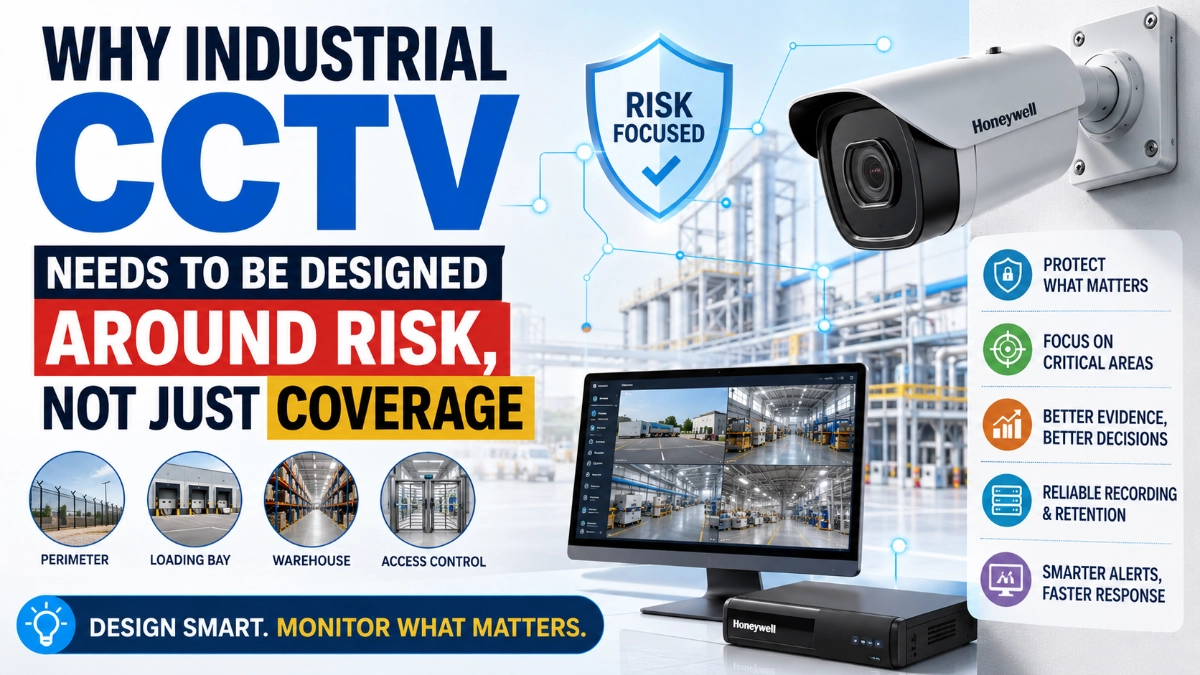
That is why effective industrial CCTV design should start with risk, not just coverage.
A risk-based CCTV system asks a different set of questions:
- What assets need protection?
- Where can an incident occur?
- Who needs to be identified?
- What events should trigger an alert?
- Which areas require continuous monitoring?
- How much detail must the video provide?
- How long should recordings remain available?
- What happens if a camera, network connection, or NVR fails?
The goal is not to install the maximum number of cameras. The goal is to create a surveillance system that provides the right visibility at the right locations for the right risks.
What Is Risk-Based CCTV Design?
Risk-based CCTV design means planning surveillance around the threats, assets, people, processes, and operational consequences within a facility.
Instead of saying, “We need one camera for every 500 square feet,” an engineer first studies the site.
For example, a manufacturing facility may have:
- Main gates
- Employee entrances
- Loading bays
- Raw material storage
- Finished goods warehouses
- Production lines
- Server or control rooms
- Fuel or chemical storage
- Parking areas
- Perimeter fencing
- Restricted-access rooms
- Emergency exits
Each location has a different security requirement.
A warehouse aisle may need reliable activity detection. A vehicle gate may require clear identification of license plates. A restricted room may need facial identification and access-event correlation.
Therefore, one camera type or one coverage rule cannot solve every surveillance requirement.
Why Camera Coverage Alone Can Be Misleading
Coverage tells you what a camera can see.
It does not necessarily tell you what the camera can prove.
Consider a camera mounted high above a factory entrance. It may provide an excellent wide-angle view. However, a person’s face may occupy only a small portion of the image.
The camera technically covers the entrance.
Yet, if an incident occurs, the footage may not provide enough detail to identify the individual.
This is one of the biggest differences between basic CCTV planning and professional surveillance design.
A good design considers:
Coverage + image detail + lighting + viewing angle + operational purpose + recording + response.
In other words, the question should not be:
“Can the camera see the area?”
The better question is:
“Can the system provide useful evidence when something goes wrong?”
Start With a Risk Assessment
Before selecting cameras, engineers should identify the major risks within the facility.
A simple risk assessment can classify areas such as:
1. Critical areas
These areas could cause major operational, financial, or safety consequences if compromised.
Examples include:
- Control rooms
- Server rooms
- High-value storage
- Critical production equipment
- Restricted process areas
These locations may require higher image quality, continuous recording, redundancy, and stronger access controls.
2. High-traffic areas
These include:
- Main entrances
- Employee gates
- Loading docks
- Reception areas
- Parking entrances
The objective may involve identifying people, vehicles, or unusual activity.
3. Low-risk areas
These may only require general situational awareness.
Examples include:
- Open warehouse spaces
- General corridors
- Peripheral areas
These locations may not need the same camera specifications as critical zones.
This approach helps prevent both under-design and over-design.
Define What the Camera Must Achieve
One of the most useful questions in CCTV design is:
What do we need to know from this camera?
The answer determines the camera specification.
For example:
| Surveillance objective | Typical requirement |
|---|---|
| General monitoring | Wide area visibility |
| Intrusion detection | Reliable detection of movement |
| Person identification | Sufficient facial detail |
| Vehicle monitoring | Clear vehicle and plate visibility |
| Process monitoring | Detailed view of equipment or activity |
| Perimeter security | Long-range detection and verification |
| Evidence collection | High-quality recording and retention |
This distinction matters because a camera designed for detection is not automatically suitable for identification.
Choose Bullet and Dome Cameras Based on Risk
The camera form factor should also align with the application.
Bullet cameras
Bullet cameras can work well for applications that require a more directional field of view.
They are often useful for:
- Perimeter monitoring
- Long corridors
- Parking areas
- Gates
- Building approaches
- Outdoor monitoring
For example, an industrial site may use Impact by Honeywell bullet cameras as part of a perimeter strategy where the camera needs to focus on a defined direction.
However, engineers should select the camera based on its actual performance and environmental requirements, not simply because it is a bullet camera.
Dome cameras
Dome cameras can provide a more discreet installation and work well in many indoor environments.
They may suit:
- Offices
- Corridors
- Retail or commercial areas within industrial facilities
- Reception areas
- Production environments
- Indoor warehouses
Impact by Honeywell dome cameras can be considered when the application benefits from a compact dome form factor.
The key point is simple: camera shape should follow the application, not replace application analysis.
Lighting Can Change the Entire CCTV Design
A camera that performs well during the day may produce poor evidence at night.
Industrial sites often contain difficult lighting conditions such as:
- Bright sunlight
- Backlighting
- Headlights
- Low-light warehouses
- Uneven illumination
- Reflective metal surfaces
- Welding flashes
- Dust or haze
Therefore, engineers should evaluate the scene under actual operating conditions.
For example, a camera facing an entrance may encounter strong sunlight behind a person during certain hours. Without suitable image-processing capabilities and proper positioning, the person’s face may become too dark.
Similarly, a camera pointed toward vehicle headlights can experience strong glare.
Risk-based design therefore considers when and how the area is used, not only where it is located.
Camera Placement Matters More Than Camera Count
Adding cameras does not automatically improve security.
Poor placement can create:
- Blind spots
- Overlapping views with little additional value
- Poor facial angles
- Reflections
- Excessive backlighting
- Difficult maintenance access
- Unnecessary network traffic
- Higher storage requirements
Instead, engineers should position cameras around specific risk points.
For example, a loading bay may require separate views for:
- Vehicle approach
- Driver identification
- Loading activity
- Warehouse entrance
- Surrounding perimeter
One wide camera may cover the entire loading bay, but several purpose-built views may provide far stronger evidence.
Don’t Forget the NVR
CCTV design does not end at the camera.
The recording infrastructure is equally important.
Impact by Honeywell NVRs can form the recording layer of an IP surveillance system, but engineers should size the NVR according to the complete system requirement.
Important factors include:
- Number of cameras
- Camera resolution
- Frame rate
- Compression
- Recording mode
- Retention period
- Storage capacity
- Network bandwidth
- Redundancy requirements
- Future expansion
A common mistake is to select cameras first and think about storage later.
That can create problems.
Higher-resolution cameras generate more data. Longer retention also increases storage requirements. Analytics can add processing demands.
Therefore, camera selection, network design, and recording architecture should develop together.
Design Around Events, Not Just Video
Modern industrial CCTV can do more than continuously record video.
Depending on the system and application, video analytics can help identify events such as:
- Line crossing
- Intrusion into restricted zones
- Loitering
- Object removal
- Unusual movement
- People entering prohibited areas
- Vehicle movement
This can make surveillance more useful because operators do not have to watch every camera continuously.
However, analytics should support a clearly defined security objective.
For example, if unauthorised entry into a chemical storage area is the concern, the system should focus on detecting entry into that zone.
That is much more useful than enabling every available analytic feature without a defined purpose.
Cybersecurity Is Also Part of CCTV Risk
An IP CCTV system is part of the organisation’s digital infrastructure.
Therefore, cybersecurity should become part of the design process.
Engineers should consider:
- Strong device credentials
- Role-based access
- Network segmentation
- Secure remote access
- Firmware management
- User activity monitoring
- Regular system maintenance
- Controlled access to recordings
A CCTV system may protect physical assets while also creating a digital security risk if it is poorly configured.
That is why physical security and cybersecurity should work together.
Plan for Failure
A professional CCTV design should also ask:
What happens when something fails?
Consider a critical perimeter camera.
If that camera loses power or network connectivity, does the system generate an alert?
What happens if the NVR becomes unavailable?
Can critical footage survive a storage failure?
Can technicians quickly identify the failed device?
Risk-based design includes these questions because a security system is most valuable when something unusual happens.
For critical applications, engineers may consider appropriate redundancy for power, networking, storage, or recording infrastructure based on the site’s risk level.
CCTV Design Should Consider Future Expansion
Industrial facilities rarely remain unchanged.
A company may add:
- New production lines
- Warehouse extensions
- Additional gates
- More storage areas
- New buildings
- More employees
- New security requirements
Therefore, the initial CCTV design should allow reasonable expansion.
This can include:
- Additional network capacity
- NVR expansion capability
- Spare switch capacity
- Structured cabling provisions
- Scalable camera management
- Appropriate storage planning
A slightly forward-looking design can prevent expensive redesign later.
A Practical Risk-Based CCTV Design Process
Engineers can follow a simple sequence.
Step 1: Identify critical assets
List the people, equipment, information, materials, and areas that require protection.
Step 2: Identify threats
Consider intrusion, theft, unauthorised access, vandalism, process violations, and other site-specific risks.
Step 3: Classify locations
Separate areas into critical, high-risk, medium-risk, and general-monitoring zones.
Step 4: Define the surveillance objective
Decide whether each camera must detect, recognise, identify, monitor, or provide evidence.
Step 5: Select the camera
Choose the appropriate resolution, lens, IR capability, environmental rating, mounting style, and analytics.
Step 6: Plan the network
Calculate bandwidth, PoE requirements, uplinks, segmentation, and future capacity.
Step 7: Design recording
Calculate storage based on camera count, resolution, recording mode, frame rate, and retention requirements.
Step 8: Plan alerts and response
Define who receives alerts and what action follows an event.
Step 9: Consider failure scenarios
Review power, network, camera, storage, and system-management failures.
Step 10: Test the design
Validate camera views under real operating conditions, including day, night, changing light, and normal site activity.
Common CCTV Design Mistakes
Several mistakes appear repeatedly in industrial surveillance projects.
Mistake 1: Designing only from a floor plan
A floor plan shows physical space. It does not show lighting, movement, reflections, or operational behaviour.
Mistake 2: Using the same camera everywhere
Different locations have different objectives.
Mistake 3: Chasing resolution instead of usable detail
Higher resolution cannot compensate for poor positioning, unsuitable lenses, or difficult lighting.
Mistake 4: Ignoring storage
A high-resolution system can create significant storage requirements.
Mistake 5: Treating CCTV as a standalone system
Modern IP surveillance depends on power, networking, storage, cybersecurity, and system administration.
Mistake 6: Forgetting maintenance
Dust, vibration, weather, construction changes, and equipment failures can reduce performance over time.
The Role of a Qualified CCTV Partner
The quality of a CCTV system depends not only on the equipment but also on the design and implementation.
A qualified Impact by Honeywell distributor in India or system integrator can help engineers evaluate the application, select suitable equipment, plan the architecture, and align the system with the facility’s operational requirements.
The right approach is not to ask:
“How many cameras can we install?”
Instead, ask:
“What risks must this system help us manage, and what evidence will we need when an incident occurs?”
That shift can significantly improve CCTV planning.
Read Also: The Hidden Engineering Behind a Reliable Enterprise CCTV Network
Read Also: How Edge Intelligence Is Changing Enterprise CCTV Architecture