Enterprise CCTV is moving beyond the traditional model in which cameras send video to a central recorder for storage and monitoring. As organisations deploy hundreds or thousands of cameras across offices, factories, warehouses, campuses and retail locations, processing every video stream centrally can create challenges around bandwidth, latency, storage and scalability.
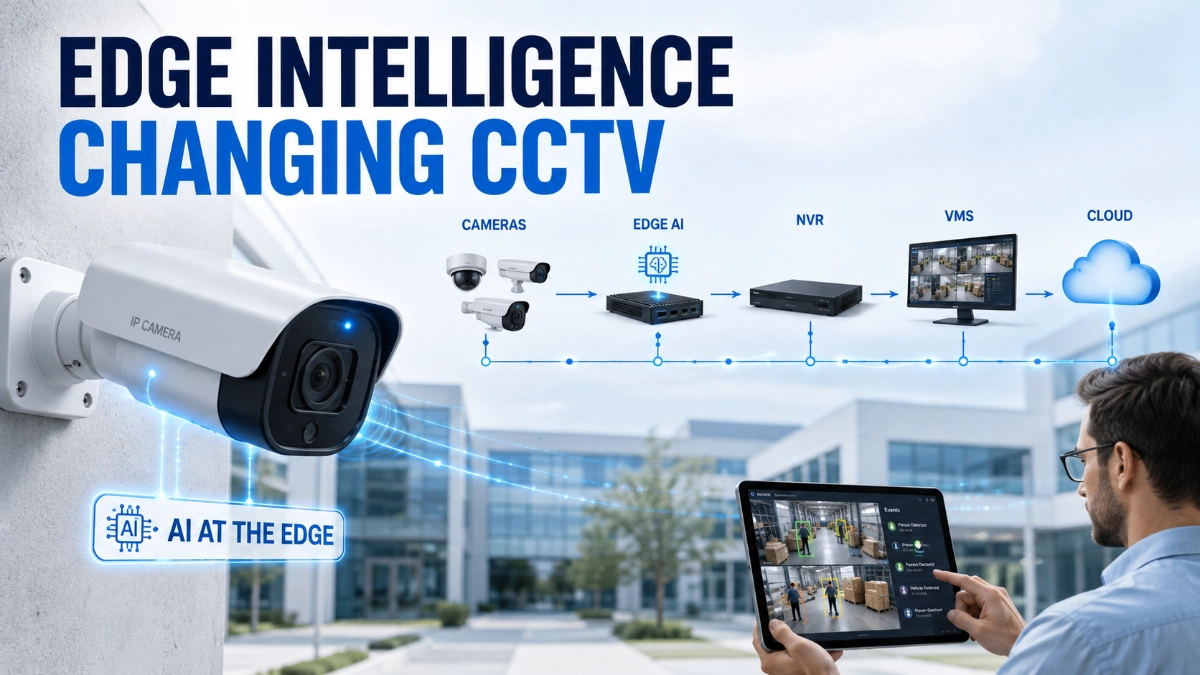
Edge intelligence is changing this architecture by moving more video analysis closer to where the footage is captured. Instead of sending every frame to a central server for analysis, intelligent cameras or edge devices can identify relevant events locally and send useful metadata, alerts or selected footage to the central platform.
This shift does not mean that NVRs, VMS platforms or centralised monitoring are becoming irrelevant. Instead, enterprise CCTV is increasingly adopting a distributed architecture in which cameras, edge devices, NVRs, VMS platforms and cloud services each perform the tasks they are best suited to handle.
What Is Edge Intelligence in CCTV?
Edge intelligence refers to processing and analysing video data near the camera or on another local edge device, rather than sending all raw video to a centralised server or cloud platform.
For example, an intelligent camera may analyse a scene and determine:
- Whether a person entered a restricted area
- Whether a vehicle crossed a virtual line
- How many people entered a facility
- Whether an object was left in a monitored zone
- Whether unusual movement occurred
- Which video segment requires attention
The system can then generate metadata or an event while continuing to record video according to the organisation’s retention policy.
ONVIF’s Profile M specifically addresses the exchange of analytics metadata and events between edge devices, VMS platforms, NVRs, cloud services and other applications. This creates a standardised pathway for connecting video analytics with broader security and IoT systems.
Why Does Edge Intelligence Matter?
The biggest change is simple: CCTV cameras are no longer just capture devices.
They are becoming intelligent endpoints within the enterprise security network.
A conventional architecture may look like:
Camera → Network → NVR/VMS → Central Analytics → Operator
An edge-intelligent architecture can look more like:
Intelligent Camera → Local Analytics → Metadata/Event → NVR/VMS → Operator
The difference becomes significant when an organisation operates a large number of cameras across multiple locations.
1. Edge Intelligence Reduces Unnecessary Network Traffic
High-resolution CCTV generates substantial network traffic. A large enterprise may have hundreds of 4MP, 8MP, or higher-resolution cameras continuously transmitting video.
If every stream travels to a centralised analytics server, the network must carry the full video load.
Edge analytics changes the equation.
The camera can analyse the video locally and communicate an event or metadata when something relevant occurs. The organisation can still retain continuous recording where required, but analytics-driven workflows do not necessarily require every frame to travel to a central processing location.
This is particularly useful for:
- Multi-building campuses
- Warehouses
- Manufacturing plants
- Retail chains
- Airports and transportation facilities
- Remote sites
- Distributed enterprise offices
A recent Indian government technical architecture document also describes edge-to-cloud surveillance as a way to perform local AI inference while sending structured alerts and relevant clips instead of continuously moving all raw video to centralised infrastructure.
Engineering takeaway: When designing an enterprise CCTV network, calculate bandwidth separately for continuous recording, live viewing, analytics metadata and event-driven traffic.
2. Faster Detection and Response
Centralised analytics introduces a network dependency between the camera and the analytics engine.
Edge processing reduces this dependency because the initial analysis happens close to the source.
Consider a warehouse perimeter.
A camera detects a person crossing a restricted boundary. Instead of sending the complete video stream to a remote analytics server and waiting for the server to process it, the camera can generate the event locally.
The security platform can then receive:
Event → Camera ID → Timestamp → Object information → Relevant video
This can support faster operator notification and automated workflows.
However, engineers should avoid treating edge processing as a guarantee of zero latency. Real-world response time still depends on camera processing capability, network design, VMS configuration, event rules and downstream systems.
3. CCTV Architecture Is Becoming Distributed
One of the most important architectural changes is the move from a centralised intelligence model to a distributed intelligence model.
In a traditional system, the NVR or server may handle much of the recording and analytics workload.
In a modern enterprise architecture, responsibilities can be distributed:
| Layer | Typical responsibility |
|---|---|
| Camera | Video capture, imaging and local analytics |
| Edge device | Additional AI processing or aggregation |
| Network | Transport, segmentation and prioritisation |
| NVR | Recording, playback and storage |
| VMS | Central management and visualization |
| Cloud | Remote access, fleet management and selected analytics |
| Enterprise systems | Access control, alarms, IoT and business workflows |
This architecture allows organisations to select where each workload should run.
For example, time-sensitive perimeter detection may run at the edge, while long-term reporting can remain centralised.
4. NVRs Still Matter in an Edge-Intelligent System
A common misconception is that edge AI will eliminate the need for NVRs.
In many enterprise environments, that is unlikely.
NVRs continue to provide important functions such as:
- Video recording
- Playback
- Storage management
- Camera management
- User access
- Event review
- Centralised evidence handling
The architecture simply becomes more intelligent.
For example:
Camera: Detects an event
NVR: Records and stores the associated video
VMS: Displays the event to the operator
Enterprise platform: Uses the event to trigger another workflow
Impact by Honeywell’s IP Series NVRs, for example, are available in multiple channel capacities and support H.265/H.264 compression, multiple HDD configurations and high-resolution video. Honeywell also describes smart features for video analysis and storage optimisation.
For larger deployments, Honeywell’s Impact Value series NVRs are listed with capacities extending from 16 to 256 channels, multiple HDD options, AI support and RAID configurations on supported models.
This illustrates an important point: edge intelligence and centralised recording are complementary technologies, not competing ones.
5. The Camera Becomes an Intelligent Endpoint
The growth of edge intelligence changes how engineers should evaluate cameras.
Resolution is still important, but it is no longer the only specification that matters.
A modern enterprise camera evaluation should also consider:
- Available analytics
- Processing capability
- Supported metadata
- Event handling
- Storage options
- Compression
- Cybersecurity features
- ONVIF compatibility
- Low-light performance
- Environmental rating
- Integration with the selected VMS
This makes camera selection more architectural than purely optical.
For example, Impact by Honeywell bullet cameras may be considered for applications where longer viewing distances and directional coverage are important, while Impact by Honeywell dome cameras can be appropriate for indoor or visually sensitive installations where a compact form factor is preferred.
The right camera should be selected according to the scene, mounting position, detection objective and system architecture, not simply by choosing the highest megapixel count.
6. Metadata Is Becoming as Important as Video
Traditional CCTV focuses primarily on video.
Edge intelligence introduces another valuable layer: metadata.
Metadata can describe what the camera has detected without requiring an operator to manually review the entire recording.
Examples include:
- Person detected
- Vehicle detected
- Object count
- Direction of movement
- License plate event
- Line-crossing event
- Area intrusion
- Time and location information
ONVIF Profile M supports standardised analytics metadata and event interfaces for functions such as object classification, object counting, license plate recognition and facial recognition where supported by conformant products. It can connect edge devices with VMS, NVR, cloud and IoT systems.
This changes video from a passive archive into a machine-readable security data source.
7. Edge Intelligence Supports Better Video Search
Imagine a warehouse with 500 cameras and 30 days of recorded footage.
Finding one incident manually can take considerable time.
With analytics metadata, operators can potentially search for specific events or object classifications rather than watching hours of footage.
For example:
Show vehicles detected near Gate 3 between 10:00 PM and midnight.
Or:
Find people entering the restricted area during the previous shift.
The exact capability depends on the camera, analytics engine and VMS, but the architectural principle is powerful: analytics can make recorded video searchable by events and objects.
8. Hybrid Edge, On-Premises and Cloud Architecture
Enterprise CCTV does not need to choose between edge and cloud.
A hybrid architecture can distribute workloads based on operational requirements.
A practical model could be:
Camera → Edge Analytics → Local NVR → Central VMS → Cloud Dashboard
The camera handles immediate detection.
The NVR provides local recording.
The VMS provides centralised monitoring.
The cloud provides remote visibility, reporting or selected fleet-level services.
This approach can be especially useful for organisations with geographically distributed sites.
ONVIF’s 2026 Profile V release candidate also reflects the industry’s movement toward standardised cloud video surveillance, including secure live streaming, cloud recording and event notifications.
9. Cybersecurity Becomes More Important
More intelligence at the edge also means more computing devices connected to the enterprise network.
Every intelligent camera becomes part of the organisation’s attack surface.
Security teams should therefore consider:
- Strong device authentication
- Unique credentials
- Firmware management
- Network segmentation
- VLAN design
- Access control
- Encryption where supported
- Secure remote access
- Logging and monitoring
- Regular vulnerability management
Network architecture should separate surveillance traffic from general business traffic wherever appropriate.
ONVIF has also been evolving its standards around interoperability and security. In 2025, ONVIF announced that it would end support for Profile S and recommend Profile T as its successor, citing the age of Profile S authentication mechanisms and modern cybersecurity recommendations.
For engineers, this is a useful reminder: interoperability and cybersecurity should be evaluated together.
10. What This Means for Enterprise CCTV Design
Edge intelligence changes the design process.
Instead of starting with:
“How many cameras do we need?”
Engineers should increasingly ask:
- What events must the system detect?
- Where should analytics run?
- Which video needs continuous recording?
- Which events require immediate response?
- How much bandwidth is available?
- How much storage is required?
- Which metadata must reach the VMS?
- What happens if the WAN connection fails?
- How will devices be secured?
- Which standards support interoperability?
This approach produces a more scalable architecture.
For example, a factory may use edge analytics for restricted-zone intrusion, local NVR recording for evidence retention and centralised VMS monitoring for security teams.
A retail chain may use people-counting or queue analytics at selected locations while keeping corporate monitoring centralised.
A logistics company may combine vehicle analytics, license plate events and local recording at warehouse gates.
Edge Intelligence vs. Traditional CCTV Architecture
| Factor | Traditional Centralised CCTV | Edge-Intelligent CCTV |
|---|---|---|
| Video processing | Mostly centralized | Distributed |
| Network dependency | Higher for analytics | Lower for local analytics |
| Detection | Central server dependent | Can occur at camera/edge |
| Metadata | Often generated centrally | Can originate at edge |
| Scalability | Can require larger central infrastructure | Workload can be distributed |
| Response | Dependent on network path | Potentially faster locally |
| Storage | Centralized/local NVR | Local NVR + distributed intelligence |
| Architecture | Camera-centric | Data- and event-centric |
The right architecture will still depend on project requirements. Edge intelligence is not automatically better for every camera or every application.
How to Choose an Edge-Intelligent CCTV Architecture
Before selecting cameras or NVRs, define the operational objective.
For perimeter security
Prioritise detection accuracy, suitable lens selection, environmental protection and event rules.
For warehouses
Consider object detection, loading-bay monitoring, vehicle movement and integration with access systems.
For factories
Evaluate restricted-area detection, PPE-related analytics where supported, machine-zone monitoring and operational safety requirements.
For offices
Consider occupancy insights, intrusion detection, access integration and privacy requirements.
For retail
Look at people counting, queue monitoring, customer-flow analytics and loss-prevention use cases.
Once the analytics requirements are clear, select the camera, network, NVR and VMS as a complete system rather than evaluating each product independently.
Where Impact by Honeywell Fits Into Modern CCTV Architecture
A modern CCTV deployment may combine different camera form factors, recording platforms and analytics capabilities according to the application.
For organisations evaluating Impact by Honeywell CCTV, the architecture should begin with the surveillance requirement rather than the product name.
Bullet cameras can support directional outdoor coverage, while dome cameras can suit many indoor and architectural applications. NVR selection then depends on camera count, resolution, storage requirements, network capacity and required recording features.
Impact by Honeywell’s NVR portfolio includes models designed for different channel capacities and storage configurations, giving system designers options for both smaller and larger surveillance deployments.
When sourcing equipment, organisations can also work with an Impact by Honeywell distributor in India to identify suitable models and availability for their project requirements.
The key principle remains the same: design the architecture first and select products that fit the architecture.
The Future of Enterprise CCTV Is Not Just More Cameras
The next generation of enterprise surveillance will not be defined simply by increasing camera resolution.
It will be defined by how effectively the system can understand, prioritise, and act on video data.
Edge intelligence is helping CCTV evolve from a recording infrastructure into a distributed data platform.
Cameras can generate intelligence.
NVRs can preserve evidence.
VMS platforms can coordinate events.
Cloud platforms can provide centralised visibility.
Enterprise systems can turn security events into automated workflows.
Open standards such as ONVIF Profile M are also helping connect analytics metadata across cameras, NVRs, VMS platforms, cloud services and IoT applications.
For engineers designing enterprise CCTV today, the most important question is therefore not simply “Which camera has the best specifications?”
It is:
“Where should intelligence live, what data should move across the network, and what action should happen when the system detects something important?”
That shift in thinking is what makes edge intelligence one of the most important architectural changes in modern enterprise CCTV.
Read Also: How AI Is Changing What Enterprises Expect From CCTV Cameras
Read Also: The CCTV Design Mistakes That Can Make Expensive Cameras Less Effective