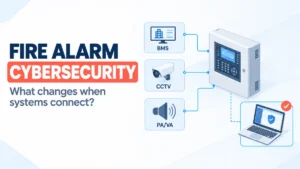
A building has a properly installed fire alarm system and a well-specified PA/VA system. Tested independently, both perform exactly as expected. Then, during an actual fire condition, the fire alarm must trigger the correct voice message, override whatever was playing, reach the correct zones, maintain the correct priority, and do this reliably for the duration of the event. This is where the engineering gets complicated: two systems that work correctly in isolation do not automatically work correctly together.
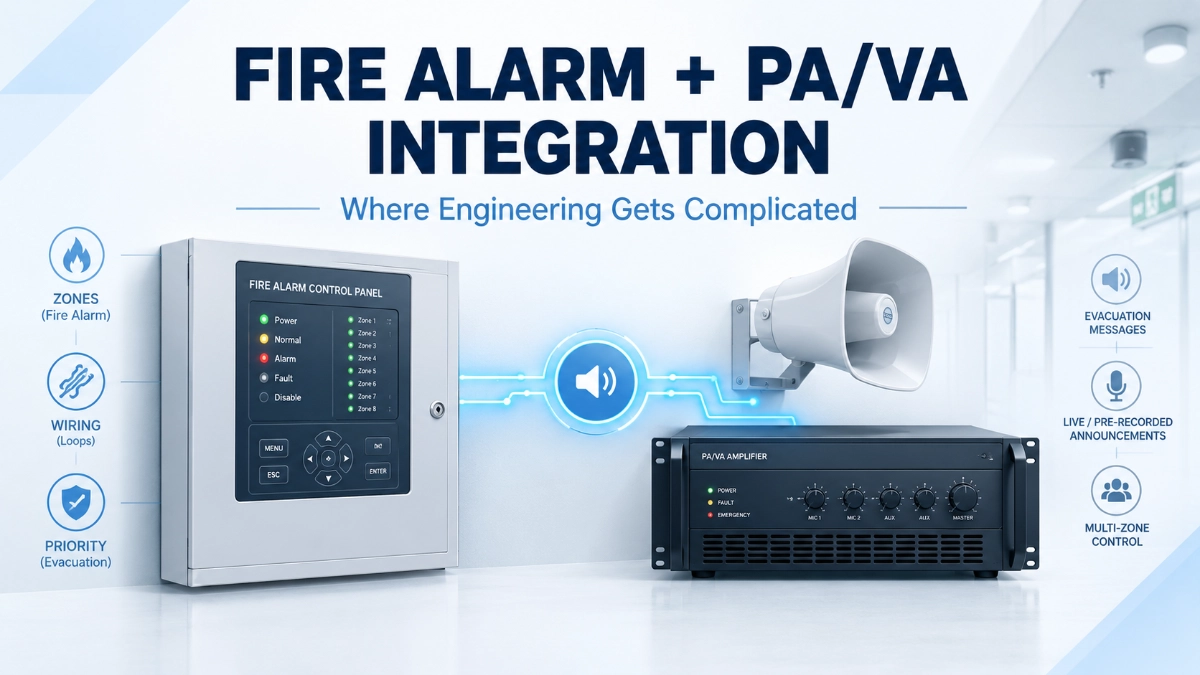
It helps to separate the terms first. Fire alarm detection and notification are core life-safety functions: detecting a condition and alerting occupants. Public address is a general-purpose system for routine, non-emergency communication. Voice alarm and emergency voice evacuation refer to a system, or a mode of a system, engineered specifically to deliver intelligible, prioritised emergency instructions during a fire condition.
A PA system built for music and staff paging is not automatically a life-safety voice evacuation system, even if it shares speakers and cabling. Whether integration is needed, and in what form, depends on the building’s risk profile, applicable design basis, and project-specific requirements, not a generic assumption.
Fire alarm integration with PA/VA systems is complicated because it is a coordinated life-safety function, not a single connection. Engineers must define how fire alarm events translate into voice messages, how priority is managed against normal announcements, how fire alarm zones map to broadcast zones, and how the interface behaves under fault or communication-loss conditions.
Every event, message, zone, and failure mode must be deliberately designed, documented in an approved cause-and-effect matrix, and verified through integrated testing, not assumed to work simply because both systems function on their own.
What Does Fire Alarm Integration With a PA/VA System Actually Mean?
At a system level, integration means the fire alarm system issues signals, or commands tied to defined conditions a general alarm, an evacuation instruction, an alert-only condition, a zone-specific emergency state, or another programmed event and the PA/VA system responds with appropriate audio: a pre-recorded message, a live announcement, phased instructions, or zone-specific guidance. There is no single correct architecture for this handoff; it depends on the fire alarm platform, the PA/VA platform, the approved design, and each manufacturer’s documented capabilities.
Why a Simple Relay Connection Is Not Enough
It’s tempting to treat integration as wiring a relay output from the fire panel into a PA/VA input. Physically, that may be exactly what happens, but that connection is the smallest part of the problem. What needs designing is everything it represents: what the signal means, what priority it carries, how it is monitored, what happens if it fails, which zones and messages it triggers, and how the sequence is verified. There is a real difference between “the fire alarm sends a signal” and “the integrated system performs the intended emergency function.”
The First Complication — Alarm Priority
Priority becomes critical once a PA/VA system also handles routine paging. What happens if paging is active when a fire condition occurs, if an operator wants a live announcement over a pre-recorded one, or if a microphone override conflicts with an automated message? None of these has a single universal answer. Priority logic which input wins, and in what order must be explicitly defined during design and tested, never left to be discovered during an emergency. The exact structure depends on the system architecture and the project’s approved design.
The Second Complication — Zoning
Fire alarm detection zones and PA/VA broadcast zones do not have to be identical. Fire alarm zoning often reflects detection circuits or floors; PA/VA zoning reflects audible coverage, public versus restricted areas, or phased evacuation groupings. As an illustrative example only: an alarm in Zone A might trigger a message broadcast to a designated evacuation area that doesn’t match Zone A exactly. This is not a universal sequence; it simply shows why zone mapping must be deliberately engineered, not assumed.
The Third Complication — Cause-and-Effect Programming
Every fire alarm event meant to trigger a PA/VA response needs a documented, approved matrix.
| Fire Alarm Event | PA/VA Response | Engineering Question |
|---|---|---|
| Alarm in Area A | Emergency message in defined areas | Which zones should receive it? |
| Alarm in multiple areas | Defined emergency response | How are simultaneous events handled? |
| System fault | Fault indication/reporting | What should operators see, and where? |
| Manual emergency activation | Emergency announcement | Who has priority — panel or operator? |
Actual responses must come from approved project documentation, not a generic template.
The Fourth Complication — Emergency Messages
An evacuation tone, a pre-recorded message, a live announcement, and a normal PA announcement each raise different questions: clarity, language, zone selection, sequencing, and operator controls. None of this is boilerplate message content, and sequencing is a project-specific decision belonging in the approved design.
The Fifth Complication — Interface and System Architecture
Broad approaches include monitored dry-contact interfaces, dedicated control I/O, purpose-built modules, or network-based integration, in centralised or distributed architectures. No single method suits every project; the right approach depends on compatibility between platforms, verified against manufacturer documentation and the approved design.
The Sixth Complication — Power and Fault Supervision
An integration that works with healthy power and network links tells you little about fault behaviour. Engineers need to know what happens if PA/VA or fire alarm power fails, communication is interrupted, an amplifier or speaker circuit faults, the interface fails, or a controller becomes unavailable. Supervision, fault indication and what an operator must do have to be part of the design, not assumed once normal operation checks out.
The Seventh Complication — Network Dependencies
Modern systems depend on more than either system alone: a fire alarm network, a PA/VA network, Ethernet infrastructure, controllers, switches, amplifiers, and communication links. Engineers should identify single points of failure and know what happens to the voice function if any one link is lost. There is no universal architecture that fits every building; what matters is that dependencies are known and accounted for.
EST3 and EST4 in Integrated Fire Alarm Architectures
Platforms such as EST3 and, in larger architectures, EST4 are commonly found in projects involving PA/VA integration. The relevant question is never generic; it’s what a specific installation actually supports, and what the project design requires. Claims about interface protocols, compatibility, or capabilities need verification against manufacturer documentation for the specific product version. Not every EST3 or EST4 installation has identical capabilities.
Where EST Fire Alarm System Design Meets PA/VA Engineering
An EST Fire Alarm System integrated with PA/VA should be treated as one component of a larger life-safety architecture, encompassing detection, alarm initiation, cause-and-effect logic, evacuation strategy, interface method, notification, monitoring, testing, and documentation. This mindset is what allows the PA/VA integration to be engineered correctly rather than bolted on afterwards.
Don’t Forget the Fire Alarm Field Devices
The PA/VA response is ultimately triggered by field-level events, so device engineering matters as much as the interface itself: EST Detectors and Devices, manual call points, I/O modules, alarm zone assignments, device condition, field wiring, and configuration all feed the cause-and-effect logic. Inaccurate device identification or zoning undermines reliable zone-based messaging regardless of PA/VA design quality.
Testing the Fire Alarm–PA/VA Integration
Testing means verifying intended emergency behaviour, not just confirming a signal reaches the other system:
- Verify individual system operation
- Verify interface operation
- Trigger representative fire alarm conditions
- Confirm correct PA/VA response
- Verify zone and message selection
- Verify priority behavior
- Test fault conditions and communication failures
- Verify monitoring/reporting
- Document results
- Correct deficiencies and retest
Skipping to step 3 leaves fault-handling and priority behaviour unverified. Documented, integrated acceptance testing separates a connected system from an engineered one.
Why the Right Technical Partner Matters
Integration projects require coordination among the fire alarm supplier, PA/VA supplier, integrator, engineer, contractor, and facility team. Working with an established EST Fire Alarm System Distributor in India helps ensure access to accurate documentation, platform-specific knowledge, commissioning support, and lifecycle availability all more critical where several parties’ work must align.
Example Cause-and-Effect Scenario
Illustrative only, not a project case study: a smoke detector in a ground-floor lobby alarms. Per the approved matrix, the panel commands the PA/VA system to play an evacuation message in the lobby and adjoining corridor. At the same time, an upper floor not yet in alarm gets an alert tone, consistent with a phased strategy. An operator can override with a live announcement.
Engineering questions remain: was zone mapping deliberately designed? Is priority between the automated message and operator override clearly defined? Was this sequence tested and documented, including microphone failure?
10 Common Mistakes in Fire Alarm and PA/VA Integration
- Treating the interface as a simple relay connection
- Failing to define alarm priority
- Assuming fire alarm zones and PA zones are identical
- Not documenting cause-and-effect
- Ignoring normal PA operation when designing emergency behaviour
- Failing to test interface faults
- Ignoring amplifier or power failure scenarios
- Not considering network dependencies
- Failing to coordinate between vendors
- Testing systems independently but never testing the integrated response
Fire Alarm–PA/VA Integration Checklist
- Design: architecture, interface method, cause-and-effect, zoning, priority, power, network dependencies.
- Installation: interface configuration, device mapping, zone mapping, documentation.
- Testing: initiation, messaging, priority, zone response, faults, communication failure, monitoring.
- Handover: as-built drawings, cause-and-effect matrix, configuration records, test results, training.
Expert Insights
- The interface is only one part of the integration; the real challenge is defining what it’s supposed to accomplish.
- Fire alarm zones and voice evacuation zones should be mapped deliberately, not assumed identical.
- A successful integrated test demonstrates the intended emergency behaviour, not just that a signal arrives.
- Cause-and-effect documentation is the bridge between system design and real-world emergency behaviour.
- Normal PA operation and emergency operation must be considered together when defining priority.
- Fault conditions reveal more about integration quality than normal operation ever will.
Key Takeaways
- Fire alarm and PA/VA integration is an engineered system, not a simple signal connection.
- Alarm priority must be explicitly defined and tested, especially where PA use overlaps with emergency operation.
- Fire alarm zones and PA/VA broadcast zones can differ and must be deliberately mapped.
- A documented, approved cause-and-effect matrix underpins correct integrated behaviour.
- Interface architecture must be verified against manufacturer documentation, not assumed.
- Power, network, and equipment faults must be designed for, not an afterthought.
Read Also: How Fire Alarm System Obsolescence Creates Hidden Engineering Risks
Read Also: Planning an EST3 to EST4 Migration: Key Engineering Questions