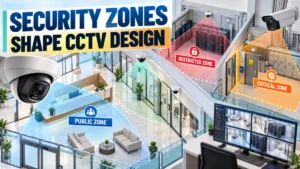
An IP camera can deliver clear video, maintain a stable network connection, and record footage continuously while still failing to meet the security objective it was installed for.

Consider a warehouse where a camera records every vehicle entering a loading bay. The footage looks sharp, and the recording system reports no errors. However, when a vehicle leaves with unauthorised goods, the video does not clearly show the driver’s face or the vehicle registration number.
The camera worked correctly. The security objective did not succeed.
This distinction matters in warehouses, factories, commercial buildings, distribution centres, parking facilities, and large industrial sites. CCTV performance should not be measured only by camera uptime or image quality. It should be measured by whether the system provides the visibility and evidence required to manage a specific security risk.
For security engineers, system integrators, IT teams, and facility managers, this requires a shift from selecting cameras based on specifications to designing surveillance systems around operational requirements.
Why Can a Working CCTV Camera Fail Its Security Objective?
A CCTV camera can fail its security objective when it records video but does not capture the information needed to detect an incident, identify a person, verify an event, or support an investigation.
Common causes include poor camera placement, unsuitable viewing angles, insufficient image detail, incorrect lighting, blind spots, inadequate retention, missing recordings, and limited monitoring or response procedures.
The solution is to define the security objective before selecting the camera, then verify the complete surveillance system under realistic operating conditions.
1. Camera Performance and Security Effectiveness Are Different
Camera performance describes how well a device operates. Security effectiveness describes how well the complete system achieves its intended purpose.
A camera may have high resolution, excellent low-light performance, and a reliable network connection. Yet these specifications cannot guarantee that it will capture the required evidence.
For example, a 4 MP camera may produce detailed footage of a person walking through a large warehouse. However, if the camera sits too far away, the person’s face may occupy only a small part of the image.
The footage may look good on a monitoring screen but provide insufficient detail for identification.
This is why engineers should evaluate three separate questions:
- Is the camera working? Does it deliver video and maintain connectivity?
- Is the image usable? Does it provide sufficient detail under actual lighting and operating conditions?
- Does the system achieve its objective? Can it detect, recognise, or identify the subject or event as required?
A successful CCTV design must address all three.
2. Camera Placement Can Matter More Than Resolution
Increasing resolution does not automatically solve a surveillance problem.
Camera placement determines which areas appear in the frame, how large subjects appear, and whether important details remain visible.
An incorrectly positioned camera may capture a wide area while providing limited detail about individual people or objects.
Common design mistakes include:
- Mounting cameras too high for useful facial detail.
- Positioning cameras too far from the target area.
- Pointing cameras toward bright windows or direct sunlight.
- Leaving gaps between adjacent coverage areas.
- Placing cameras where doors, shelves, machinery, or vehicles obstruct the view.
- Using one wide-angle camera for several security tasks that require different levels of detail.
Example: Warehouse Entrance Security
A warehouse entrance may require two different surveillance objectives.
The first objective is to monitor movement through the entrance. The second is to capture sufficient facial or vehicle detail for later investigation.
One wide-angle camera may cover the entire entrance, but it might not provide sufficient detail for both tasks.
A better design could use an overview camera to monitor general movement and a dedicated camera positioned to capture the required details at the entry point.
Engineering takeaway: Design camera coverage around the information required at each critical location, not simply the number of square metres a camera can cover.
3. Detection, Recognition, and Identification Require Different Levels of Detail
A surveillance system should deliver the right level of image detail for its intended purpose.
Detection, recognition, and identification are different objectives.
| Objective | What the footage should support |
|---|---|
| Detection | Establish that a person or object is present |
| Recognition | Determine whether a person or object is familiar |
| Identification | Obtain sufficient detail to distinguish a particular person or object |
| Observation | Understand actions, movement, or activity in an area |
These objectives require different camera positions, viewing distances, image densities, and lighting conditions.
For example, a camera covering a factory perimeter may only need to detect movement in a distant zone. A camera at an access-control point may need to capture facial details.
Engineers should therefore identify the required outcome for each scene before deciding on camera resolution, lens, mounting height, and field of view.
Where applicable, use recognised surveillance design guidance and project-specific acceptance criteria to validate the required image detail.
4. Lighting Can Defeat an Otherwise Good Camera
Lighting is one of the most overlooked factors in CCTV design.
A camera that produces excellent daytime footage may struggle at night, during sudden lighting changes, or when a subject moves between bright and dark areas.
Common problems include:
- Strong backlighting near entrances.
- Headlights pointing toward the camera.
- Uneven illumination across a scene.
- Deep shadows around doors and loading bays.
- Glare from reflective surfaces.
- Insufficient illumination for colour identification.
- Motion blur caused by slow shutter settings.
Consider a vehicle entering a facility at night. Its headlights may create a bright region in the image while leaving the driver’s face underexposed.
The camera continues recording, but the critical detail remains unclear.
Engineers should test cameras during daytime, nighttime, and changing lighting conditions. They should also evaluate wide dynamic range (WDR), infrared illumination, shutter settings, and lighting placement where appropriate.
A camera should be tested under the conditions in which the security incident could actually occur, not only during a convenient daytime inspection.
5. Blind Spots Can Exist Even When Every Camera Is Online
A camera’s field of view does not necessarily provide complete visibility of a security-sensitive area.
Physical obstructions and changing site conditions can create blind spots. Shelving, stacked inventory, parked vehicles, temporary partitions, machinery, and newly installed equipment can block previously visible areas.
This issue is particularly important in industrial facilities, where production layouts change regularly.
A camera may have provided suitable coverage when engineers commissioned the system. Months later, a new conveyor, storage rack, or machine may obstruct the same view.
The camera remains online, but its security value has changed.
How Engineers Can Reduce Blind Spots
- Review camera views after changes to the building or production layout.
- Inspect critical entry points, exits, and restricted areas.
- Check coverage from the perspective of the actual target.
- Test important scenes with people, vehicles, and equipment in normal operating positions.
- Reassess coverage after major facility modifications.
Treat CCTV coverage as a requirement that needs periodic verification, rather than a permanent result of initial installation.
6. Recording Does Not Automatically Mean Usable Evidence
Another common misconception is that a camera achieves its objective whenever the NVR stores footage.
In reality, the recording must contain the right information and remain available when required.
A surveillance system can record continuously but still fail an investigation because:
- The recording resolution is too low.
- The wrong stream is being recorded.
- Frame rate is insufficient for the activity.
- Motion-triggered recording misses part of an event.
- The recording schedule excludes the relevant period.
- Retention is shorter than the investigation requires.
- The NVR has storage errors or missing footage.
- Timestamps are inconsistent across cameras.
For example, a loading bay camera might record a vehicle entering the site but miss the event that occurred several seconds later because of an unsuitable recording configuration.
Engineers should verify actual recorded footage instead of relying solely on live viewing or an online status indicator.
When evaluating an NVR, including Impact by Honeywell NVRs, review supported camera channels, recording resolution, incoming bandwidth, storage capacity, retention requirements, playback performance, and the recording features needed for the application.
The key question is not simply whether the NVR records. It is whether the recording system preserves the evidence the security team needs.
7. CCTV Is Only One Part of the Security Response
A camera can capture a suspicious event without anyone acting on it.
This can happen when operators monitor too many feeds, alarms are not configured correctly, notifications reach the wrong team, or incident procedures are unclear.
Consider a restricted warehouse area where a camera records unauthorised entry. If the system does not generate an actionable alert and no one reviews the footage until the following day, the camera may provide evidence after the event without helping prevent or contain it.
The appropriate design depends on the security objective.
Some applications require continuous monitoring. Others may rely on event-based alerts, scheduled reviews, or investigation after an incident.
Engineers should clarify:
- Who monitors the cameras?
- Which events require an alert?
- Who receives the alert?
- What response time is expected?
- What happens if the operator or network becomes unavailable?
- How will the organisation retrieve evidence afterwards?
CCTV effectiveness depends on the combination of image capture, recording, monitoring, and response procedures.
8. Choose Cameras According to the Security Objective
Different camera types suit different surveillance tasks. The correct choice depends on the environment, viewing distance, lighting, mounting options, and required image detail.
For example, Impact by Honeywell bullet cameras may be considered for directional views of entrances, driveways, or perimeter areas. Impact by Honeywell dome cameras may suit applications requiring a compact camera form factor for indoor spaces or other appropriate mounting locations.
However, the form factor alone does not determine suitability. Engineers should check the exact model’s resolution, lens options, field of view, low-light performance, environmental rating, and compatibility with the recording system.
When evaluating Impact by Honeywell CCTV, assess the equipment against a documented set of security requirements rather than choosing a camera based on resolution or appearance alone.
For projects in India, an Impact by Honeywell distributor in India can be a useful source for checking current product specifications and availability during equipment selection.
The objective is to match the camera to the task while ensuring that the complete surveillance system can deliver the required outcome.
9. A Practical CCTV Security-Objective Checklist
Before commissioning a CCTV system, engineers should verify the following:
Security requirements
- Define the threat or operational risk.
- Identify what the camera must detect, observe, recognise, or identify.
- Specify the evidence required after an incident.
Camera design
- Verify camera position and viewing angle.
- Check lens and field of view.
- Confirm adequate image detail at the target location.
- Test daytime and nighttime performance.
- Identify blind spots and potential obstructions.
Recording and network
- Confirm the correct stream and recording settings.
- Verify recording continuity and playback.
- Check storage capacity and retention.
- Confirm timestamps and system time synchronisation.
- Verify camera and NVR connectivity.
Operations
- Confirm monitoring and alert requirements.
- Test relevant event notifications.
- Define escalation and incident response procedures.
- Schedule periodic reviews after site changes.
The most important step is to validate the system against realistic scenarios. A successful commissioning test should demonstrate that the system can achieve its documented security objectives, not merely that every camera appears online.
Conclusion: Measure CCTV by the Outcome It Delivers
A CCTV camera can work perfectly at the device level and still fail the security objective that justified its installation.
Poor positioning, unsuitable lighting, blind spots, insufficient image detail, recording gaps, and weak response procedures can all reduce the value of a surveillance system.
Engineers can avoid these problems by defining security objectives first, designing camera coverage around real risks, validating recorded evidence, and reviewing the system whenever site conditions change.
The most useful question is not simply, “Is the camera working?”
It is “If a security incident occurred here today, would this system capture the information we need to understand what happened and take the right action?”
That is the standard that turns a functioning CCTV installation into an effective security system.
Read Also: How Security Zones Should Influence Commercial CCTV Design
Read Also: How Security and Facility Teams Can Have Different CCTV Requirements