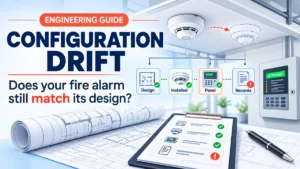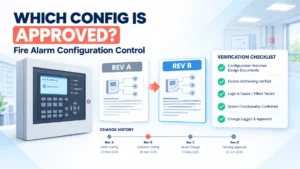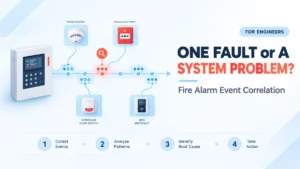
Introduction: When the Installed System No Longer Matches the Approved Design
A warehouse operator adds a mezzanine. During the work, a contractor replaces a damaged smoke detector and moves a second one by three metres to clear new ductwork. Both devices test well, and the fire alarm control panel shows normal. Months later, a consultant opens the approved drawings. The moved detector still sits in its original position. The device schedule describes a bay that no longer exists. Nobody has reviewed the cause-and-effect matrix since the renovation.
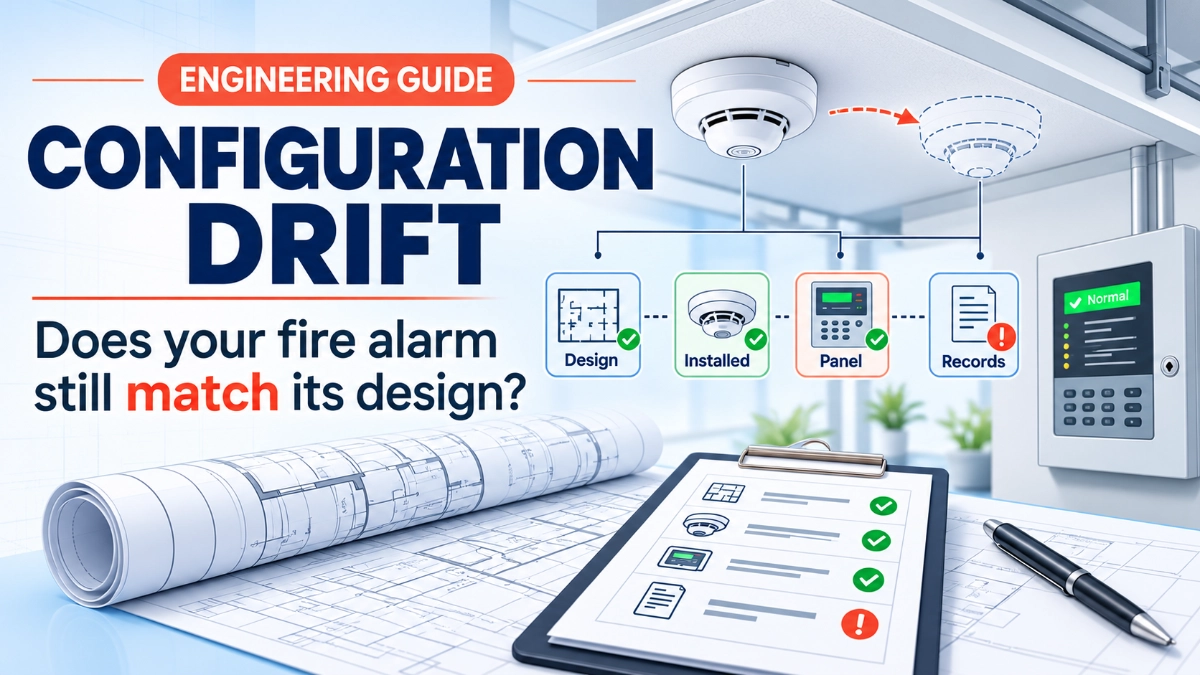
Nothing here proves the system will fail. But the team can no longer show that it does what the design intended. That gap is fire alarm configuration drift.
Four reference points must stay consistent with each other:
- The approved fire alarm design
- The installed devices and physical connections
- The current panel configuration and programmed logic
- The current site documentation and configuration records
A normal panel status shows that the panel sees no fault or alarm. It does not prove that detection coverage, zoning, or output responses still match the design.
What Is Fire Alarm Configuration Drift?
Fire alarm configuration drift is the gradual divergence between an approved or previously verified fire alarm arrangement and the system as it is now installed, programmed, and documented. It develops when changes are not fully reviewed, authorised, tested, or recorded. Drift can involve hardware, software, programmed logic, device addresses, interfaces, or documentation.
Several terms describe different situations:
- Device fault: A component fails to perform, and the panel usually reports it.
- Approved change: A modification that was reviewed, authorised, tested, and documented. This is a controlled change, not drift.
- Undocumented change: A modification that was made but never recorded.
- Configuration mismatch: Two sources disagree, such as a panel label and a drawing.
- Outdated record: The system is correct, but the record has not caught up.
- Design or installation discrepancy: The installed system differs from the approved design, whether since commissioning or since the last verified state.
How does drift differ from a device fault?
A fault is an event. Drift is a condition that builds up. A faulty detector normally produces an indication at the panel. Drift often produces none, because a healthy device in the wrong place, or a working output with outdated logic, raises no fault.
Not every change creates a problem. The risk depends on the nature of the change, its effect on system functions, the applicable requirements, and whether review and testing take place.
How Small Changes Can Create Larger Configuration Gaps
Drift usually starts with individually reasonable decisions. Each one below follows the same pattern: the change, the possible discrepancy, and the verification step.
- Device replacement: A detector is swapped, but the inventory still lists the old model and installation date. Verify compatibility with the panel and circuit using the manufacturer’s instructions, test the device, and update the inventory. Reprogramming is not always needed. It depends on device type, system architecture, configuration, and the specific change.
- Detector relocation: A detector moves to clear a duct or rack. Coverage and spacing assumptions may no longer hold. Review the new position against the design basis and applicable requirements, then update drawings and schedules.
- Address changes: An address is reassigned or duplicated, so the drawing and the panel disagree. An alarm may then point responders to the wrong location. Activate the device and confirm that the panel identifies the correct place.
- Panel programming edits: Someone adjusts zone grouping or labels to manage a nuisance alarm. Compare the result with the approved configuration and test the affected functions.
- Outdated cause-and-effect matrices: A new fan or door is added, but the matrix is not revised. Compare the matrix with the programmed logic and the required responses.
- Interface modifications: A relay module serving HVAC, access control, or a lift is replaced or remapped. Test the interface end to end, and coordinate with the owner of the other system.
- Unrecorded temporary isolations: A device is disabled during dusty work and never re-enabled. Reconcile the isolation log with the panel’s disabled-points list.
- Incomplete restoration: After maintenance, a point stays disabled, or the programming backup is not saved. Verify restoration and record it.
- Renovations and upgrades: New partitions, new equipment, or a change of use alter the hazards the design assumed. Re-evaluate the design basis, not just the device count.
The Four-Way Mismatch: Design, Installation, Configuration, and Documentation
The four-way mismatch occurs when the approved design, the installed system, the panel configuration, and the site documentation no longer agree. Each layer can drift independently, which is why one correct layer cannot vouch for the others.
- Approved design: This records what the system was meant to achieve: detection coverage, zoning, interfaces, and required responses.
- Installed system: This is what physically exists: devices, wiring, modules, interfaces, locations, and connections.
- Panel configuration: This covers device assignments, labels, zones, programming, cause-and-effect logic, and other settings.
- Site documentation: This includes approved and as-built drawings, device schedules, configuration backups, test records, change logs, and maintenance history.
Consider a single detector relocation. The move can affect:
- The as-built drawing, which still shows the old position.
- The device schedule and zone description.
- The panel’s location text for that address.
- The coverage assumptions in the original design.
- Any cause-and-effect entry that depends on that detector’s zone.
- The commissioning and test records that referred to the old position.
The correct verification method compares the records with the physical installation and the approved functional requirements. No single file, including the panel export, should be treated as the sole source of truth.
Why Fire Alarm Panel Programming and Cause-and-Effect Logic Matter
Panel programming turns device signals into actions. A cause-and-effect matrix documents which inputs should produce which outputs. When programming and matrix agree with the design, the system responds as intended.
Depending on the design, programmed logic may govern:
- Device-to-location identification and zone assignments.
- Alarm responses and notification arrangements.
- Output and interface logic.
- HVAC shutdown or control interfaces.
- Door-release interfaces.
- Lift or other building-system interfaces.
- Fault and supervisory indications, where the system supports them.
On an addressable fire alarm panel, much of this logic lives in software, so a change can be invisible on site. If someone edits a zone assignment without recording it, the intended response and the actual response may differ even though every device works.
This article does not describe how to bypass or suppress safety functions. Programming changes belong to authorised, competent personnel working to the manufacturer’s procedures and the project’s change process.
Why Outdated As-Built Drawings and Digital Records Are a Risk
Documentation is part of safety management because every later decision relies on it. Technicians use drawings to locate devices, engineers use schedules to assess changes, and auditors use test records to judge compliance.
Where adopted, NFPA 72 addresses documentation in its Chapter 7. Its provisions cover record (as-built) drawings, a record of completion, inspection and testing records, and records of site-specific software. When site-specific software changes, NFPA 72 calls for a revised record of completion. Section numbers vary by edition, and local rules may differ.
Useful records include:
- Approved design drawings and as-built drawings.
- Device schedules and device replacement records.
- Panel configuration exports with backup dates.
- Cause-and-effect matrices.
- Commissioning, inspection, and test reports.
- Firmware and software version records.
- Change approvals and restoration records.
Version control, clear file naming, revision history, controlled access, and traceability keep these records trustworthy. Digital records improve consistency, but only when they are accurate, current, accessible, and governed.
How to Detect Fire Alarm Configuration Drift
Engineers detect drift by comparing evidence from all four layers and investigating every unexplained difference. Useful checks include:
- Comparing approved drawings with the installed system.
- Verifying device locations and identifiers on site.
- Reviewing panel configuration records, device schedules, and zone descriptions.
- Comparing current configuration with the last authorised backup.
- Examining change logs, maintenance records, and isolation records.
- Reviewing cause-and-effect documentation against programmed logic.
- Testing affected functions after approved changes.
The scope depends on the type of modification and the applicable project requirements. Visual inspection alone cannot verify programming or functional requirements.
A Configuration Management Process for Fire Alarm Systems
Fire alarm configuration management applies change control to the whole system. ISO 10007, a general guidance standard, describes configuration management in terms of planning, identification, change control, status accounting, and audit. It is not specific to fire alarms, and fire codes do not mandate this exact workflow. The steps below are engineering practice and should be adapted to the system, project procedures, applicable standards, and local regulations.
- Identify the proposed change.
- Record the reason and the affected devices or functions.
- Review the approved design and applicable requirements.
- Assess the effect on detection, notification, interfaces, and cause-and-effect logic.
- Obtain the required authorisation.
- Implement the change using competent, authorised personnel.
- Perform the required inspection and functional testing.
- Update drawings, schedules, programming records, and other affected documents.
- Save and clearly identify the verified configuration backup.
- Record approval, testing, outstanding issues, and restoration status.
For testing, NFPA 72 includes reacceptance provisions in Chapter 14. In the editions reviewed, added devices are functionally tested. When site-specific software changes, affected functions are tested in full, along with a further sample of unaffected devices. Check the edition and amendments your jurisdiction has adopted..
How Digital Configuration Records Improve Traceability
A digital document repository stores files. A configuration-management process also controls who may change them, why, and what verification followed. Disciplined digital records can support:
- Revision history and change authorisation.
- Device inventories and configuration backup management.
- Comparison between revisions.
- Test evidence and maintenance history.
- Responsibility assignment and audit trails.
- Identification of unresolved discrepancies.
Whatever platform is installed, such as a GST fire alarm system on a commercial site, the manufacturer’s programming tools and documentation define how configurations are exported, identified, and restored. No tool prevents drift automatically. Technology supports governance, but it does not replace engineering review, verification, and testing.
Addressable and Conventional Fire Alarm Systems: Different Records, Same Need for Control
Both architectures need accurate records, authorised changes, and appropriate testing. What differs is the content of the records.
For addressable systems, track device addresses, device descriptions, loop assignments, panel programming, and interfaces. Replacement records for addressable detectors matter because the address, type, and location must stay linked.
For conventional systems, track zone assignments, circuit records, device locations, circuit integrity, and connected interfaces. A conventional fire alarm panel identifies a zone rather than an individual device, so an accurate zone description and a current schedule of conventional detectors become essential. Moving a detector across a zone boundary, for example, changes what an alarm means.
An addressable system does not eliminate drift, and a conventional system is not inherently less reliable. Each simply fails to document itself in a different way.
Practical Fire Alarm Configuration Drift Checklist
- Are the latest approved drawings available?
- Do device locations match the current records?
- Do panel labels and device descriptions match site conditions?
- Are programming backups version-controlled?
- Are changes authorised and traceable?
- Are cause-and-effect records current?
- Are isolations and restorations documented?
- Are interface modifications recorded?
- Have affected functions been tested?
- Have as-built drawings and device schedules been updated?
- Are unresolved discrepancies assigned for follow-up?
- Is the verified configuration backup clearly identified?
Conclusion: Preserve Design Intent Through Controlled Change
Fire alarm reliability depends on more than selecting suitable equipment. It depends on keeping the approved design, installed devices, panel programming, functional testing, and site records aligned for the life of the system. Fire alarm configuration drift is the slow loss of that alignment, and a normal panel status will not reveal it.
The remedy is a repeatable process: review → authorise → implement → verify → document → maintain. Applied to every change, large or small, it keeps the system recognisable to the people who designed it, tested it, and must rely on it.
Read Also: How Process Exhaust Systems Can Influence Fire Detection Strategy
Read Also: The Production Line Moved. What Happened to Fire Detection Coverage?