A manufacturing facility commissions its fire alarm system around a defined control architecture. Years later, the site adds a BMS interface for status reporting, places monitoring equipment on a shared network, and lets an external contractor use a maintenance workstation. The system keeps operating normally, and nothing is compromised. But the engineering team now has new questions. Which systems can communicate with the fire alarm infrastructure? Who can access configuration tools? Are the connections necessary and controlled? Can a change to a connected system affect the approved configuration? What happens if an interface or workstation becomes unavailable? Who reviews access and changes?
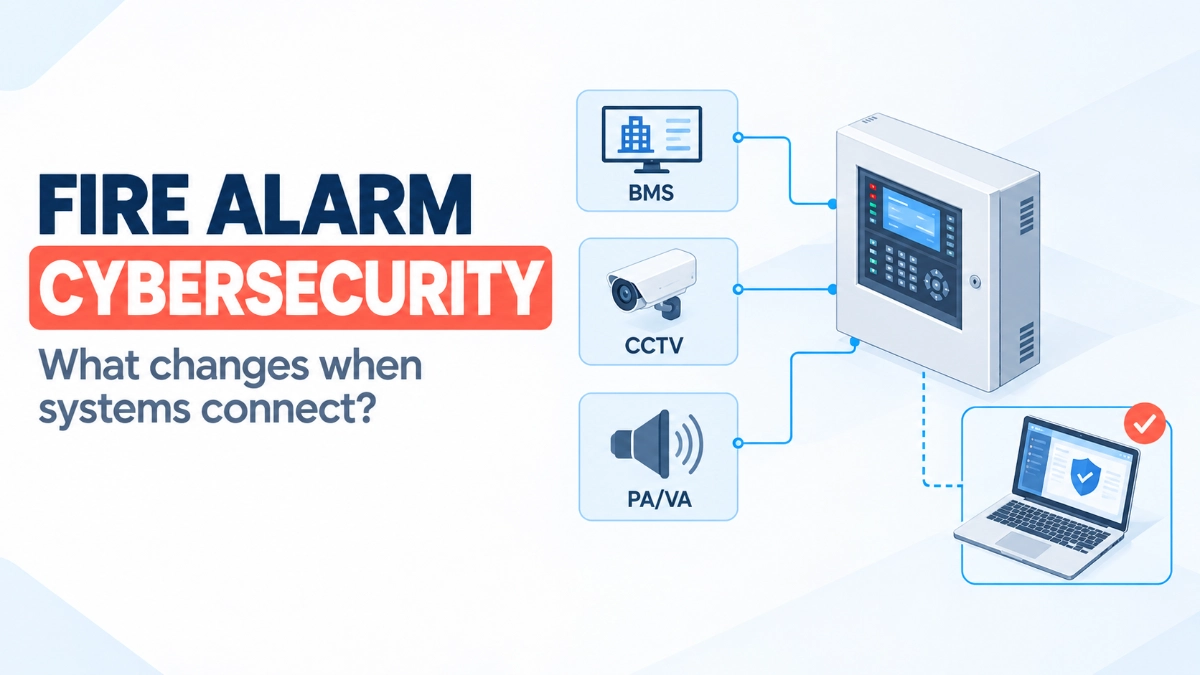
These questions show that fire alarm cybersecurity changes as architecture and maintenance practices change. It starts with understanding the system as installed, not with assuming a panel is exposed.
Why does cybersecurity matter for connected fire alarm systems? Links to BMS platforms, IP networks, engineering workstations, monitoring services, and remote maintenance arrangements can add access paths and dependencies. Appropriate measures include understanding network boundaries, limiting access to authorised personnel, controlling configuration changes, protecting credentials, maintaining backups, and reviewing third-party connections. Requirements depend on the installed architecture, manufacturer guidance, project requirements, and applicable regulations. Not every panel is internet-connected, and controls must preserve approved safety functions and operational reliability.
Why Fire Alarm Cybersecurity Is More Than an Internet Connection
Fire alarm system cybersecurity concerns the complete architecture, not only the control panel. Installations vary widely. Some are standalone and locally operated. Others exchange status with a building management system or other ELV platforms, use IP-based communication within the facility, depend on engineering workstations for configuration and diagnostics, or support remote monitoring or maintenance where the design and site arrangements allow it. Third-party service providers and shared infrastructure add further dependencies.
Three conditions are often conflated, yet they are not interchangeable:
- Internal network connection: The system communicates with other devices on a site network.
- External connection: A defined path beyond the site, such as a monitoring service or remote support arrangement.
- Direct public internet accessibility: The system is reachable from the public internet.
A system can have the first without the second, and the second without the third. Establish which applies before concluding.
Where Cybersecurity Considerations Enter the Fire Alarm Architecture
Network Connections and System Boundaries
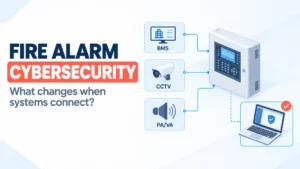
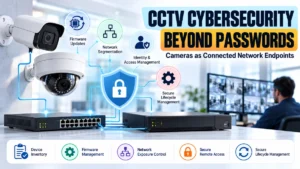
Connections to BMS, CCTV, PAVA, monitoring systems, and engineering workstations each need a purpose, an owner, and a documented boundary. Undocumented or poorly understood connections complicate access control, fault investigation, and responsibility assignment. When an interface misbehaves, nobody should have to ask which team owns it.
An interface does not automatically mean unrestricted shared access. A BMS that receives status data has a different relationship with the fire alarm system than a platform that can issue commands. Document which one applies. For any EST Fire Alarm System, the approved architecture and interface list define what is intended, and connections outside them deserve review.
Engineering Workstations and Configuration Tools
Computers used to configure, maintain, or diagnose fire alarm systems deserve attention because they hold configuration files and tools. Review:
- Who can use the workstation, and whether accounts and permissions suit their roles.
- How software and configuration files are maintained.
- How removable media and transferred files are handled.
- Whether the machine is used for unrelated tasks.
- How changes are authorised and recorded.
The right workstation arrangement depends on the project, manufacturer requirements, and site policy. No single architecture suits every installation.
Remote Maintenance and Third-Party Access
Where remote support is available and enabled, it changes the access model. Define who authorises each connection, when access is permitted, which personnel are responsible, how credentials are issued and withdrawn, and how completed work is reviewed.
Remote access is not an inherent feature of every fire alarm system. Check the installed architecture and approved arrangements before assuming it exists.
Network Segmentation: Why Clear Boundaries Matter
Fire alarm network segmentation means separating systems or functions where the architecture and risk assessment justify it, and limiting communication between zones to what is needed. In practice, that means defining which systems must exchange information, reviewing links between operational technology and corporate IT networks, documenting approved paths, and making sure monitoring and maintenance arrangements do not create uncontrolled dependencies.
| Engineering consideration | Risk if poorly managed | Practical response |
|---|---|---|
| Unnecessary network connectivity | More communication paths than the system requires | Review and document necessary connections |
| Unclear system boundaries | Uncertain ownership and troubleshooting responsibilities | Maintain an approved architecture and interface diagram |
| Shared IT/OT infrastructure | Dependencies that may be overlooked during planning | Assess separation and access controls appropriate to the site |
| Uncontrolled third-party access | Access beyond the intended maintenance scope | Define authorisation, permissions, and review procedures |
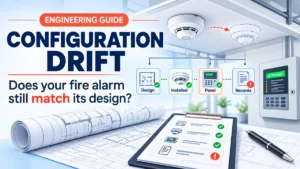
| Undocumented network changes | Configuration drift and uncertainty during investigation | Apply change control and update records |
Segmentation methods must match the actual network design, manufacturer requirements, and operational constraints. No topology is universally appropriate.
Access Control and Configuration Security
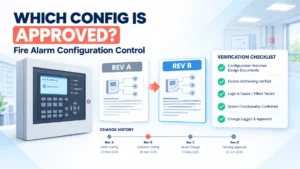
Fire alarm configuration security is central because a configuration change can have operational consequences even when no one acts maliciously. Good practice mirrors established engineering discipline: baselines, authorisation, testing, and traceability.
- Restrict configuration changes to authorised, competent personnel.
- Use individual accounts where supported and practical, and avoid shared credentials where accountability matters.
- Protect credentials and approved configuration files.
- Keep controlled backups and version history.
- Record who made each change, why, and how it was verified.
- Review access when responsibilities or service arrangements change.
The same discipline applies to installed equipment records. Accurate inventories of EST Detectors and Devices, with addresses and approved settings, make controlled changes and later audits far easier.
What Could Go Wrong? Understanding Risk Without Exaggerating It
These are possible scenarios, not confirmed vulnerabilities, and none applies to every installation. Each depends on conditions being present.
- Unauthorised access to a configuration workstation: The consequence is exposure of configuration data or unapproved changes, and it requires inadequate account control or physical access. Individual accounts, workstation restrictions, and change records help.
- A remote-maintenance account left active: Access persists beyond the intended scope, and it requires remote support to exist. Defined access windows and periodic account review help.
- An undocumented network change: A connected interface may be disrupted, which mainly affects monitoring availability. Change control and updated diagrams help.
- An unreviewed configuration modification: An approved function could be altered, and this is a safety-function risk. Baselines, authorisation, and post-change verification help.
- Inadequate backups: A legitimate maintenance error takes longer to recover from. Controlled backups and version history help.
- A shared network dependency: Monitoring or supporting information becomes unavailable. Dependency assessment helps.
Separate risks to monitoring availability, maintenance workflows, and fire alarm safety functions. A BMS or CCTV connection does not automatically give anyone control of the fire alarm system.
How to Build a Practical Cybersecurity Review for a Fire Alarm System
- Document the architecture: Panels, segments, interfaces, workstations, remote-access arrangements, and third-party connections where present.
- Identify access paths: How personnel, service providers, and connected systems reach components or information.
- Review permissions: Confirm privileges match current responsibilities.
- Assess network boundaries: Flag unnecessary connections and unclear interfaces.
- Review configuration controls: Confirm baselines, change records, backups, and verification evidence.
- Check maintenance arrangements: Establish who authorises remote support and how work is documented.
- Define incident and recovery responsibilities: Escalate cybersecurity concerns without bypassing fire safety procedures.
- Record findings and actions: Assign owners and track remediation through the site’s approved process.
Involve the fire alarm specialist, IT/OT team, facility operator, and manufacturer or authorised service provider as appropriate. Do not disconnect live systems, change network rules, disable interfaces, or alter configurations without an approved impact assessment and authorisation.
Cybersecurity and Connected ELV Systems: BMS, CCTV, and PAVA
Responsibilities overlap when fire alarm systems exchange information with other ELV platforms. A BMS may receive approved fire alarm status. CCTV may support incident review. PAVA may interact with fire alarm functions where the approved design requires it. Shared networks, servers, workstations, or maintenance contractors can link these systems operationally even when their functions differ.
Keep status monitoring clearly distinct from authorised safety-related control. Every interface should have a documented purpose, defined responsibilities, and access restrictions. Systems do not all use the same protocols, and not every installation supports direct integration. Never change safety-related logic solely to simplify cybersecurity management.
EST Fire Alarm Systems and Configuration Security
For Edwards/EST installations, begin by identifying the platform. EST3 and EST4 are separate platforms, so do not assume their software tools, network architectures, or access controls match. Record the platform in project documentation and planning, then confirm the installed architecture, available access mechanisms, manufacturer-supported maintenance procedures, configuration records, and approved interfaces before making any security-related change.
Any model-specific security capability or procedure must be verified against current official manufacturer documentation.
A Practical Cybersecurity Checklist for Project and Maintenance Teams
Use this as a review aid, not a substitute for a formal risk assessment, applicable regulations, or manufacturer instructions.
- Current system architecture and relevant interfaces are documented.
- Network connections and responsibilities are understood.
- Access is restricted according to approved roles and requirements.
- Configuration changes follow authorisation and verification procedures.
- Relevant configuration records and backups are maintained.
- Remote maintenance arrangements are documented where applicable.
- Third-party access is reviewed and appropriately controlled.
- Connected-system dependencies are assessed.
- Incident escalation and recovery responsibilities are defined.
- Cybersecurity changes are coordinated with fire safety and operational requirements.
Key Takeaways
- Connectivity changes the access and dependency model, but not every system is internet-connected.
- Network segmentation should follow the actual architecture and risk assessment.
- Access permissions and configuration control are core engineering concerns.
- Third-party and remote maintenance arrangements need defined responsibilities.
- Cybersecurity improvements must preserve approved fire alarm functions and operational reliability.
Fire alarm cybersecurity begins with knowing the real architecture. For product and project support on the platforms discussed here, an EST Fire Alarm System Distributor in India can help with equipment selection and coordinated delivery, while security assessments remain a matter for qualified specialists.
Read Also: Configuration Version Control for Fire Alarm Systems: An Overlooked Engineering Discipline