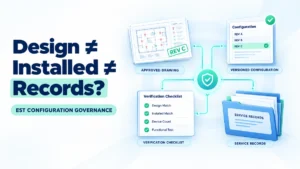
A fire alarm system passes commissioning. Months later, a service engineer finds that the configuration backup, approved drawings, device schedule, and installed field devices do not fully agree. The system may well work; the difficulty is that nobody can say with confidence which record is authoritative.
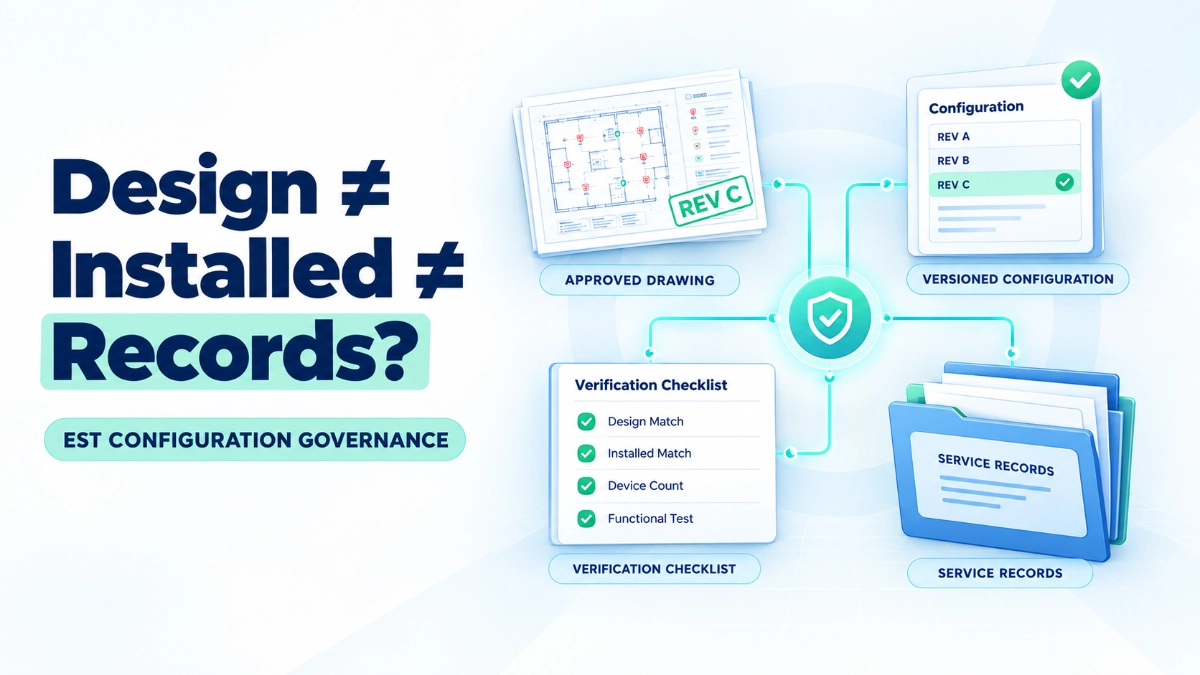
This happens quietly. Late project changes, device replacements, panel modifications, contractor handovers, maintenance visits, and unfinished record updates each leave small gaps. A mismatch does not prove the system is unsafe, but it requires investigation and risk-based assessment before anyone relies on the records.
Configuration governance is not file storage or document control. It is a controlled process that keeps design intent, installed equipment, approved logic, verified operation, and current service records traceable to one another. The goal is a system whose documents, configuration, and field condition can be reconciled on demand. This article sets out a practical lifecycle for an EST fire alarm system, with tables and a checklist you can adapt.
EST configuration governance keeps the approved fire alarm design, installed configuration, verification evidence, and service records aligned across the system’s life. An approved baseline gives changes a reference. A controlled process authorises and records each modification. Risk-based testing produces evidence. Version-identified backups and revision history support recovery and audits. Updated as-built and handover records give maintenance teams information they can trust. Without verification evidence, records prove only intent. Each element depends on the others; remove one and the rest become harder to rely on.
What Configuration Governance Means in an EST Fire Alarm Project
These activities are related but not interchangeable. Design approval confirms intent. Configuration management controls the programmed system. Installation places equipment. Commissioning and verification demonstrate operation. Maintenance sustains it. Document control manages the records. A drawing revision alone does not show that a configuration was changed, installed, tested, or approved.
Four records must stay traceable:
- Approved design intent
- Installed system and configuration
- Verification and acceptance evidence
- Current service and handover records
Why Approved Design, Installed Configuration and Service Records Drift Apart
Drift is usually cumulative, not dramatic.
| Cause | Consequence | Control |
|---|---|---|
| Late project changes | Drawings lag site | Freeze baseline, log changes |
| Replaced devices or modules | Schedule lists wrong item | Record address and serial |
| Changed addresses or labels | Panel, label, plan disagree | Update all together |
| Altered cause-and-effect logic | Unreviewed behavior | Approve, then retest |
| Unrecorded field corrections | Hidden deviations | Capture redlines at site |
| Multiple configuration copies | Wrong file restored | One controlled location |
| Unclear programming access | Untraceable changes | Named owners, access log |
| Incomplete contractor handover | Missing baseline | Handover checklist |
| Service edits without records | Outdated documentation | Make records part of close-out |
A suspected discrepancy is a record mismatch awaiting investigation. A confirmed configuration defect is a verified difference affecting required functions.
Why must the approved design match the installed configuration? The approved design records what stakeholders and authorities accepted. If the installed configuration differs, devices, alarm sequences, or interfaces may not behave as reviewed, and technicians may troubleshoot using wrong information. Any difference should be investigated, then corrected or formally approved and documented.
The EST Configuration Governance Lifecycle
Treat this as a practical governance model, not a manufacturer-mandated procedure.
| Stage | Required Control | Evidence to Retain | Responsible Role |
|---|---|---|---|
| 1. Approved baseline | Identify approved drawings, schedules, sequence, cause-and-effect matrix, configuration reference | Baseline register, approvals | Consultant, project manager |
| 2. Installed baseline | Survey field devices and live configuration at an agreed milestone; separate assumptions from verified data | Survey results, deviation list | Commissioning engineer |
| 3. Authorise change | Describe, justify, review; assess effects on connected systems and required functions | Request, impact review, approval | Change authority |
| 4. Implement change | Authorised personnel only; correct revision identified; coordinate with facility authority | Change log, revision record | Authorized integrator |
| 5. Verify result | Test affected functions in proportion to impact | Test records, open defects | Commissioning engineer |
| 6. Update records | After verification and approval, revise configuration record, drawings, schedules, cause-and-effect, revision history | Revised records, revision log | Document controller |
| 7. Back up, hand over | Create version-identified backup; restrict access; record location | Backup inventory, handover record | Integrator, facility manager |
| 8. Periodic audit | Compare records with live system; review changes; confirm backups; close discrepancies | Audit report, actions | Facility manager |
Do not apply one test scope to every change. Base it on the modification, system design, applicable requirements, and the authority having jurisdiction. Checks may include device identification, alarm sequences, interfaces, supervisory signals, fault reporting, and notification. Passing one modified function does not prove every function remains correct.
How should engineers verify a modified fire alarm system? Identify the functions the change could affect, then test them against the approved requirements. Check device identification, sequences, interfaces, supervisory and fault signals, and notification where relevant. Record results and unresolved deviations, and agree scope with the authority having jurisdiction where required.
What a Controlled Fire Alarm Configuration Change Should Look Like
Illustrative hypothetical, not a real project. A production facility modifies an area, so a detector must move and an approved interface sequence must change.
- Facility raises a change request.
- Consultant reviews it against approved design and operational needs.
- Team assesses affected devices, logic, interfaces, and records.
- Change authority approves before work starts.
- Authorised personnel implement it.
- Engineers test affected functions.
- Results and open issues are recorded.
- Approved records and backup are updated.
- Maintenance receives a formal handover.
If the field change is made but records and backup stay unchanged, the next engineer works from outdated information. Restoring that backup could reinstate old logic, and the schedule may point to the wrong location, slowing fault tracing.
The Minimum Record Set for EST Configuration Governance
The exact set depends on project, contract, system design, local codes, and approval process.
| Record | Why It Matters | When to Update |
|---|---|---|
| Approved drawings and revisions | Defines accepted design | Each approved revision |
| Device schedule and addresses | Links devices to locations | Any device or address change |
| Cause-and-effect matrix | Defines required outputs | Any logic change |
| Approved baseline reference | Identifies reference state | After approved baseline change |
| Change register | Shows what changed, why | Every change |
| Change approval records | Proves authorization | Before implementation |
| Test and commissioning results | Evidence of operation | After each verification |
| Deviation register | Tracks open issues | When raised or closed |
| Backup inventory | Locates valid backups | Each new backup |
| Backup date and version ID | Prevents wrong restore | Each backup |
| Access and responsibility records | Names who may modify | Personnel changes |
| As-built drawings | Show installed state | After verified change |
| Service and maintenance history | Reveals actual interventions | Every visit |
| Handover and acceptance records | Define transferred responsibility | Each handover |
Configuration Governance Considerations for EST3 and EST4
Governance principles apply to both platforms; procedures may differ. Before changing or recovering a system, verify the installed platform, hardware and software versions, approved configuration tools, and current Edwards documentation, and involve appropriately authorised personnel. Do not assume EST3 and EST4 share configuration formats, networking arrangements, migration procedures, or compatibility rules, and do not move a backup between platforms without verified documentation. For broader context, see the EST Fire Alarm System overview and EST Detectors and Devices when reconciling device records.
Common Configuration Governance Failures and How to Prevent Them
| Failure | Why It Creates Problems | Preventive Control |
|---|---|---|
| Multiple files treated as current | Wrong version used | One controlled location |
| Changes without approval | Untraceable differences | Mandatory change request |
| No post-change test evidence | Function unverified | Test record required for closure |
| Schedule differs from installation | Slower fault tracing | Update at every replacement |
| Backups lacking dates or versions | Recovery uncertainty | Naming and version rule |
| Replaced devices unrecorded | Address history gaps | Replacement log |
| Unclear programming access | No accountability | Named owners, access list |
| Incomplete service handover | Service lacks baseline | Handover checklist |
| No periodic record review | Drift accumulates | Scheduled audit |
Scale controls to project complexity.
A Practical Configuration Governance Checklist
- ☐ Is the approved baseline identifiable?
- ☐ Does installed configuration match verified field conditions?
- ☐ Are changes approved and traceable?
- ☐ Is test evidence available for modified functions?
- ☐ Are drawings and device records current?
- ☐ Are backups versioned and securely controlled?
- ☐ Can we identify who made and approved each change?
- ☐ Are unresolved deviations documented?
- ☐ Has the service team received correct records?
- ☐ Is there a defined process for future modifications?
This checklist supports governance; it does not replace formal inspection, commissioning, or statutory acceptance requirements.
Best Practices for Long-Term Configuration Integrity
- Assign named configuration ownership.
- Keep one designated controlled record set.
- Separate proposed, approved, and verified revisions.
- Restrict programming access appropriately.
- Document changes promptly.
- Test according to impact.
- Keep backups controlled and recoverable.
- Review records after maintenance or expansion.
- Train service teams on the change process.
Governance is an ongoing operational responsibility, not an activity that ends at commissioning.
When replacing equipment, confirm the exact product, version, and documentation with your supplier. Readers researching an EST Fire Alarm System Distributor in India can start here; verify any authorisation status directly with the manufacturer. Related reading:
Key Takeaways
- Governance links design, installation, verification, backups, and service records.
- A drawing revision does not prove a tested change.
- Establish an approved baseline first.
- Separate suspected discrepancies from confirmed defects.
- Authorise changes before implementation.
- Scale testing to the modification’s impact.
- Version and date every backup.
- Verify platform-specific procedures before changing or recovering EST3 or EST4.
- Audit the live system periodically.
Read Also: Standardising EST Across Buildings: Benefits and Risks
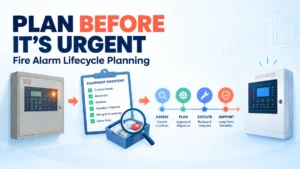
Read Also: Fire Alarm Platform Lifecycle Planning: How to Prepare Before Support or Replacement Becomes Urgent