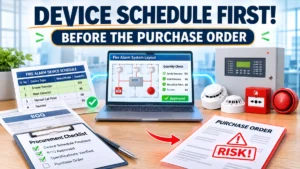
An industrial project reaches its procurement stage. The team holds approved layout drawings, a preliminary bill of quantities and a tight delivery schedule. To protect the timeline, procurement issues a purchase order for smoke detectors, heat detectors, manual call points, sounders, and control panels.
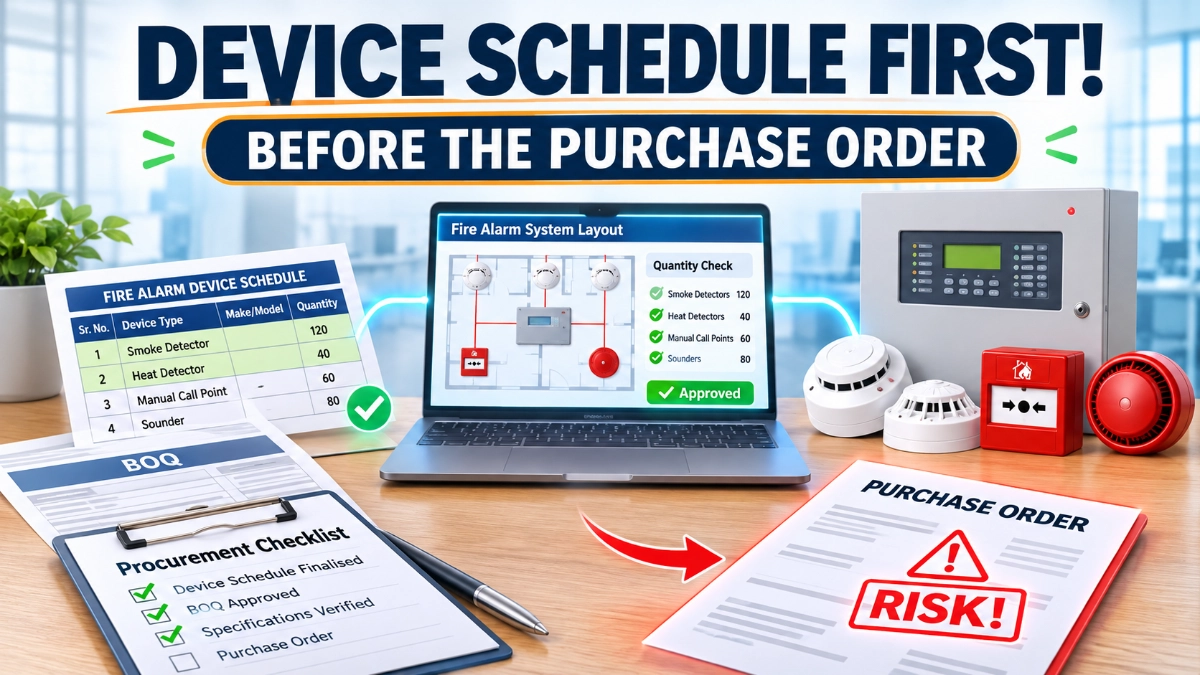
Three weeks later, engineering coordination finds more detectors than estimated. It also finds that the detector bases were never listed, that interface modules are missing, and that the loop layout has changed. The order is already placed.
This is the most common weakness in fire alarm system procurement. The risk starts before any equipment ships. If the device schedule is incomplete, procurement works from changing information.
The device schedule is the link between fire alarm design, material planning, procurement and project execution. This guide explains why it must be verified before the purchase order is released.
What Is a Fire Alarm Device Schedule?
A fire alarm device schedule is a controlled engineering document that lists every device in the system with its type, model, quantity, location and technical details. It turns the design into items that can be counted, checked and bought.
A complete schedule normally includes:
- Device description and type
- Manufacturer and model number
- Quantity
- Installation location, floor or area
- Loop or zone reference
- Control panel compatibility
- Accessories and mounting requirements
- Technical specifications
- Drawing references and revision number
How it differs from related documents
What is the difference between a BOQ and a device schedule? A fire alarm BOQ is a commercial document. It groups items and quantities for pricing. A device schedule is an engineering document. It records where each device goes and which exact model serves it.
The documents work as a chain:
- Equipment list: An early, approximate list of equipment types. It is not verified.
- Device schedule: The verified, location-based record of every device.
- BOQ: The priced summary of quantities drawn from the verified design.
- Material Requisition (MR): The formal request to buy specified items in specified quantities.
- Purchase Order (PO): The commercial commitment to a supplier.
A preliminary equipment list is not a verified device schedule. Treating it as one carries early errors into every later document.
Why the Device Schedule Must Be Finalised Before Procurement
Why is a device schedule important before procurement? It fixes quantities, models, accessories and system capacity in one approved baseline. Procurement then buys what the design needs, not what an early estimate suggested.
The intended flow is: device schedule → verified device quantities → material requisition → supplier quotation → purchase order.
Before ordering, the engineering team should verify:
- Device quantities and detector types
- Control panel, loop and zone capacity
- Input/output modules and interface requirements
- Manual call points, sounders and visual indicators
- Repeater panels
- Power supplies and batteries
- Bases and mounting accessories
- Isolation devices
This review reduces the chance of missing or wrongly specified equipment. Procurement should follow an approved and coordinated design baseline, within the project’s own approval procedures.
What Happens When Equipment Is Ordered Before the Schedule Is Verified?
What happens if fire alarm devices are ordered in incorrect quantities? The project faces shortages, surplus stock or both. It then needs additional orders, change approvals and schedule adjustments.
Common problems include:
- Incorrect device quantities. Preliminary drawings often do not show the final device count.
- Wrong detector selection. Different areas may need different detection technologies or environmental suitability.
- Missing accessories. Bases, isolators, mounting parts and interfaces are easy to overlook.
- Compatibility problems. Not every device works with every control panel or architecture.
- Loop capacity and expansion issues. Device counts and configuration must be checked against approved equipment specifications and design requirements.
- Cost variation. Extra orders, replacements, expedited delivery and surplus stock all affect cost.
- Installation delays. Missing materials interrupt installation sequencing.
These are practical risks. This article makes no claim about how often they occur or what they cost.
Illustrative Example: An Industrial Facility With an Addressable System
This scenario is illustrative. It is not an actual project case study.
An industrial facility needs an addressable fire alarm system. The initial procurement list includes smoke detectors, heat detectors, manual call points, sounders and control panels. The purchase order is issued from this list.
During engineering coordination, the team finds additional modules, loop isolators and detector bases. Some device locations change. Loop quantities are revised.
The unverified order now causes several problems:
- Missing accessories: Bases and isolators were never ordered.
- Incorrect quantities: Some device types are short, others in surplus.
- Compatibility questions: The ordered models must be rechecked against the selected panel.
- Additional procurement: A second order follows, with its own lead time.
- Reconciliation issues: Received items no longer match the original order.
- Schedule changes: Installation crews wait for missing items.
With a verified device schedule, engineering resolves these points first. The MR then lists every device, base, module and isolator. Suppliers quote against the same scope, and the PO reflects the approved design.
Understanding the Relationship Between Drawings, BOQ and Device Schedule
No single document is enough. Each one answers a different question:
- Layout drawings show where devices go.
- System architecture, loop and riser diagrams show how devices connect.
- Device schedules record exactly what each device is.
- The BOQ prices the verified quantities.
- Technical submittals and approved material specifications confirm what may be supplied.
Consider this example. A layout drawing shows a detector, but the BOQ omits its required base. The procurement package is incomplete, even though no one made an obvious error.
Resolve such discrepancies through engineering coordination before ordering. Procurement should not fill the gap by assumption.
Device Compatibility: Why Model Numbers Matter
Why should fire alarm equipment compatibility be checked before ordering? Similar-looking devices can have different electrical, communication or compatibility requirements. A wrong model may not work with the panel.
Procurement accuracy goes beyond buying the right category of device. The schedule should confirm model-level compatibility for:
- Addressable and conventional devices
- Detectors and their bases
- Loop isolators and input/output modules
- Manual call points, sounders and visual alarm devices
- Repeater panels and power supplies
Do not assume that products from different manufacturers can be mixed. Check the manufacturer’s compatibility documentation for each combination. In European practice, EN 54-13 addresses compatibility and connectability assessment of system components. Whether it applies depends on the project and jurisdiction.
For example, an addressable fire alarm panel works with specific addressable detectors and modules. Confirm each model against the manufacturer’s documentation. Do not assume a device fits because it belongs to the same product family.
Addressable vs Conventional Systems: Procurement Considerations
How do addressable and conventional systems affect procurement planning? They organise quantities differently. Addressable systems count devices by loop. Conventional systems count them by zone. The schedule must follow the chosen architecture.
Neither architecture is universally better. The right choice depends on the project.
Addressable fire alarm system
- Quantities follow loops
- Devices need addresses
- Detectors, isolators and modules must be compatible with the panel
- Panel loop capacity must be checked against the approved specification
- System-specific accessories must be included
Conventional fire alarm system
- Quantities follow zones
- Detectors must be compatible with the zone circuits
- End-of-line arrangements must be defined
- Panel zone capacity must be checked
- Sounders and manual call points must be compatible
A conventional fire alarm panel serves zone-based layouts, so conventional detectors should be scheduled by zone. Addressable detectors should be scheduled by loop and address.
How an Accurate Device Schedule Supports Procurement Planning
How does an accurate device schedule reduce procurement errors? It gives procurement a single approved source for quantities, models and accessories. Requisitions, quotations and deliveries then trace back to the same record.
With a verified schedule, procurement teams can:
- Prepare accurate material requisitions
- Request comparable supplier quotations
- Verify model numbers and confirm quantities
- Identify long-lead equipment and accessories
- Plan phased deliveries against installation milestones
- Avoid duplicate orders
- Track approved and pending materials
Mark each quantity clearly as approved, provisional or awaiting engineering confirmation. Order approved items first. Hold the others until engineering confirms them.
Sourcing also matters. Teams specifying GST (Gulf Security Technology) equipment may work with a distributor. A GST fire alarm system distributor in India can supply the equipment. Still, the project must confirm models and compatibility against GST’s own manufacturer documentation. Innxeon Technologies Pvt Ltd is a PAN-India distributor of GST addressable and conventional fire alarm systems, panels, detectors and related devices. It is not the manufacturer.
The Role of Engineering, Procurement and Project Teams
Procurement accuracy is a shared responsibility.
Engineering team
- Develops and verifies the device schedule
- Confirms specifications and compatibility
- Coordinates drawings and system architecture
Procurement team
- Obtains quotations
- Checks offers against approved specifications
- Verifies quantities and model numbers
- Coordinates delivery schedules
Project management team
- Aligns material availability with milestones
- Tracks engineering approvals
- Manages changes and procurement risk
Quality team
- Reviews material documentation
- Checks delivered equipment against approved submittals and purchase requirements
Procurement should never substitute technical specifications without engineering approval.
A Practical Fire Alarm Procurement Checklist Before Raising a PO
What should be checked before raising a fire alarm purchase order? Check the approved drawings, schedule revision, quantities, models, capacity, accessories and submittals.
- Confirm the latest approved fire alarm drawings.
- Verify the device schedule revision.
- Cross-check device quantities against the drawings.
- Confirm detector types and applications.
- Verify control panel capacity.
- Check loop or zone requirements.
- Confirm model numbers and manufacturer compatibility.
- Include required bases and accessories.
- Verify modules, isolators and interface devices.
- Check power supply and battery requirements.
- Review technical submittal approvals.
- Confirm delivery priorities and project requirements.
The final checklist should reflect the project’s approved design, specifications, applicable standards and procurement procedures.
Why Revision Control Matters After the Purchase Order
Designs change after procurement begins. The question is whether the change is controlled.
The chain is: approved drawing revision → updated device schedule → procurement change control.
Good revision control tracks:
- Revision numbers on drawings and schedules
- Approved changes and quantity variations
- Material substitution approvals
- Purchase order amendments
- Surplus equipment and additional procurement
- Delivery tracking
- As-built documentation
Procurement should always work from the latest approved revision. It should also keep traceability between the schedule, BOQ, submittals and purchase order.
Conclusion: Accurate Procurement Starts With Accurate Engineering Information
The device schedule is not just a counting document. It connects design intent with material selection, procurement accuracy, installation readiness and project coordination.
Good fire alarm system procurement follows a clear order. Verify the device schedule. Resolve technical discrepancies. Confirm equipment compatibility. Align quantities. Then release the purchase order.
Read Also: Industrial Fire Alarm Cable Routing: How to Evaluate Site Conditions Before Installation