
A factory floor rarely stays the same for long. New machinery arrives, production lines move, storage racks expand, temporary workstations appear, and operational areas change. While these modifications may improve production efficiency, they can create an unexpected problem: existing CCTV cameras may no longer provide the coverage they were originally designed for.
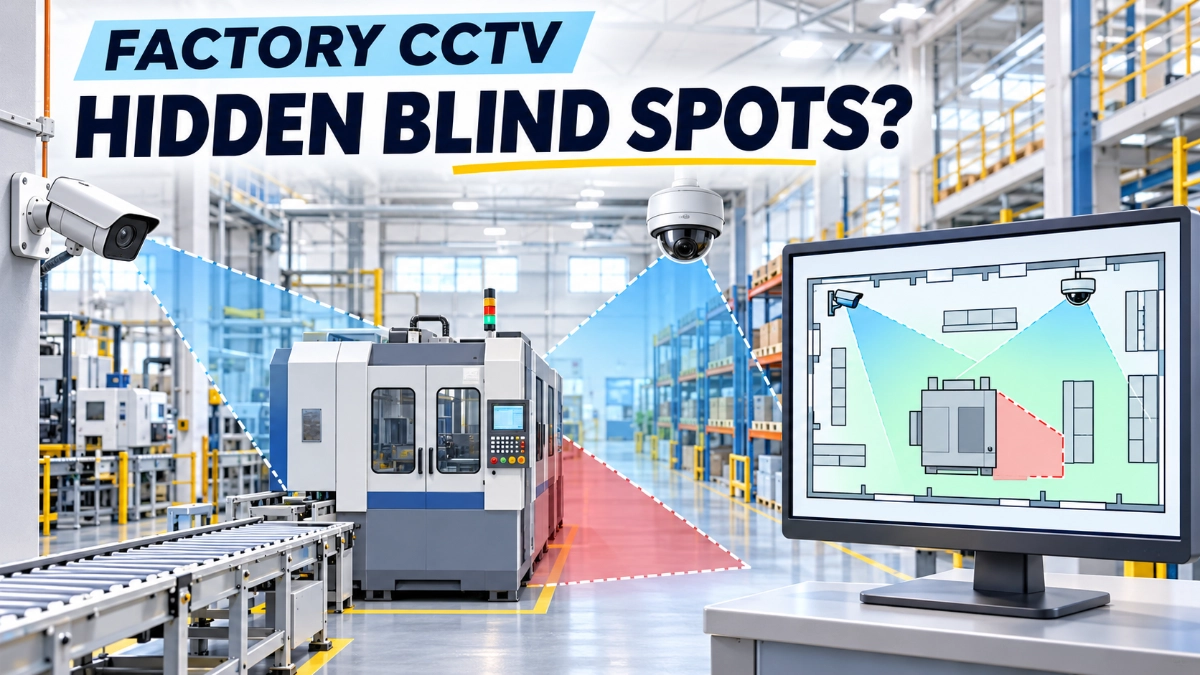
A camera that previously monitored an entire production line may now face an obstruction. A newly installed storage rack may block the view of an emergency exit. A relocated machine may create a hidden area between two camera coverage zones.
These problems are not always visible during routine CCTV monitoring. Cameras may remain online, recording may continue, and the NVR may show no errors. However, important areas can remain outside the camera’s effective field of view.
For security engineers, facility managers, CCTV consultants, and system integrators, reviewing camera coverage after factory layout changes is an essential part of maintaining effective surveillance.
This article explains how factory modifications create CCTV blind spots, how engineers can identify them, and what they should evaluate before modifying an existing surveillance system.
How Do You Identify CCTV Blind Spots After Factory Layout Changes?
To identify new CCTV blind spots after a factory layout change, engineers should compare the original camera layout with the updated factory floor plan, inspect physical obstructions, review actual camera footage, and verify whether critical areas remain visible.
The assessment should cover production lines, storage racks, loading bays, pedestrian routes, emergency exits, machine enclosures, and restricted access areas.
Engineers should also evaluate camera viewing angles, mounting heights, lighting conditions, overlapping coverage, and recording quality. If existing cameras cannot provide the required visibility, they may need repositioning or additional coverage.
1. Why Factory Layout Changes Create New CCTV Blind Spots
CCTV camera placement is usually planned around the factory’s physical layout and operational requirements at the time of installation.
However, industrial environments change frequently.
Common factory modifications include:
- Installation of new production machinery.
- Relocation of manufacturing equipment.
- Expansion of warehouse storage racks.
- Addition of conveyor systems.
- Installation of temporary partitions.
- Changes in material handling routes.
- Modification of loading and unloading areas.
- Expansion of restricted operational zones.
Each modification can affect the camera’s field of view.
For example, a camera installed above a production line may initially provide a clear view of workers and equipment. After a large machine is installed nearby, the machine housing may block part of the camera’s viewing area.
The camera continues recording, but the surveillance coverage has changed.
The important engineering consideration is that factory layout changes should trigger a CCTV coverage review, even when no camera or network equipment has been modified.
2. Identify Physical Obstructions in the Camera’s Field of View
Physical obstructions are among the most common causes of surveillance blind spots in industrial environments.
New machinery, storage racks, electrical panels, cable trays, structural columns, and partitions can block previously clear viewing angles.
Engineers should inspect the camera’s actual field of view rather than relying only on the original installation drawing.
Pay particular attention to:
- Tall machinery and production equipment.
- High-density storage racks.
- Conveyor belts and material handling systems.
- Structural columns and support beams.
- Temporary and permanent partitions.
- Suspended equipment and overhead structures.
- Large inventory stored near camera sightlines.
For example, if a factory introduces a new automated packaging machine, engineers should check whether its enclosure blocks the camera’s view of nearby operator positions.
A small obstruction can create a significant surveillance gap, particularly in areas where workers or materials frequently move.
3. Reassess Camera Coverage Around New Production Lines
Production line modifications can change both camera visibility and surveillance requirements.
When equipment moves, the original camera angle may no longer capture important operational activities.
Consider a factory where three production machines are monitored by two CCTV cameras. Management later introduces a fourth machine and changes the position of the existing conveyor.
The original cameras may still cover the same general area, but the new arrangement could create:
- Unmonitored machine access points.
- Hidden areas between production equipment.
- Poor visibility of operator positions.
- Obstructed material movement routes.
- Gaps between adjacent camera views.
Engineers should identify which operational activities require monitoring and determine whether the existing cameras can capture them effectively.
Simply covering the entire production floor is not enough. The camera should provide useful visibility of the intended activity.
4. Review Warehouse Racks and Storage Area Expansion
Warehouse expansion is another major reason for CCTV coverage changes.
Storage racks often become taller, wider, or more densely arranged as inventory requirements increase.
This can significantly affect camera visibility.
A camera that previously monitored an open storage floor may lose visibility when new racks create narrow aisles and enclosed storage sections.
Engineers should evaluate:
- Rack height: Can the camera still see important areas beyond the racks?
- Aisle coverage: Are movement routes visible from appropriate viewing angles?
- Loading zones: Can cameras capture vehicle movement and material handling activities?
- Inventory areas: Do stored materials block views of access points or restricted zones?
- Intersection points: Are blind spots developing where warehouse aisles meet?
For large warehouses, engineers should assess camera coverage aisle by aisle rather than assuming that one wide-angle camera can monitor several storage sections.
5. Check Camera Field of View and Mounting Height
A camera’s field of view determines how much of an area it can capture.
However, a wider field of view does not automatically provide better surveillance.
For example, a camera installed at a very high mounting position may capture a large section of the factory floor but provide limited facial or activity details.
Similarly, a camera with a narrow field of view may deliver useful detail but leave adjacent areas uncovered.
After factory modifications, engineers should review:
- Camera mounting height.
- Horizontal and vertical viewing angles.
- Lens focal length.
- Distance from the target area.
- Image resolution.
- Lighting conditions.
- Expected subject movement.
- Required identification or monitoring detail.
The objective is to achieve useful coverage, not simply to capture the largest possible area.
Engineers should also distinguish between detection, observation, recognition, and identification requirements when selecting camera positions.
6. Identify Blind Spots at Emergency Exits and Restricted Areas
Factory layout modifications can change access routes and emergency movement patterns.
A previously monitored emergency exit may become partially obstructed by new equipment. A newly created restricted area may remain outside the existing camera coverage.
These locations deserve special attention because they often have important operational and security requirements.
Review CCTV visibility around:
- Emergency exits.
- Fire escape routes.
- Restricted access doors.
- Electrical rooms.
- Control rooms.
- Hazardous material storage areas.
- Equipment access points.
- Loading and unloading entrances.
CCTV should complement physical security, access control, and applicable fire and life safety arrangements. It should not replace required emergency signage, unobstructed escape routes, or other safety provisions.
7. Evaluate Lighting Changes After Factory Modifications
Factory layout changes can also affect lighting conditions.
New machinery, partitions, reflective surfaces, and overhead structures can introduce shadows or glare.
For example, a new metal storage rack may reflect infrared illumination towards a nearby camera. Similarly, a production area with newly installed bright lighting may create high contrast between the foreground and background.
Engineers should review:
- Daylight entering through windows and skylights.
- Shadows created by new machinery.
- Reflections from metal and glass surfaces.
- Low-light conditions.
- Headlights around loading bays.
- Infrared reflection from nearby objects.
- Changes between day and night operations.
A camera that provides clear footage during daytime may produce poor images during night shifts.
Therefore, engineers should review recorded footage under different operating and lighting conditions.
8. Use CCTV Floor Plans and Coverage Mapping
One of the most effective ways to identify surveillance gaps is to maintain an updated CCTV floor plan.
The drawing should include:
- Camera identification numbers.
- Camera mounting locations.
- Viewing directions.
- Approximate coverage areas.
- Lens specifications.
- Critical monitoring zones.
- Known obstructions.
- Network and recording references.
After a factory layout change, compare the updated floor plan with the original CCTV design.
This comparison helps engineers identify areas where camera coverage has changed.
For larger facilities, CCTV design software or site-survey tools can help visualize camera fields of view and overlapping coverage.
However, drawings should always be verified through physical site inspections and actual camera footage.
A theoretical coverage diagram cannot fully represent every real-world obstruction or lighting condition.
9. When Should Engineers Reposition Existing Cameras or Install New Ones?
Not every surveillance blind spot requires an additional camera.
Sometimes, adjusting the existing camera position or viewing angle can restore the required coverage.
Engineers should consider three approaches.
Option 1: Reposition existing cameras
This may work when a small change in camera location or angle can remove an obstruction without creating another coverage gap.
Option 2: Adjust the lens or viewing configuration
Where supported by the camera, changing the focal length or image settings may improve visibility of the required area.
Option 3: Install additional cameras
An additional camera may be necessary when new machinery, separate storage aisles, or expanded operational zones create areas that existing cameras cannot monitor effectively.
When evaluating new equipment, engineers can consider suitable models from the Impact by Honeywell CCTV range based on the application, viewing distance, lighting, and installation environment.
For example, Impact by Honeywell bullet cameras may be suitable for directional monitoring of specific production or external areas, while Impact by Honeywell dome cameras can be evaluated for indoor monitoring where their form factor suits the installation.
Recording capacity and compatibility should also be considered when expanding the system. The selected Impact by Honeywell NVR’s should support the planned camera count, stream requirements, recording configuration, and storage capacity.
10. A Practical CCTV Coverage Audit Checklist for Factory Engineers
A structured inspection helps ensure that factory modifications do not leave important surveillance areas unmonitored.
Use this checklist after major layout changes.
Factory layout
- Obtain the updated factory floor plan.
- Identify newly installed machinery.
- Check relocated production lines.
- Review new storage racks and partitions.
- Identify modified access routes.
Camera coverage
- Inspect every affected camera view.
- Check new physical obstructions.
- Verify mounting height and viewing angle.
- Review production line coverage.
- Check warehouse aisle visibility.
- Verify emergency exit visibility.
- Identify gaps between camera coverage zones.
Image quality
- Review actual recorded footage.
- Check day and night visibility.
- Evaluate glare and shadows.
- Verify image detail at required distances.
- Check camera focus and lens settings.
Recording and system performance
- Confirm affected cameras are recording.
- Verify NVR channel availability.
- Check storage capacity.
- Test playback.
- Update camera location documentation.
The inspection should be repeated whenever significant factory modifications affect camera sightlines or security requirements.
11. How to Maintain CCTV Coverage as Factories Continue to Change
CCTV coverage should not be treated as a one-time installation activity.
Factories continuously introduce new machinery, storage arrangements, production processes, and access routes. Therefore, surveillance design should evolve alongside the facility.
A practical approach includes:
- Conducting CCTV coverage reviews during factory expansion planning.
- Involving security engineers before major machinery relocation.
- Updating CCTV drawings after installation changes.
- Reviewing camera footage during periodic inspections.
- Maintaining records of camera repositioning and replacements.
- Checking NVR recording capacity before adding cameras.
- Reviewing coverage after changes to restricted or high-priority areas.
Organizations sourcing surveillance equipment can also consult an authorised or relevant Impact by Honeywell distributor in India to verify available product specifications and suitable equipment options before finalizing system modifications.
The goal is to maintain useful surveillance coverage as the factory environment evolves.
Conclusion: Factory Layout Changes Should Trigger a CCTV Coverage Review
A factory’s surveillance requirements do not remain constant as its operations expand.
New machinery, additional storage racks, relocated production lines, and modified access routes can create blind spots that were not present during the original CCTV installation.
The challenge is that these problems often develop without generating any camera or NVR error.
For engineers, the solution is to connect factory layout planning with CCTV coverage assessment. Updated floor plans, physical inspections, camera-view analysis, and recorded footage reviews help identify surveillance gaps before they affect security operations.
A reliable factory CCTV system is not simply one where every camera is online. It is one where the right areas remain visible, important activities can be monitored, and coverage continues to match the actual factory layout.
Read Also: NVR Recording Gaps: How to Trace Problems Across Cameras, Networks and Storage
Read Also: CCTV Network Segmentation: What Should Engineers Evaluate Before Separating Camera Traffic?