For decades, businesses installed CCTV cameras for one reason: to catch theft or intrusion after it happened. That reactive mindset still exists in many organisations, but it no longer reflects what modern camera systems can actually do.
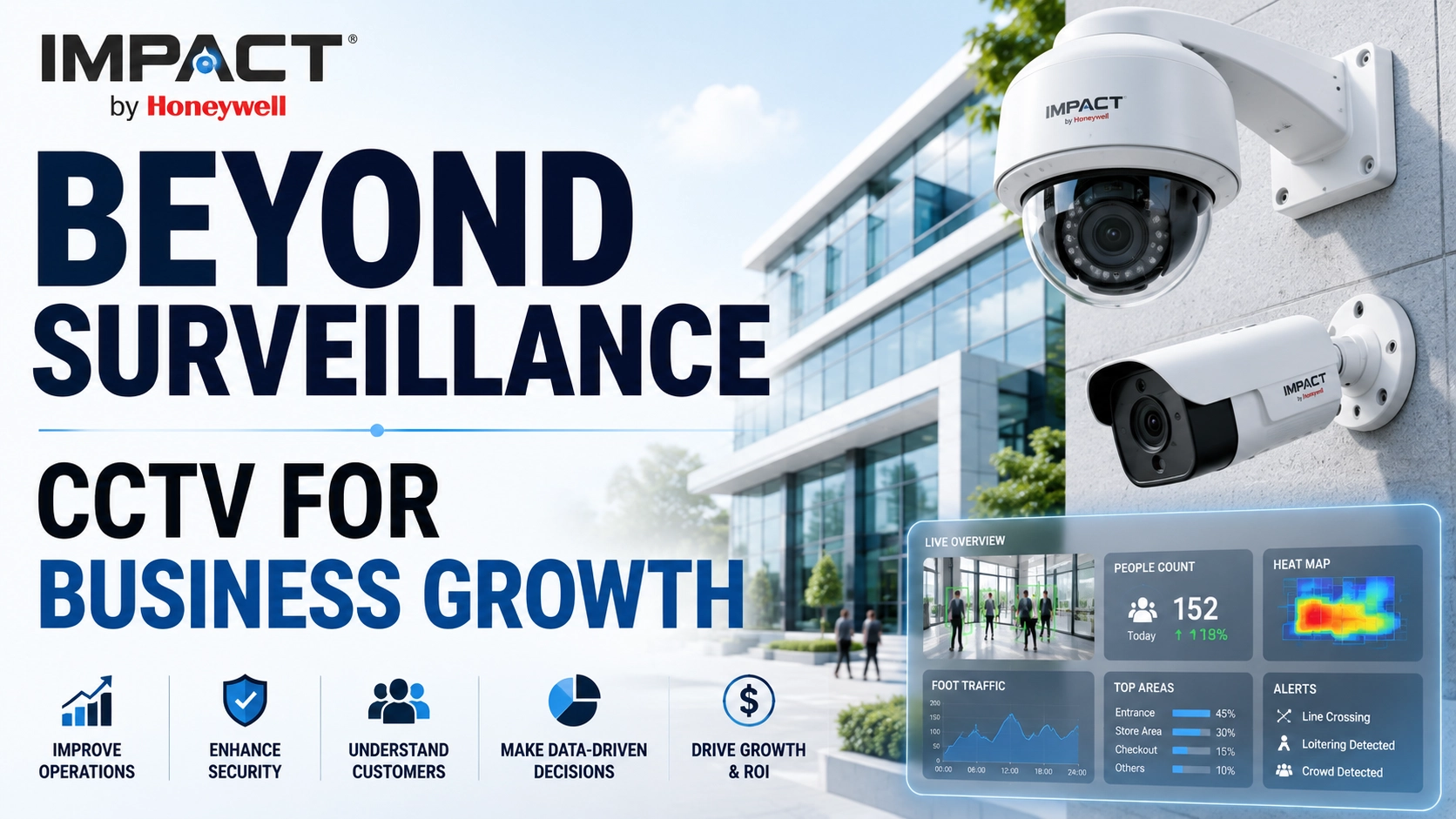
Enterprise CCTV has quietly evolved into a business intelligence tool. It now helps facility managers track occupancy, helps manufacturers catch quality defects, and helps retailers understand customer behaviour. Security remains part of the story, but it is no longer the whole story.
This article explains how enterprise CCTV works, how it differs from traditional surveillance, and how organisations across manufacturing, warehousing, retail, healthcare, and hospitality are using it to solve operational problems that have nothing to do with catching intruders.
Enterprise CCTV combines networked cameras, AI-powered video analytics, and centralised management software to deliver security, operational insights, and compliance data across single or multiple sites. It goes beyond recording footage by turning video into actionable business intelligence.
Key Takeaways
- Enterprise CCTV integrates with access control, fire alarm systems, and Building Management Systems (BMS) for unified facility oversight.
- AI-powered analytics extract business insights such as foot traffic patterns, queue lengths, and safety compliance from live video.
- Manufacturing and warehouse operators use CCTV for quality control, workflow monitoring, and loss prevention.
- Multi-site businesses rely on cloud-based enterprise CCTV for centralised, remote management.
- Cybersecurity, following frameworks like NIST and ISO 27001, is now a core consideration in enterprise video deployments.
What Enterprise CCTV Really Means
Enterprise CCTV refers to a networked video surveillance system designed for organisations with complex operational needs, not just security requirements. It typically includes IP cameras, Network Video Recorders (NVRs) or cloud storage, video management software (VMS), and AI analytics engines working together.
Unlike a basic home or small-shop setup, enterprise CCTV is built to scale. It supports hundreds or thousands of camera channels, multiple sites, role-based user access, and integration with other business systems. The goal is not just to record events but to make video data searchable, actionable, and connected to broader operations.
How Enterprise CCTV Differs From Traditional Surveillance
Traditional CCTV answers one question: “What happened?” Enterprise CCTV answers several more: “What is happening right now?”, “What patterns are emerging?”, and “How can we act on this data?”
This shift happens because enterprise systems process video through AI models that detect objects, count people, recognise patterns, and flag anomalies in real time. Traditional systems, by contrast, mostly store footage for manual review after an incident.
Business Intelligence Through CCTV Analytics
Video analytics convert raw footage into structured data. Instead of a security guard watching dozens of screens, software automatically counts vehicles, tracks dwell time, or measures queue length.
This matters because video is one of the richest, most underused data sources in any facility. A single camera at an entrance can reveal peak visiting hours, average visit duration, and conversion patterns without any additional hardware.
AI-Powered Video Analytics in Practice
AI analytics typically fall into a few practical categories:
- People counting: Measures footfall at entrances, exits, or specific zones.
- Object and vehicle detection: Identifies delivery trucks, forklifts, or unauthorised vehicles.
- Behaviour analysis: Flags loitering, crowding, or unusual movement patterns.
- PPE and safety compliance: Detects whether workers wear helmets, vests, or masks in designated zones.
- Heat mapping: Visualises where people spend the most time within a space.
These capabilities apply differently depending on the industry, which is why enterprise CCTV design always starts with the specific operational problem a business wants to solve.
Operational Efficiency and Workplace Safety
Facility managers increasingly use CCTV to monitor process flow rather than just perimeter security. In a distribution centre, for example, cameras can track how long it takes to load a truck, helping managers identify bottlenecks in the loading dock.
Workplace safety monitoring uses similar logic. Cameras positioned near heavy machinery or high-risk zones can detect when someone enters without proper protective equipment, triggering an alert before an incident occurs rather than only documenting it afterwards.
Manufacturing Quality Control
On production lines, cameras paired with computer vision can spot defects that are difficult for the human eye to catch consistently over an eight-hour shift. This does not replace dedicated machine-vision inspection systems, but general-purpose enterprise cameras can supplement quality checks at packaging or assembly stages, flagging irregularities for human review.
Warehouse and Logistics Optimisation
Warehouses use enterprise CCTV to monitor picking accuracy, dock utilisation, and inventory movement. When paired with time-stamped video, discrepancies in stock counts become easier to investigate because managers can review footage tied directly to the moment an item was moved.
Logistics operators extend this further by monitoring loading bays, verifying delivery timings against schedules, and confirming that goods are handled according to protocol before they leave the facility.
Retail Analytics and Queue Management
Retailers use enterprise CCTV to understand shopper behaviour, not just prevent shoplifting. Heat maps reveal which aisles attract the most attention, while people-counting data helps store managers schedule staff more efficiently during peak hours.
Queue management analytics measure how long customers wait at checkout counters. When wait times exceed a set threshold, the system can alert staff to open another till, directly improving the customer experience without manual monitoring.
Visitor and Occupancy Monitoring
Commercial buildings, coworking spaces, and educational campuses use occupancy monitoring to manage space utilisation and comply with capacity regulations. This became especially relevant after global health guidelines pushed organisations to track real-time occupancy for safety compliance.
Visitor analytics also help facility teams understand traffic flow between buildings, informing decisions about signage, staffing at reception desks, or the layout of common areas.
Loss Prevention and Compliance Monitoring
Loss prevention remains one of the most established use cases, but enterprise CCTV strengthens it through analytics rather than passive recording. Point-of-sale integration, for instance, can flag transactions that do not match items scanned on camera, helping loss prevention teams investigate discrepancies faster.
Compliance monitoring is equally important in regulated industries. Healthcare facilities use video documentation to support incident reporting, while manufacturing plants use it to demonstrate adherence to safety protocols during audits. Organisations following frameworks such as those published by ASIS International often incorporate video evidence as part of their broader risk management documentation.
Remote Management and Multi-Site Business Monitoring
Businesses operating across multiple locations benefit significantly from centralised video management. A regional facility manager can review footage from ten stores or warehouses through a single dashboard instead of visiting each site individually.
Cloud-based enterprise CCTV platforms make this remote oversight practical, since managers can access live and recorded footage securely from any authorised device. This reduces travel time for audits and speeds up incident investigation across distributed operations.
Integration With Access Control, Fire Alarms, and BMS
Enterprise CCTV rarely operates in isolation. It typically integrates with three other systems:
- Access control: Linking door events with video verifies who actually entered a space, not just whose credential was used.
- Fire alarm systems: Integration allows operators to visually confirm alarm triggers, reducing false-alarm response costs. This aligns with life-safety documentation practices referenced by organisations like the NFPA.
- Building Management Systems (BMS): Combining video with HVAC, lighting, and energy data helps facility teams correlate occupancy with energy usage, supporting sustainability goals.
This integration transforms CCTV from a standalone security tool into a connected node within the broader building intelligence ecosystem.
Cybersecurity Considerations in Enterprise CCTV
Every networked camera is also a network endpoint, which means enterprise CCTV carries genuine cybersecurity responsibilities. Weak passwords, outdated firmware, and unsegmented networks are common vulnerabilities that security teams must address.
Best practices generally include network segmentation for camera traffic, regular firmware updates, and role-based access control for the VMS. Organisations often align these practices with guidance from the NIST Cybersecurity Framework and ISO 27001, while device interoperability standards from ONVIF help ensure cameras and recorders from different manufacturers communicate securely. Agencies such as CISA have also published advisories on securing IP-based surveillance infrastructure, reflecting how seriously the industry now treats video systems as part of enterprise IT security.
Cloud vs On-Premise Deployments
Choosing between cloud and on-premise storage depends on bandwidth availability, data retention requirements, and budget structure. Cloud deployments reduce upfront hardware costs and simplify remote access, while on-premise systems offer more control over data residency and can perform better in bandwidth-constrained environments.
Many enterprises now adopt hybrid models, storing critical footage locally for immediate access while archiving longer-term data in the cloud for compliance and disaster recovery purposes.
Traditional CCTV vs Enterprise CCTV
| Factor | Traditional CCTV | Enterprise CCTV |
|---|---|---|
| Purpose | Incident recording | Security plus operational intelligence |
| AI Capabilities | Minimal or none | People counting, PPE detection, behaviour analysis |
| Business Analytics | Not available | Heat maps, queue data, occupancy trends |
| Scalability | Limited to single site | Multi-site, cloud-managed |
| Integration | Standalone | Access control, fire alarms, BMS |
| Reporting | Manual footage review | Automated dashboards and alerts |
| ROI | Security cost centre | Security plus efficiency gains |
Decision Framework: Is Enterprise CCTV Right for Your Business?
Use these questions to evaluate whether an enterprise-grade system fits your organisation’s needs:
- Number of locations: Do you manage more than one site that would benefit from centralised monitoring?
- Employee count: Does your workforce size make manual safety and compliance monitoring impractical?
- Security needs: Do you require advanced detection beyond basic motion alerts?
- Analytics requirements: Would foot traffic, queue, or occupancy data improve decision-making?
- Compliance needs: Does your industry require documented safety or audit evidence?
- Future scalability: Do you expect to add locations, cameras, or integrations within the next few years?
If you answer “yes” to three or more of these points, an enterprise CCTV platform is likely to deliver measurable value beyond security alone.
ROI Beyond Security
Calculating ROI for enterprise CCTV should account for more than reduced theft or vandalism. Labour savings from automated monitoring, faster incident investigation, reduced false fire-alarm dispatches, and improved staff scheduling based on occupancy data all contribute to the total return.
Facility teams evaluating solutions such as Impact by Honeywell CCTV often find that the combination of reliable hardware and analytics software affects both security posture and day-to-day operational efficiency. Organisations sourcing through an Impact by Honeywell CCTV Distributor in India typically look for a balance of local support, standards compliance, and long-term scalability when planning enterprise-wide rollouts.
Hardware choices also matter for specific use cases. Impact by Honeywell Bullet Cameras are commonly deployed for long-range outdoor monitoring such as perimeters and loading docks, while Impact by Honeywell Dome Cameras suit indoor retail and office environments where a discreet, tamper-resistant form factor is preferred. Behind these cameras, Impact by Honeywell NVRs handle recording, storage, and integration with the broader video management platform.
Future Trends in Enterprise Video Intelligence
Enterprise CCTV is moving toward greater autonomy and deeper system integration. Edge AI processing, where analytics run directly on the camera rather than a central server, is reducing bandwidth demands and improving response times.
Predictive analytics are also emerging, using historical video data to forecast staffing needs, maintenance schedules, or peak occupancy periods rather than just reporting on what already happened. As these capabilities mature, the line between “security system” and “operations platform” will continue to blur.
Conclusion
Enterprise CCTV has moved well beyond its original purpose of catching intruders on tape. Today, it functions as an operational intelligence layer that supports safety compliance, quality control, customer experience, and multi-site management.
Businesses that treat CCTV purely as a security expense miss the broader value it can deliver. Those that integrate it thoughtfully with access control, fire systems, and BMS platforms, while addressing cybersecurity fundamentals, position themselves to extract measurable operational returns from technology they were already planning to install.
Read Also: Why Intelligent CCTV Is Transforming Factory Management
Read Also: CCTV ROI: Measuring Business Value Beyond Loss Prevention