An industrial facility commissions an addressable fire alarm panel with substantial unused device capacity. Two years later, it adds a production area, a warehouse extension, new interfaces, additional detection zones, and a separate building.
On paper, the panel still has room. In practice, the team is now dealing with loop loading, power requirements, network architecture, cable routes, cause-and-effect complexity, and documentation that no longer matches the site.
So the central question is this: if a fire alarm system has unused capacity, is it automatically scalable?
A fire alarm panel can have plenty of spare capacity and still be a poor platform for the building’s next expansion.
Is Fire Alarm Capacity the Same as Scalability?
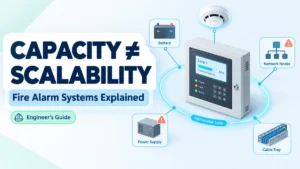
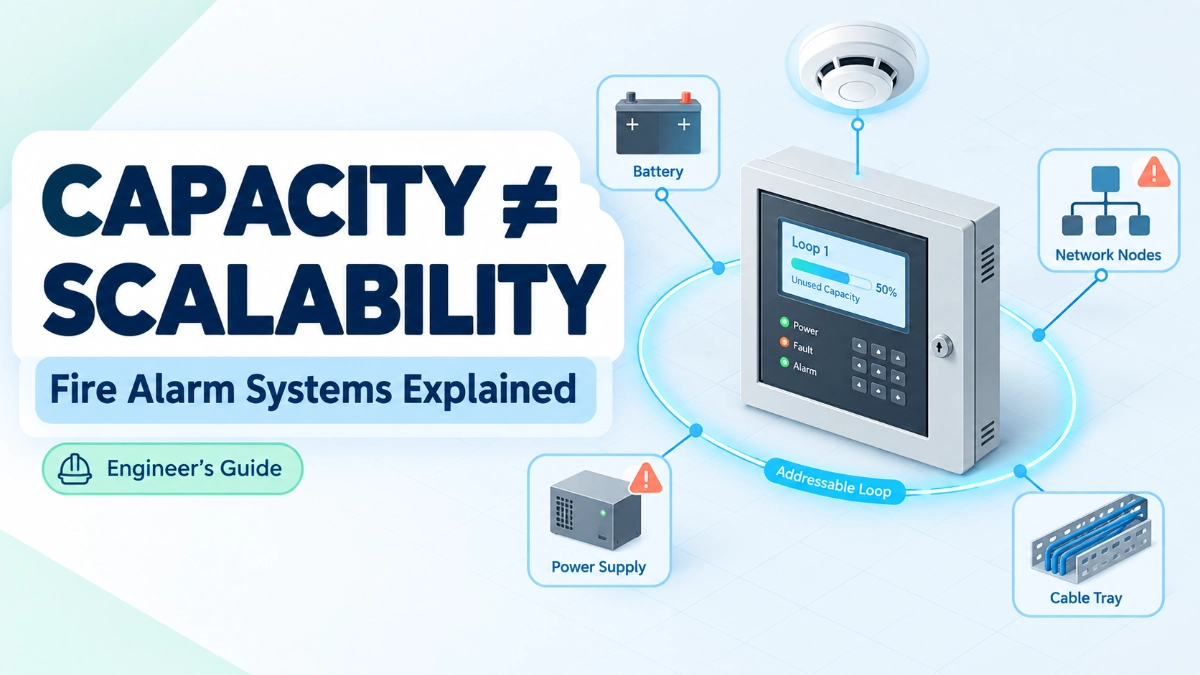
No. Capacity is a technical limit or available resource within a system. Scalability is the system’s ability to accommodate growth without creating disproportionate complexity, reliability, power, communication, maintenance, documentation, or integration problems.
Example: spare device capacity means little if the added devices exceed what the power supply and batteries can support.
What Does Fire Alarm System Capacity Actually Mean?
Fire alarm system capacity is the amount of a defined resource available for use. No single number describes the whole system, because different subsystems have different constraints. Capacity may refer to:
- Devices, loops, and zones
- Panel and networked-panel capacity
- Input/output points
- Power supply and battery capacity
- Notification appliance loading
- Communication channels and monitoring interfaces
- Physical space in enclosures
- Available cable infrastructure
An addressable fire alarm system’s capacity is therefore a set of separate limits, and the most restrictive one determines what can actually be added. For any platform, including an EST Fire Alarm System installation, confirm each limit against current manufacturer documentation.
What Does Real-World Fire Alarm Scalability Mean?
Scalability is the ability to accommodate justified future change while the system stays reliable, maintainable, understandable, supportable, documented, testable, serviceable, and operationally manageable.
It involves more than adding devices: architecture, power, network, wiring, programming, cause-and-effect, interfaces, physical infrastructure, and lifecycle planning all matter.
Capacity vs Scalability — The Engineering Difference
| Factor | Capacity | Real-World Scalability |
|---|---|---|
| Devices | How many can technically be connected | Can devices be added without practical problems? |
| Loops | Available loop resources | Can expansion be distributed effectively? |
| Power | Available electrical capacity | Can added loads be supported under required conditions? |
| Network | Available communication resources | Can the architecture stay manageable as the system grows? |
| Programming | Available configuration capability | Can cause-and-effect remain understandable and maintainable? |
| Maintenance | Existing service capability | Can engineers troubleshoot the expanded system efficiently? |
| Documentation | Current drawings and configuration | Can the expanded architecture remain accurately documented? |
| Future growth | Unused technical capacity | Is that capacity usable for the expected expansion? |
Why “Unused Capacity” Can Be Misleading
Available device or loop capacity should not end the assessment. The following are engineering considerations, not universal failure conditions.
Device capacity exists, but power is limited
Additional devices may fit the loop, but auxiliary power, notification loads, and standby batteries may need review.
Panel capacity exists, but the network becomes complex
The panel may accept more equipment, yet communication paths and network management become harder to design and verify.
Device capacity exists, but physical infrastructure does not
Cable routes, containment, risers, access, or building layout can create practical limits that a capacity figure never shows.
Capacity exists, but maintenance becomes difficult
A technically expandable system can become harder to troubleshoot, document, and service as complexity increases.
How Device and Loop Capacity Affect Real-World Scalability
In addressable systems, the question is not only how many devices a loop can carry, but how they are distributed. Engineers should evaluate:
- Device distribution and loop loading
- Device types on each loop
- Isolation requirements where applicable
- Cable routes and future areas
- Spare capacity and expansion zones
- Loop segmentation and maintenance accessibility
Actual allowable capacity comes from manufacturer documentation and project requirements. Reserving spare capacity per loop, or assigning loops by area, usually eases later expansion.
Power Capacity Is Often the Hidden Scalability Constraint
Power should be assessed alongside device capacity. Review panel power, auxiliary power, notification loads, remote devices, interface and network equipment, and standby battery requirements, then add the planned future loads.
A system can have available device capacity while having insufficient practical power capacity for the planned expansion.
Avoid rules of thumb. Run project-specific power and battery calculations using the actual equipment and applicable requirements, and repeat them whenever loads change.
Network Scalability Changes the Engineering Problem
Growth often introduces multiple panels, multi-building layouts, and networked architecture. Engineers then need to consider communication paths, shared infrastructure, central monitoring, remote annunciation, additional interfaces, network management, and failure scenarios.
Does adding another panel simply increase capacity, or does it also increase architectural complexity?
Usually both. Scalability depends on how the system behaves as its network grows: how faults are detected, how communication degrades, and whether problems remain diagnosable.
Future Expansion Should Influence Fire Alarm Design From Day One
Engineers should understand how the building is expected to develop: warehouse expansion, new production lines, additional floors, new office areas, extra buildings, tenant changes, new equipment, and future ELV integration.
There is a difference between designing for today’s building and designing an architecture that can accommodate justified future change. This does not mean oversizing everything. Excessive unused capacity adds cost and complexity of its own. The aim is to reserve capacity where growth is credible.
EST3 and EST4 — Why Platform Selection Should Consider More Than Capacity
Engineers evaluating architecture and future expansion may consider platforms such as EST3 and EST4. Headline capacity is only one input; evaluation should also cover architecture, expansion requirements, device ecosystem, network and power requirements, integration, programming, documentation, maintenance, technical support, and lifecycle planning.
Neither platform should be assumed universally better. Device counts, loop limits, networking behaviour, compatibility, and migration paths must be verified against current manufacturer documentation for the specific project. The better choice is the one whose verified characteristics match the building’s expected growth.
Field Devices Are Part of Scalability
Scalability does not stop at the control panel. Smoke detectors, heat detectors, manual call points, modules, notification devices, supervisory devices, specialised detection, and interface devices all affect how easily a system grows. When considering EST Detectors and Devices, or any device range, confirm availability, compatibility, environmental suitability, installation conditions, maintenance needs, and configuration requirements.
Cause-and-Effect Complexity Grows With the System
Expansion increases logical complexity as well as device count. New zones, buildings, and interfaces such as HVAC, access control, BMS, PA/VA, and monitoring each add dependencies to the cause-and-effect matrix. An architecture can have technical capacity while becoming steadily harder to understand and maintain.
Scalability must account for logical complexity as well as physical capacity.
Documentation and Maintenance Are Part of Scalability
A system is not truly scalable if engineers cannot accurately understand it after expansion. Keep updated as-built drawings, device schedules, loop diagrams, cause-and-effect matrices, configuration records, network diagrams, battery calculations, modification records, testing records, and maintenance history. Without them, a technically expandable system becomes a difficult maintenance environment.
A Practical Framework for Evaluating Real-World Scalability
This framework supports engineering evaluation and does not replace manufacturer documentation or project-specific requirements.
- Current capacity: What resources are available today?
- Planned growth: What changes are expected?
- Physical infrastructure: Can the building support the expansion?
- Power: Can the additional load be supported?
- Communication: Can the network architecture accommodate growth?
- Logic: Can cause-and-effect remain manageable?
- Integration: Which additional systems will need interfaces?
- Maintenance: Can engineers troubleshoot the expanded system?
- Documentation: Can every modification stay accurately documented?
- Lifecycle: Can the expanded architecture remain supportable over time?
Common Mistakes When Evaluating Fire Alarm Scalability
- Looking only at device count. It hides every other constraint.
- Treating panel capacity as total system capacity. Loops, power, and networks have separate limits.
- Ignoring power requirements. Loads and standby needs grow.
- Ignoring network architecture. More panels mean more dependencies.
- Ignoring cable infrastructure. Routes and containment constrain expansion.
- Assuming unused capacity is automatically usable. Location and loading decide usability.
- Failing to consider future building changes. Growth belongs in initial design.
- Ignoring cause-and-effect complexity. Complex logic is hard to test.
- Forgetting maintenance and documentation. Undocumented expansion undermines serviceability.
- Selecting equipment only for today’s requirements. Lifecycle needs matter.
Fire Alarm Scalability Review Checklist
- What device capacity exists, and what remains?
- What are the actual loop and zone constraints?
- Is power capacity sufficient, and are standby requirements reviewed?
- Is the network infrastructure expandable?
- Are future buildings or areas expected?
- Can existing cables and containment support expansion?
- Will cause-and-effect become significantly more complex?
- What additional integrations are expected?
- Will compatible devices and spare parts remain available?
- Can the maintenance team support the expanded architecture?
- Are drawings and configuration records current?
- Is the expansion consistent with manufacturer requirements?
- Does the architecture remain practical after expansion?
Procurement and Supplier Evaluation
For new projects, expansions, or upgrades, evaluate the complete lifecycle, not only the initial equipment price. Consider technical documentation, product availability, device ecosystem, spare parts, technical support, training, engineering assistance, expansion options, integration support, and commissioning support. When sourcing through an EST Fire Alarm System Distributor in India, or any supplier, engineers should ask how consistently these are provided, since expansion often follows years later.
When Does Capacity Stop Being Practical Scalability?
No universal threshold makes a system suddenly unscalable. Instead, look for warning signs:
- Expansion requires disproportionate redesign.
- Power becomes difficult to accommodate.
- Network architecture becomes needlessly complex.
- Documentation becomes hard to maintain.
- Troubleshooting becomes increasingly difficult.
- New interfaces create tangled dependencies.
- Spare capacity exists but is hard to use.
- Future changes require repeated major modifications.
Technical possibility is not always the same as engineering practicality.
Conclusion — Capacity Is a Number; Scalability Is a Design Property
A fire alarm system should not be judged only by how many devices or loops it can technically accommodate. A scalable architecture also accounts for power, network, physical infrastructure, devices, cause-and-effect, integration, maintenance, documentation, future growth, and lifecycle support.
Capacity answers “How much can the system accommodate?” Scalability answers “Can the system continue to accommodate change without creating disproportionate engineering and operational problems?
Read Also: Why ELV Integration Fails When Cause-and-Effect Is Designed Too Late
Read Also: The Difference Between a Recurring Fault and a Random Fault