India’s skyline is changing fast. Malls, IT parks, hospitals, warehouses, and high-rise residences are being built at a pace the country has rarely seen. With this growth comes a quieter, less visible shift: the way buildings detect and respond to fire.
For decades, conventional fire alarm panels were the default choice. They were simple, affordable, and familiar. But as buildings have grown taller, more complex, and more valuable, that simplicity has started to work against safety rather than for it.
Today, addressable fire alarm systems are rapidly becoming the preferred and, in many cases, expected standard for commercial and industrial fire protection in India. This shift isn’t driven by trend-chasing. It’s driven by how modern buildings actually behave during a fire event, and by what fire safety consultants, insurers, and regulators now expect from a protection system.
This article explains why the change is happening, how addressable technology works, and what it means for anyone planning, specifying, or maintaining a fire alarm system in India.
Why India’s Fire Safety Landscape Is Changing
Three forces are reshaping fire protection decisions in India: building complexity, regulatory maturity, and rising accountability after major fire incidents.
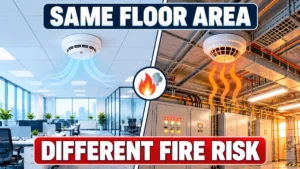
- Buildings are larger and more layered: A single commercial tower today may include retail floors, office space, parking basements, and mechanical plant rooms, each with different fire risks. A single-zone conventional system cannot accurately describe this complexity.
- Regulatory expectations have matured: Municipal fire NOC (No Objection Certificate) processes, insurance audits, and occupancy certifications increasingly reference the National Building Code (NBC) of India and international benchmarks like NFPA and EN 54. Consultants are expected to justify their system design, not just install a panel that “works.”
- Post-incident scrutiny has increased: After several high-profile fire incidents in commercial and healthcare buildings over the past decade, fire departments and building authorities across Indian states have tightened inspection and compliance requirements. Faster, more precise detection is no longer a preference; it’s a documented expectation in many jurisdictions.
Together, these forces have pushed the market toward systems that can pinpoint a fire’s exact location, integrate with other building systems, and provide auditable data capabilities that define addressable fire alarm technology.
What Is an Addressable Fire Alarm System?
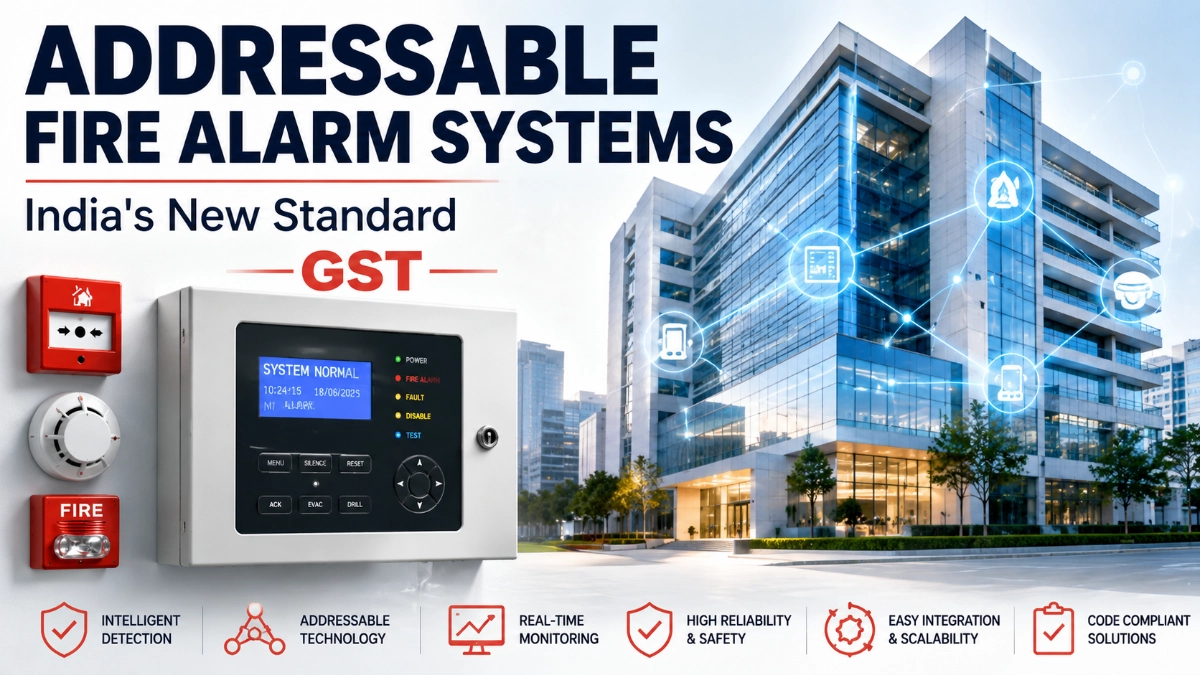
An addressable fire alarm system is a fire detection network where every detector, call point, and module has a unique digital address on the control panel. This allows the addressable fire alarm control panel to identify the exact device that triggered an alarm, rather than just the general zone, enabling faster and more accurate emergency response.
Unlike conventional systems, which group multiple detectors into a single wired zone, an addressable system assigns each device its own identity on a communication loop. When a detector activates, the panel doesn’t just say “Zone 3”; it says “Detector 14, Third Floor Server Room.”
This precision is the foundation of everything else addressable systems offer: faster response, easier maintenance, and better integration with modern building management.
How Addressable Technology Works
An addressable fire alarm system operates on a looped or networked wiring architecture, where devices communicate digitally with a central addressable fire alarm panel.
1. The loop architecture: Devices smoke detectors, heat detectors, manual call points, and input/output modules) are wired in a continuous loop back to the panel. Each device has a programmed address.
2. Continuous polling: The panel continuously polls every device on the loop, checking its status (normal, fault, or alarm) several times per second. This is different from conventional systems, which only report a triggered state.
3. Analogue sensing: Many addressable detectors use analogue sensing, meaning they report actual smoke density or temperature values, not just a simple threshold trigger. This allows the panel to apply intelligent algorithms to reduce false alarms.
4. Precise location reporting: When an alarm condition occurs, the panel displays the exact device, its location text, and the time of activation critical information for fire wardens and emergency responders.
5. Loop resilience: Because devices are wired in a loop (not a simple branch), a single cable fault typically doesn’t disable the entire circuit; the panel can usually operate the loop from both directions until repaired.
Conventional vs Addressable Fire Alarm Systems: A Direct Comparison
| Feature | Conventional Fire Alarm Panel | Addressable Fire Alarm Panel |
|---|---|---|
| Fault/alarm location | Zone-level only | Exact device-level |
| Wiring architecture | Radial, zone-based | Looped, digitally addressed |
| False alarm management | Limited | Advanced, analogue-based algorithms |
| Scalability | Difficult beyond a certain size | Highly scalable across large buildings |
| Maintenance and diagnostics | Manual, zone-by-zone checks | Automated device-level diagnostics |
| Integration with BMS/access control | Limited | Extensive |
| Best suited for | Small, single-purpose buildings | Large, multi-zone, or high-occupancy buildings |
| Typical upfront cost | Lower | Higher |
| Typical lifecycle cost | Higher (labour-intensive maintenance) | Lower (efficient diagnostics) |
Key takeaway: Conventional systems remain suitable for small, low-risk buildings. But once a building has multiple floors, mixed occupancy, or high footfall, addressable systems consistently outperform conventional detectors and conventional fire alarm panels on both safety and total cost of ownership.
Why Commercial Buildings Prefer Addressable Systems
Commercial building owners and facility managers are not choosing addressable systems because they are newer. They are choosing them because of measurable operational advantages.
- Faster emergency response: Security teams and fire wardens can direct occupants and responders to the exact source of a fire within seconds, rather than searching an entire zone.
- Fewer false alarms: Analogue addressable detectors distinguish between genuine smoke conditions and nuisance sources like dust, steam, or cooking fumes far more reliably than conventional threshold-based detectors.
- Simplified expansion: Adding a new floor, tenant fit-out, or wing to a building is far easier on a looped addressable network than on a conventional zone-wired system, which often requires new wiring runs and panel zone expansion.
- Centralised monitoring: Facility teams managing multi-building campuses, IT parks, hospitals, and universities benefit from networked addressable panels that consolidate alarm data into a single monitoring point.
Industries Driving Adoption in India
Adoption isn’t uniform across all sectors. Certain industries are moving toward addressable systems faster because their risk profile or regulatory exposure demands it.
- IT parks and corporate campuses: High occupancy density and continuous operations require precise, low-disruption detection.
- Healthcare facilities: Patient evacuation planning depends on exact fire location data, not general zone alerts.
- Hospitality (hotels and resorts): Multi-floor guest occupancy and life-safety liability make device-level detection essential.
- Manufacturing and industrial plants: Process areas often require integration between fire detection and process shutdown systems.
- Data centres: Early, precise detection protects both life safety and high-value equipment.
- Retail malls and mixed-use developments: Large, open floor plates and public footfall demand fast, accurate alarm response.
- Warehousing and logistics parks: Expansive floor areas make zone-based detection impractical.
Expert insight: Fire safety consultants increasingly recommend addressable systems by default for any building exceeding four floors or 2,000 square meters of built-up area, aligning with the layered protection philosophy found in NFPA 72 and NBC India fire safety provisions.
Benefits Beyond Fire Detection
Addressable fire alarm systems increasingly function as part of a broader building intelligence layer, not just a life-safety component.
- Integration with building management systems (BMS): Alarm events can automatically trigger HVAC shutdown, smoke damper closure, or elevator recall.
- Access control coordination: Addressable panels can interface with access systems to unlock designated escape routes during an alarm.
- Voice evacuation coordination: Larger addressable systems often integrate with public address and voice alarm systems for phased, floor-by-floor evacuation instructions.
- Data logging for audits: Every event test, fault, alarm, or reset is logged with a timestamp, supporting compliance audits and insurance documentation.
Maintenance and Lifecycle Advantages
Addressable fire alarm systems reduce maintenance costs by identifying the exact faulty device instead of requiring technicians to inspect an entire zone. This cuts diagnostic time, reduces unnecessary component replacement, and allows predictive maintenance based on device-level performance data logged by the panel.
Maintenance is where addressable systems often justify their higher upfront cost.
Zone-by-zone troubleshooting versus device-level diagnostics: On a conventional panel, a fault in “Zone 4” could mean checking a dozen devices. On an addressable panel, the technician goes directly to the flagged device.
Reduced downtime: Faster fault isolation means shorter periods where a building operates with a degraded fire detection system, a factor auditors and insurers pay close attention to.
Predictive maintenance potential: Analogue value trends (e.g., gradual dust build-up in a detector chamber) can flag devices needing cleaning before they generate a fault or false alarm.
Lower long-term labour cost: For large campuses with in-house facility teams, the cumulative time saved on troubleshooting often offsets the higher initial investment within a few years.
Compliance With Modern Fire Safety Standards
Fire alarm system design in India is increasingly benchmarked against a combination of domestic and international references.
- National Building Code (NBC) of India provides the foundational framework for fire and life safety requirements in Indian buildings, including detection, alarm, and evacuation provisions referenced by most state fire departments during NOC approval.
- NFPA 72 (US-based, widely referenced globally) outlines detailed technical requirements for fire alarm and signalling systems, and is commonly used by consultants in India as a design reference for complex or international-standard projects.
- EN 54 is the European standard series governing fire detection and fire alarm system components. Many addressable detectors and panels installed in India carry EN 54 certification, giving specifiers a recognised benchmark for device performance and reliability.
Are addressable systems mandatory in India? Addressable fire alarm systems are not universally mandatory by a single national law, but many state fire NOC authorities, insurance underwriters, and high-rise or high-occupancy building codes effectively require them due to building size, height, or occupancy classification thresholds.
Consultants should always verify current state-specific fire department requirements, since implementation varies by jurisdiction and building classification.
Future of Intelligent Fire Alarm Systems
The next phase of addressable technology is already visible in newer commercial installations.
- Cloud-connected monitoring: Remote visibility into panel status for multi-site facility teams and monitoring stations.
- AI-assisted false alarm filtering: Algorithms that cross-reference multiple sensor inputs (smoke, heat, CO) before triggering a full evacuation alarm.
- Wireless addressable devices: Useful for heritage buildings or retrofit projects where new cabling is impractical.
- Deeper IoT integration: Fire alarm data feeding into broader smart-building dashboards alongside energy, security, and occupancy analytics.
These trends point toward fire alarm systems becoming less of a standalone safety box and more of an integrated node within a building’s overall intelligence infrastructure.
Common Misconceptions About Addressable Fire Alarm Systems
- “Addressable systems are only for very large buildings.” While they offer the most value in large or complex buildings, mid-sized commercial buildings with mixed occupancy also benefit from precise detection and easier future expansion.
- “Conventional systems are cheaper overall.” They are cheaper upfront, but lifecycle maintenance and troubleshooting labour often narrow or reverse that gap over a system’s operational life.
- “More devices always mean more complexity.” Addressable loops are designed for scale. Adding devices is generally simpler than expanding a conventional zoned system, not more complex.
- “Addressable and intelligent fire alarm systems are the same thing.” Addressable refers to the device-level identification capability. Intelligent (or analogue addressable) typically adds sensing algorithms for false alarm reduction, a related but distinct capability worth clarifying with your system integrator.
Expert Recommendations for Specifiers and Building Owners
- Classify the building correctly first: Occupancy type, height, and floor area should drive the system choice, not budget alone.
- Confirm loop capacity early: Addressable loops have a defined maximum device capacity per manufacturer; oversizing a loop at design stage avoids costly rework later.
- Check certification: Look for EN 54-certified components when specifying addressable detectors and panels for projects targeting international-standard compliance.
- Plan for integration: Coordinate fire alarm design with BMS, access control, and voice evacuation teams from the design phase, not after installation.
- Budget for lifecycle, not just installation: Evaluate total cost of ownership, including diagnostics, technician time, and false-alarm-related downtime.
Solutions such as GST Fire Alarm Systems are commonly specified in Indian commercial and industrial projects as an example of an addressable platform designed around these principles: loop-based architecture, device-level diagnostics, and integration flexibility for multi-building campuses.
Conclusion
The shift toward addressable fire alarm systems in India is not a passing trend; it reflects how buildings, regulations, and risk expectations have genuinely changed. As commercial and industrial spaces grow taller, denser, and more integrated with smart building technology, precise, device-level fire detection has moved from a premium feature to a practical necessity.
For engineers, consultants, and building owners planning a new fire protection system, the decision increasingly isn’t whether addressable technology is worth the investment; it’s how to design it correctly for the building’s specific risk profile, occupancy, and compliance requirements.
Read Also: Event Logging: The Underrated Feature of Modern Fire Alarm Systems
Read Also: How Intelligent Fire Alarm Systems Simplify Annual Testing