India Is Building Factories at Record Speed, But Is Fire Safety Keeping Pace?
India’s Make in India initiative has triggered a wave of industrial expansion, new factories, logistics corridors, data centers, EV manufacturing plants, and automated warehouses. This growth is fundamentally changing fire safety requirements. Larger, more complex, and more densely equipped facilities demand fire detection infrastructure that goes far beyond conventional systems. This article examines the intersection of India’s manufacturing rise and the evolving fire safety standards industrial decision-makers need to understand now.
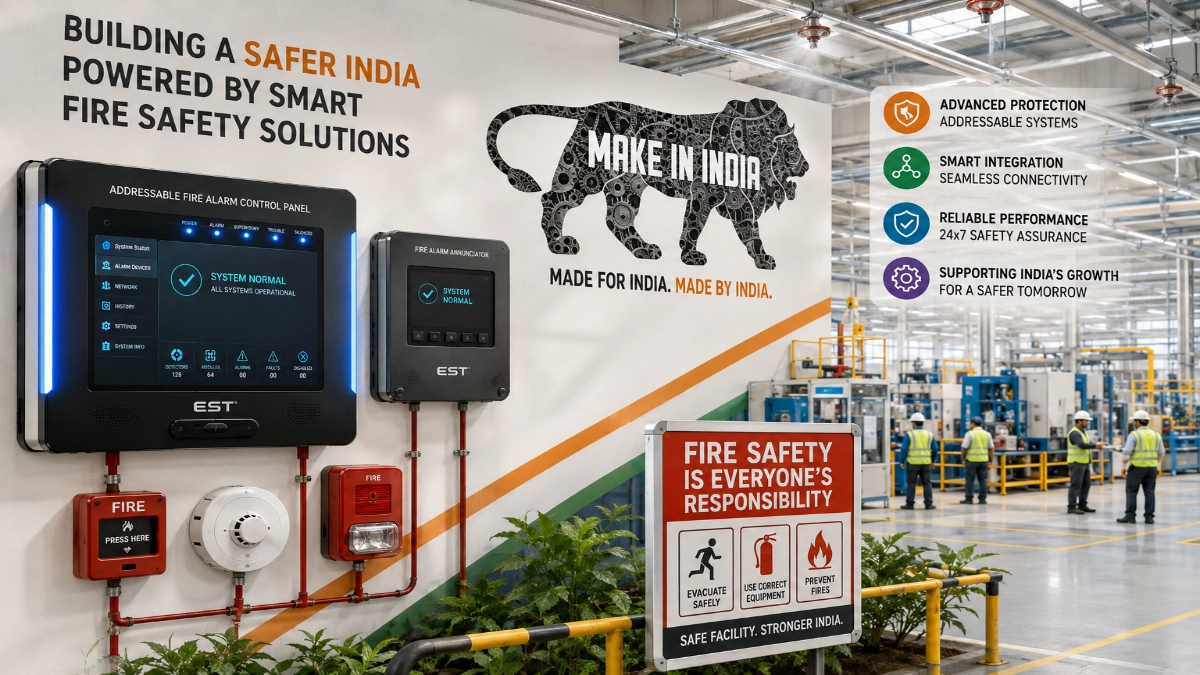
Understanding the Make in India Movement
What is Make in India?
Make in India is a national initiative launched in September 2014 by the Government of India to transform the country into a global manufacturing hub. It targets 27 key sectors, including electronics, defence, automotive, pharmaceuticals, textiles and food processing by attracting foreign direct investment, reducing regulatory friction and building world-class industrial infrastructure.
The results have been measurable. India climbed from 142nd to 63rd in the World Bank’s Ease of Doing Business Index between 2014 and 2020. FDI inflows into the manufacturing sector have grown significantly and industrial corridors spanning thousands of kilometres are now operational or under active development across the country.
Key infrastructure programs driving this expansion include:
- Delhi-Mumbai Industrial Corridor (DMIC): A 1,504 km freight corridor anchoring smart industrial cities across six states.
- Chennai-Bengaluru Industrial Corridor (CBIC): Targeting electronics, automotive, and defence clusters.
- Amritsar-Kolkata Industrial Corridor (AKIC): Covering the northern industrial belt.
- Production Linked Incentive (PLI) Schemes: Offering incentives across 14 sectors, including mobile manufacturing, speciality steel, solar modules, and pharmaceuticals.
The scale of this buildout is not simply economic; it has deep implications for safety infrastructure planning that are only beginning to receive serious industry attention.
Why Industrial Growth Is Reshaping Fire Safety Requirements
How does industrial growth influence fire safety requirements?
Industrial growth does not scale linearly with fire risk. As facilities grow larger, more interconnected and more densely equipped, fire risk grows disproportionately, driven by higher asset concentration, more complex operational processes and the round-the-clock nature of modern manufacturing.
Four structural shifts define the current challenge:
1. Larger Facilities, Greater Exposure
Modern greenfield manufacturing plants being built under PLI schemes frequently exceed 100,000 square meters of floor area. A facility of that scale demands detection coverage across multiple fire zones, varied occupancy types, and diverse hazard profiles, all within a single campus. Conventional zone-based fire alarm systems were not designed for environments of this complexity.
2. Higher Asset Concentration
Electronics manufacturing lines, robotic assembly systems, precision CNC machinery, and automated storage and retrieval systems represent asset concentrations that would have been uncommon in Indian industrial facilities a decade ago. A single production line in a semiconductor or mobile assembly plant may represent hundreds of crores in capital investment. Fire incidents in these environments are not merely dangerous; they are existential for operations.
3. Increased Operational Complexity
Modern manufacturing environments integrate IT systems, OT (operational technology) networks, climate-controlled production environments, cleanrooms, chemical handling areas, and high-bay storage within the same physical footprint. Each zone carries distinct fire risk characteristics. Uniform detection strategies applied across differentiated risk environments create blind spots.
4. 24/7 Manufacturing
India’s industrial expansion is pushing facilities toward continuous operations to maximise capacity utilisation under the PLI scheme timelines. Round-the-clock manufacturing means fire events can occur during night shifts with reduced personnel on-site. This places greater weight on automated detection, early warning capability, and rapid alarm response, factors that depend entirely on the quality of installed fire detection infrastructure.
Emerging Fire Safety Challenges in Modern Manufacturing Facilities
What fire safety challenges are emerging in India’s manufacturing sector?
India’s expanding industrial base is generating a new tier of fire safety challenges that legacy systems and outdated safety frameworks are poorly equipped to handle.
Automated Warehouses and Logistics Parks
India’s logistics sector is undergoing rapid modernisation. Mega-warehouses exceeding 500,000 square feet, developed by logistics majors and e-commerce operators, increasingly use automated storage systems with racking heights of 12 to 20 meters. Conventional smoke detectors mounted on flat ceilings cannot reliably detect fires that originate at floor level or within dense rack structures. These environments require purpose-designed in-rack detection strategies, beam detectors, or aspirating smoke detection systems capable of identifying smoke at trace concentrations before flames develop.
Battery Storage and EV Manufacturing
India’s EV manufacturing ambitions, anchored by PLI schemes for advanced chemistry cells and EV components, have introduced lithium-ion battery storage as a significant new fire hazard. Lithium-ion thermal runaway events are chemically unique: they self-sustain, generate intense heat rapidly, and can reignite hours after apparent suppression.
Standard heat and smoke detectors often activate too late in a thermal runaway sequence to enable meaningful intervention. This environment demands very early warning detection capable of identifying off-gas signatures that precede thermal runaway, a requirement that points toward electrochemical gas detection and high-sensitivity aspirating systems.
Electronics and Semiconductor Manufacturing
India’s electronics manufacturing sector, covering mobile devices, consumer electronics, and components, is expanding rapidly across states like Tamil Nadu, Telangana, Andhra Pradesh, and Karnataka. These cleanroom and ESD-controlled environments present a paradox: they must maintain particulate-free air while also supporting fire detection. Conventional ionisation or photoelectric detectors introduce contamination risks in cleanroom zones. High-sensitivity aspirating smoke detection (HSASD) systems, which sample air through a remote pipe network and analyse it away from the cleanroom, resolve this conflict. Their adoption in Indian electronics manufacturing remains uneven, creating measurable gaps in protection.
Data Centres
India’s data centre capacity is expanding aggressively, driven by digital public infrastructure programs, cloud adoption, and hyperscaler investment. A data centre fire event is categorically different from a conventional industrial fire; suppression must occur without water-based systems that damage server infrastructure, and detection must trigger before temperatures rise to levels that cause equipment failure. Very early smoke detection apparatus (VESDA) systems integrated with addressable fire alarm control panels have become the global standard for data centre fire protection. Indian data centre operators are progressively adopting these standards, but Tier 2 and Tier 3 facilities often lag.
Chemical and Pharmaceutical Facilities
India’s pharmaceutical sector, already a global leader in API and generic drug production, is under pressure to modernise manufacturing infrastructure under regulatory frameworks like the WHO-GMP and US FDA standards. These facilities handle flammable solvents, reactive chemicals and dust-generating processes. Multi-sensor detection combining heat, smoke, and flame sensing is increasingly necessary, as is integration with process control systems that can halt chemical flows when fire events are detected.
The Evolution of Fire Detection in Industrial Infrastructure
Why are modern factories adopting advanced fire detection systems?
The shift from conventional to intelligent fire detection in Indian industrial facilities is driven by three converging forces: regulatory tightening, insurance risk assessment, and engineering best practice.
- Regulatory Evolution: The National Building Code of India (NBC 2016) introduced more detailed requirements for fire detection systems in industrial buildings. State fire safety regulations and factory inspector guidelines are progressively aligning with international norms. Industrial corridors developed under central government programs are also incorporating fire safety infrastructure requirements into their master planning documents, a development that directly influences factory approval processes.
- Insurance and Risk Assessment: Industrial fire insurance underwriters are increasingly scrutinising detection system specifications during policy renewals and claims assessments. Facilities equipped with addressable fire alarm systems, which provide point-specific fault and alarm identification, demonstrate demonstrably lower risk profiles than those using conventional zone systems. This directly influences premium calculations and maximum insurable values.
- Engineering Best Practice: The growing presence of international EPC contractors, global manufacturing partners, and multinational occupiers in Indian industrial parks is raising baseline expectations for fire protection design. Global automotive OEMs, electronics majors, and logistics operators bring standardised fire safety specifications from their international facilities and expect Indian-built plants to match them.
Conventional vs. Addressable Fire Alarm Systems: A Comparison
| Parameter | Conventional Systems | Addressable Systems |
|---|---|---|
| Alarm Identification | Zone-level only | Individual device-level |
| Fault Identification | Zone-level only | Device-specific location |
| Scalability | Limited | High — supports large facility networks |
| Integration Capability | Basic | BMS, access control, suppression systems |
| False Alarm Management | Difficult | Cross-zoning and verification possible |
| Maintenance Efficiency | Manual zone checks | Remote diagnostics and status monitoring |
| Suitable Facility Scale | Small to medium | Medium to large industrial facilities |
The transition from conventional to addressable fire alarm infrastructure is no longer an upgrade; it is a minimum expectation for new industrial construction at scale.
Fire Safety Framework for Future-Ready Manufacturing Facilities
A structured fire safety framework helps industrial planners move beyond compliance minimums toward genuinely resilient fire protection infrastructure.
| Pillar | Description | Key Actions |
|---|---|---|
| 1. Hazard-Based Zoning | Map the facility by distinct fire risk profiles, not physical boundaries alone | Identify flammable storage, high-value equipment, cleanrooms, battery areas, and chemical handling separately |
| 2. Detection Technology Match | Select detection technology matched to the hazard in each zone | Use HSASD for cleanrooms, aspirating detection for high-bay storage, and multi-sensor devices for mixed-use industrial areas |
| 3. Addressable Alarm Architecture | Deploy addressable fire alarm control panels as the backbone of detection infrastructure | Ensure panel capacity supports future expansion without system replacement |
| 4. Integration with Building and Process Systems | Connect fire alarm systems to BMS, HVAC, suppression systems, and process control | Define automatic responses: door closure, damper activation, process line shutdown |
| 5. Verified Alarm Protocols | Implement alarm verification sequences to minimize false alarm disruption to production | Use cross-zone logic, confirmation timers, and investigation protocols before evacuation triggers |
| 6. Maintenance and Testing Regime | Establish documented periodic testing schedules for all detection devices and alarm functions | Align with NBC requirements and insurer stipulations; maintain testing records |
| 7. Competency and Response Planning | Train facility safety teams on system operation, alarm response, and coordination with fire services | Develop and rehearse emergency response plans specific to each high-risk zone |
How Industrial Decision-Makers Can Prepare for Future Safety Demands
For manufacturing business owners, facility managers, and EPC contractors navigating India’s industrial expansion, the following actions represent the foundation of future-ready fire safety planning.
During Facility Design Phase:
- Include a qualified fire safety consultant in the project team from the concept stage, not as a compliance afterthought.
- Require hazard-specific fire protection design documents as part of the engineering brief.
- Specify addressable fire alarm systems as the detection standard for facilities above 2,000 square meters.
- Design cable routes and detection device locations based on risk zone maps, not just structural convenience.
During Construction and Commissioning:
- Ensure fire alarm system installation is completed before mechanical and electrical commissioning begins, as fire risk exists during construction.
- Conduct factory acceptance testing (FAT) for fire alarm control panels before delivery to the site.
- Require site acceptance testing (SAT) with documented device-by-device verification.
During Operations:
- Establish a formal fire safety management system with assigned responsibilities at the plant management level.
- Integrate fire alarm system status into the facility’s operational control centre, not just the security gatehouse.
- Review fire safety documentation before any facility modification, process change, or occupancy change.
Future Outlook: Smart Factories and Intelligent Fire Detection
India’s industrial ambition does not end with the current wave of factory construction. The trajectory points toward Industry 4.0 integration, connected manufacturing environments where machines, systems and infrastructure communicate continuously.
In this environment, fire detection infrastructure will evolve from a standalone safety system to a node within the facility’s broader intelligent monitoring network.
- AI-Driven Fire Risk Monitoring: Fire alarm systems integrated with AI-based analytics platforms will move from reactive detection to predictive risk identification, analysing environmental data patterns to flag elevated risk conditions before fire events occur.
- Connected Detection Networks: Industrial corridors with multiple facilities will increasingly deploy centralised fire monitoring platforms, enabling estate-level visibility and faster coordination with emergency services.
- Digital Twins and Fire Safety Simulation: Industrial facilities building operational digital twins will integrate fire detection system data into simulated environments for training, testing, and emergency response planning.
- Self-Monitoring Detection Infrastructure: Next-generation addressable systems are incorporating continuous self-diagnostics, predictive maintenance alerts, and automatic compliance documentation, reducing the burden on facility safety teams while improving system reliability.
India’s manufacturing growth story is compelling. The fire safety infrastructure story that runs alongside it is still being written, and the decisions made during this period of rapid buildout will determine the resilience of Indian industrial facilities for the next two decades.
Read Also: What Industrial Leaders Should Know About AI-Powered Monitoring
Read Also: How AI Is Changing the Way Facilities Detect and Respond to Risks