A forklift clips a support beam in a warehouse aisle that no camera ever covered. A contractor walks out of a loading dock with equipment nobody notices until the monthly audit. A near-miss on the plant floor never makes it into the incident log because there’s no footage to review.
None of these is a camera failure. They’re blind spot failures.

Every large facility has those spaces where visibility quietly breaks down and risk quietly builds up. Enterprise CCTV exists to close those gaps, not just to record video. Done well, it turns invisible risk into visible, actionable data.
This article explains what operational blind spots actually are, why they cost enterprises more than most teams realise, and how modern CCTV systems supported by AI analytics help facility and security leaders see what they’ve been missing.
What Are Operational Blind Spots?
Operational blind spots are physical or procedural areas within a facility where visibility, monitoring, or accountability breaks down, leaving activity unrecorded and risks undetected. They can be a literal camera gap, a corridor, dock door, or storage aisle with no coverage or a monitoring gap, where footage exists but nobody reviews it in time to act.
Blind spots matter because they’re where incidents happen without a trace. A safety violation, theft, or process breakdown in a blind spot generates no alert, no footage, and no accountability until the damage is already done.
Example: In a multi-building logistics campus, the gap between two warehouses is often treated as “just a walkway.” In practice, it’s a common site for unauthorised access, unrecorded near-misses, and unmonitored vehicle movement.
Why Blind Spots Become Costly for Enterprises
Blind spots rarely cause a single dramatic incident. More often, they cause a slow accumulation of avoidable losses.
Why it matters: Every blind spot represents a decision made without data, a safety investigation with no footage, a shrinkage report with no explanation, an insurance claim with no evidence to support it.
Here’s where the cost typically shows up:
- Safety and compliance exposure: Incidents in unmonitored zones are harder to investigate, document, and prevent from recurring.
- Inventory and asset shrinkage: Unrecorded areas are where internal theft and unexplained losses concentrate.
- Operational inefficiency: Bottlenecks, unsafe shortcuts, and process deviations go unnoticed without visual data.
- Legal and insurance risk: Missing footage weakens an organisation’s position in liability claims and regulatory audits.
- Slower incident response: Without live visibility, teams react to consequences instead of catching problems as they develop.
Enterprise example: A manufacturing plant with strong perimeter security but poor internal camera coverage may stop external theft entirely while internal shrinkage and unsafe material handling continue unchecked, because nobody is watching the interior workflow.
Common Areas Where Blind Spots Exist
Blind spots tend to cluster in predictable places. Facility teams that map these zones first typically see the fastest improvement in coverage.
| Facility Type | Common Blind Spot Zones |
|---|---|
| Warehouses | Racking aisles, mezzanine levels, loading dock edges |
| Manufacturing plants | Machine blind corners, material staging areas, maintenance bays |
| Logistics hubs | Yard/trailer areas, inter-building walkways, vehicle queuing zones |
| Office campuses | Parking structures, stairwells, service corridors |
| Multi-site organizations | Handoff points between site boundaries and third-party access areas |
A useful pattern: blind spots concentrate wherever responsibility is shared, or unclear dock doors shared between logistics and security teams, or corridors that fall “between” two departments’ zones of ownership. Nobody owns the camera coverage because nobody fully owns the space.
How Enterprise CCTV Eliminates Blind Spots
Enterprise CCTV eliminates blind spots by combining strategic camera placement, overlapping fields of view, and centralised monitoring so that no operational zone goes unrecorded or unreviewed. It replaces isolated, reactive cameras with a connected system designed around how the facility actually operates.
This works through a few core mechanisms:
1. Strategic Camera Placement
Cameras are positioned based on traffic flow, risk zones, and choke points, not just building corners. Overlapping coverage ensures that one camera’s blind angle is captured by another.
2. High-Resolution, Wide-Coverage Hardware
Modern bullet cameras are well suited to long, narrow spaces such as corridors and perimeter fencing, while dome cameras offer wide-angle, discreet coverage for open interior areas like warehouse floors and lobbies. Choosing the right form factor for each zone is what actually closes a gap, not just adding more cameras.
3. Centralised Recording and Retrieval
An enterprise-grade NVR (Network Video Recorder) consolidates footage from every camera into a single, searchable system, so security teams aren’t checking ten different feeds to reconstruct one incident.
4. Structured Coverage Audits
Enterprise CCTV isn’t a “install and forget” system. Periodic coverage reviews catch new blind spots created by layout changes, new racking, or facility expansion.
Implementation consideration: Camera count is not the same as camera coverage. A facility can have 80 cameras and still have significant blind spots if placement wasn’t planned around actual movement and risk patterns rather than convenience.
Role of AI Analytics in Modern Enterprise CCTV
AI-powered CCTV systems improve visibility by automatically detecting movement, intrusion, loitering, and abnormal activity in real time, flagging events for human review instead of requiring someone to watch every feed continuously. This shifts surveillance from a passive recording tool to an active monitoring system.
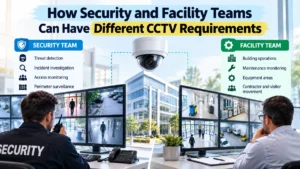
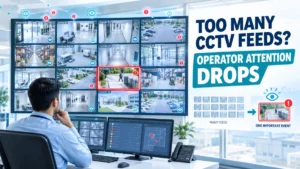
Why this matters: even a perfectly placed camera network is only useful if someone reviews the footage in time to act. Most enterprises don’t have staff to watch dozens of feeds around the clock, which is itself a monitoring blind spot.
AI analytics commonly used in enterprise environments include:
- Motion and intrusion detection in restricted or after-hours zones.
- People and vehicle counting for throughput and capacity planning.
- Line-crossing and loitering alerts for perimeter and dock areas.
- Object left/removed detection for asset protection.
- Heat mapping to identify underused or over-congested zones.
Enterprise example: A distribution centre using AI-based line-crossing alerts on yard cameras can flag unauthorised trailer access within seconds, something a human monitoring twelve screens would likely miss during a shift change.
Benefits Beyond Security
Enterprise CCTV, when treated as an operational tool rather than just a security system, delivers value well beyond incident prevention.
- Process improvement: Reviewing footage of bottlenecks helps operations teams redesign workflows around real behaviour, not assumptions.
- Safety culture reinforcement: Visible, well-communicated monitoring encourages consistent adherence to safety procedures.
- Dispute resolution: Clear footage settles delivery disputes, damage claims, and workplace incidents faster.
- Training and quality control: Recorded footage of standard operations supports onboarding and process audits.
- Data for capacity planning: People-counting and heat-mapping data inform layout and staffing decisions.
How CCTV improves operational efficiency: By capturing accurate, timestamped visual data across a facility, CCTV lets operations teams identify recurring bottlenecks, misused space, and process delays that are otherwise invisible in reports, turning surveillance data into a continuous improvement tool rather than a purely reactive record.
How to Conduct a CCTV Blind Spot Assessment
Companies can audit surveillance blind spots by walking the facility with current camera layout maps, physically checking each zone’s field of view against real foot and vehicle traffic, and cross-referencing incident history with available footage to identify where coverage failed.
A structured assessment typically follows these steps:
- Map current camera coverage against an up-to-date facility floor plan.
- Walk every zone in person, checking sightlines from each camera’s actual mounted position.
- Cross-reference recent incidents safety, theft, near-misses against available footage to see where coverage failed.
- Identify shared-ownership areas (dock doors, inter-building walkways) where accountability for monitoring is unclear.
- Test low-light and night coverage separately, since blind spots often appear only after dark.
- Review monitoring capacity, not just camera count confirm someone (or an AI system) actually reviews footage from every zone.
- Document findings and prioritise by risk level and incident frequency, not just ease of installation.
Expert tip: Run this audit after any layout change, new racking, a new production line, or a reconfigured dock since physical changes are the most common cause of new blind spots in existing facilities.
Common Mistakes Organisations Make
- Treating camera count as coverage: More cameras without planning still leaves gaps.
- Ignoring low-light performance: Many blind spots are only blind spots after sunset.
- No ownership for shared zones: Walkways and dock doors between departments often fall through the cracks.
- Skipping regular audits: Facilities change; camera coverage plans rarely get updated to match.
- No monitoring plan for AI alerts: Installing analytics without a process to act on alerts wastes the investment.
Myth vs. Reality
| Myth | Reality |
|---|---|
| More cameras always mean better coverage | Poorly placed cameras create redundant coverage in some zones and leave others completely blind |
| CCTV is only for security | Enterprise CCTV also supports safety compliance, process improvement, and dispute resolution |
| AI analytics replace human oversight | AI analytics reduce the monitoring burden but still require a defined response process |
| Blind spots are mostly a warehouse problem | Blind spots occur in offices, yards, and multi-site organisations just as often |
Future Trends in Enterprise Surveillance
Enterprise surveillance continues to move from passive recording toward predictive, integrated systems. Expect wider adoption of:
- Edge AI processing, reducing bandwidth needs by analysing footage at the camera level
- Integration with access control and IoT sensors for unified facility visibility
- Predictive analytics that flag unusual patterns before an incident occurs, not just after
- Cloud-based multi-site monitoring, giving enterprise security teams a single view across locations
Organisations evaluating new hardware are increasingly comparing enterprise-grade options like Impact by Honeywell CCTV systems, which pair traditional camera hardware with analytics-ready infrastructure suited to multi-site deployments. For organisations sourcing at scale, working with an established Impact by Honeywell CCTV Distributor in India can simplify procurement, installation planning, and after-sales support across multiple facilities. Camera hardware choices including Impact by Honeywell Bullet Cameras for perimeter and corridor coverage, Impact by Honeywell Dome Cameras for open interior zones, and centralised Impact by Honeywell NVRs for footage management illustrate how enterprises are combining form-factor-specific hardware with centralised recording to close coverage gaps systematically.
Key Takeaways
- Operational blind spots are gaps in visibility or monitoring, not just missing cameras.
- Blind spots cluster in predictable zones: docks, aisles, corridors, and shared-ownership areas.
- Camera count doesn’t equal coverage; placement strategy matters more than volume.
- AI analytics turn passive recording into active, real-time monitoring.
- Regular audits, not one-time installs, keep coverage aligned with a changing facility.
- Enterprise CCTV delivers value beyond security: process improvement, dispute resolution, and capacity planning.
Conclusion
Blind spots don’t announce themselves. They sit quietly in the gaps between departments, behind racking, and past the edge of a camera’s field of view until an incident forces someone to go looking for footage that was never captured.
Enterprise CCTV closes those gaps by treating visibility as a system to be designed, not a byproduct of wherever cameras happen to be mounted. Strategic placement, the right hardware for each zone, centralised recording, and AI-driven monitoring work together to turn blind spots into fully accounted-for operational data.
For facility and security leaders, the real question isn’t whether blind spots exist; every large site has them. It’s whether the organisation has actually mapped them and built a system designed to close them.
Read Also: Beyond Surveillance: Business Applications of Enterprise CCTV
Read Also: Why Intelligent CCTV Is Transforming Factory Management