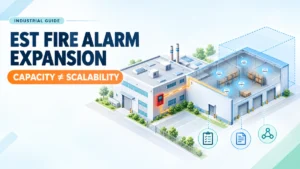
A university adds a new academic block. A hospital opens an emergency wing. A technology park brings a fourth building online. Each of these moments is a milestone for growth and, quietly, a stress test for fire safety.
Most campuses don’t start large. They start with one or two buildings and a fire alarm system sized to match. Years later, after several rounds of expansion, that same system is often stretched well past its original design. Panels run out of spare capacity. New buildings get “bolted on” with separate, unconnected controls. Facility teams lose visibility over which zone triggered an alert, and where.
This is not a rare problem. It’s the default outcome when fire alarm planning doesn’t account for growth from day one.
Scalable fire alarm infrastructure solves this by design. Instead of treating each new building as a separate fire safety project, it treats the entire campus as one evolving, connected system. That distinction matters more than it might seem because when a fire alarm system can’t grow cleanly with a campus, the result isn’t just extra cost. It’s slower detection, confused evacuations, and gaps in life safety coverage exactly when they matter most.
This article looks at why scalability should be a core design requirement, not an afterthought for any large or growing campus, and what facility teams, consultants, and building owners should look for when planning fire alarm infrastructure that lasts.
What Is Scalable Fire Alarm Infrastructure?
Scalable fire alarm infrastructure is a fire detection and notification system designed to expand in devices, buildings, and monitoring capacity without requiring a full replacement each time the campus grows.
In practical terms, this usually means an addressable fire alarm system built on expandable loops, networked control panels, and software that can bring new buildings under one monitoring umbrella. Each detector, call point, or module carries its own address, so the control panel knows exactly which device triggered an alarm and where it’s physically located.
Compare that to a conventional system, where devices are wired in zones rather than individually addressed. Conventional systems work well for smaller, single-building sites. But as a campus adds buildings, floors, or wings, the lack of individual device addressing and networking becomes a real operational limitation.
Scalability isn’t a single feature. It’s a combination of loop capacity, panel networking, software licensing, and cable infrastructure planning that, together, determine how easily a fire alarm system can absorb future growth.
Why Campus Expansion Creates Fire Protection Challenges
Growth changes the shape of a fire safety problem. A single building has one perimeter, one set of exits, and one panel to monitor. A campus has many of each, spread across a footprint that keeps changing.
Educational institutions expand almost continuously; new academic blocks, hostels, laboratories, and sports complexes are added over years or decades. Hospital campuses grow in a different way: emergency wings, diagnostic centres, and speciality units are often added under time pressure, with fire safety needing to keep pace with clinical priorities. Corporate headquarters add towers as headcount grows. Manufacturing campuses add production buildings and warehouses as capacity increases. Technology parks and government facilities follow similar patterns, often adding buildings from different contractors and timelines.
In each case, the fire alarm system that made sense for the original footprint eventually stops matching the actual site. According to NFPA 101, fire alarm requirements are tied closely to occupancy classification and building use, which means a campus with mixed uses classrooms, labs, dormitories, offices often needs a system flexible enough to meet different code requirements for different structures, all monitored coherently.
The risk isn’t only technical. It’s operational. Fragmented fire detection means facility and security teams may need to watch multiple, disconnected panels or software systems just to know what’s happening across the site. In an actual fire event, that fragmentation costs time, and time is the one resource a fire response can’t recover.
Common Problems With Conventional Fixed-Size Systems
Fixed-capacity fire alarm systems create predictable problems once a campus starts growing:
- Zone-based limitations: Conventional panels group devices into zones rather than individual addresses, making it harder to pinpoint the exact location of an alarm inside a large zone.
- Rewiring for every expansion: Adding devices beyond the original wiring plan often means new cable runs, new zone circuits, and disruption to occupied buildings.
- No native networking: Many conventional panels aren’t designed to communicate with panels in other buildings, so each new structure needs its own standalone system.
- Slower fault diagnosis: When a fault occurs, technicians may need to physically inspect the zone rather than reading a fault report at the panel or via remote monitoring.
- Higher long-term cost: Each expansion becomes its own capital project instead of an incremental addition to existing infrastructure.
None of this means conventional systems are unsafe for their intended use. They remain a sound, cost-effective choice for smaller, single-building sites with no expansion plans. The mismatch appears specifically when a fixed-capacity system is asked to serve a campus that keeps growing.
Benefits of Addressable Fire Alarm Systems in Large Campuses
Addressable fire alarm systems are built around the idea that every device a smoke detector, heat detector, or manual call point has its own identity on the network. This single design choice changes how a campus can plan, monitor, and expand its fire safety infrastructure.
- Loop architecture: Devices are wired on loops that can typically support well over a hundred addressable points per loop, depending on the panel. Spare capacity can be built in from the start, so new devices are added to existing loops rather than requiring new wiring infrastructure.
- Networked panels: Individual building panels can be linked into a single network, allowing one control point or several synchronised ones to monitor the entire campus. This is the foundation of true multi-building monitoring.
- Intelligent detectors: Addressable detectors can report not just an alarm, but device status, including contamination levels, faults, and pre-alarm conditions, supporting predictive maintenance rather than reactive repairs.
- Centralised monitoring: Security and facility teams can view alarms, faults, and system status from a single interface, regardless of which building triggered the event.
- Reduced rewiring on expansion: Because loops and panels are designed with expansion in mind, adding a new building or wing typically means extending the network rather than re-engineering it.
- Faster fault identification: Since every device has its own address, technicians can identify the exact device affected by a fault, cutting troubleshooting time significantly compared with zone-based diagnosis.
- Device-level diagnostics: Maintenance teams can see which specific detector needs cleaning or replacement, rather than testing an entire zone.
Products such as the GST Fire Alarm System are built around this addressable, networkable architecture, which is why they are frequently specified for large, multi-building sites where future expansion is expected rather than optional.
Key Features Every Large Campus Should Look For
When evaluating fire alarm infrastructure for a large or growing campus, a few features consistently separate systems that scale well from those that don’t.
- Expandable loops with spare addressable capacity built in from day one, not added later as an afterthought.
- Modular panels that can be upgraded with additional cards or modules rather than replaced outright.
- Networking capability between panels across buildings, supporting a unified campus-wide view.
- Intelligent addressable devices that report status and location individually.
- Integration with BMS (Building Management Systems) so fire events can trigger HVAC shutdowns, lift recalls, or access control responses automatically.
- Integration with CCTV to allow security teams to visually verify alarms in real time.
- Integration with PA/VA (public address/voice alarm) systems for clear, zone-specific evacuation instructions.
- Redundant communication paths, so a single cable fault or panel issue doesn’t take down monitoring for the whole campus.
- Event logging with time-stamped historical records for compliance audits and incident review.
- Remote monitoring capability, allowing facility teams or third-party monitoring stations to view system status off-site.
- Software scalability, meaning the monitoring platform itself can support additional panels and devices through licensing rather than a full software replacement.
An Addressable Fire Alarm Panel that supports all of the above gives a campus room to grow for years without a forced system overhaul.
Addressable vs Conventional Systems for Growing Campuses
| Factor | Addressable Fire Alarm Panel | Conventional Fire Alarm Panel |
|---|---|---|
| Scalability | Designed for loop expansion and panel networking | Limited by fixed zone circuits |
| Expansion cost | Lower incremental cost per added device | Higher cost; often requires new wiring/zones |
| Device identification | Exact device-level location | Zone-level location only |
| Maintenance | Device-level diagnostics and status reporting | Zone-level testing required |
| Fault diagnosis | Fast, pinpointed to specific device | Slower, requires physical zone inspection |
| Installation | Loop wiring, fewer cable runs per device | Home-run wiring per zone, more cabling |
| Network capability | Multi-panel, multi-building networking supported | Typically standalone per building |
| Best applications | Campuses, hospitals, high-rises, multi-building sites | Small single-building sites with no expansion plans |
This comparison isn’t about one system being universally “better.” A small standalone building with no expansion plans may be served perfectly well by a Conventional Fire Alarm Panel using Conventional Detectors. The addressable approach earns its cost premium specifically when a site is large, multi-building, or expected to grow, which describes most campuses by definition.
Real-World Expansion Scenarios
- A university adds a new academic block: With a networked addressable system, the new block’s panel joins the existing campus network. Facility staff monitor it from the same interface used for existing buildings, and Addressable Detectors in the new block are automatically visible on the central system, without a parallel monitoring setup.
- A hospital adds an emergency wing: Healthcare campuses can’t afford ambiguity during a fire event, given the presence of non-ambulatory patients. A scalable system lets the new wing’s detection integrate directly with existing evacuation protocols, nurse call coordination, and PA/VA zones, rather than operating as an isolated system that staff must learn separately.
- An industrial campus adds a production building: Manufacturing sites often have stricter fire risk profiles due to equipment, chemicals, or process heat. Scalable infrastructure allows the new building’s detection loop to extend from existing network infrastructure, maintaining consistent monitoring standards across old and new structures alike.
- A corporate office adds another tower: As headcount grows, so does the need for coordinated evacuation and centralised alarm visibility. Networked panels mean security desks continue to monitor from one system, even as the corporate campus footprint doubles or triples over time.
In each scenario, the savings aren’t only about avoiding new cabling. They come from not having to redesign monitoring procedures, retrain staff, or accept blind spots between old and new infrastructure. Facilities looking to source addressable panels for such expansions can approach an authorised GST Fire Alarm System Distributor in India, such as Innxeon Technologies, to specify compatible equipment for the new build.
Common Planning Mistakes
Even well-intentioned fire safety planning can go wrong when scalability isn’t treated as a core requirement from the outset.
- Underestimating future expansion: Sizing a system exactly for current needs, with no spare loop or panel capacity, guarantees a costly redesign later.
- Choosing fixed-capacity panels for a site with known or likely future growth, simply because the upfront cost looks lower.
- Ignoring networking capability and treating each new building as a standalone fire safety project.
- Lack of spare loop capacity, forcing new cable runs for what should be simple device additions.
- Poor cable planning, including insufficient conduit or pathway capacity for future loop extensions.
- No redundancy in communication paths, creating a single point of failure across the whole campus.
- Selecting incompatible devices from different manufacturers or protocols, which can complicate future integration and maintenance.
Most of these mistakes are cheaper to avoid at the design stage than to fix after construction is complete.
Best Practices for Future-Proof Fire Alarm Infrastructure
- Plan for the campus you’ll have in ten years, not just the one you have today. Even a conservative growth estimate should inform loop and panel sizing.
- Build in spare addressable capacity on every loop during initial installation, rather than waiting until it’s needed.
- Standardise on one addressable protocol across the campus to simplify future integration and maintenance contracts.
- Design for panel networking from the start, even if only one building exists initially.
- Document the system architecture clearly, including spare capacity, so future teams don’t have to reverse-engineer the design.
- Schedule regular system reviews aligned with campus master planning, not just routine fire safety inspections.
- Prioritise integration readiness with BMS, CCTV, and PA/VA systems, even if those integrations aren’t implemented on day one.
- Work with consultants and integrators experienced in multi-building fire alarm networks, since campus-scale design differs meaningfully from single-building design.
Following NFPA 72 guidance on system design, along with periodic inspection, testing, and maintenance schedules, helps ensure that scalability built in at design time actually holds up as the campus grows.
Conclusion
Fire alarm infrastructure is one of those systems that’s easy to underestimate when a campus is small and expensive to fix once it isn’t. The core lesson is straightforward: scalability isn’t a luxury feature for large campuses. It’s a basic requirement, because campuses rarely stop growing once construction begins.
Addressable, networked fire alarm systems give facility managers, safety officers, and consultants a way to plan once and expand repeatedly, rather than restarting fire safety design with every new building. That translates into lower long-term costs, faster fault diagnosis, and most importantly, more reliable life safety coverage across an entire site, not just the buildings that existed on day one.
Planning for scalability today is, in the end, a straightforward trade: a little more upfront design discipline in exchange for years of smoother, lower-cost expansion later.
Organisations evaluating scalable, addressable fire alarm systems for campus infrastructure can explore the GST Fire Alarm System range through Innxeon Technologies, a PAN-India distributor of GST fire alarm products.
Read Also: Fire Alarm Considerations for Modern Logistics Parks
Read Also: Why Fire Alarm Expandability Matters More Than Initial Capacity