Most building owners choose a fire alarm system the way they choose a filing cabinet: they count today’s needs and buy exactly that much. This approach feels efficient, but it often creates a costly problem a few years later.
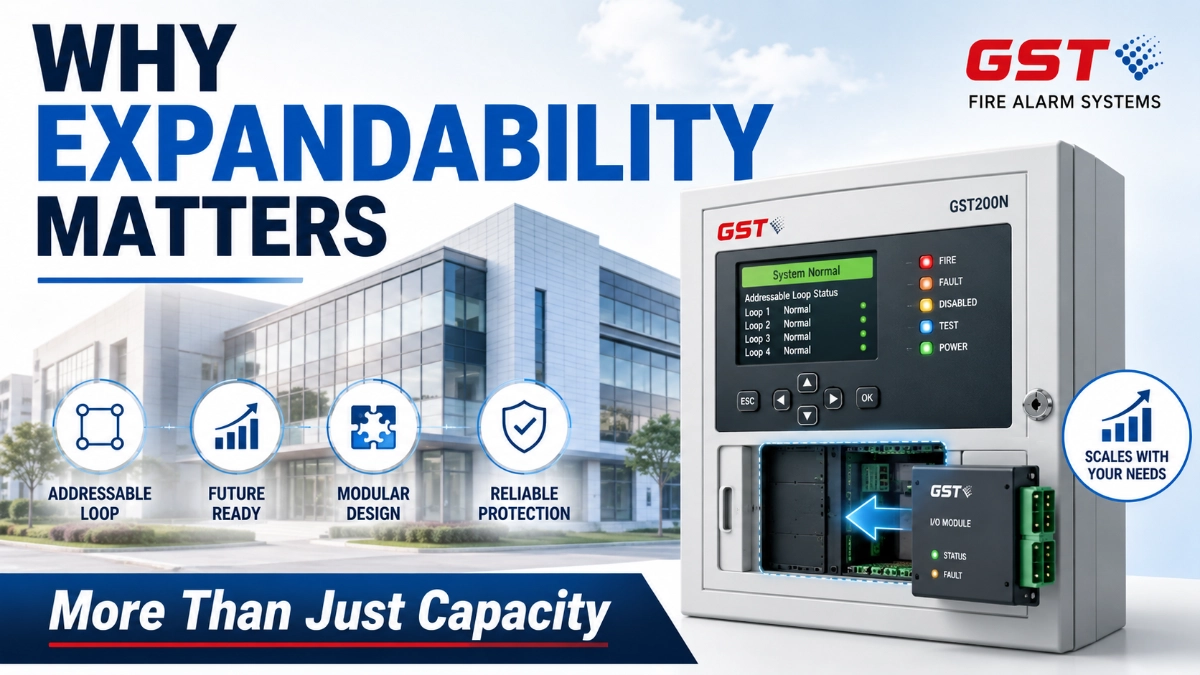
Buildings change. Floors get added, warehouses expand, hospital wings open, and office layouts get reconfigured. When a fire alarm panel has no room to grow, the change becomes an expensive, disruptive replacement project rather than a simple upgrade.
This article explains why expandability, not just initial device capacity, should drive fire alarm system selection. It covers the engineering reasoning, the financial logic, and the practical planning steps that experienced fire protection professionals use.
What Expandability Means in a Fire Alarm System
What is an expandable fire alarm system? It is a fire alarm panel and network architecture designed to accept additional initiating devices, notification appliances, loops, modules, or networked panels after installation, without requiring a full system replacement.
Expandability is not the same as having a large panel. A panel with 500 device points but no spare loop capacity, no expansion slots, and no networking option is still a fixed-capacity system in practice. True expandability depends on architecture, not just point count.
An expandable addressable fire alarm panel typically offers spare loop capacity, modular expansion cards, and the ability to network with additional panels as a building grows. This is different from a conventional fire alarm panel, where zones are hardwired, and capacity increases usually mean adding entirely new hardware runs.
Key takeaway: Expandability is a design property, not a size metric. A smaller panel with a scalable architecture often outperforms a larger fixed panel over the building’s lifecycle.
Initial Capacity vs. Future Capacity: Why the Distinction Matters
Initial capacity answers one question: how many devices does the building need on day one? Future capacity answers a more important question: how many devices might this building need over the next 10 to 20 years?
Most fire alarm systems remain in service for 15 to 25 years. Very few buildings stay static for that long. Renovations, tenant changes, code updates, and business growth all push device counts upward.
Design engineers who plan only for opening-day requirements are effectively designing for a building that will never change. That assumption rarely holds in commercial, industrial, or institutional properties.
| Planning Approach | Assumes | Real-World Result |
|---|---|---|
| Initial capacity only | Building stays the same | Forced upgrades within 3–7 years |
| Future capacity planning | Building will evolve | Smooth, low-cost expansions over decades |
Why Many Buildings Outgrow Their Original Fire Alarm Design
Why is fire alarm expandability important? Because buildings rarely stay the same size or layout for long, and a system without spare capacity cannot absorb growth without a costly retrofit or replacement.
Facility managers see this pattern constantly. A distribution centre adds a mezzanine level. A school builds a new wing. A hotel converts storage space into additional guest rooms. Each of these changes adds initiating devices, notification appliances, or new zones.
When the original panel has no spare loop capacity or expansion path, the project team faces two bad options: overload the existing loops beyond their rated capacity, or replace the panel entirely. Neither option is cheap, and neither would have been necessary if expandability had been built in from the start.
Common Expansion Scenarios by Building Type
- Commercial offices: Additional floors, tenant fit-outs, open-plan reconfigurations.
- Industrial facilities: Warehouse extensions, new production lines, added storage racking.
- Healthcare facilities: New patient wings, equipment rooms, isolation units.
- Hospitality: Additional guest floors, banquet halls, renovated common areas.
- Educational campuses: New classroom blocks, laboratories, dormitories.
- Residential high-rises: Additional towers, amenity floors, parking structure expansions.
Each scenario adds initiating devices, notification appliances, or entire zones that the original design may never have anticipated.
The Risk of Buying Only for Today’s Requirements
What happens if a fire alarm system reaches maximum capacity? The building can no longer add detectors, modules, or notification devices on that loop or panel without a hardware upgrade, a new loop, or a full panel replacement, depending on the architecture.
This is more than an inconvenience. A panel at capacity during a renovation project can delay occupancy permits, since new areas cannot be protected until the fire alarm system is expanded or replaced.
Undersized systems also create compliance exposure. Local fire codes require adequate coverage for occupied space. If a fire alarm panel cannot accommodate new detection points, the building may temporarily fall out of compliance until the system is upgraded.
Expert Tip: During design, calculate spare loop capacity as a percentage, not just a device count. A loop rated for 250 points that already carries 230 addressable detectors has far less usable headroom than the raw numbers suggest, especially once you factor in modules for dampers, sprinklers, and elevator recall.
The Financial Impact of Replacing an Undersized System
Replacing a fire alarm system is rarely a like-for-like swap. It typically involves new field wiring, updated device addressing, revised as-built drawings, recommissioning, and often temporary fire watch coverage during the transition.
A mid-sized commercial building can spend significantly more replacing an undersized panel mid-life than it would have spent upgrading to a scalable system at the outset. The price difference between a fixed-capacity panel and an expandable one at purchase time is usually small compared to the cost of a forced replacement later.
How do expandable systems reduce future costs? They allow facility teams to add devices, loops, or networked panels using existing infrastructure and licensing, avoiding the labour, downtime, and design costs associated with a full system swap.
Lifecycle Cost Comparison
| Factor | Fixed-Capacity System | Expandable System |
|---|---|---|
| Upfront cost | Slightly lower | Slightly higher |
| Expansion cost | High (often full replacement) | Low (add modules or loops) |
| Downtime during upgrades | Significant | Minimal |
| Compliance risk during growth | Higher | Lower |
| Long-term cost of ownership | Higher | Lower |
Benefits of Modular and Expandable Addressable Systems
Can addressable fire alarm systems be expanded? Yes. Addressable systems use individually identified devices on a shared loop, which makes it straightforward to add detectors, modules, or notification circuits within the loop’s spare capacity, or to add loops and network additional panels as needed.
This is one of the clearest advantages addressable technology has over conventional systems. Addressable detectors report a unique identity to the panel, so adding new devices means assigning new addresses rather than rewiring entire zones. Conventional detectors, by contrast, are wired in groups per zone, so expansion often means adding new circuits and, in many cases, new zone cards.
Modular platforms extend this advantage further. Expansion cards, network modules, and additional panel nodes let a fire alarm infrastructure grow alongside the building without disturbing the core system design.
Manufacturers such as GST design their addressable platforms with this kind of scalability in mind. A GST fire alarm system typically supports expansion through additional loop cards and networked panels, making it a practical reference point when evaluating modular, future-ready addressable solutions. Facility teams working with a GST fire alarm system distributor in India can usually plan phased expansions using the same panel family as the building grows, rather than re-engineering the fire alarm infrastructure from scratch.
How Expandability Improves Lifecycle Cost
Every building has a lifecycle: construction, occupancy, renovation, and eventual major retrofit. A fire alarm system that matches this lifecycle avoids being the bottleneck during renovation phases.
Lifecycle cost planning treats the fire alarm system as infrastructure, not a fixed fixture. Spare capacity, software licensing that supports device growth, and a clear expansion path all reduce the total cost of ownership over 15 to 25 years.
Is buying a larger fire alarm panel worth it? Not automatically. What matters is whether the panel’s architecture supports expansion through spare loop capacity, modular cards, and networking, not simply how many devices it can hold on day one.
The Role of Loop Architecture and Intelligent Addressing
Loop architecture determines how much a system can grow without major rework. A well-planned loop leaves spare capacity for future initiating devices and modules, rather than running near its rated maximum from day one.
Intelligent addressing allows each device to communicate its identity, status, and location to the panel individually. This makes adding a new detector or module a configuration task rather than a rewiring project, provided the loop has spare capacity.
How much spare capacity should a fire alarm panel have? Many fire protection engineers plan for 20 to 30 per cent spare capacity on each loop at initial installation, though the right figure depends on the building’s expected growth, renovation plans, and occupancy type.
Loop Utilisation Planning Checklist
- Calculate total device points needed for current design.
- Add a spare capacity buffer based on expected renovations.
- Confirm the loop’s rated maximum against combined current and spare load.
- Reserve address ranges for anticipated future zones.
- Document spare capacity in the as-built drawings for future reference.
Planning for Future Building Extensions
Engineers who design for expandability start by asking how the building might change, not just how it functions today. This includes reviewing site master plans, zoning allowances, and any known phased construction.
Networking multiple panels is a core strategy for large or expanding campuses. A networked fire alarm infrastructure allows new buildings or wings to connect to the existing system, sharing monitoring and control without duplicating the entire platform.
Cable infrastructure planning also matters. Running spare conduit or cable pathways during initial construction makes future device additions far simpler than retrofitting cable routes through finished spaces.
Compliance Considerations When Expanding Systems
How do engineers plan for future fire alarm expansion? They combine code-driven device density calculations with spare capacity planning, ensuring that both current and anticipated future areas meet applicable fire alarm and life safety code requirements.
Expanding a fire alarm system is not just a technical task. Any added devices, zones, or notification appliances typically require updated system documentation, inspection, and testing to confirm continued code compliance.
Working with a scalable platform simplifies this process because expansion follows an established design pattern rather than requiring a new compliance review from scratch. This is particularly valuable for industrial fire alarm system planning, where phased construction is common, and compliance timelines are often tight.
Common Mistakes to Avoid
- Sizing the panel exactly to current device counts with no spare loop capacity.
- Choosing conventional zoning for buildings with known future expansion plans.
- Skipping cable infrastructure planning for spare pathways during construction.
- Ignoring networking capability when a multi-building or campus layout is likely.
- Overlooking software licensing limits that cap device growth even when hardware allows more.
- Failing to document spare capacity, leaving future teams to guess at available headroom.
Questions Buyers Should Ask Before Purchasing a Fire Alarm Panel
- What percentage of spare loop capacity does this panel offer at installation?
- Can the system be expanded with additional modules without replacing the main panel?
- Does the platform support networking multiple panels for future buildings or wings?
- What is the maximum device count the software licensing supports, and does the license need upgrading as devices are added?
- What is the expected service life of this panel family, and how long will expansion components remain available?
- How does the manufacturer support phased installations across multi-year construction projects?
Checklist: How to Choose an Expandable Fire Alarm System
- Confirm spare loop capacity of at least 20–30 per cent at handover.
- Verify availability of expansion cards and networking modules.
- Check software licensing supports future device growth.
- Review cable and conduit infrastructure for spare pathways.
- Confirm the panel family has a long-term manufacturer support roadmap.
- Ensure the system architecture aligns with anticipated renovation or expansion plans.
- Document current and spare capacity in system handover documentation.
Final Key Takeaways
Fire alarm systems protect buildings for decades, not just for the day they are commissioned. Choosing a system based solely on current device counts overlooks how much buildings typically change over their service life.
Expandable, modular addressable systems offer a clear long-term advantage. They accommodate renovations, extensions, and campus growth without the cost and disruption of a full system replacement.
Fire safety engineers, MEP consultants, and building owners should treat expandability as a core design requirement, not an optional upgrade. Spare loop capacity, modular expansion options, and networking capability all reduce lifecycle cost and compliance risk.
When evaluating a new fire alarm platform, look beyond the device count on the spec sheet. Ask how the system grows, how much it costs to expand, and how well it will support the building’s next decade, not just its first day of occupancy.
Read Also: How to Evaluate a Fire Alarm Supplier Beyond Product Pricing
Read Also: Fire Alarm Procurement Mistakes That Increase Project Costs