Walk into the control room of a large hospital, an airport, or a manufacturing plant, and you will often find the same problem: fire alarm panels from four or five different manufacturers, installed a decade apart, that do not communicate with each other. This fragmented infrastructure is the natural result of uncoordinated expansion. Each contractor brought their preferred brand, and over time, the facility ended up with a patchwork of systems that no single person fully understands.
This is one of the most common and costly challenges facing large facilities today. Fire alarm system standardisation addresses it directly by bringing every panel, detector, and communication link under a single, unified platform. For enterprise facility managers, fire safety consultants, and MEP engineers, understanding how to approach standardisation and why it matters is increasingly essential.
What Fire Alarm System Standardisation Actually Means
Standardisation means selecting a single fire alarm panel family, a consistent detector type, and a unified communication protocol, then applying that choice across every building, zone, and site in the facility. Rather than managing multiple systems in parallel, the facility operates one intelligent, integrated fire alarm architecture.
There are three core decisions involved:
- Selecting a panel platform (addressable or conventional) that will serve as the standard for all current and future installations.
- Deploying compatible detectors, call points, sounders, and interface modules from the same product family.
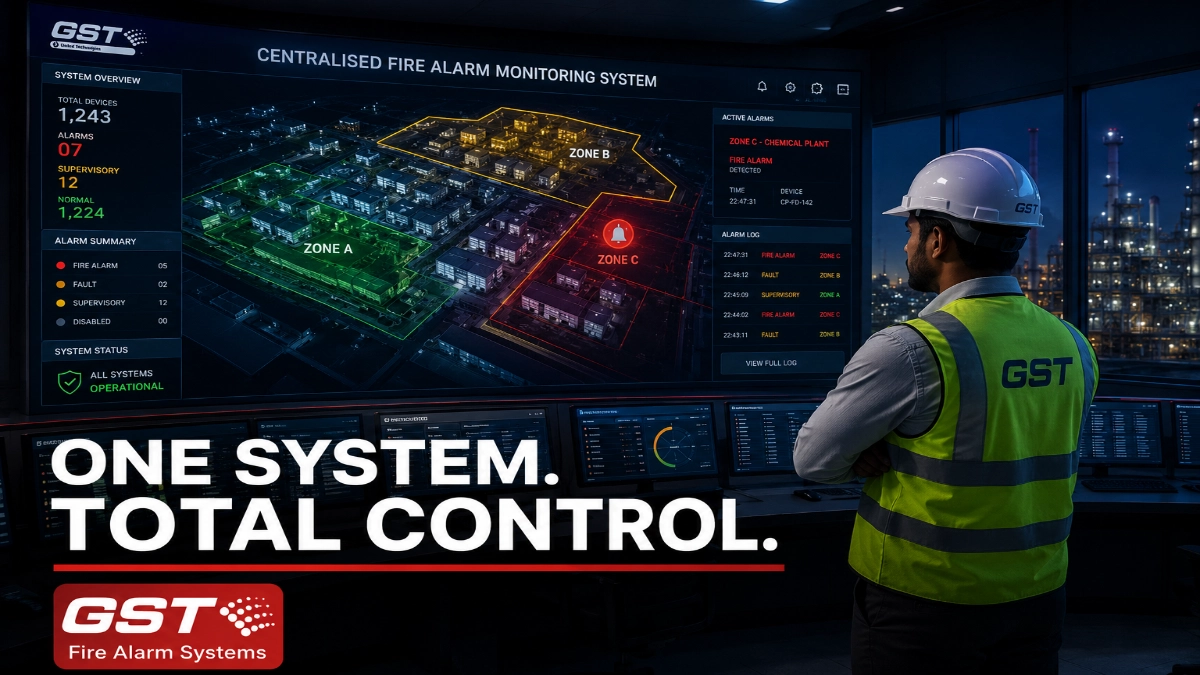
- Networking all panels so the entire facility can be monitored from a single control point.
When executed properly, a standardised fire alarm system behaves as a single intelligent network even across multiple buildings or geographically separated sites.
Why Multi-Brand Systems Create Real Operational Problems
The consequences of a fragmented fire alarm environment go well beyond inconvenience. Facilities running multiple brands face a compound set of operational and safety challenges:
- Different panels require different software, diagnostic tools, and trained technicians, multiplying maintenance complexity.
- Spare parts cannot be shared between systems, creating separate inventories and longer lead times during faults.
- Integration with Building Management Systems becomes difficult or impossible when protocols do not match.
- Emergency responders face confusion during real alarm events when signals come from unfamiliar, disconnected interfaces.
- Compliance reporting requires pulling data from multiple platforms, increasing the administrative burden significantly.
- Manufacturers discontinue older product lines, leaving facilities with unsupported hardware and no clear upgrade path.
| Industry Reality: Facilities running four or more fire alarm brands can spend up to three times more on annual maintenance than comparable facilities on a single standardised platform due to fragmented service contracts, separate spare part inventories, and multiple technician skill sets required. |
The Operational Benefits of a Standardised Fire Alarm Platform
Centralised Monitoring
A standardised architecture enables every detector, panel, and zone to be visible from a single operator dashboard. Alarms, pre-alarm warnings, and system faults appear in real time across the entire facility. Emergency response is faster, evacuation coordination is clearer, and no alarm event goes undetected because it appeared on an isolated panel in a separate building.
Simplified Maintenance
With a single product family across the site, a single Annual Maintenance Contract covers everything. Technicians need expertise in one system. Fault codes, diagnostic menus, and testing procedures are identical in every building. Planned preventive maintenance schedules are straightforward to design and execute uniformly, and service records paint a complete picture of the entire installation’s health.
Spare Parts Efficiency
A standardised fire alarm system eliminates the need for separate spare part inventories per brand. One consolidated stock of detectors, loop cards, relay modules, and sounders covers every panel on site. High-volume purchasing from a single supplier improves pricing, and critical parts are available without waiting on multiple vendor lead times.
Consistent Staff Training
Safety officers and building security teams learn one interface. Emergency drills and evacuation procedures are consistent because alarm signals come from a familiar, unified source. New staff training is faster and applies universally. External contractors and fire department inspectors can operate the system more confidently during audits or emergencies.
Why Enterprise Facilities Prefer Addressable Fire Alarm Systems
The most important technical decision in any fire alarm standardisation project is the choice between conventional and addressable systems. For any large facility with more than 50 detectors, addressable is not a premium option; it is the practical and economical choice.
| Feature | Conventional System | Addressable System |
| Detection Precision | Zone-level only | Exact device location |
| Fault Identification | Manual investigation required | Instant device-specific fault report |
| Scalability | Limited; new zones needed for expansion | High loop capacity easily extended |
| False Alarm Management | Limited discrimination | Pre-alarm thresholds reduce nuisance alarms |
| BMS Integration | Dry contact outputs only | Multi-protocol (Modbus, BACnet, IP) |
| Long-Term Cost | Higher operational cost | Lower through lifecycle efficiency |
| Diagnostics | Basic fault/alarm signal | Full event log, signal strength, device status |
GST addressable fire alarm panels support high device capacities per loop with full event logging, intelligent signal processing, and multi-panel network capability, making them well-suited for hospitals, airports, campuses, and industrial facilities of any scale.
BMS Integration and Scalability for Future Growth
Large facilities rely on Building Management Systems to coordinate HVAC, access control, CCTV, and emergency lighting. A standardised fire alarm system with built-in Modbus or BACnet communication connects directly to BMS platforms, enabling automatic responses on alarm: HVAC shutdown to prevent smoke spread, fire door release, emergency lighting activation, and CCTV redirection to the alarm zone.
Scalability is equally important. Facilities that expand in phases, such as a new hospital wing, an additional warehouse bay, and a second production hall, need a fire alarm architecture that accommodates growth without replacing existing infrastructure. GST fire alarm systems are designed for exactly this: additional panels join the existing network, new detectors extend existing loops, and commissioning follows a consistent procedure regardless of project phase.
Migrating from Legacy Systems: A Practical Approach
Most standardisation projects involve an existing facility, not a greenfield build. Phased migration is the standard approach, allowing the facility to maintain full fire safety coverage throughout the upgrade without operational disruption.
- Audit the existing installation: Document every panel, detector type, zone configuration, and cable route.
- Select the standardised platform: Choose a panel family and detector range that meets current needs and future expansion plans.
- Prioritise replacement: Start with the oldest, highest-risk panels and zones first.
- Reuse existing infrastructure where possible: Existing cable routes and containment can often be repurposed for new addressable loops after a condition assessment.
- Commission sequentially: Integrate each phase into the new standardised network before decommissioning legacy equipment.
- Train the safety team: Complete staff training on the new unified platform before final legacy decommission.
- Update compliance documentation: Produce updated as-built records, zone schedules, and evacuation plans.
Cybersecurity in Networked Fire Alarm Systems
As fire alarm systems become IP-connected, cybersecurity becomes a genuine operational consideration. Networked fire alarm infrastructure should be isolated from corporate IT networks using dedicated VLANs or physical separation. Default device credentials must be changed at commissioning. Remote access should be restricted to authorised personnel only, and firmware update schedules should be maintained to close known vulnerabilities.
This is not a theoretical risk; it is a recognised consideration in enterprise safety system design, and facilities that address it during the standardisation project avoid costly remediation later.
How GST Fire Alarm Systems Support Enterprise Standardisation
GST fire alarm systems address the full range of requirements for large-scale standardisation projects. Their addressable panel range scales from standalone single-building installations to fully networked multi-panel systems covering campuses, industrial complexes, and airport terminals. Peer-to-peer panel networking supports centralised monitoring across all zones, with both RS485 loop connectivity and IP-based options for long-distance or multi-site deployments.
GST addressable detectors incorporate signal processing that distinguishes genuine fire signatures from environmental noise, reducing false alarm rates in challenging environments, including industrial kitchens, dusty warehouses, and high-humidity process areas. The system’s multi-protocol communication outputs make BMS integration practical rather than aspirational.
For facilities planning long-term maintenance efficiency, a standardised GST installation means one AMC, one spare parts inventory, one training programme, and one consistent diagnostic platform across the entire estate, translating directly into lower annual operating costs and higher system reliability over the full maintenance lifecycle.
Read Also: The Biggest Weakness in Many Industrial Fire Safety Strategies
Read Also: The Dangerous Assumption Many Industries Make About Fire Detection