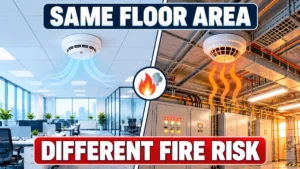
Picture a hospital in 2030. The moment an anomalous heat signature appears in a storage corridor, an AI engine cross-references live temperature readings, air-particulate data, and CCTV analytics all within milliseconds. It confirms a fire risk, triggers a suppression system, reroutes staff via dynamic signage, and notifies the city’s emergency coordination hub before any human has seen a single alert.
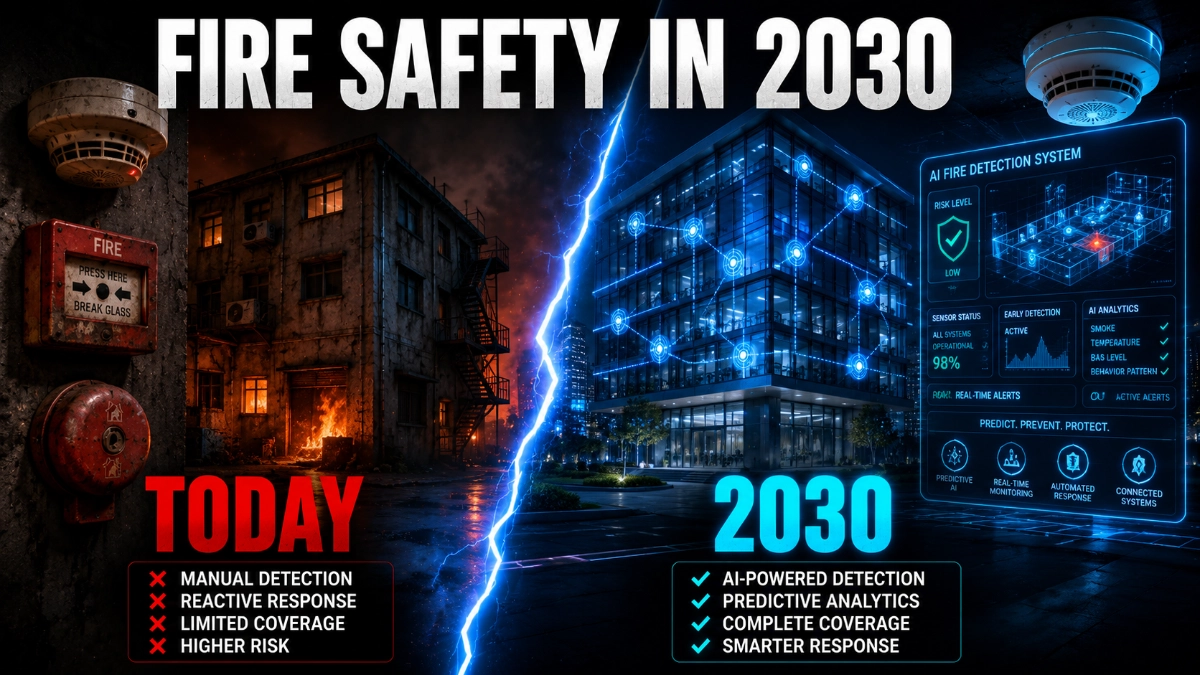
This is not science fiction. It is the direction that fire safety infrastructure is moving, and the organisations that prepare today will be the safest, most compliant, and most operationally resilient by 2030.
Rapid urbanisation, smart infrastructure investment, AI-driven building management, stricter compliance mandates, and the growing complexity of mixed-use developments are all converging. Together, they are creating an urgent need for fire safety systems that are intelligent, connected, autonomous, and future-proof.
Why Current Fire Safety Infrastructure Needs to Evolve
Most fire detection systems in operation today were designed for simpler times. Conventional fire alarm panels monitor fixed zones and trigger an alarm when a threshold is breached. They cannot distinguish between a genuine fire, a dusty detector, or a malfunctioning sensor.
This limitation has real consequences. Studies across global fire authorities consistently show that false alarms can account for up to 80% of emergency callouts in commercial buildings. Each false alarm costs time, money, and erodes occupant trust in the system itself.
Modern buildings compound the problem. High-rise towers, mixed-use developments, underground transport hubs, and data centres all present complex geometries, high occupant densities, and varied risk profiles that single-technology systems struggle to manage. Add cybersecurity vulnerabilities in increasingly connected buildings, and the gap between current infrastructure and future needs becomes stark.
Key insight: The fundamental challenge is not just detecting fire faster; it is detecting it more accurately, responding more intelligently, and integrating safety with everything else in the building.
Core Components of an Ideal Fire Safety Infrastructure in 2030
Intelligent Fire Detection
The cornerstone of future fire safety is AI-powered multi-sensor detection. Rather than relying on a single smoke or heat detector, next-generation systems will combine optical smoke sensors, CO detectors, thermal imaging, air-particulate analysis, and ambient condition monitoring into a single detection layer.
AI engines will analyse data streams from all sensors simultaneously. This allows the system to distinguish between real fire signatures and benign triggers like cooking smoke, steam, or dust, dramatically reducing false alarms. Predictive detection models will also identify preconditions for fire, such as abnormal equipment heat signatures, before a flame or smoke event occurs.
Addressable detectors already represent a significant advancement over conventional alternatives. Unlike conventional detectors, which report only to a zone, addressable detectors communicate their exact identity and status to an addressable fire alarm panel in real time. By 2030, this granular data will feed directly into AI analytics engines, enabling faster and more precise responses.
Smart Addressable Networks
Future buildings will rely on scalable, addressable network architectures. Every device detector, sounder, beacon, and call point will have a unique digital identity and communicate its status continuously. Fault identification that once required manual inspection will become instant and automatic.
Zone-level intelligence means that a fault or alarm in one section of a building does not cascade unnecessarily across the entire system. Smart addressable networks will also support modular expansion as buildings grow or change use, a critical advantage for developers and facility managers managing evolving assets.
Autonomous Emergency Response
When a fire is confirmed, the speed of response determines survival outcomes. By 2030, autonomous emergency response systems will activate suppression, manage evacuation routing dynamically, broadcast targeted PA announcements to specific zones, and unlock or secure access control points, all without waiting for a human to make a decision.
Occupancy-aware evacuation systems will know in real time how many people are in each zone and will direct them to the safest exit route based on live fire progression data. AI-assisted emergency management will coordinate the building response and simultaneously transmit structured incident data to incoming fire services.
Integrated Safety Ecosystem
No single system operates in isolation in a future-ready building. The ideal 2030 fire safety infrastructure integrates fire alarm systems, CCTV analytics, building management systems (BMS), access control, public address and voice alarm systems, and IoT sensor networks into a single, unified platform.
This integration means that a fire event triggers a coordinated building-wide response, not a series of disconnected alerts across separate systems. A GST fire alarm system, for example, is designed with an open integration architecture, enabling it to connect with BMS and third-party platforms, making it well-suited to future-ready deployments.
Traditional vs 2030 Fire Safety: At a Glance
| Feature | Traditional Systems (Today) | Ideal Infrastructure (2030) |
| Detection | Smoke/heat sensors only | Multi-sensor AI analytics |
| Response | Manual, human-dependent | Automated, AI-coordinated |
| False Alarms | High — up to 80% of alerts | Reduced by 60–70% via AI |
| Maintenance | Scheduled, reactive | Predictive, continuous |
| Integration | Siloed systems | Unified BMS ecosystem |
| Scalability | Limited, costly to expand | Cloud-native, modular |
| Cybersecurity | Minimal or absent | End-to-end encrypted, segmented |
The Role of Artificial Intelligence in Fire Safety
AI is not simply a feature added on top of fire safety systems. In the 2030 vision, it becomes the central intelligence layer that transforms every other component.
Predictive Maintenance
AI platforms will continuously monitor the health of every detector, panel, sounder, and sensor in a building. By analysing performance trends, they will predict which devices are approaching failure before they malfunction, eliminating the risk of a detector being inactive when it is most needed. This shifts maintenance from reactive scheduling to continuous, data-driven optimisation.
Digital Twins
A digital twin is a virtual replica of a physical building, updated in real time from sensor data. Fire safety engineers will use digital twins to model fire propagation scenarios, test evacuation strategies, and validate system coverage, all without disrupting the actual building. During a real incident, a digital twin gives emergency responders a live, accurate picture of conditions inside the building before they enter.
Behavioural Analytics and Risk Forecasting
AI will analyse building usage patterns, occupancy trends, equipment behaviour, and environmental conditions to generate fire risk forecasts. A data centre running consistently higher-than-normal thermal loads in a specific row of servers will trigger a risk alert days before any traditional sensor would respond.
Automated incident reporting will produce structured, regulatory-compliant documentation the moment an event occurs, simplifying post-incident review and compliance management significantly.
Section 4: Smart Buildings and Smart Cities
The 2030 fire safety vision extends well beyond individual buildings. Smart cities will connect fire safety systems across residential towers, industrial facilities, commercial campuses, transport hubs, airports, hospitals, and educational institutions into a city-wide emergency coordination network.
Centralised monitoring platforms operated by city authorities or specialist monitoring providers will receive real-time data from thousands of buildings simultaneously. When a fire event is confirmed, the platform can coordinate emergency service dispatch, adjust traffic signal sequencing to clear routes, alert nearby hospitals, and notify building managers across adjacent properties.
For organisations managing large property portfolios, this city-scale integration means that a fire event at one facility can trigger precautionary checks and heightened alert status across all connected assets, a capability that simply does not exist with today’s siloed systems.
Section 5: Cybersecurity and Resilience in Future Fire Safety Systems
As fire safety systems become increasingly networked, they become increasingly attractive targets for cyber threats. A compromised fire alarm system could be manipulated to trigger false alarms, suppress genuine alerts, or disrupt building operations during a critical incident.
The ideal 2030 infrastructure addresses this through multiple layers of protection. Encrypted communication protocols will secure all data transmission between devices, panels, and cloud platforms. Network segmentation will isolate fire safety systems from general IT networks, limiting the blast radius of any breach.
Redundancy architecture ensures that if a primary communication path fails, whether through a technical fault or a cyberattack, secondary and tertiary pathways maintain system integrity. Organisations will also implement regular penetration testing, cloud security audits, and disaster recovery planning as standard practice.
Resilience principle: A fire safety system that can be disabled by a cyber event is not a safe system. Redundancy and segmentation are non-negotiable in connected infrastructure.
Sustainability and Green Fire Safety Infrastructure
Sustainability is no longer optional in building infrastructure, and fire safety is no exception. By 2030, organisations will expect fire safety systems that consume less energy, last longer, and integrate seamlessly with green building certifications such as LEED and BREEAM.
Low-power addressable detectors, solar-assisted monitoring stations, and energy-harvesting IoT sensors will reduce the operational carbon footprint of safety systems. Long-life intelligent devices with predictive maintenance support will reduce replacement frequency and associated waste.
Carbon-conscious infrastructure planning will also influence how fire suppression agents are selected, with a shift away from environmentally damaging HFCs toward water mist, inert gas, and other clean agent systems that protect the asset without harming the atmosphere.
Future Technologies That May Shape Fire Safety by 2030
Several emerging technologies will accelerate the evolution of fire safety infrastructure in the coming years:
- Edge computing: Processing sensor data locally at the device level reduces latency, enables faster response, and reduces dependency on cloud connectivity.
- Digital twins: Virtual building replicas enable real-time scenario modelling and live incident support.
- Robotics: Autonomous inspection robots will patrol facilities, check detector status, and even assist in early suppression in hazardous areas.
- Drones: Fire assessment drones will provide aerial thermal imaging and building reconnaissance during active incidents, giving commanders critical situational awareness.
- Cloud-based monitoring platforms: Centralised, cloud-native monitoring will enable remote management of thousands of sites from a single interface.
- Predictive risk intelligence: Machine learning models trained on global fire incident data will generate building-specific risk scores and prescriptive recommendations.
- 5G connectivity: Ultra-low latency networks will enable real-time data transmission between all building systems, supporting instantaneous AI decision-making.
Section 8: What Organisations Should Do Today to Prepare for 2030
The gap between current fire safety infrastructure and the 2030 ideal is significant but bridgeable. The organisations that start now will be better positioned for compliance, safety performance, and operational efficiency in the coming years.
Infrastructure Planning
Audit your current fire safety systems. Map out the age, capability, and integration potential of every component. Identify where conventional systems can be upgraded to addressable architectures, and where integration with BMS and access control is feasible.
Technology Modernisation
Prioritise investment in addressable fire alarm panels and addressable detectors as the foundation layer. These platforms are scalable, data-rich, and compatible with future AI integration. A GST fire alarm system distributor in India can advise on locally available solutions that meet international standards.
Staff Training and Compliance Readiness
Technology alone is not enough. Invest in training facility managers, safety officers, and response teams on how to interpret AI-generated alerts, use digital dashboards, and respond to automated system actions. Begin engaging with compliance frameworks that are expected to evolve toward smart system requirements.
Cybersecurity and Data Management
Treat fire safety systems as part of your broader cybersecurity estate. Implement network segmentation, access controls, encryption, and regular security assessments now before connectivity requirements increase.
Expert Insight
“What separates future-ready organisations from those that merely meet minimum fire safety requirements? It comes down to one thing: intent. Minimum compliance is reactive it asks, ‘Are we meeting the standard?’ Future-ready organisations ask, ‘Are we as safe as we can be, and can we prove it?’ That shift in mindset drives investment in integrated systems, data-driven maintenance, and staff capability long before regulators mandate it.”
— Perspective from senior fire safety engineering practice
Key Takeaways
- AI-powered multi-sensor detection will reduce false alarms by 60–70% compared to conventional single-sensor systems.
- Addressable fire alarm panels and addressable detectors form the essential foundation of scalable, intelligent fire safety infrastructure.
- Digital twins enable real-time incident modelling and give emergency responders live building intelligence.
- Autonomous emergency response systems will manage evacuation, suppression, and emergency service coordination without waiting for human decisions.
- Smart city integration will connect building-level fire safety with city-wide emergency coordination platforms.
- Cybersecurity must be embedded in fire safety system design, not added as an afterthought.
- Sustainability considerations will drive the adoption of low-energy detectors, clean suppression agents, and long-life intelligent devices.
- Organisations that audit, modernise, and integrate their fire safety infrastructure now will face significantly lower compliance risk and operational disruption in the future.
- Predictive maintenance driven by AI will eliminate reactive maintenance schedules and reduce system downtime.
- The 2030 vision is not a single technology; it is an ecosystem. Integration across fire alarm, BMS, CCTV, access control, and PA systems is the defining characteristic.
Conclusion
The ideal fire safety infrastructure in 2030 is not defined by any single technology. It is defined by integration, intelligence, and resilience. It is a system that detects fires earlier, responds faster, communicates across every building system, connects to city-wide emergency networks, and proves its own performance through continuous data.
The organisations that invest in this vision today, starting with addressable networks, smart integration, and AI-ready platforms, are not simply preparing for future regulations. They are building a genuine competitive and safety advantage. In a world where buildings are smarter, occupancy is more complex, and fire risks are more varied than ever before, that advantage will matter enormously.
The fire safety leaders of 2030 are making decisions right now. The question is whether your organisation will be among them.
Read Also: Fire Safety Lessons from the Rapid Growth of India’s Data Centre Sector
Read Also: The Overlooked Relationship Between Facility Design and Fire Response Speed