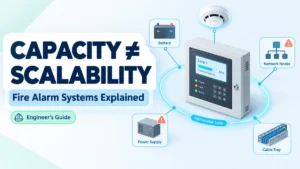
Many organisations assume fire alarm upgrade costs are driven by new technology. In reality, the biggest cost factor is often poor infrastructure planning made years earlier. Decisions about panel capacity, network architecture, device addressing, and expansion planning can significantly influence how expensive future upgrades become.
Introduction
Most fire alarm upgrades aren’t triggered by system failure. They’re triggered by building growth a new wing, a change in occupancy, an added production line, or a tenant fit-out that pushes an existing panel past its limits. When that happens, the upgrade budget isn’t really decided in the moment. It was decided years earlier, at design time, when engineers chose a control panel, sized a loop, or laid out a network.
A fire alarm control panel installed with no spare capacity, no documented device map, and no room to expand almost guarantees an expensive retrofit later. A system designed with lifecycle planning in mind even modestly tends to absorb growth with minimal disruption. This article is written for the engineers and consultants who make those early decisions, so they can understand which choices carry long-term cost consequences and which ones quietly protect a client’s future budget.
Proactive infrastructure planning reduces future fire alarm upgrade costs by building in spare capacity, scalable network architecture, and standardised addressable devices from the start. When panels, loops, and documentation are designed for growth, future expansions require adding devices rather than replacing infrastructure, cutting installation time, downtime, and reprogramming costs significantly.
Why Fire Alarm Upgrade Costs Increase
Upgrade costs rarely come from a single cause. They usually accumulate from several infrastructure gaps compounding over time:
- Building expansion: New floors, wings, or structures that exceed the original system’s device or zone capacity.
- Occupancy changes: A warehouse converted to office space, or a retail floor becoming a lab, often requires different detector types and notification coverage.
- Technology obsolescence: Legacy conventional panels or discontinued components that can no longer be sourced or serviced.
- Capacity limitations: Loops, panels, or network nodes that were sized only for day-one requirements.
- Poor documentation: Missing as-built drawings, device schedules, or addressing records that turn a simple addition into a full system audit.
- Inflexible system design: Proprietary or rigid architectures that don’t support modular growth without significant rework.
Individually, each of these is manageable. Together, and without planning, they force a full-scale retrofit instead of an incremental upgrade.
Infrastructure Decisions That Save Money Later
Selecting a Scalable Fire Alarm Platform
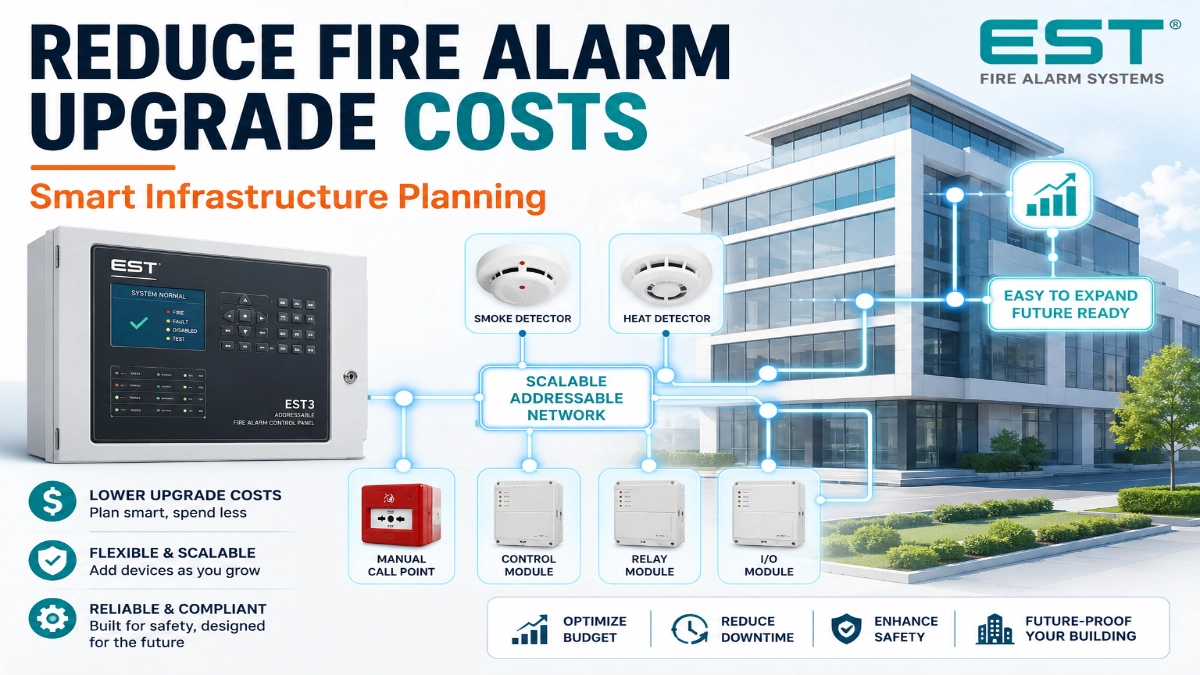
The single biggest lever available at design time is platform selection. An intelligent, addressable fire alarm system built on a modular architecture allows a facility to add loops, panels, and devices without replacing the core system. Enterprise-grade platforms such as the EST Fire Alarm System are structured around this principle: panels that can grow through additional modules and networked nodes rather than requiring a new installation.
Planning Spare Loop Capacity
Reserving 15–25% spare capacity on each signalling line circuit at installation is inexpensive compared to adding a new loop or panel later. Spare capacity means new smoke detectors, heat detectors, or manual call points can be added directly to an existing loop instead of triggering a network redesign.
Using Intelligent Addressable Devices
An addressable fire alarm system gives each device smoke detectors, heat detectors, monitor modules, relay modules its own identifiable address on the loop. This makes future additions, diagnostics, and troubleshooting far simpler than conventional zone-based wiring, where adding a single device can mean rewiring an entire zone.
Designing Flexible Network Architecture
A fire alarm network built with expansion in mind extra network nodes, uncommitted network interfaces, and documented IP or communication addressing allows new buildings or floors to join the existing network instead of operating as an isolated system requiring separate monitoring.
Planning Device Expansion Zones
Identifying likely future device locations during design (even if devices aren’t installed immediately) means conduit, back boxes, and addressable points can be roughed in during initial construction. This is dramatically cheaper than retrofitting conduit through finished walls and ceilings later.
Standardising Components Across Buildings
Using consistent smoke detectors, heat detectors, manual call points, and notification appliances across a campus or portfolio simplifies spare parts inventory, technician training, and future integration. Standardisation also keeps a facility manager from having to support multiple parallel device ecosystems.
Maintaining Accurate Documentation
Detailed device schedules, addressing logs, network diagrams, and as-built drawings are what make future upgrades fast. Without them, every upgrade begins with a costly discovery phase just to understand what’s already installed.
Common Design Mistakes That Increase Upgrade Costs
| Design Mistake | Long-Term Consequence |
|---|---|
| Undersized control panels | Forces full panel replacement instead of module addition |
| Poor loop planning | Requires new loops or rewiring when capacity is exceeded |
| Limited network capacity | Prevents new buildings from joining the existing fire alarm network |
| Inconsistent device selection | Increases spare parts complexity and integration difficulty |
| Ignoring future building phases | Leads to isolated, unconnected systems across a campus |
| Inadequate documentation | Adds discovery and re-engineering costs to every future project |
Practical recommendation: even when a client’s current scope doesn’t call for expansion, consultants should specify panels and network components rated for at least one additional growth phase. The incremental cost at design time is small compared to a forced panel replacement three years later.
The Role of EST3 and EST4 in Long-Term Infrastructure Planning
Enterprise-grade fire alarm control panels are often chosen specifically for their lifecycle flexibility. The EST3 Fire Alarm Panel and EST4 Fire Alarm Panel are examples of platforms built around modular expansion; additional loop cards, network interfaces, and intelligent modules can typically be added within the existing panel architecture rather than requiring a system replacement.
This matters for lifecycle planning because it decouples “adding capacity” from “replacing the system.” A facility that starts with a single EST3 or EST4 panel can, in principle, expand its network of panels, intelligent modules, monitor modules, and relay modules as the building grows, provided the initial design accounted for that growth path. This is the core value of choosing an intelligent fire alarm system: modernisation becomes a matter of extension, not replacement.
Lifecycle Planning Framework for Consultants
| Step | Action | Why It Matters |
|---|---|---|
| 1. Assess Future Building Growth | Review master plans, phased construction, and occupancy forecasts | Determines realistic future device and zone counts |
| 2. Evaluate Expansion Requirements | Identify likely new wings, floors, or connected buildings | Informs network and panel sizing |
| 3. Plan Spare Capacity | Reserve loop, panel, and network headroom | Avoids forced hardware replacement |
| 4. Standardise Devices | Select consistent detector and module families | Simplifies maintenance and future integration |
| 5. Design Scalable Networks | Use expandable network architecture and addressing schemes | Allows new buildings to join without isolation |
| 6. Document Infrastructure | Maintain as-built drawings, device schedules, addressing logs | Reduces discovery time in future projects |
| 7. Prepare Modernisation Roadmap | Outline anticipated upgrade phases and rough timelines | Gives facility owners a budget-planning tool |
Real-World Example
Consider a commercial campus planned for three construction phases over eight years: an office building, a warehouse addition in year three, and a second office tower in year seven.
With an addressable panel, spare loop capacity, and an expandable network from day one, later phases are straightforward: new loops connect to existing panels, new panels join the existing network, and technicians reference existing documentation instead of re-surveying the site.
Compare that to a campus where the original panel was sized exactly for day-one occupancy with no spare capacity. Each new phase then needs an isolated system, duplicate monitoring, and manual integration with the building management system (BMS), far more costly than the modest premium paid for scalable infrastructure at the outset.
Expert Insights
- Spare capacity is an investment, not wasted infrastructure: Unused loop or panel capacity costs almost nothing until needed, at which point it eliminates a far larger retrofit.
- Lifecycle planning should begin before equipment selection: Choosing a panel without understanding a building’s growth trajectory is planning backwards.
- Standardised devices simplify maintenance and future upgrades: A single device family reduces technician training time and spare parts inventory.
- Documentation is one of the most valuable assets during modernisation: Accurate as-built records can shave weeks off an upgrade’s engineering phase.
- Consultants should design for expansion even when clients don’t request it: Clients rarely think in ten-year horizons; consultants often plan that far ahead alone.
- Network architecture decisions outlast individual devices: Detectors get replaced over a building’s life; the underlying network topology usually doesn’t.
- Plan BMS integration early: Retrofitting building management system integration into a fire alarm network is harder than designing for it upfront.
Key Takeaways
- Fire alarm upgrade costs are usually determined at design time, not at upgrade time.
- Reserve spare loop and panel capacity during initial installation.
- Choose an intelligent, addressable fire alarm system with modular architecture.
- Design network infrastructure with room for additional nodes and panels.
- Standardise smoke detectors, heat detectors, manual call points, and notification appliances.
- Maintain complete, accurate as-built documentation and addressing logs.
- Plan device expansion zones and rough-in infrastructure before finishes are complete.
- Build a modernisation roadmap so facility owners can budget for future phases.
Design Decisions vs. Future Upgrade Impact
| Design Decision | Impact on Future Upgrades |
|---|---|
| Scalable panel platform (e.g., EST3, EST4) | Enables module addition instead of panel replacement |
| Spare loop capacity | Reduces need for new loops or rewiring |
| Addressable devices | Simplifies adding and diagnosing devices |
| Expandable network architecture | Allows new buildings to join the existing system |
| Standardized components | Lowers maintenance and integration costs |
| Accurate documentation | Cuts engineering and discovery time |
| Expansion zone planning | Avoids retrofitting conduit and back boxes later |
Read Also: The Role of System Redundancy in Modern Fire Alarm Infrastructure
Read Also: Fire Alarm Infrastructure Trends Every Consultant Should Watch