A high-end CCTV camera does not automatically create a high-performance surveillance system.
A camera may offer high resolution, advanced analytics, wide dynamic range and intelligent features, yet still produce poor evidence if the overall system design is wrong. In many projects, the problem is not the camera itself. It is the way the camera, lens, lighting, network, storage and recording system work together.
This is why CCTV design should be treated as an engineering exercise rather than simply a product-selection exercise.
A well-designed surveillance system should answer practical questions before equipment is purchased:
- What area needs to be monitored?
- What level of identification is required?
- Where will the camera be installed?
- What lighting conditions will exist?
- How much network bandwidth will the system consume?
- How many days of footage must be retained?
- Where will recording take place?
- What happens if the network or storage system fails?
Ignoring these questions can make even expensive cameras significantly less effective.
Google recommends creating helpful, reliable, people-first content that provides substantial value rather than content written primarily to manipulate rankings. Its guidance for AI search also emphasises unique, useful information, clear organisation and strong technical foundations.
Why Expensive CCTV Cameras Can Still Underperform
CCTV performance depends on more than megapixels.
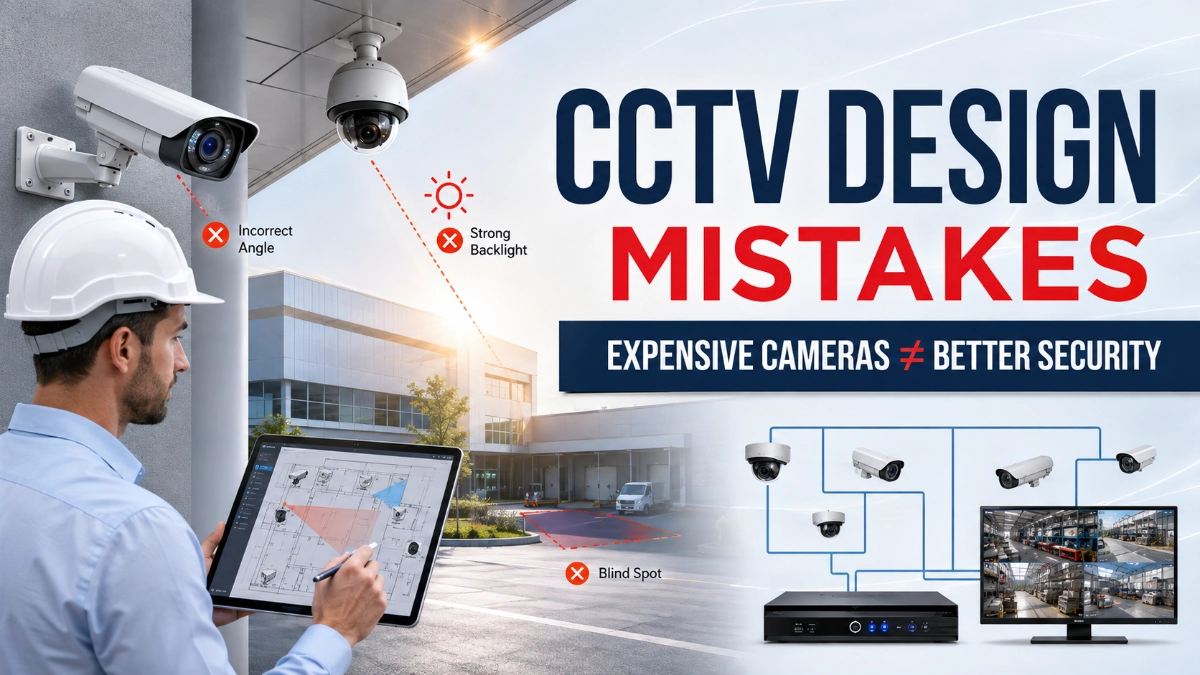
Consider a 4K camera installed above a warehouse entrance. If the camera is positioned too far away, aimed at the wrong angle, exposed to strong backlighting and configured with excessive compression, the resulting footage may not provide useful identification.
The camera specification may look impressive on paper. The surveillance outcome may not.
A useful way to think about CCTV design is:
Camera performance = camera capability + correct placement + suitable optics + lighting + network + recording + configuration
If one of these elements is poorly designed, it can become the weakest link in the system.
Here are the most common CCTV design mistakes engineers and system planners should avoid.
1. Choosing Cameras Before Defining the Surveillance Objective
One of the biggest mistakes is selecting cameras based on resolution, brand or price before defining what the camera needs to accomplish.
A camera used for general monitoring does not necessarily require the same design as a camera intended to identify a person, read a license plate or monitor a restricted access point.
Start by defining the required outcome.
For example:
- Monitoring: Understand what is happening in an area.
- Detection: Determine whether an object or person is present.
- Recognition: Determine whether a person is familiar or unfamiliar.
- Identification: Capture enough detail to establish identity.
The required field of view, camera position, focal length and image quality should follow this objective.
Engineering takeaway
Do not start with “Which 8 MP camera should we buy?”
Start with:
“What evidence must this camera provide?”
That question leads to a much better design.
2. Treating Megapixels as the Main Measure of CCTV Quality
Higher resolution can improve image detail, but resolution alone does not guarantee useful footage.
A high-resolution camera may still struggle if:
- The subject occupies only a small part of the image.
- The lens is inappropriate for the required distance.
- Lighting is poor.
- Motion blur is excessive.
- Compression is too aggressive.
- The camera is incorrectly positioned.
For example, installing a high-resolution wide-angle camera to cover a large parking area may produce an attractive overview but insufficient facial detail at the far end.
This is why engineers should evaluate pixel density, target distance, lens selection and required identification level, not just megapixels.
3. Poor Camera Placement
Camera placement is one of the most important parts of CCTV design.
A technically advanced camera cannot compensate for an unsuitable viewing angle.
Common placement mistakes include mounting cameras:
- Too high above the target
- Directly facing bright windows
- Behind obstructions
- Too far from important activity
- At angles that hide facial features
- Where vibration affects image stability
For entrances, for example, a camera should generally be positioned to capture useful facial information rather than simply providing a wide overview of the doorway.
Before installation, review the actual scene from the proposed mounting position.
Ask:
If an incident happened here tomorrow, would this camera capture the evidence investigators would actually need?
That question often exposes design problems before they become installation problems.
4. Ignoring Lighting Conditions
Lighting can make or break surveillance footage.
A camera installed in a controlled indoor environment may perform very differently from one installed in a warehouse entrance, parking lot or outdoor loading area.
Designers should evaluate:
- Daylight
- Low-light conditions
- Artificial lighting
- Shadows
- Headlights
- Reflections
- Strong backlighting
- Rapid changes between bright and dark areas
Wide Dynamic Range (WDR) can help manage scenes with significant differences between bright and dark areas, but it is not a substitute for good camera positioning and lighting design.
A camera facing a bright window, for instance, may produce a dark subject even when the camera has advanced image-processing capabilities.
5. Using the Wrong Lens or Field of View
The lens determines how the camera sees the scene.
A wide field of view may be useful for general situational awareness but can reduce the amount of detail available on distant subjects.
Conversely, a narrow field of view may provide more detail over a specific area but leave blind spots elsewhere.
Engineers should consider:
- Target distance
- Required field of view
- Sensor size
- Focal length
- Mounting height
- Identification requirements
- Potential future changes to the scene
For critical areas, perform a field-of-view assessment before finalising the camera model.
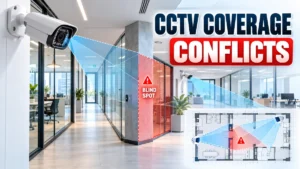
6. Designing Cameras Without Considering Blind Spots
A CCTV layout can look complete on a floor plan while still containing serious blind spots.
Typical problem areas include:
- Corners
- Staircases
- Lift lobbies
- Door approaches
- Loading bays
- Behind large machinery
- Shelving aisles
- Vehicle entry and exit points
Do not simply count cameras.
Instead, map the areas that matter and identify whether each critical zone has adequate visual coverage.
A good CCTV design should also consider how one camera’s view overlaps with another where appropriate. This can improve incident tracking and reduce the chance that an important event disappears between coverage areas.
7. Underestimating Network Bandwidth
IP cameras generate continuous data. As camera resolution, frame rate and bitrate increase, network requirements also increase.
A system designer should calculate the expected traffic rather than assuming an existing network can handle the cameras.
Bandwidth planning should consider:
- Number of cameras
- Resolution
- Frame rate
- Compression
- Bitrate
- Continuous versus event recording
- Live-view requirements
- Network architecture
- Future expansion
A network that works during initial testing may become congested when additional cameras, users or video streams are added.
For larger deployments, network segmentation, appropriate switching capacity and traffic management should be part of the design from the beginning.
8. Choosing an NVR Without Calculating Storage Requirements
Storage is another area where CCTV projects often fail.
Recording requirements depend on much more than the number of cameras.
Storage planning should consider:
Number of cameras × bitrate × recording hours × retention period
Other factors include:
- Continuous or motion-based recording
- Resolution
- Frame rate
- Compression
- Recording schedules
- Redundancy requirements
- NVR capacity
- Future expansion
Selecting an NVR based only on the number of camera channels can result in insufficient storage or poor performance.
When evaluating Impact by Honeywell NVRs, for example, the appropriate model should be matched to the project’s camera count, recording requirements, storage needs and system architecture rather than selected solely by channel count.
9. Forgetting Future Expansion
A CCTV system should not be designed only for today’s requirements.
A business may add:
- New buildings
- Additional entrances
- More parking areas
- Warehouses
- Production lines
- Access-control points
- Additional users
If the network, NVR capacity and physical infrastructure have no expansion margin, a seemingly successful project can become expensive to upgrade later.
Engineers should therefore document current requirements and identify realistic expansion capacity.
10. Poor Cable and Infrastructure Planning
Camera performance also depends on the infrastructure supporting it.
Common mistakes include:
- Excessive cable distances
- Poor-quality connectors
- Incorrect cable routing
- Insufficient PoE capacity
- Inadequate rack space
- Poor environmental protection
- No consideration for grounding and surge protection where required
Outdoor cameras deserve particular attention because environmental exposure can affect equipment and connections.
Infrastructure should be designed with the same care as the cameras themselves.
11. Ignoring Cybersecurity
Modern CCTV systems are networked computing devices. Security therefore extends beyond physical protection.
A poorly secured surveillance network can create unnecessary cybersecurity risks.
Good practices include:
- Change default credentials.
- Use strong, unique passwords.
- Keep firmware updated according to the manufacturer’s guidance.
- Restrict unnecessary network access.
- Segment surveillance traffic where appropriate.
- Limit administrative privileges.
- Secure remote access.
- Maintain an inventory of connected devices.
Cybersecurity should be incorporated during system design rather than added after installation.
12. Using One Camera Type Everywhere
Different environments require different camera characteristics.
A warehouse aisle may benefit from a different camera configuration than:
- A reception area
- Parking facility
- Retail store
- Factory floor
- Building entrance
- Elevator lobby
- Outdoor perimeter
For example, Impact by Honeywell bullet cameras may be considered for applications where a directional viewing pattern is appropriate, while Impact by Honeywell dome cameras can suit environments where a more discreet ceiling or wall-mounted form factor is preferred.
The important principle is not to select a camera simply because it is popular.
Match the camera type to the scene.
13. Poor Camera Configuration After Installation
Even correctly installed cameras can underperform because of configuration errors.
Important settings may include:
- Exposure
- Shutter speed
- Gain
- White balance
- WDR
- Noise reduction
- Bitrate
- Frame rate
- Motion detection
- Image orientation
Factory-default settings may not be ideal for every environment.
A commissioning process should therefore include daytime and nighttime testing where applicable, along with verification of critical views.
14. Designing for Live View but Forgetting Recorded Evidence
A camera can look excellent on a live monitor while the recorded footage tells a different story.
Why?
Because recording settings may use a lower bitrate, frame rate or resolution than the live stream.
For critical cameras, verify both:
What the operator sees live
and
What the system actually records.
Incident investigation depends on recorded evidence, not just a good live preview.
15. Failing to Test the Complete System
The final mistake is treating installation as the end of the project.
A professional CCTV commissioning process should test the complete chain:
Camera → PoE/network → switch → network → NVR → storage → client software → recorded footage
Testing should confirm:
- Camera connectivity
- Image quality
- Night performance where applicable
- Recording
- Playback
- Time synchronization
- Storage capacity
- Network performance
- User permissions
- Remote access, if required
- Failure and recovery behavior
A system is not truly ready because every camera appears online.
It is ready when the complete surveillance workflow has been verified.
A Practical CCTV Design Review Before Procurement
Before finalising a CCTV project, engineers can use this simple review sequence:
Step 1: Define the objective
Identify whether each camera provides monitoring, detection, recognition or identification.
Step 2: Map critical areas
Mark entrances, exits, restricted areas, loading zones, production areas, parking spaces and other important locations.
Step 3: Select the viewing geometry
Determine mounting position, target distance, lens and field of view.
Step 4: Evaluate lighting
Check both daytime and nighttime conditions where applicable.
Step 5: Calculate bandwidth
Estimate expected traffic based on camera count, resolution, frame rate, bitrate and recording configuration.
Step 6: Calculate storage
Determine required retention and recording mode before selecting the NVR.
Step 7: Design the network
Confirm PoE capacity, switching, uplinks, segmentation and expansion requirements.
Step 8: Consider cybersecurity
Plan credentials, access control, firmware management and network security.
Step 9: Test the design
Review camera views and potential blind spots before installation.
Step 10: Commission the system
Verify both live video and recorded evidence after installation.
The Bottom Line
The most expensive CCTV camera is not necessarily the best-performing camera.
A well-designed surveillance system combines the right camera, lens, position, lighting, network, storage and configuration. If any of these elements are poorly planned, the system may deliver less useful evidence than expected.
For organisations evaluating Impact by Honeywell CCTV solutions, the same engineering principle applies: select equipment according to the surveillance objective and integrate it into a properly designed infrastructure rather than judging performance from camera specifications alone.
For projects sourcing these systems in India, working with an Impact by Honeywell distributor in India can help organisations identify suitable product options for their defined requirements. However, the final system design should always be based on the project’s actual coverage, environmental, network, recording and compliance needs.
The best CCTV design is not the one with the most cameras or the highest resolution.
It is the one that consistently captures the evidence the project actually needs.
Read Also: Video Intelligence vs Traditional CCTV Monitoring
Read Also: How Industrial CCTV Improves Supply Chain Visibility