For decades, CCTV cameras served one primary purpose: to record what happens and store it for later review. Security teams retrieved footage after incidents, courts used recordings as evidence, and facility managers checked camera feeds only when something went wrong. The system was entirely passive, a silent witness with no ability to act or analyse.
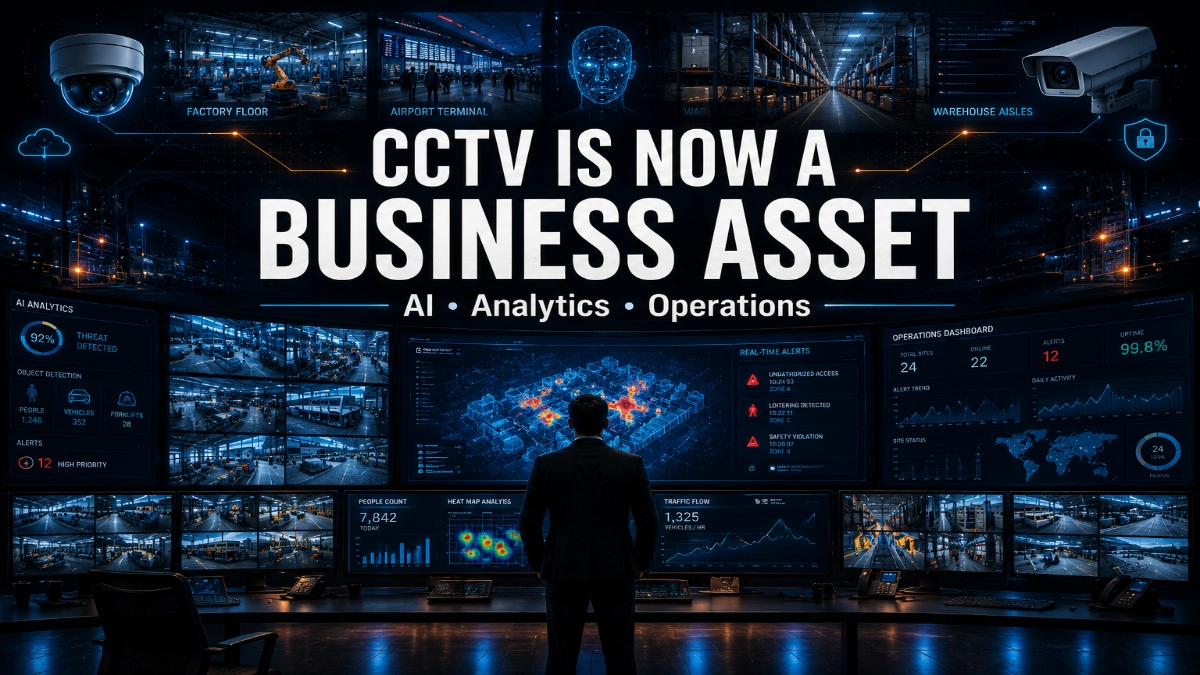
That model is no longer adequate for modern enterprise operations.
Today, intelligent surveillance infrastructure has become one of the most strategically valuable technology investments an enterprise can make. What was once a cost centre, a line item under physical security, is now an operational intelligence platform that delivers measurable business value across safety, logistics, compliance, workforce management, and real-time decision-making.
This transformation has been driven by three converging forces: the maturation of AI-powered video analytics, the proliferation of high-resolution IP cameras, and the availability of cloud-native and edge computing infrastructure. Together, these forces have turned CCTV systems into enterprise-grade data platforms.
This article examines why intelligent surveillance infrastructure is fast becoming a strategic business asset and what enterprise leaders, security integrators, and facility managers need to understand about this shift.
What Traditional CCTV Systems Were Designed For
Conventional CCTV infrastructure was engineered around a narrow and specific use case: deter crime, record activity, and provide post-incident evidence. The architecture reflected these limited goals.
Traditional systems typically consisted of:
- Analogue cameras transmit video via coaxial cables.
- Digital Video Recorders (DVRs) with limited local storage.
- Basic motion-triggered recording with no intelligent filtering.
- Low-resolution footage unsuitable for automated analysis.
- Standalone deployments with no integration to other business systems.
- Manual review processes require dedicated security personnel.
This architecture worked reasonably well in small, static environments. A retail outlet, a small office, or a residential compound could be adequately protected with a few cameras connected to a local DVR.
But as enterprises grew larger, more distributed, and operationally complex, these systems began to show deep structural limitations.
The Limitations of Conventional Surveillance Architecture
Conventional CCTV systems created several operational challenges that modern enterprises can no longer accept:
- Siloed data: Footage lived in isolated DVRs with no connectivity to business intelligence systems.
- Reactive-only posture: Systems only helped after incidents occurred; there was no capability to prevent or predict events.
- High storage costs: Large facilities generated enormous volumes of video with low retrieval value.
- Limited coverage intelligence: Cameras recorded everything indiscriminately, making useful data extraction nearly impossible at scale.
- No multi-site visibility: Managing surveillance across dozens of locations required physical presence or fragmented, inconsistent systems.
- Poor integration: CCTV had no connection to access control, fire alarms, building management systems (BMS), or ERP platforms.
- Cybersecurity vulnerabilities: Older IP cameras often shipped with default credentials and outdated firmware, creating serious network exposure.
These limitations pushed enterprises to demand fundamentally different surveillance capabilities systems that could do far more than record.
Why Modern Enterprises Expect More from Surveillance Infrastructure
Enterprise operations today are complex, data-driven, and distributed. A global manufacturer managing 40 plants, a logistics company running 20 distribution hubs, or a commercial real estate developer operating 50 office towers cannot afford surveillance infrastructure that only answers questions after incidents occur.
Modern enterprises need surveillance systems that:
- Generate actionable intelligence from live and recorded video.
- Integrate seamlessly with operational systems, including BMS, access control, fire alarms, and ERP.
- Support remote monitoring and management across geographically dispersed sites.
- Enable real-time decision-making based on video-derived insights.
- Scale cost-efficiently without requiring proportional increases in hardware or personnel.
- Meet increasingly stringent regulatory and compliance requirements.
- Contribute directly to business continuity, workforce safety, and risk management strategies.
Intelligent enterprise surveillance ecosystems built on IP cameras, AI video analytics, cloud storage, and edge computing are purpose-built to meet these demands.
How CCTV Infrastructure Now Supports Strategic Business Functions
The most significant change in modern surveillance is not the hardware. It is what the data from that hardware can do. Here is how intelligent surveillance infrastructure now powers critical business functions across enterprise operations.
1. Operational Intelligence and Process Visibility
AI-powered video analytics can monitor industrial processes in real time, identifying inefficiencies, bottlenecks, and deviations from standard operating procedures. In manufacturing plants, surveillance cameras equipped with computer vision track production line throughput, machine utilisation, and material flow, giving operations managers data they previously had to gather manually or through separate sensor networks.
This transforms surveillance cameras into continuous process auditors, generating operational intelligence that directly improves productivity and reduces downtime.
2. Workforce Safety Monitoring
Safety compliance in industrial environments has historically depended on manual inspections. AI surveillance changes this fundamentally. Modern intelligent monitoring systems can automatically detect:
- Workers entering restricted or hazardous zones without authorisation.
- Missing or improperly worn personal protective equipment (PPE).
- Proximity violations between personnel and heavy machinery.
- Slip, trip, and fall events with immediate automated alerts.
- Overcrowding in confined spaces or emergency egress paths.
For industrial facility managers and business continuity teams, this real-time safety layer reduces accident rates, supports regulatory compliance, and significantly lowers liability exposure.
3. Logistics Optimisation and Supply Chain Visibility
In warehouses and logistics hubs, intelligent surveillance tracks inventory movement, loading dock activity, vehicle dwell times, and workflow sequencing. AI video analytics can identify when specific loading bays are congested, when dispatch sequences are out of order, or when inventory is misplaced, providing logistics managers with data that was previously invisible.
Airports use intelligent surveillance to monitor baggage handling systems, passenger flow patterns, and ground vehicle movements. Logistics companies deploy enterprise video analytics to track driver behaviour, vehicle loading compliance, and departure timing, all contributing to measurable cost reductions and service level improvements.
4. Occupancy Analytics and Space Utilisation
For commercial real estate developers and office tower operators, understanding how physical space is actually used is a major business intelligence gap. Intelligent surveillance systems fill this gap by providing accurate, real-time occupancy data: which zones are busy, when peak usage occurs, which floors consistently underperform, and how tenant patterns shift over time.
This data drives smarter space planning decisions, HVAC and energy optimisation, and tenant service improvements, delivering measurable operational cost savings directly attributable to surveillance infrastructure.
5. Customer Behaviour Analysis in Retail Environments
Retail chains have long sought to understand customer movement patterns, dwell times at product displays, and conversion funnels in physical stores. AI-powered surveillance platforms deliver this intelligence at scale without requiring separate sensor networks or additional technology investments.
Heat mapping, queue detection, and traffic flow analytics generated from surveillance infrastructure help retail operators redesign store layouts, improve staff allocation, and reduce checkout wait times, directly influencing revenue performance.
6. AI-Powered Anomaly Detection and Incident Prediction
One of the most powerful capabilities of modern intelligent surveillance infrastructure is the ability to detect behavioural and operational anomalies before they escalate into incidents. Machine learning models trained on historical video data can identify:
- Unusual movement patterns in secure areas.
- Vehicles are parked in atypical locations near critical infrastructure.
- Crowd formation patterns that precede confrontational events.
- Machinery behaviour that deviates from operational norms.
- Intrusion attempts before the perimeter breach is complete.
This predictive intelligence layer shifts enterprise security from a reactive posture to a proactive one, reducing incident rates, accelerating response times, and lowering the operational costs of security management.
7. Asset Protection and Inventory Integrity
Intelligent surveillance combined with AI video analytics provides continuous, automated protection for high-value assets. Data centres use enterprise video analytics to monitor server room access with computer vision, cross-referencing camera feeds with access control logs to detect and flag unauthorised attempts in real time.
Manufacturing facilities track tools, equipment, and materials through video-based asset monitoring, reducing loss, theft, and inventory discrepancies without increasing headcount.
8. Emergency Coordination and Incident Management
When emergencies occur, such as fires, evacuations, medical incidents, or security breaches, enterprise surveillance infrastructure becomes the operational spine of the response. Integrated surveillance systems connected to fire alarm panels, building management systems, and emergency notification platforms enable:
- Automatic camera positioning toward incident locations.
- Real-time situation awareness for emergency coordinators.
- Evacuation route monitoring to identify blocked egress paths.
- Headcount verification in muster areas through video analytics.
- Live video feeds delivered directly to first responders.
9. Compliance Monitoring and Regulatory Reporting
Industries operating under strict regulatory frameworks, such as food processing, pharmaceuticals, hazardous materials handling, and financial trading floors, use intelligent surveillance to maintain and demonstrate compliance. Automated alerts for procedure violations, timestamped audit trails, and AI-generated compliance reports reduce the labour cost of regulatory adherence while improving accuracy and reliability.
This is particularly valuable for multi-site enterprise operations where manual compliance auditing would require prohibitive staffing levels.
10. Remote Operations Management and Multi-Site Enterprise Visibility
Unified surveillance platforms aggregate camera feeds, analytics data, and alert streams from dozens or hundreds of sites into a single enterprise command centre interface. Operations managers and security operations centre (SOC) professionals can monitor an entire portfolio of facilities from a centralised dashboard, reducing the need for on-site staffing while improving situational awareness.
For enterprises managing geographically dispersed operations, retail chains, transportation networks, energy infrastructure, and smart city deployments, this multi-site enterprise visibility represents a fundamental operational advantage.
Why Traditional CCTV Strategies No Longer Meet Enterprise Needs
The gap between traditional CCTV deployment and modern enterprise surveillance requirements is not incremental. It is structural.
Traditional CCTV strategies fail modern enterprises on four critical dimensions:
- Intelligence gap: Traditional systems record without understanding. Modern enterprises need surveillance infrastructure that can analyse, detect, classify, and alert automatically and in real time.
- Integration gap: Legacy CCTV operates in isolation. Enterprise operations require surveillance data to flow into BMS, access control, fire alarm systems, ERP platforms, and business intelligence dashboards.
- Scale gap: Adding cameras to a traditional DVR-based system is expensive and complex. Modern enterprises need cloud-native and edge AI architectures that scale cost-efficiently across hundreds of sites.
- Value gap: Traditional systems deliver security value only. Intelligent enterprise surveillance ecosystems deliver operational, safety, compliance, and business intelligence value simultaneously.
Enterprises that continue to invest in traditional CCTV architectures are not simply missing efficiency gains. They are actively creating operational blind spots, compliance risks, and competitive disadvantages.
How Intelligent Surveillance Infrastructure Creates Business Value
The business case for intelligent enterprise surveillance is no longer theoretical. Deployments across manufacturing, logistics, retail, commercial real estate, and critical infrastructure have produced documented, quantifiable outcomes.
Operational Efficiency Gains
AI video analytics applied to production lines and logistics workflows routinely identify inefficiencies that manual observation misses entirely. Cycle time analysis, bottleneck identification, and workforce productivity monitoring through intelligent surveillance have produced documented throughput improvements of 8 to 15 per cent in high-volume manufacturing environments.
Accelerated Security Response
Automated anomaly detection and real-time alerting reduce average security response times from minutes to seconds. For enterprise facilities managing large physical footprints, this speed differential represents the difference between incident containment and significant operational disruption.
Reduced Compliance and Safety Costs
Automated compliance monitoring eliminates the need for manual safety audits across large facilities. Enterprises using AI-powered surveillance for PPE compliance and zone safety monitoring have reported measurable reductions in workplace incidents and corresponding decreases in regulatory penalties and insurance premiums.
Smarter Maintenance Planning
Intelligent surveillance systems can monitor the condition of physical assets, equipment, machinery, vehicles, and infrastructure using visual diagnostics. Anomalies detected through AI video analysis can trigger predictive maintenance workflows, reducing unplanned downtime and extending asset lifecycles.
Infrastructure Scalability Without Proportional Cost Growth
Cloud-native surveillance infrastructure eliminates the hardware scaling bottleneck of traditional DVR-based systems. Adding 50 cameras to a cloud-connected enterprise surveillance ecosystem requires no additional on-premise server hardware, only network bandwidth and cloud storage capacity, both of which scale at significantly lower cost than physical infrastructure.
Traditional CCTV vs. Intelligent Enterprise Surveillance: A Direct Comparison
The following table illustrates the fundamental differences between legacy surveillance deployments and modern intelligent enterprise surveillance ecosystems.
| Feature / Capability | Traditional CCTV Infrastructure | Intelligent Enterprise Surveillance Ecosystem |
| Primary Purpose | Security costs only | Security + operational intelligence + business analytics |
| Data Utilization | Video stored, rarely reviewed | Real-time AI analysis, actionable insights |
| Analytics Capability | None or basic motion detection | AI-powered object, behavior, and anomaly detection |
| Integration | Standalone, siloed system | Integrated with BMS, access control, fire alarms, ERP |
| Scalability | Manual expansion, high cost | Cloud-native, edge AI, scales with demand |
| Remote Access | Limited, often on-premise only | Unified remote management across all sites |
| Business Value | Cost center (security only) | Revenue enabler, operational optimizer, risk reducer |
| Incident Response | Reactive, post-event review | Proactive alerts, real-time automated response |
| Maintenance | Reactive break-fix model | Predictive maintenance using AI diagnostics |
| Compliance Support | Manual log retrieval | Automated compliance reports and audit trails |
| Multi-site Visibility | Fragmented, site-by-site | Centralized dashboard with enterprise-wide view |
| Data Storage | Local DVR/NVR, high hardware cost | Hybrid cloud storage, cost-efficient, scalable |
| Workforce Safety | Reactive incident recording | Real-time PPE detection, zone compliance alerts |
| Cybersecurity | Minimal, often default passwords | Encrypted, zero-trust, SOC-integrated |
| ROI Model | Security cost only | Multi-dimensional: safety + ops + analytics + continuity |
Real-World Deployment Examples Across Industries
Manufacturing Plants
A heavy equipment manufacturer deployed intelligent surveillance infrastructure across its production facilities to monitor assembly line compliance, track component movement, and enforce safety zone regulations. Computer vision algorithms automatically detected workers entering high-voltage areas without required PPE and generated immediate alerts to supervisors. The deployment reduced safety incidents by 34 per cent in the first operating year.
Airports and Transportation Hubs
Major international airports have integrated intelligent surveillance ecosystems with passenger processing systems, baggage handling operations, and ground vehicle management. AI-powered monitoring tracks queue lengths at security checkpoints in real time, triggering automated staff reallocation to reduce average passenger wait times. Video analytics applied to baggage loading operations has measurably reduced mishandling rates.
Warehouses and Logistics Hubs
Large-scale distribution centre operators use enterprise video analytics to monitor inventory staging areas, loading dock activity, and vehicle turnaround times. Intelligent surveillance platforms integrated with warehouse management systems (WMS) provide operations managers with real-time visibility into fulfilment workflows, reducing error rates and improving throughput without additional headcount.
Smart Cities and Public Infrastructure
Municipal governments and smart city planners deploy AI-powered surveillance infrastructure across transportation networks, public spaces, and critical utilities. Intelligent monitoring systems track traffic flow patterns, detect abandoned objects, and monitor crowd dynamics in real time, providing city operations centres with situational awareness at a scale that traditional patrol-based monitoring could never achieve.
Commercial Office Towers and Real Estate
Commercial real estate operators use intelligent surveillance for occupancy analytics, access management, and energy optimisation. Accurate, real-time occupancy data feeds directly into HVAC and lighting control systems, reducing energy consumption while maintaining optimal occupant comfort. Landlords use surveillance-generated usage data to inform lease negotiations and space redesign decisions.
Data Centres
Data centre operators deploy enterprise video analytics to monitor physical access to server environments with AI-enhanced precision. Cross-referencing camera feeds with access control logs enables automatic detection of tailgating attempts, unauthorised equipment removal, and unusual behavioural patterns in secure server areas, providing a security layer that access control alone cannot deliver.
Retail Chains
Large retail operators integrate intelligent surveillance platforms with point-of-sale data to analyse the relationship between customer movement patterns and purchase conversion rates. Heat mapping and queue analytics generated from surveillance infrastructure directly inform staffing schedules, store layout redesigns, and promotional display placements.
Cybersecurity in Enterprise Surveillance Ecosystems
As surveillance infrastructure becomes deeply integrated with business-critical systems, cybersecurity considerations become mission-critical. Enterprise surveillance deployments must address:
- End-to-end encryption of video streams and stored footage.
- Zero-trust network architecture for camera and analytics server access.
- Regular firmware updates and vulnerability patching across all camera endpoints.
- Role-based access control for surveillance management platforms.
- Intrusion detection monitoring for surveillance network traffic.
- Integration with SOC platforms for unified threat visibility.
Enterprises evaluating intelligent surveillance solutions should require documented cybersecurity frameworks and regular third-party penetration testing as standard procurement requirements. Platforms such as Impact by Honeywell are engineered with enterprise-grade cybersecurity architectures that address these requirements at scale.
Integration with Enterprise Systems: BMS, Access Control, and Beyond
The full business value of intelligent surveillance infrastructure is realised only when it operates as part of a connected enterprise technology ecosystem. Modern surveillance platforms integrate with:
- Building Management Systems (BMS): Surveillance data feeds into HVAC, lighting, and energy management systems to optimise building operations based on real occupancy patterns.
- Access Control Systems: Cross-referencing video feeds with access control logs enables automatic detection of unauthorised access, tailgating, and credential misuse.
- Fire Alarm Systems: Integrated surveillance platforms automatically position cameras toward alarm activation points, providing emergency coordinators with immediate visual situational awareness.
- ERP and Workforce Management Platforms: AI-generated workforce activity data from surveillance systems integrates with HR and operations platforms to support performance management and productivity analysis.
- Business Intelligence Dashboards: Video analytics data aggregated across sites flows into enterprise BI platforms, enabling executive decision-makers to incorporate surveillance-derived insights into strategic planning.
Distributors of advanced surveillance platforms, including Impact by Honeywell distributors in India, play a critical role in supporting this integration work, providing technical expertise, deployment services, and ongoing support for enterprise-scale intelligent surveillance ecosystems.
The Future of Enterprise Surveillance Infrastructure
The trajectory of intelligent surveillance infrastructure points toward even deeper integration of AI, autonomous systems, and predictive analytics. Several developments will define the next phase of enterprise surveillance evolution:
Edge AI Analytics
Processing video analytics at the camera edge rather than in centralised servers reduces bandwidth consumption, lowers latency, and enables real-time decision-making even in locations with limited network connectivity. Edge AI cameras are increasingly capable of running sophisticated detection models locally, sending only actionable alerts rather than raw video streams.
Digital Twins for Enterprise Operations
Surveillance-derived data will increasingly feed digital twin models of physical facilities’ virtual representations that replicate real-world operational conditions in real time. Facility managers will use these models to simulate layout changes, emergency scenarios, and operational workflow adjustments before implementing them physically.
Autonomous Surveillance Systems
AI-driven drone surveillance, robotic patrol platforms, and self-directing PTZ camera networks will increasingly replace static camera arrays in large outdoor environments and infrastructure sites. These autonomous systems will dynamically prioritise coverage based on detected activity, dramatically extending effective surveillance coverage without proportional increases in infrastructure cost.
Cloud-Native and Hybrid Surveillance Infrastructure
Cloud-native surveillance architectures with hybrid local and cloud storage, centralised management, and elastic compute resources will become the deployment standard for enterprise-scale operations. The ability to manage thousands of cameras across hundreds of sites from a unified cloud platform, with AI analytics processed at the edge and insights delivered to central dashboards, represents the operational target for enterprise surveillance infrastructure planners.
Unified Security and Operational Intelligence Platforms
The long-term direction of enterprise surveillance is convergence, the merging of physical security, operational analytics, building intelligence, and business continuity into unified platforms. Enterprises will increasingly evaluate surveillance infrastructure not as a security system, but as an operational intelligence platform that happens to include security as one of its many value streams.
Enterprise solutions like Impact by Honeywell are at the forefront of this convergence, offering integrated platforms that connect surveillance, access control, fire safety, and building management into cohesive operational intelligence ecosystems designed for the demands of modern enterprise infrastructure.
Practical Deployment and Optimisation Recommendations
For enterprise decision-makers and security integrators planning intelligent surveillance deployments, the following principles should guide architecture and implementation decisions:
- Start with business outcomes, not technology specifications. Define what operational intelligence you need before selecting camera models or analytics platforms.
- Design for integration from day one. Ensure your surveillance infrastructure is built on open APIs and interoperability standards that allow connection to BMS, access control, and ERP systems.
- Prioritise cybersecurity architecture as a non-negotiable requirement, not an optional add-on.
- Scale plan. Select cloud-native or hybrid architectures that allow you to add cameras and analytics capabilities without replacing core infrastructure.
- Invest in analytics, not just cameras. The business value of modern surveillance comes from AI-powered analytics platforms, not from higher camera resolution alone.
- Engage qualified distribution and integration partners who have documented experience with enterprise-scale deployments. Impact by Honeywell distributors in India, for example, provides the technical expertise and regional support infrastructure that enterprise deployments require.
- Establish ongoing governance for surveillance data, including access policies, retention schedules, compliance frameworks, and cybersecurity review cycles.
Read Also: What Makes Modern CCTV Systems Smarter Than Traditional Surveillance
Read Also: Synchronisation Challenges in Multi-City Surveillance Operations