A fire alarm system is only as effective as its weakest link. Facilities around the world invest heavily in advanced fire alarm panels, addressable detectors, and smart monitoring infrastructure, yet many of these systems underperform during real-world incidents. The reason is rarely the technology itself. More often, it is where the detectors are placed.
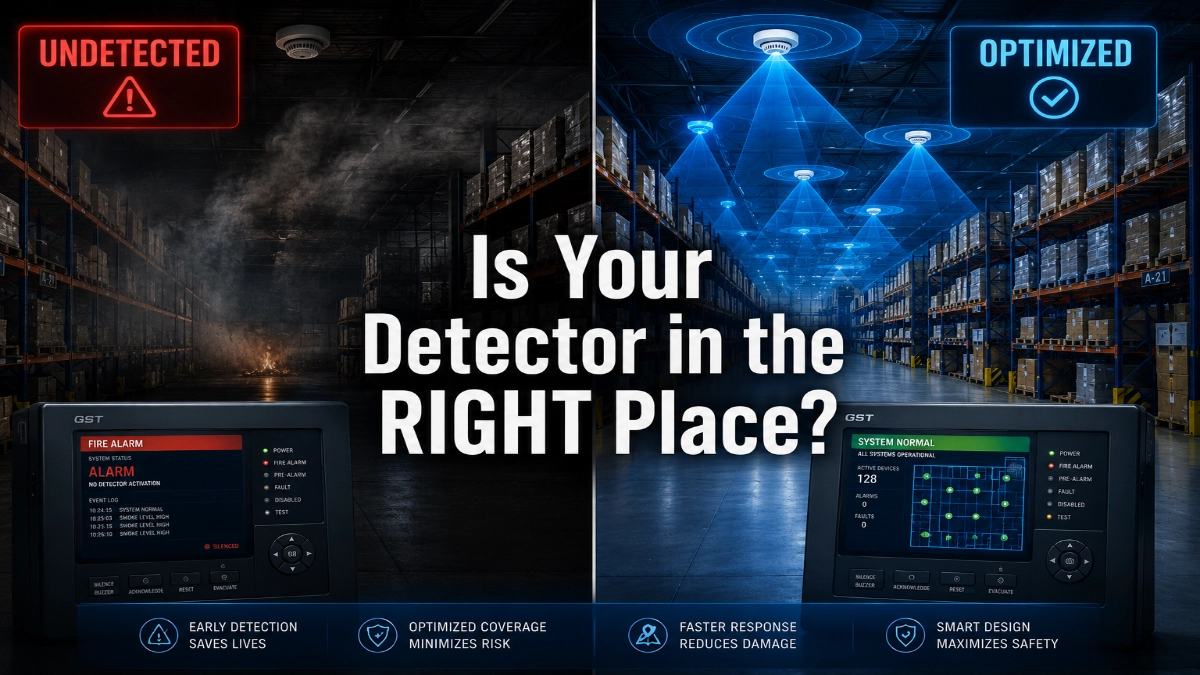
Detector placement is the single most misunderstood factor in fire detection system design. It is not enough to select the right detector for the right environment. Engineers and facility managers must also ensure that each detector is positioned where it can reliably detect fire signatures, smoke particles, heat, or flames within the shortest possible time window.
This article explains why intelligent detector placement is a non-negotiable foundation of fire detection efficiency. It covers the science of fire behaviour, the engineering challenges of real-world environments, the practical impact of poor placement decisions, and the strategies that fire safety professionals, MEP consultants, and facility operators need to deploy fire detection systems that are fast, reliable, and compliant.
What Is Fire Detector Placement and Why Does It Matter?
Fire detector placement refers to the physical positioning of fire detection devices, including smoke detectors, heat detectors, beam detectors, aspirating smoke detection (ASD) systems, flame detectors, and multi-sensor devices, within a structure to ensure maximum detection coverage, minimum response time, and reliable performance under real-world conditions.
The goal of placement strategy is not simply to meet the minimum spacing requirements in fire codes such as NFPA 72 (National Fire Alarm and Signalling Code) or BS 5839. The goal is to ensure that every detector is placed where it can actually detect fire at the earliest possible moment, in the specific environmental conditions of that space.
Fire does not behave the same way in every environment. Smoke rises, but it can also stratify, travel horizontally through air currents, or be suppressed by ventilation systems before reaching a ceiling-mounted detector. Heat travels upward but is affected by thermal boundaries, airflow rates, and ceiling geometry. Understanding these dynamics is what separates a well-designed fire detection layout from one that creates dangerous detection gaps.
How Smoke and Heat Behave in Real-World Environments
Before designing a detector layout, engineers must understand the physics of fire behaviour in three-dimensional spaces.
Smoke Behavior
When a fire ignites, combustion products, including smoke particles, rise in a thermal plume. In a standard room with a flat ceiling, smoke spreads outward from the plume and reaches ceiling-mounted detectors relatively quickly. However, in complex environments, this straightforward behaviour is disrupted by several factors:
- Stratification: In tall spaces, smoke may cool before reaching the ceiling and form a horizontal layer at mid-height, preventing it from triggering ceiling-mounted detectors.
- HVAC interference: Air supply and return systems can dilute smoke, redirect its travel path, or create negative pressure zones that draw smoke away from detectors.
- Dead air pockets: Corners, recessed areas, and enclosed spaces may trap air without sufficient circulation, causing smoke to bypass detectors entirely.
- Horizontal airflow: High-velocity air movement across ceilings can push smoke away from detector coverage zones.
Heat Behavior
Heat-sensing detectors respond to the rate of temperature rise or a fixed temperature threshold. Heat rises naturally, but in environments with:
- In high ambient temperatures (foundries, industrial ovens, boiler rooms), baseline temperature levels may be close to fixed-threshold detector settings.
- Large open volumes, heat may dissipate before reaching a ceiling-mounted detector at a meaningful concentration.
- Cold storage environments, thermal gradients can create false readings or suppress detection entirely.
| KEY INSIGHT Fire detection speed is not just about sensor sensitivity. It is about placing that sensor at exactly the point where fire signatures will arrive earliest. Every metre of incorrect placement can cost critical minutes during an emergency response. |
Key Detector Placement Considerations for Modern Facilities
1. Ceiling Height and Geometry
Ceiling height is one of the primary variables in detector placement design. Standard ceiling heights of 2.7–3 m work well with conventional smoke detectors. As ceiling height increases beyond 8–10 m, smoke stratification becomes a serious concern. In spaces with ceilings above 12 m, such as warehouses, atriums, aircraft hangars, and sports arenas, projected beam detectors or aspirating smoke detection (ASD) systems are often the preferred solution because they can detect smoke across wide horizontal planes without relying on smoke reaching the ceiling.
Sloped and peaked ceilings require detectors placed at or near the apex, where hot gases accumulate first. Coffered ceilings, beam-interrupted ceilings, and grid-style T-bar ceilings introduce compartmentalisation effects that must be mapped carefully.
2. HVAC Airflow Interference
HVAC systems are one of the most significant sources of detector placement errors. Air supply diffusers create turbulence zones that can dilute smoke concentrations before they trigger point-type smoke detectors. Return air grilles can pull smoke away from detector coverage zones entirely.
NFPA 72 recommends that smoke detectors be placed no closer than 1.5 m (5 feet) from HVAC supply diffusers, and fire alarm engineers must evaluate airflow patterns across the ceiling before finalising detector positions. In data centres and clean rooms, where precision HVAC is fundamental to operations, this challenge is amplified.
3. Dead Air Spaces
Dead air spaces are low-velocity zones in corners, along walls near the floor, and in enclosed structural voids. In these areas, smoke or heat may accumulate slowly or fail to circulate to nearby detectors. NFPA 72 and BS 5839 specify minimum distances from walls (typically no closer than 10 cm) and from corners (no closer than 10 cm from the ceiling-wall intersection) for exactly this reason. Failing to account for dead air spaces can leave entire sections of a facility effectively undetected.
4. Beam and Structural Obstructions
Exposed structural beams, ductwork, large pipe runs, and storage racks create physical barriers that interrupt smoke travel. When ceiling-mounted smoke detectors are positioned on the opposite side of a beam from the fire source, the beam acts as a barrier, delaying or preventing smoke from reaching the detector. The standard guidance from NFPA 72 is that when beams project more than 460 mm (18 inches) below the ceiling, they should be treated as walls for detector spacing purposes. Engineers must map every structural obstruction and design detector coverage zones accordingly.
5. High-Temperature Industrial Environments
In foundries, steel mills, glass manufacturing facilities, and similar industrial environments, ambient temperatures can regularly exceed 50°C. Standard fixed-temperature heat detectors, rated at 57°C or 68°C, are unsuitable for these locations because they would trigger constantly from ambient heat. Rate-of-rise heat detectors or higher-threshold fixed-temperature detectors must be selected, and their placement must account for the fact that fire-related heat increases may be masked by the high background temperature environment.
6. Dust-Heavy Industrial Zones
In cement plants, grain processing facilities, woodworking shops, and mining environments, ambient dust levels are high enough to trigger nuisance alarms in standard ionisation or photoelectric smoke detectors. Here, the placement strategy must prioritise dust-resistant detector technologies such as aspirating smoke detection systems with advanced signal processing, or multi-sensor detectors with environmental compensation. The physical placement must also consider dust accumulation patterns and cleaning schedules.
7. Warehouse Rack Configurations
High-bay warehouses with storage racks reaching 10–15 m create layered detection challenges. Detectors mounted only at ceiling level may miss ground-floor fires that ignite between rack rows, where both vertical airflow and horizontal smoke travel are impeded by the racks themselves. In such environments, in-rack smoke detectors mounted at multiple elevations within the rack structure are combined with ceiling-level coverage and, in some cases, projected beam detectors spanning across the rack tops.
8. Atriums and Open Spaces
Large atriums, airport terminal halls, hotel lobbies, and convention centre floors present unique challenges because of their vast vertical volume. Smoke stratification is almost inevitable in these spaces, and standard spot detectors mounted at ceiling height will frequently fail to detect ground-floor fires in time. Multi-level beam detector arrays, video smoke detection (VSD) technology, and aspirating smoke detection systems designed for high-sensitivity detection of low-density smoke are the preferred solutions for atrium environments.
9. Data Centre Cooling Airflow
Modern data centres use precision air conditioning (CRAC/CRAH units), hot aisle/cold aisle containment, and in some cases, liquid cooling. These environments generate complex, highly engineered airflow patterns that can rapidly dilute smoke concentrations and redirect smoke travel in unpredictable ways. Very Early Warning Fire Detection (VEWFD) aspirating smoke detection systems are now the standard recommendation for data centres, because they actively sample air from multiple points and can detect smoke at concentrations as low as 0.0015% obs/m far earlier than any standard spot detector could respond.
10. Kitchen and Steam Environments
Commercial kitchens produce steam, cooking aerosols, and elevated ambient temperatures that are environmentally hostile to standard smoke detectors. Placing standard optical smoke detectors near kitchen areas causes persistent nuisance alarms. The correct approach is to use heat-only detectors in kitchen spaces and position smoke detectors only in adjacent corridors or areas outside the cooking zone’s direct influence. Where detection is required closer to cooking equipment, multi-sensor detectors with cross-referencing algorithms can significantly reduce false alarm rates.
11. Smoke Stratification Effects
Smoke stratification occurs when smoke cools and loses buoyancy before reaching the ceiling. This is most common in spaces with ceiling heights above 6 m, where the thermal plume from a small, slow-burning fire can cool to the ambient temperature of the surrounding air before reaching the ceiling-mounted detector. The result is a horizontal band of smoke hanging at mid-height visible to occupants, but invisible to ceiling-mounted detectors. Solutions include beam detectors mounted at intermediate heights, or aspirating smoke detection systems with sampling pipes distributed at multiple vertical levels.
12. Multi-Level Infrastructure Complexity
Multi-storey buildings, stacked mezzanines, and split-level industrial facilities require distinct detection zones for each level. Smoke from a ground-floor fire may travel vertically through open stairwells or service voids to upper levels before triggering a detector on its original level. Without intelligent zoning, enabled by an addressable fire alarm panel, it becomes impossible to pinpoint the actual origin of the fire from the control room. Properly zoned multi-level layouts, supported by addressable detectors, allow fire response teams to act on precise location data immediately.
13. Intelligent Zoning Considerations
Zoning strategy defines how detectors are grouped and how fire events are reported to the control panel. In a conventional fire alarm panel system, all detectors on a zone circuit report collectively, making it impossible to identify which individual detector has triggered. In contrast, an addressable fire alarm panel assigns a unique digital address to each detector, allowing the panel to identify precisely which device has activated, its location, and, in advanced systems, its current alarm threshold status and environmental readings.
Intelligent zoning through addressable systems is not just an operational convenience; it is a critical factor in fire response efficiency. When emergency responders receive a precise detector address rather than a broad zone notification, they can direct their response to the exact location in seconds, rather than searching through entire floors or zones.
Placement Requirements by Detector Type
Smoke Detectors
Point-type smoke detectors, both ionisation and photoelectric, are the most widely deployed detection devices in commercial and residential buildings. Standard placement guidelines specify a maximum spacing of 9.1 m (30 feet) between detectors in open areas, with positioning at the highest point of the ceiling. In rooms with irregular shapes or structural barriers, spacing must be recalculated based on the effective coverage radius of each device. Photoelectric detectors are generally preferred in slow-smouldering fire scenarios, while ionisation types respond faster to fast-flaming fires, and placement must account for the likely fire type in each environment.
Heat Detectors
Heat detectors are suitable for environments where smoke detectors would generate nuisance alarms, such as kitchens, dusty industrial areas, garages, and areas near exhaust sources. Standard point-type heat detectors follow similar spacing rules to smoke detectors, but their effective coverage area is smaller because heat does not spread as efficiently as smoke. Rate-of-rise detectors must be positioned where they can sense the temperature increase pattern of a real fire rather than slow ambient heating from HVAC or industrial processes.
Projected Beam Detectors
Beam detectors use a transmitter-receiver pair mounted on opposing walls or a retroreflective arrangement to project an infrared beam across a large horizontal span, typically up to 100 m. They are ideal for warehouses, atriums, aircraft hangars, and large open spaces. Correct placement requires ensuring a clear, unobstructed optical path between transmitter and receiver, proper alignment, and positioning at heights that capture stratified smoke layers while avoiding HVAC interference zones. Reflective surfaces, steam, and heavy condensation can create false obscuration signals if beam alignment is not carefully planned.
Aspirating Smoke Detection Systems
Aspirating smoke detection (ASD) systems, including VESDA and similar Very Early Warning Fire Detection platforms, use a network of sampling pipes to actively draw air from multiple locations across a protected space into a centralised high-sensitivity detection chamber. Placement of the sampling pipe network is a specialised engineering discipline. Pipe lengths, hole spacing, airflow balance, and sampling point elevation all affect sensitivity and response time. In data centres, museums, heritage archives, and semiconductor manufacturing facilities, ASD systems are the preferred choice precisely because their sampling network can be tailored to the exact airflow patterns of the environment.
Flame Detectors
Flame detectors, including UV, IR, and combined UV/IR types, detect the electromagnetic radiation emitted by actual flames, rather than smoke or heat. Their placement must ensure a direct line of sight to the protected area, with the detector positioned to avoid obstructions from machinery, equipment, or structural elements. Flame detectors are most commonly deployed in open industrial environments, such as petroleum facilities, chemical plants, paint spray booths, and fuel storage areas, where rapid open-flame fires are the primary threat and smoke-based detection would respond too slowly. Shadow zones created by equipment or structures must be mapped and eliminated through additional detector positions.
Multi-Sensor Detectors
Multi-sensor detectors combine two or more detection technologies, typically optical smoke sensing, heat sensing, and sometimes carbon monoxide detection, into a single device with cross-referencing signal processing. This cross-referencing significantly reduces false alarm rates while improving genuine fire detection reliability. Placement strategy for multi-sensor devices follows similar principles to standard smoke detectors, but the benefit of their enhanced environmental discrimination means they can often be positioned in more challenging environments near (but not directly adjacent to) HVAC diffusers, in lightly dusty environments, or in spaces with moderate cooking aerosols where standard smoke detectors would produce unacceptable false alarm rates.
How Poor Detector Placement Affects Fire Safety Outcomes
Detection Speed
Every second matters in a fire emergency. The time between ignition and detector activation determines how much time occupants have to evacuate and how much time firefighters have to suppress the fire before it grows beyond control. Poorly placed detectors positioned in dead air zones, beyond effective coverage radii, or downstream of HVAC return vents can delay detection by minutes. In a fast-developing fire, those minutes are the difference between a contained incident and a catastrophic event.
False Alarms
False alarms are one of the most operationally damaging consequences of poor detector placement. Detectors placed near HVAC diffusers, kitchen areas, steam sources, or dusty industrial equipment generate persistent nuisance alarms that erode the credibility of the fire alarm system, cause evacuation fatigue among occupants, and increase emergency service callouts. Over time, staff begin to ignore alarm activations, a behaviour pattern that becomes directly dangerous when a real fire occurs. Proper placement, matched to environmental conditions, eliminates the vast majority of preventable false alarms.
Emergency Response Coordination
When a fire alarm activates without a precise location because the system uses conventional detectors on zone circuits rather than addressable detectors, emergency responders must manually search a broad area to locate the fire. This search takes time that the fire is actively using to grow. An addressable fire alarm system with correctly positioned detectors delivers a precise device address to the control panel, allowing both internal security staff and external firefighters to direct their response immediately to the correct location.
Compliance Inspections
During periodic fire safety inspections, compliance authorities check detector placement against the applicable codes NFPA 72, BS 5839, IS 2189, or regional equivalents. Detectors found to be outside specified spacing limits, too close to HVAC diffusers, or absent from required zones result in non-compliance notices, enforcement action, and potential closure orders. For commercial and industrial facilities, fire safety compliance is not just a legal obligation; it is a fundamental component of insurance coverage, operating licenses, and occupancy permits.
Evacuation Efficiency
A well-placed fire detection system activates the alarm at the earliest possible stage of a fire, giving occupants maximum time to evacuate safely. Detectors positioned too far from ignition-prone areas, or in locations where fire signatures arrive late, compress the available evacuation window. In high-density occupancy environments, such as stadiums, hospitals, shopping centres, and airports, this compression directly threatens lives.
Maintenance Complexity
Detectors placed in difficult-to-access locations, high ceiling-mounted devices in tall warehouses, detectors above false ceilings without adequate access hatches, or devices within confined machinery spaces dramatically increase the time and cost of routine maintenance, testing, and replacement. Thoughtful placement strategy accounts not only for detection performance but also for the practical requirements of regular inspection, cleaning, and calibration.
Practical Deployment Examples Across Industry Sectors
Manufacturing Plants
In manufacturing environments, fire risks vary dramatically across a single facility, from office areas requiring standard smoke detection to press rooms, paint booths, and welding stations requiring specialised flame or heat detection. A well-designed industrial fire alarm system maps each zone to the appropriate detector type and placement strategy, using an addressable fire alarm panel to provide zone-level precision and integration with process shutdown systems.
Warehouses and Logistics Hubs
High-bay warehouses with dense rack storage, variable inventory types, and active forklift traffic require multi-level detection strategies. Ceiling-level projected beam detectors combined with in-rack conventional detectors and active aspirating smoke detection sampling points at rack mid-levels provide comprehensive coverage that no single-layer approach can achieve.
Airports
Airport terminals present vast open volumes, high occupancy, complex structural geometries, and stringent false alarm constraints. Video smoke detection, aspirating smoke detection in check-in halls and departure lounges, multi-sensor detectors in retail units, and carefully positioned beam detectors across terminal roofs create layered detection networks that must perform reliably under 24/7 operational conditions.
Hospitals
Hospital fire detection systems must balance sensitivity to detect fires as early as possible, with false alarm suppression, because unnecessary evacuations of clinical areas create direct patient safety risks. Multi-sensor detectors are widely used in ward areas, while aspirating smoke detection is preferred in operating theatres, ICUs, and server rooms. Each zone of a hospital fire detection system must be individually designed to reflect the specific occupancy, clinical use, and ventilation characteristics of that space.
Data Centres
Data centres demand Very Early Warning Fire Detection. Aspirating smoke detection systems with sampling pipes distributed throughout raised-floor plenums, above-ceiling voids, and within server cabinet rows, combined with addressable conventional detectors in support areas, provide the layered coverage that mission-critical facilities require. A GST fire alarm system or equivalent intelligent addressable platform integrates detector data with building management systems to enable automated suppression activation and facility-wide incident management.
Commercial Towers
High-rise commercial towers require floor-by-floor detection zoning, stairwell and lift shaft monitoring, and integration with evacuation management systems. Addressable detectors on each floor, connected to a central addressable fire alarm panel, allow security operations centres to monitor the entire building from a single interface and coordinate floor-by-floor evacuation with precision.
Smart Buildings
In smart building environments, fire detection is integrated with BMS platforms, access control, HVAC management, and emergency lighting systems. Addressable fire alarm systems with intelligent detector analytics provide real-time environmental data, not just alarm states, enabling predictive maintenance scheduling, detector health monitoring, and automated system testing.
Most Common Detector Placement Mistakes
Even experienced fire protection engineers can fall into placement errors that compromise detection performance. The most frequently observed mistakes include:
- Placing smoke detectors directly adjacent to HVAC supply diffusers, where turbulent airflow dilutes smoke before it reaches the sensor.
- Ignoring dead air zones in corners, recessed ceiling areas, and enclosed structural voids.
- Using ceiling-only detection in spaces with ceiling heights above 8 m, without accounting for smoke stratification.
- Failing to account for physical obstructions, such as beams, ductwork, and large pipe runs, that interrupt smoke travel paths.
- Selecting standard fixed-temperature heat detectors for high-ambient-temperature industrial environments.
- Placing smoke detectors inside kitchens or steam-intensive areas instead of using heat detectors or multi-sensor devices.
- Using conventional zone-based detectors in environments where precise fire location identification is operationally critical.
- Neglecting in-rack detection in high-bay warehouse environments and relying solely on ceiling-level coverage.
- Positioning beam detectors without verifying a clear optical path across the full span of the protected area.
- Placing aspirating smoke detection sampling holes without balancing airflow through the pipe network results in unequal sensitivity across sampling points.
- Failing to update detector layouts after facility changes, such as new partitions, relocated HVAC equipment, or changes in occupancy type.
| KEY INSIGHT: The most expensive fire detection mistake is not the one that triggers a false alarm. It is the placement decision that delays real fire detection by even a few minutes. In a fast-developing fire, those minutes determine whether the facility survives intact. |
How Intelligent Detector Placement Improves Fire Safety Outcomes
When detector placement is engineered with intelligence combining compliance requirements, environmental analysis, airflow modelling, and detector technology selection, the measurable benefits are significant across every dimension of fire safety performance:
- Faster detection: Detectors positioned at optimal locations within the thermal and airflow dynamics of each space activate sooner, providing maximum response time.
- Fewer false alarms: Environmental matching eliminates the primary sources of nuisance activations, preserving the credibility of the fire alarm system and preventing evacuation fatigue.
- Precise emergency response: Addressable detector networks deliver exact device locations to the fire panel, enabling responders to act immediately on accurate information.
- Seamless compliance: Layouts engineered to meet or exceed NFPA 72, BS 5839, and regional codes avoid enforcement action and insurance complications.
- Lower lifecycle costs: Optimised placement reduces the frequency of nuisance alarm callouts, maintenance interventions, and premature device replacements.
- Integration-ready infrastructure: Addressable systems designed with intelligent placement are inherently ready for BMS integration, fire suppression system interfacing, and smart building automation.
- Scalability: An intelligently planned layout is designed with expansion in mind, allowing additional detector loops or zones to be added as facilities grow without requiring full system redesigns.
Poorly Planned vs Optimised Detector Layouts: A Direct Comparison
| Detection Category | Poorly Planned Layout | Optimised Intelligent Layout |
| Detection Speed | Delayed — smoke or heat reaches detector late | Fast — detectors positioned at ideal detection points |
| False Alarm Rate | High — detectors near HVAC vents or heat sources | Low — placement accounts for airflow and environment |
| Coverage Gaps | Frequent — dead air zones and beam obstructions missed | Minimal — CFD modeling eliminates blind spots |
| Compliance Status | Often non-compliant with NFPA 72 or BS 5839 | Fully compliant with current codes and standards |
| Maintenance Load | High — frequent nuisance trips and sensor replacements | Low — optimized placement reduces wear and callouts |
| Emergency Response | Confused — inaccurate zone activation misleads responders | Precise — addressable system pinpoints fire location |
| Scalability | Difficult — retrofitting requires major rework | Easy — intelligent zoning supports future expansion |
| System Intelligence | Limited — conventional detectors with no data output | Advanced — addressable detectors with analytics and BMS integration |
| Lifecycle Cost | High — repeated inspections, fixes, and replacements | Lower — planned placement reduces total cost of ownership |
The Future of Detector Placement: AI, CFD Modelling, and Digital Twins
AI-Assisted Detector Positioning
Artificial intelligence is beginning to transform the way fire protection engineers design detector layouts. AI-powered design platforms can ingest building floor plans, occupancy data, HVAC system specifications, and historical fire incident data to generate optimised detector placement recommendations, identifying coverage gaps, flagging potential dead air zones, and suggesting alternative positions that human designers might overlook. These tools do not replace engineering judgment, but they dramatically accelerate the design process and improve consistency across complex, multi-zone facilities.
Computational Fluid Dynamics Fire Modelling
Computational Fluid Dynamics (CFD) fire modelling software, including Fire Dynamics Simulator (FDS) developed by NIST, allows engineers to simulate fire behaviour in three dimensions before a single detector is installed. CFD modelling generates detailed visualisations of smoke and heat plume behaviour under the specific airflow conditions of a building, enabling engineers to identify exactly where smoke will travel, where stratification will occur, and where detector positioning is most effective. For large, complex, or mission-critical facilities, CFD-based design has become the gold standard for defensible, performance-based detector placement.
Smart Detector Analytics
Modern addressable detectors are no longer passive sensors that simply trigger when a threshold is crossed. Advanced addressable detectors continuously report environmental data, ambient temperature, smoke particle count, humidity levels, and device health metrics to the fire alarm panel and, through integration, to building management systems. This continuous data stream enables facility managers to monitor detector performance in real time, identify devices approaching service thresholds before they cause nuisance alarms, and build predictive maintenance schedules based on actual environmental conditions.
Digital Twins for Fire Safety Design
Digital twin technology, creating a real-time virtual model of a building that mirrors its physical state, is beginning to be applied to fire safety infrastructure. A digital twin of a facility’s fire detection system allows engineers to test changes to detector layouts, evaluate the impact of facility modifications on detection coverage, and run fire scenario simulations without disrupting live operations. For large industrial campuses, data centres, and healthcare facilities, digital twin platforms provide a continuous validation tool for fire detection infrastructure.
Adaptive Detection Systems
Next-generation fire detection systems are moving toward adaptive algorithms that adjust detector sensitivity thresholds based on real-time environmental conditions. Rather than operating at a fixed sensitivity level, adaptive detectors modify their alarm thresholds in response to changing dust levels, humidity, occupancy patterns, and HVAC states. This adaptability reduces false alarms in dynamic environments while maintaining or even improving genuine fire detection sensitivity. Combined with intelligent detector placement, adaptive systems represent a step-change in detection reliability.
Predictive Fire Monitoring
Predictive fire monitoring integrates detector analytics, environmental sensor data, and building operational data to identify early indicators of fire risk, overheating electrical equipment, abnormal temperature patterns, or environmental changes associated with equipment faults before an actual fire ignites. This capability transforms fire detection from a reactive system into a proactive risk management platform, enabling facility operators to address fire hazards at their source before they escalate into emergencies.
Maintenance, Compliance, and Lifecycle Considerations
Intelligent detector placement is not a one-time engineering exercise. It requires ongoing validation throughout the lifecycle of the building and its fire detection infrastructure. Key operational considerations include:
- Regular verification that detector positions have not been compromised by facility changes, new partitions, relocated machinery, or modified HVAC configurations.
- Scheduled detector testing and calibration to verify that each device is performing within its specified sensitivity parameters.
- Documented compliance records maintained against applicable fire codes, ready for periodic inspection by fire safety authorities.
- Integration with a planned preventive maintenance (PPM) program that schedules detector cleaning, sensitivity testing, and device replacement based on manufacturer recommendations and environmental conditions.
- Post-incident review of detector activation patterns to identify any placement improvements that could improve future detection speed or accuracy.
For facilities operating addressable fire alarm systems, whether based on an addressable fire alarm panel with conventional detectors or a fully addressable network of intelligent devices, the panel’s event log provides a valuable data source for ongoing placement optimisation. Activation histories, pre-alarm events, and fault records can reveal patterns that point to placement issues before they become critical.
Read Also: The Real Difference Between Cheap and Intelligent Fire Alarm Systems
Read Also: Remote Diagnostics for PAN India Fire Alarm Infrastructure
Conclusion: Placement Is Not an Afterthought
Fire detection technology has advanced significantly over the past two decades. Addressable detectors, aspirating smoke detection systems, multi-sensor devices, and AI-assisted monitoring platforms represent a genuine step-change in fire safety capability. But no technology, however advanced, can compensate for poor placement decisions.
The engineering logic is straightforward: a detector placed in the wrong location will always respond more slowly, generate more false alarms, and deliver less operational value than the same detector placed correctly. For fire safety consultants, MEP engineers, facility managers, and infrastructure planners, detector placement must be treated as a first-order design decision, not a final-step installation detail.
Modern facilities demand modern placement strategies: CFD-modelled airflow analysis, intelligent addressable zoning, sector-specific detector selection, and lifecycle-aware maintenance planning. When placement is engineered with the same rigour as panel selection, cabling design, and system commissioning, fire detection systems deliver their full potential, protecting lives, assets, and operations with the reliability that mission-critical environments demand.