Replacing an ageing fire alarm panel may look like the obvious modernisation strategy. But if the detectors are obsolete, the wiring is undocumented, the cause-and-effect logic is unclear, and the existing interfaces are incompatible, a new panel may solve only one part of the problem.
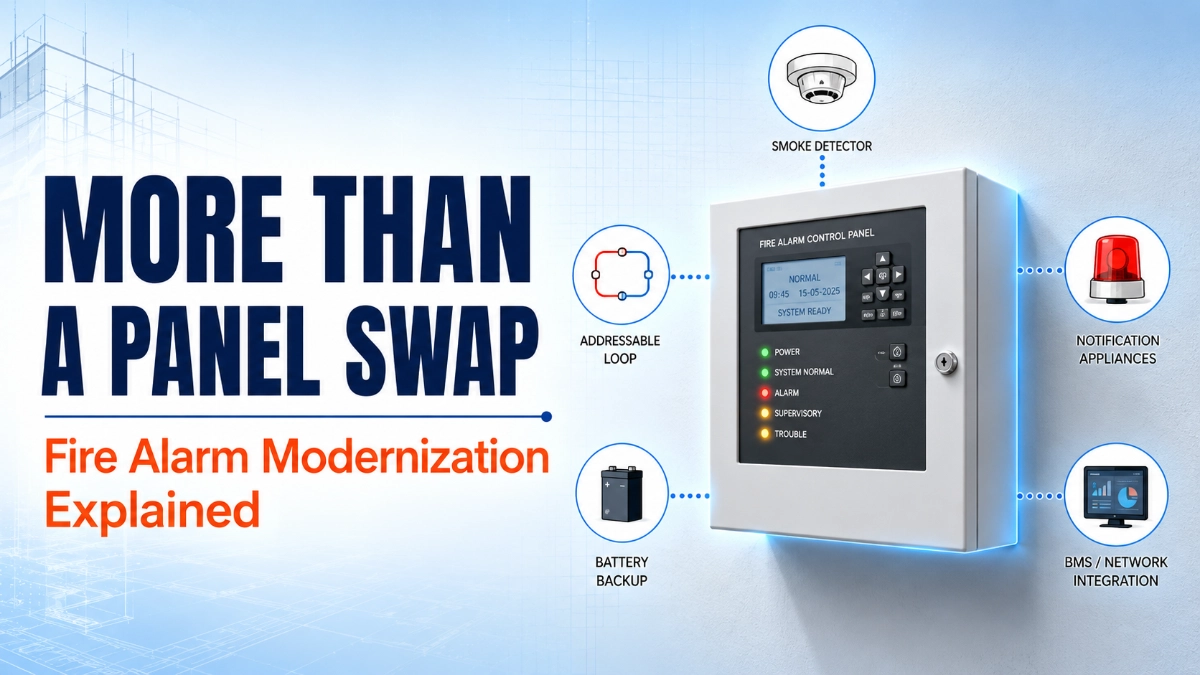
Many facility teams treat fire alarm system modernisation as an equipment swap: remove the old fire alarm control panel, install a new one, and consider the project complete. In practice, an ageing fire alarm system is a network of interdependent components: detectors, modules, wiring, power supplies, notification appliances, programming, and building-system interfaces installed and configured together over years, sometimes decades. Replacing only the panel without evaluating what it connects to can leave critical gaps unaddressed. A proper modernisation project starts with assessment, not equipment selection, because the condition and compatibility of the surrounding infrastructure often determines whether the upgrade succeeds.
Is Fire Alarm Modernisation Just About Replacing the Panel?
No. Modernisation typically involves evaluating the control panel, field devices, wiring, power supplies, notification appliances, modules, network architecture, cause-and-effect programming, interfaces, and documentation. The extent of replacement depends on existing condition, device compatibility, manufacturer requirements, project specifications, and building operational needs, not on panel replacement alone.
What Does Fire Alarm System Modernisation Actually Mean?
Modernisation is often confused with related but distinct activities:
- Repair: Restoring a faulty component to working condition.
- Maintenance: Routine inspection, testing, and servicing to keep the system operational.
- Upgrade: Adding capability or replacing specific components within the existing architecture.
- Modernisation: A broader evaluation and update of architecture, devices, programming, and integration to align with current requirements and long-term supportability.
- Complete replacement: Removing the entire system and installing a new one from the ground up.
Modernisation sits between an upgrade and full replacement. It can range from targeted improvements replacing obsolete modules or reprogramming cause-and-effect logic to a comprehensive migration of panels, devices, and network architecture. Not every legacy system requires complete replacement; scope depends on verified conditions, not assumptions.
Why Panel Replacement Alone Can Create a False Sense of Modernisation
Focusing only on the control panel can leave several issues unresolved: obsolete detectors, ageing modules with unknown reliability, field devices incompatible with the new platform, wiring of unknown condition, outdated cause-and-effect programming, missing documentation, unrecorded legacy interfaces, and insufficient spare capacity for future expansion.
The control panel is the brain of the system, but modernisation must also evaluate the nervous system and field infrastructure connected to it. This is an analogy, not a technical definition, but it captures why a new panel connected to an unevaluated field network does not automatically produce a modern, reliable fire alarm system.
8 Things Engineers Should Evaluate Before Replacing a Fire Alarm Panel
1. Existing Fire Alarm Panel: Age, supportability, fault history, spare-part availability, and expansion capability.
2. Existing Detectors: Type, age, compatibility with the proposed platform, environmental exposure, and maintenance history.
3. Existing Modules and Field Devices: Compatibility, functional condition, addressing scheme, and availability of direct replacements.
4. Existing Wiring: Physical condition, circuit configuration, documentation, termination quality, and compatibility with the proposed architecture. No wiring type should be assumed automatically reusable or unsuitable without inspection.
5. Notification Appliances: Bells, sounders, strobes, speakers, and voice evacuation interfaces, including compatibility and condition.
6. Power Supplies and Batteries: Power requirements, standby capacity, condition, additional anticipated loads, and future capacity needs.
7. Cause-and-Effect Logic: Whether existing sequences are documented, still valid, and appropriate for the modernised architecture.
8. Interfaces and Integration: BMS, HVAC, access control, elevators, suppression systems, and other emergency systems, each assessed individually.
Can Existing Fire Alarm Detectors and Devices Be Reused?
Reuse depends on manufacturer compatibility, platform compatibility, device age and condition, availability, proposed architecture, and applicable manufacturer documentation. A device that is physically compatible with a new loop is not necessarily technically suitable for the new platform’s protocol, addressing scheme, or diagnostic requirements.
“Physically compatible” does not automatically mean “technically suitable.” When evaluating retained components, the condition and compatibility of existing EST Detectors and Devices should be verified against manufacturer documentation before a decision is made on retention versus replacement. No assumption should be made either way without field validation.
What About Existing Fire Alarm Wiring?
Wiring assessment is one of the most underestimated parts of modernisation. Engineers should review circuit topology, cable condition, available documentation, termination quality, environmental exposure, circuit loading, and any history of intermittent faults.
Retaining existing wiring can sometimes reduce disruption and cost, particularly in occupied facilities. But this should never be assumed; it must be verified through inspection and testing against the requirements of the new architecture. Unsupported guarantees about wiring reuse create risk later in commissioning.
Why Cause-and-Effect Logic Should Be Treated as a Modernisation Asset
Legacy systems frequently control or interface with HVAC shutdown, smoke control, elevator recall, access control unlocking, fire door release, suppression activation, and emergency communication. These sequences represent years of site-specific engineering decisions, but they are not automatically correct simply because the system has run for years without issue.
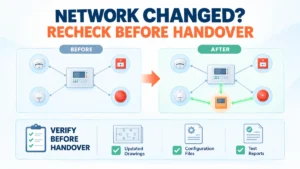
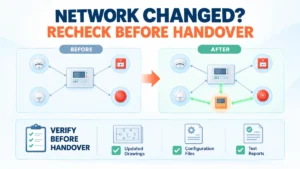
A disciplined approach follows: Document → Review → Validate → Reprogram → Test. Existing cause-and-effect matrices should be documented as found, reviewed against current needs and requirements, validated with stakeholders, reprogrammed into the new platform, and tested end-to-end before handover.
The Documentation Problem in Legacy Fire Alarm Systems
Older facilities commonly suffer from missing as-built drawings, outdated device schedules, incorrect labelling, incomplete cause-and-effect records, undocumented programming changes, and missing network diagrams one of the biggest hidden risk factors in modernisation planning.
A detailed site survey and field verification are often necessary before finalising scope, budget, or platform selection. Skipping this step tends to shift discovery and cost into the construction phase, where changes are more disruptive.
When a Phased Fire Alarm Modernisation Strategy Makes Sense
Some facilities cannot take their fire alarm system offline for an extended period. Hospitals, industrial plants, data centres, warehouses, multi-building campuses, and other critical infrastructure often require continuous protection throughout the project.
A phased approach typically follows: Assessment → Prioritisation → Migration → Testing → Documentation → Expansion. This allows modernisation to proceed building-by-building or zone-by-zone, with temporary fire protection maintained throughout. Phased modernisation is not always best for smaller, single-building sites; a single coordinated migration may be more efficient, but it is valuable for complex or occupied environments.
How EST Fire Alarm System Fits Into a Modernisation Strategy
When evaluating an EST Fire Alarm System for a modernisation project, engineers typically consider existing system requirements, proposed architecture, field device compatibility, network design, integration needs, expansion capacity, and long-term lifecycle support. This evaluation should be based on documented site conditions rather than assumptions; an EST-based platform does not automatically allow existing devices or wiring to be reused without verification.
EST3 vs EST4: Why Modernisation Should Start With Requirements, Not Product Names
Discussions about EST3 and EST4 often begin with product comparisons, but a sound strategy starts elsewhere: with building requirements, system scale, required architecture, integration needs, expansion plans, existing infrastructure, and lifecycle strategy.
Once these requirements are defined and verified, the appropriate platform can be selected to match them. Neither platform should be assumed universally superior for every project; the right choice depends on the specific facility and its documented future needs. Platform capabilities should always be confirmed against current manufacturer documentation rather than general assumptions.
The Hidden Costs of Treating Modernisation as a Panel Replacement
Projects scoped as “panel-only” frequently encounter unexpected costs later: unplanned device replacement, additional wiring work, interface redesign, extra programming and testing effort, documentation updates, temporary protection arrangements during transition, training, and constraints on future expansion. Actual cost impact varies significantly by project and should be assessed case-by-case rather than estimated in general terms.
Modernisation Should Also Prepare the System for the Next Decade
Beyond solving today’s problems, modernisation should build in future readiness: expansion and spare addressing capacity, scalable network architecture, ongoing device availability, manufacturer technical support, current documentation, sustainable maintenance planning, and flexibility for future building or occupancy changes. No universal lifespan can be promised for any system; future readiness depends on how well the architecture and documentation are maintained after commissioning.
10 Questions Engineers Should Ask Before Approving a Fire Alarm Modernisation
- Why is the existing system being modernised?
- Which components are obsolete or unsupported?
- Can existing detectors be retained?
- Can existing wiring be retained?
- Are existing modules compatible with the proposed platform?
- What cause-and-effect logic must be preserved or changed?
- Which building-system interfaces must remain operational throughout?
- What documentation currently exists, and what needs field verification?
- What future expansion is anticipated for the facility?
- How will the modernised system be tested and formally handed over?
Expert Insights
- Panel replacement is one component of modernisation, not the project itself.
- Device compatibility must be verified against documentation, never assumed from device type alone.
- Existing wiring deserves assessment, not automatic reuse or replacement.
- Cause-and-effect logic is one of the most overlooked, yet most critical, parts of migration.
- Documentation quality often determines how complex and costly modernisation becomes.
- Future expansion needs should shape today’s architecture decisions, not be addressed once capacity runs out.
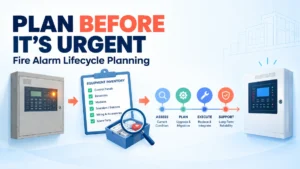
- Modernisation is best treated as a lifecycle project: assessment, design, migration, and long-term support, not a one-time purchase.
Key Takeaways
- Begin with a full system assessment, not equipment selection.
- Evaluate detectors, modules, and devices individually, not as one category.
- Inspect and document existing wiring before assuming reuse.
- Document, review, and validate cause-and-effect before reprogramming.
- Treat missing documentation as a project risk needing field verification.
- Consider phased modernisation for occupied or critical facilities.
- Select platforms such as EST3 or EST4 based on verified requirements, not preference.
- Plan for expansion, maintenance, and lifecycle support from the outset.
Read Also: Why Fire Alarm Engineers Should Treat Configuration Files Like Critical Assets
Read Also: How Fire Alarm System Architecture Influences Future Maintenance Costs